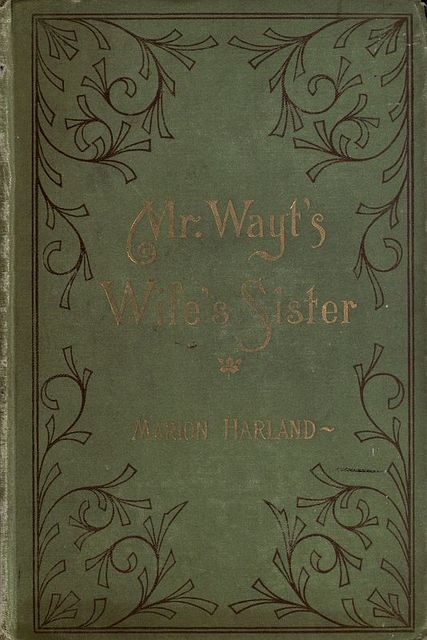
Читать бесплатно онлайн книгу Loitering in Pleasant Paths
Loiterings in Pleasant Paths
LOITERINGS
IN
Pleasant Paths
BY
MARION HARLAND
Author of “The Dinner Year-Book,” “Common Sense in the Household,” Etc.
NEW YORK
CHARLES SCRIBNER’S SONS
743 and 745 Broadway
1880
COPYRIGHT BY
CHARLES SCRIBNER’S SONS.
1880.
Trow’s Printing and Bookbinding Company,
201-213 East 12th Street,
NEW YORK.
INTRODUCTION.

WHEN I began the MS. of this book, it was with the intention of including it in the “Common Sense in the Household Series,” in which event it was to be entitled, “Familiar Talks from Afar.”
For reasons that seemed good to my publishers and to me, this purpose was not carried out, except as it has influenced the tone of the composition; given to each chapter the character of experiences remembered and recounted to a few friends by the fireside, rather than that of a sustained and formal narrative, penned in dignified seclusion, amid guide-books and written memoranda.
This is the truthful history of the foreign life of an American family whose main object in “going on a pilgrimage” was the restoration of health to one of its members. In seeking and finding the lost treasure, we found so much else which enriched us for all time, that, in the telling of it, I have been embarrassed by a plethora of materials. I have described some of the things we wanted to see—as we saw them,—writing con amore, but with such manifold strayings from the beaten track into by-paths and over moors, and in such homely, familiar phrase, that I foresee criticism from the disciples of routine and the sedate students of chronology, topography and general statistics. I comfort myself, under the prospective infliction, with the belief which has not played me false in days past,—to wit: that what I have enjoyed writing some may like to read. I add to this the hope that the fresh-hearted traveler who dares think and feel for, and of himself, in visiting the Old World which is to him the New, may find in this record of how we made it Home to us, practical and valuable hints for the guidance of his wanderings.
MARION HARLAND.
Springfield, Mass., April, 1880.
CONTENTS.
CHAPTER I.
PAGEThe Average Briton,
1CHAPTER II.
Olla Podrida,
14CHAPTER III.
Spurgeon and Cummings,
29CHAPTER IV.
The Two Elizabeths,
39CHAPTER V.
Prince Guy,
52CHAPTER VI.
Shakspeare and Irving,
67CHAPTER VII.
Kenilworth,
84CHAPTER VIII.
Oxford,
96CHAPTER IX.
Sky-larks and Stoke-Pogis,
111CHAPTER X.
Our English Cousins,
121CHAPTER XI.
Over the Channel,
137CHAPTER XII.
Versailles—Expiatory Chapel—Père Lachaise,
154CHAPTER XIII.
Southward Bound,
170CHAPTER XIV.
Pope, King, and Forum,
183CHAPTER XV.
On Christmas-Day,
196CHAPTER XVI.
L’Allegro and Il Penseroso,
216CHAPTER XVII.
With the Skeletons,
230CHAPTER XVIII.
“Paul—a Prisoner,”
243CHAPTER XIX.
Tasso and Tusculum,
258CHAPTER XX.
From Pompeii to Lake Avernus,
272CHAPTER XXI.
“A Sorosis Lark,”
293CHAPTER XXII.
In Florence and Pisa,
308CHAPTER XXIII.
“Beautiful Venice,”
325CHAPTER XXIV.
Bologna,
339CHAPTER XXV.
“Non é Possibile!”
351CHAPTER XXVI.
Lucerne and The Rigi,
366CHAPTER XXVII.
Personal and Practical,
379CHAPTER XXVIII.
Home-life in Geneva—Ferney,
392CHAPTER XXIX.
Calvin—The Diodati House—Primroses,
408CHAPTER XXX.
Corinne at Coppet,
419CHAPTER XXXI.
Chillon,
428LOITERINGS IN PLEASANT PATHS.
CHAPTER I.
The Average Briton.

SUNDAY in London: For the first time since our arrival in the city we saw it under what passes in that latitude and language for sunshine. For ten days we had dwelt beneath a curtain of gray crape resting upon the chimney-tops, leaving the pavements dry to dustiness. “Gray crape” is poetical—rather—and sounds better than the truth, which is, that the drapery, without fold or shading, over-canopying us, was precisely in color like very dirty, unbleached muslin, a tint made fashionable within a year or so, under the name of “Queen Isabella’s linen” (“le linge de la Reine Isabeau”). The fixed cloud depressed and oppressed us singularly. It was a black screen set above the eyes, which we were all the while tempted to push up in order to see more clearly and farther,—a heavy hand upon brain and chest. For the opaqueness, the clinging rimes of the “London fog,” we were prepared. Of the mysterious withholding for days and weeks of clouds threatening every minute to fall, we had never heard. We had bought umbrellas at Sangster’s, as does every sensible tourist immediately after securing rooms at a hotel, and never stirred abroad without them; but the pristine plaits had not been disturbed. Struggle as we might with the notion, we could not rid ourselves of the odd impression that the whole nation had gone into mourning. Pleasure-seeking, on the part of sojourners who respected conventionalities, savored of indecorum. We were more at our ease in the crypt of St. Paul’s, and among the dead of Westminster Abbey, than anywhere else, and felt the conclave of murderers, the blood-flecked faces of the severed heads, the genuine lunette and knife of Samson’s guillotine in Madame Tussaud’s Chamber of Horrors, to be “quite the thing in the circumstances.”
The evil, nameless spell was broken by the clangor of the Sabbath bells. “The gray pavilion rose” and did not fall—for twenty-four hours. Strolling through St. James’s Park in the hour preceding sunsetting, we pointed out to one another the pale blue, dappled with white, of the zenith, the reddening mists of the horizon. The ground was strewed with autumnal leaves, russet and brown. The subdued monotony of the two shades of decay did not move us to adverse criticism. The crimsons, golds, and purples that were robing woods we knew of over the water, would be incongruous in this sober-hued land. In the matter of light and color, he who tarries in England in autumn, winter, and early spring, soon learns to be thankful for small favors. We were grateful and satisfied. We were in a mood to be in love with England,—“our old home;” still walked her soil as in a blessed dream, haunted only by sharp dreads of awakening to the knowledge that the realization of the hopes, and longings, and imaginings of many years was made of such stuff as had been our cloud-pictures. We were in process of an experience we were ashamed to speak of until we learned how common it was with other voyagers, whose planning and pining had resembled ours in kind and degree. None of us was willing to say how much time was given to a comical weighing of the identity question, somewhat after the fashion of poor Nelly on the roadside in the moonlight:—If this were England, who then were we? If these pilgrims were ourselves—veritable and unaltered—could it be true that we were here? If I do not express well what was as vague as tormenting, it is not because the system of spiritual and mental acclimation was not a reality.
The Palace of St. James, a range of brick and dinginess, stretched before us as we returned to the starting-point of the walk around the park, taking in the Bird-cage Walk, where Charles II. built his aviaries and lounged, Nelly Gwynne, or the Duchess of Portsmouth, at his side, a basket of puppies hung over his lace collar and ruffled cravat. It is not a palatial pile—even to eyes undried from the juice of Puck’s “little western flower.”
“It would still be a very decent abode for the horses of royalty—hardly for their grooms,” said Caput, critically. “And it is worth looking at when one remembers how long bloody Mary lay there, hideous, forsaken, half dead, the cancerous memories of Calais and Philip’s desertion consuming her vitals. There lived and died the gallant boy who was the eldest son of James I. If he had succeeded to the throne his brother Charles would have worn his head more comfortably and longer upon his shoulders. That is, unless, as in the case of Henry VIII., the manhood of the Prince of Wales had belied the promise of early youth.”
“It was in St. James’s Palace that Charles spent his last night,” I interrupted. It takes a long time for the novice to become accustomed to the strange thrill that vibrates through soul and nerves when such reminiscences overtake him, converting the place whereon he stands into holy ground. I was a novice, and rushed on impetuously. “The rooms in which he slept and made his toilet for the scaffold were in the old Manor-house, a wing of the palace since torn down. Why can’t they let things alone? But the park is here, and—” glancing dubiously along the avenues—“it is just possible—altogether possible—that some of these oldest trees may be the same that stood here then. On that morning, when—you remember?—the ground being covered lightly with snow, the king walked with a quick step across the park to Whitehall, calling to the guard, ‘Step on apace, my good fellows!’”
Measuring with careful eye an air line between the palace and a building with a cupola, on the St. James Street side of the park, we turned our steps along this. The dying leaves rustled under our feet, settling sighingly into the path behind us. The “light snow” had muffled the ring of the “quick step” more like the impatient tread of a bridegroom than that of a doomed man shortening the already brief space betwixt him and fate. Within the shadow of Whitehall, we paused.
“The scaffold was built just without the window of the banqueting-hall,” we reminded each other. “As late as the reign of William and Mary, the king’s blood was visible upon the window-sill. Jacobites made great capital of the insensibility of his granddaughter, who held her drawing-rooms in that very apartment. The crowd must have been densest about here, and spread far into the park. But how can we know just where the scaffold stood? It was low, for the people leaped upon it after the execution and dipped handkerchiefs in the blood, to be laid away as precious relics. Those windows are rather high!” glancing helplessly upward. “And which is the banqueting-hall?”
“Baldeker’s London” was then in press for the rescue of the next season’s traveller from like pits of perplexity. Not having it, and the “hand-books” we had provided ourselves with proving dumb guides in the emergency, the simplest and most natural road out of ignorance was to ask a question or two of some intelligent native-born Londoner.
In this wise, then, we first made the acquaintance of the Average Briton,—a being who figured almost as often in our subsequent wanderings as did the travelling American. I do not undertake to say which was the more ridiculous or vexatious of the two, according as our purpose at the time of meeting them chanced to be diversion or information.
The Average Briton of this Sabbath-day was smug and rotund; in complexion, rubicund; complacent of visage, and a little rolling in gait, being duck-legged. A child trotted by him upon a pair of limbs cut dutifully after the paternal pattern, swinging upon the paternal hand. Upon the other side of the central figure, arrayed in matronly black silk and a velvet hat with a white plume, walked a lady of whom Hawthorne has left us a portrait:
“She has an awful ponderosity of frame, not pulpy, like the looser development of our few fat women, but massive with solid beef and streaky tallow; so that (though struggling manfully against the idea) you inevitably think of her as made up of steaks and sirloins. She imposes awe and respect by the muchness of her personality to such a degree that you probably credit her with far greater moral and intellectual force than she can fairly claim. Without anything positively salient, or actually offensive, or, indeed, unjustly formidable to her neighbors, she has the effect of a seventy-four gun ship in time of peace.” I had ample time to remember and to verify each line of the picture during the parley with her husband that succeeded our encounter. A citizen of London-town was he. We were so far right in our premises. One who had attended “divine service” in the morning; partaken of roast mutton and a pint of half-and-half at an early dinner; who would presently go home from this stretch of the legs, with good appetite and conscience to a “mouthful of somethink ’ot with his tea,” and come up to time with unflagging powers to bread, cheese, cold meat, pickles, and ale, at a nine o’clock supper. Our old home teems with such. Heaven send them length of days and more wit!
Caput stepped into the path of the substantial pair; lifted his hat in recognition of the lady’s presence and apology for the interruption.
“Excuse me, sir—”
I groaned inwardly. Had I not drilled him in the omission of the luckless monosyllable ever since we saw the Highlands of Navesink melt into the horizon? How many times had I iterated and reiterated the adage?—“In England one says ‘sir’ to prince, master, or servant. It is a confession of inferiority, or an insult.” Nature and (American) grace were too strong for me.
“Excuse me, sir! But can you tell me just where the scaffold was erected on which Charles the First was executed?”
The Average Briton stared bovinely. Be sure he did not touch his hat to me, nor echo the “sir,” nor yet betray how flatteringly it fell upon his unaccustomed ear. Being short of stature, he stared at an angle of forty-five degrees to gain his interlocutor’s face, unlocked his shaven jaws and uttered in a rumbling stomach-base the Shibboleth of his tribe and nation:
“I really carnt say!”
Caput fell back in good order—i. e., raising his hat again to the Complete British Matron, whose face had not changed by so much as the twitch of an eyelid while the colloquy was in progress. She paid no attention whatever to the homage offered to the sex through “the muchness of her personality,” nor were the creases in her lord’s double chin deepened by any inclination of his head.
“The fellow is an underbred dolt!” said Caput, looking after them as they sailed along the walk.
“In that case it is a pity you called him ‘sir,’ and said ‘erected’ and ‘executed,’” remarked I, with excruciating mildness. “Here comes another! Ask him where King Charles was beheaded.”
No. 2 was smugger and smoother than No. 1. He had silvery hair and mutton-leg whiskers, and a cable watch-chain trained over a satin waistcoat, adjuncts which imparted a look of yet intenser respectability. There was a moral and social flavor of bank-directorships and alder-manic expectations about him, almost warranting the “sir” which slipped again from the incorrigible tongue.
We had the same answer to a word and intonation. The formula must be taught to them over their crib-rails as our babies are drilled to lisp—“Now I lay me.” Grown reckless and slightly wicked, we accosted ten others in quick succession in every variety of phraseology, of which the subject was susceptible, but always to the same effect. Where stood the scaffold of Charles the First, Charles Stuart, Charles the Martyr, Charles, father of the Merry Monarch, the grandparent of Mary of Orange and Good Queen Anne? Could any man of British mould designate to us the terminus of that quick step over the snowy park on the morning of the 30th of January, 1649, the next stage to that “which, though turbulent and troublesome, would be a very short one, yet would carry him a great way—even from earth to Heaven?”
Eight intelligent Londoners said, “I really carnt say!” more or less drawlingly. Two answered bluntly, “Dawnt know!” over their shoulders, without staying or breaking their saunter. Finally, we espied a youth sitting under a tree—one of those from which the melting snow might have dropped upon the prisoner’s head—why not the thrifty oak he had pointed out to Bishop Juxon in nearing Whitehall, as “the tree planted by my brother Henry?” The youth was neatly dressed, comely of countenance, and he held an open book, his eyes riveted upon the open page.
“That looks promising!” ejaculated Caput. There was genuine respect in his address:
“I beg your pardon for interrupting you, but can you inform me, etc., etc.?”
The student raised his head, and looked at us with lacklustre or abstracted eyes.
“Hey?”
Caput repeated the query distinctly and with emphasis.
“Chawles the First?”
“Yes!” less patiently. “The king whose head was cut off by order of Cromwell’s parliament, under the windows of Whitehall, in 1649?”
“Never heard of him!” rejoined the countryman of Hume, Macaulay, and Froude, resuming his studies.
Caput recoiled as from an electric eel. “I wouldn’t have believed it, had any one else heard and repeated it to me!” gasped he, when out of ear-shot. “Do you suppose there is a hod-carrier in Boston who does not know the history of Faneuil Hall?”
“Hundreds! Hod-carriers are usually of foreign birth.”
“Or a school-boy in America who never heard of Arnold’s treason and André’s fate? Or, for that matter, who cannot, when twelve years old, tell the whole story of King Charles’s death, even to the ‘Remember!’ as he laid his head upon the block?”
I had a new difficulty to present.
“While you have been catechizing the enlightened British public, I have been thinking—and I am afraid we are sentimentalizing in the wrong place. I have harrowing doubts as to this being the real Whitehall. The palace was burned in the time of William and Mary—or a portion of it—and but partially rebuilt by Inigo Jones. There is altogether too much of this to be the genuine article. And it is startlingly modern!”
It was a spacious building, and did not look as if it had a story. The exterior was stuccoed and smoke-blackened, but the London air would have dyed it to such complexion in ten years. A belvidere or cupola finished it above. Beneath this, on the ground-floor, separating the wings, was an archway leading into St. James Street. The citizens whom we had questioned had, with the exception of the student, emerged from or disappeared in this passage from park to thoroughfare. We saw now a sentinel, in red coat and helmet, turn in his beat up and down under the arch.
“Is this Old Whitehall?” we asked.
He shook his head without halting.
“Where is it?”
He pointed to a building on the opposite side of the street. It was two stories—lofty ones—high above the basement. Twenty-one windows shone in the handsome front. We traversed the arched passage, planted ourselves upon the sidewalk and gazed, bewildered, at the one-and-twenty windows. Through which of them had passed the kingly form we seemed to have seen for ourselves, so familiar were the oval face and pointed beard, the great eyes darkened all his life long with prophecy of doom? Through which had been borne the outraged corpse, the bloody drippings staining the sill? Upon what spot of the pavement trodden by the throng of Sabbath idlers had fallen the purple rain from a monarch’s heart? For sweet pity’s sake, had none marked the place by so much as a cross in the flagging? All else around us bore the stamp of a later age. Were the apparently venerable walls pointed out by the sentinel the banqueting-hall where the granddaughter held her court, or was this Inigo Jones’s (the Inevitable) restoration?
“One might imagine regicide so common a crime in England as not to be considered worthy of special note!” we grumbled, a strong sense of injury upon our foiled souls.
Just then down the street strode a policeman, and, at sight of our puzzled faces, hesitated with an inquiring look. I cheerfully offer my testimony here to the civility, intelligence, and general benevolence of the London police. We met them always when we needed their services, and as invariably found them ready and able to do all we required of them, sometimes insisting upon going a block out of their way to show us our route. Perfunctory politeness? It may have been, but it was so much better than none at all, or surly familiarity! The man to whom we now addressed ourselves was tall and brawny, with features that lighted pleasantly in the hearing of our tale of defeat.
“My father used to tell me,” he said, respectful still, but dropping into the easy conversational strain an exceptionally obliging New York “Bobby” might use in like circumstances, “that the king was led out through that window,” indicating, not one of the triple row in the banqueting-room, but a smaller in a lower and older wing, “and executed in front of the main hall. Some say the banqueting-chamber was not burned with the rest of the palace. Others that it was. My father was inclined to believe that this is the original building. I have heard him tell the tale over and over until you might have thought he had been there himself. The Park ran clear up to Old Whitehall then, you see—where this street is now. The crowd covered all this ground where we are standing, the soldiers being nearest the scaffold. That stood, as nearly as I can make out, about there!” tapping the sidewalk with his stick. “A few feet to the right or the left don’t make much difference, you know, sir. It does seem queer, and a little sad, there’s not so much as a stone let into the wall, or a bit of an inscription. But those were rough times, you know.”
“We are very much obliged to you!” Caput said heartily, holding out his hand, the palm significantly inverted.
The man shook his head. “Not at all, sir! Against the rules of the force! I have done nothing worth talking about. If my father were living, now! But people nowadays care less and less for old stories.”
He touched his cap in moving away.
“The truest gentleman we have met this afternoon!” pronounced Caput. “Now, we will go back into the park, out of this bustle, and think it all over!”
This had become already a pet phrase and a pet practice with us. The amateur dramatization, sometimes partially spoken, for the most part silent, was our way of appropriating and assimilating as our very own what we saw and learned. It was a family trick, understood among ourselves. Quiet, freedom from platitudinal queries and comment, and comparative solitude, were the favorable conditions for fullest enjoyment of it.
The student was so absorbed in his book—I hope it was history!—as not to see us when we passed. The sunlight fell aslant upon the dark-red walls of the old palace, lying low, long, and gloomy, across the end of the walk. A stiff, dismal place—yet Elizabeth, in all her glory, had been moderately contented with it. Within a state bed-chamber, yet to be seen, the equivocal circumstances—or the coincidences interpreted as equivocal by the faction hostile to the crown,—attending the birth of the son of James II. and Mary of Modena laid the first stone of the mass of distrust that in the end crushed the hopes of “The Pretender.” The “first gentleman of Europe” opened his baby eyes in this vulgar world under the roof of the house his father had already begun to consider unfit for a king’s dwelling, and to meditate taxation of his American colonies for funds with which to build a greater. Queen Victoria was married in the Chapel of St. James, adjoining the palace. Upon the mantel of the venerable Presence-chamber are the initials of Henry VIII. and Anne Boleyn, intertwisted in a loving tangle. They should have been fashioned in wax instead of the sterner substance that had hardly left the carver’s hand for the place of honor in the royal drawing-room before the vane of Henry’s affections veered from Anne to Jane. It is said that he congratulated himself and the new queen upon the involutions of the cipher that might be read almost as plainly “H. J.” as “H. A.” So, there it stands—the sad satire upon wedded love that mocked the eyes of discreet Jane, the one consort who died a natural death while in possession of his very temporary devotion,—and the two Katherines who succeeded her.
By contrast with sombre St. James’s, Buckingham Palace is a meretricious mushroom, scarcely deserving a passing glance. The air was bland for early November, and we sat upon a bench under a tree that let slow, faded leaves down upon our heads while we “thought it all over,” until the gathering glooms in the deep archway, flanked by sentry-boxes, shaped themselves into a procession of the “born and died” in the low-browed chambers. To recite their names would be to give an abstract of the history of the mightiest realm of the earth for four centuries.
And, set apart by supreme sorrow from his fellows, ever foremost in our dream-pictures, walked he, who “made trim,” by his own command, “for his second marriage-day,” hastened through the snowy avenues of the park to find a pillow for the Lord’s anointed upon the headsman’s block before the windows of the banqueting-room of Whitehall.
CHAPTER II.
Olla Podrida.

IN one week we had been twice to Westminster Abbey, once to the Tower; had seen St. Paul’s, Hyde Park, Tussaud’s Wax Works, Mr. Spurgeon, the New Houses of Parliament, Billingsgate, the Monument, Hyde Park, the British Museum, and more palaces than I can or care to remember. In all this time we had not a ray of sunshine, but neither had a drop of rain fallen. We began to leave umbrellas at home, and to be less susceptible in spirits to the glooming of the dusky canopy upborne by the chimneys. That one clear—for London—Sunday had made the curtain so nearly translucent as to assure us that behind the clouds the sun was still shining, and we took heart of grace for sight-seeing.
But in the course of seven smoky-days we became slightly surfeited with “lions.” Weary, to employ a culinary figure, of heavy roast and boiled, we longed for the variety of spicy entrées—savory “little dishes” not to be found on the carte, and which were not served to the conventional sight-seer. One morning, when the children had gone to “the Zoo” with papa and The Invaluable, Prima—the sharer with me of the aforesaid whim—and myself left the hotel at ten o’clock to carry into effect a carefully-prepared programme. We had made a list of places where “everybody” did not go; which “Golden Guides” and “Weeks in London” omitted entirely, or slurred over with slighting mention; which local ciceroni knew not of, and couriers disdained, but each of which had for us peculiar association and attraction.
Four-wheelers were respectable for unattended women, and cheaper than hansoms. But there was a tincture of adventure in making our tour in one of the latter, not taking into account the advantages of being able to see all in front of us, and the less “stuffy” odor of the interior. Sallying forth, with a pricking, yet delicious sense of questionableness that recalled our school-day pranks, we sought the nearest cab-stand and selected a clean-looking vehicle, drawn by a strong horse with promise of speed in body and legs. The driver was an elderly man in decent garb. The entire establishment seemed safe and reputable so far as the nature of our enterprise could partake of these characteristics. When seated, we gave an order with inward glee, but perfect gravity of demeanor.
“Newgate Prison!”
We had judged shrewdly respecting the qualities of our horse. It was exhilarating, even in the dull, dead atmosphere we could not breathe freely while on foot, to be whirled through the unknown streets, past delightless parks and dolefuller mansions in the West End, in and out of disjointed lanes that ran madly up to one turn and down to another, as if seeking a way out of the mesh of “squares” and “roads” and “rows,”—perceiving satisfiedly, as we did all the time, that we were leaving aristocratic and even respectable purlieus behind as speedily as if our desires, and not the invisible “cabby,” shaped our flight. We brought up with a jerk. Cabs—in the guidance of old or young men—have one manner of stopping; as if the “concern,” driver, horse and hansom, had meant to go on for ever, like Tennyson’s brook, and reversed the design suddenly upon reaching the address given them, perhaps, an hour ago. We jerked up now, in a narrow street shut in on both sides by black walls. The trap above our heads opened.
“Newgate on the right, mem! Old Bailey on the left!”
The little door shut with a snap. We leaned forward for a sight of the prison on the right. Contemptible in dimensions by comparison with the spacious edifice of our imaginations, it was in darksomeness and relentless expression, a stony melancholy that left hope out of the question, just what it should—and must—have been. The pall enwrapping the city was thickest just here, resting, like wide, evil wings upon the clustered roofs we could see over the high wall. The air was lifeless; the street strangely quiet. Besides ourselves we did not see a human being within the abhorrent precincts. The prison-front, facing the smaller “Old Bailey,” is three hundred feet long. In architecture it is English,—bald and ugly as brick, mortar, and iron can make it. In three minutes we loathed the place.
“You can go on!” I called to the pilot, pushing up the flap in the roof. “Drive to the church in which the condemned prisoners used to hear their last sermon.”
“Yes, mem!” Now we detected a rich, full-bodied Scotch brogue in his speech. “Pairhaps ye wouldna’ moind knawing that by that gett—where ye’ll see the bairs—the puir wretches went on the verra same mornin’. Wha passed by that gett never cam’ back.”
It was a dour-looking passage to a disgraceful death; a small door crossed by iron bars, and fastened with a rusty chain. It made us sick to think who had dragged their feet across the dirt-crusted threshold, and when.
The cab jerked up again in half a minute, although we had rushed off at a smart trot that engaged to land us at least a mile off.
“St. Sephulchre’s, mem!”
I have alluded to the difficulty of determining the age of London buildings from the outward appearance. A year in the sooty moisture that bathes them for seven or eight months out of twelve, destroys all fairness of coloring, leaving them without other beauty than such as depends upon symmetrical proportions, graceful outlines and carving. The humidity eats into the pores of the stone as cosmetics impair the texture of a woman’s skin. But St. Sepulchre has a right to be blasé. It antedated the Great Fire of 1666, the noble porch escaping ruin from the flames as by a miracle. It is black, like everything else in the neighborhood, and, to our apprehension, not comely beyond the portico. The interior is as cheerless as the outside, cold and musty. Throughout, the church has the air of a battered crone with the sins of a fast youth upon her conscience. There are vaults beneath the floor, lettered memorial-stones in the aisle, tarnished brasses on the walls. Clammy sweats break out upon floor, walls, pews and altar in damp weather, and this day of our visit had begun to be damp. It was an unwholesome place even to be buried in. What we wanted to see was a flat stone on the southern side of the choir, reached in bright weather by such daring sunbeams as could make their way through a window, the glass of which was both painted and dirty. A brownish-gray stone, rough-grained, and so much defaced that imagination comes to the help of the eyes that strive to read it: “Captain John Smith—Sometime Governour of Virginia and Admirall of New-England.” He died in 1631, aged fifty-two. The Three Turks’ Heads are still discernible upon the escutcheon above the inscription. The rhyming epitaph begins with—
“Here lyes One conquerd that Hath conquerd Kings.”
We knew that much and failed to decipher the rest.
Family traditions, tenderly transmitted through eight generations, touching the unwritten life of the famous soldier of fortune, of the brother who was his heir-at-law, and bequeathed the coat-of-arms to American descendants, were our nursery tales. For him whose love of sea and wildwood was a passion captivity nor courts could tame, his burial-place is a sorry one, although esteemed honorable. I think he would have chosen rather an unknown grave upon the border of the Chickahominy or James, the stars, that had guided him through swamp and desert, for tapers, instead of organ-thrill and incense, the song of mockingbirds and scent of pine woods. The more one knows and thinks and sees of St. Sepulchre’s the less tolerant is he of it as a spot of sepulture for this gallant and true knight. They interred him there because it was his parish church. But they—the English—are not backward in removing other people’s bones when it suits their pride or convenience to do so. In the square tower, lately restored, hangs the bell that has tolled for two hundred years when the condemned passed out of the little iron gate we had just seen. They used to hang them at Tyburn, afterward in the street before the prison. Now, executions take place privately within the Newgate walls. In the brave old times, when refinement of torture was appreciated more highly than now as a means of grace and a Christian art, the criminal had the privilege of hearing his own funeral sermon,—which was rarely, we may infer, a panegyric,—seated upon his coffin in the broad aisle of St. Sepulchre’s. There was a plat of flowers then in the tiny yard where the grass cannot sprout now for the coal-dust, and as the poor creature took his place—the service done—upon the coffin in the cart that was to take him to the gallows, a child was put forward to present him with a bouquet of blossoms grown under the droppings of the sanctuary. What manner of herbs could they have been? Rue, rosemary, life-everlasting? Yet they may have had their message to the dim eyes that looked down upon them—for the quailing human heart—of the Father’s love for the lowest and vilest of His created things.
“Temple Bar!” was our next order.
Before we reached it our driver checked his horse of his own accord, got down from his perch at the back, and presented his weather-beaten face at my side.
“I’ve thocht”—respectfully, and with unction learned in the “kirk”—“that it might eenterest the leddies to know that this is the square where mony hundreds of men, wimmen, and, one may say, eenfants, were burrned alive for the sake of the Faith.”
And in saying it, he lifted his hat quite from his head in reverence, we were touched to note, was not meant for us, but as a tribute to those of whom the world was not worthy.
“Smithfield!” we cried in a breath. “Oh! let us get out!”
It is a hollow square, a small, railed-in garden and fountain in the middle; around these extends on three sides an immense market, the pride of modern London, a structure of much pretension, with four towers and a roof, like that of a conservatory, of glass and iron, supported by iron pillars. A very Babel of buying and selling, of hawkers’ and carters’ yells, at that early hour of the day. The stake was near the fine old church of St. Bartholomew, which faces the open space. Excepting the ancient temple, founded in 1102, there is no vestige of the Smithfield (Smooth-field) where Wallace was hanged, drawn and quartered in 1305; where the “Gentle Mortimer” of a royal paramour was beheaded in 1330, and, in the reign of Mary I., the “Good Catholic,” three hundred of her subjects, John Rogers and Bradford among them, were burned with as little scruple as the white-aproned butcher in the market-stall near by slices off a prime steak for a customer. The church has been several times restored, but the Norman tower bears the date 1628. It, too, felt the Great Fire, and the heat and smoke of crueller flames, in the midst of which One like unto the Son of Man walked with His children. Against the walls was built the stage for the accommodation of the Lord Mayor of London, the Duke of Norfolk and the Earl of Bedford, that they might, at their ease, behold Anne Askew burn. They were in too prudent dread of the explosion of the powder-bag tied about her waist to sit near enough to hear her say to the sheriff’s offer of pardon if she would recant—“I came not hither to deny my Lord!”
St. Bartholomew the Great stands yet in Smithfield. Above it bow the heavens that opened to receive the souls born into immortality through the travail of that bloody reign. Forty years ago, they were digging in the ground in front of the church to lay pavements, or gas-pipes, or water-mains, or some other nineteenth-century device, and the picks struck into a mass of charred human bones.
“Unknown!” Stephen Gardiner and his helpers had a brisk run of business between St. Andrew’s Day, 1554, and November 17, 1558. There was no time to gather up the fragments. Ah, well! God and His angels knew where was buried the precious seed of the Church.
How the cockles of our canny Scot’s heart warmed toward us when he perceived that he and we were of one mind anent Smithfield! that we took in, without cavil, the breadth and depth of his words—“The Faith!” During that busy four years tender women, girls and babes in age proved, with strong men, what it meant to “earnestly contend for” it.
In a gush of confidence induced by the kinship of sentiment upon this point, we told our friend what we wanted to see in the city, that day, and why, and found him wonderfully versed in other matters besides martyrology. He named a dozen places of interest not upon our schedule, and volunteered to call out the names of noted localities through the loop-hole overhead, as we passed them. This arrangement insured the success of our escapade, for his judicious selection of routes, so as to waste no time in barren neighborhoods, was only surpassed by the quality of the pellets of information dropped into our ears.
St. John’s gate was, in aspect, the most venerable relic we saw in London. They told us in the office at the gateway that it and the Priory—now destroyed—were built in 1111; but recollecting that the Pope’s confirmation of the first constitution of the Order of the Knights of St. John of Jerusalem bore date of 1113, we nursed some unspoken doubts. The prior who finished the building in 1504 modestly left his family coat-of-arms upon the wall of the small entrance-room, now used as an office. This black and bruised arch marks what was the rallying-point of British chivalry and piety during three crusades. Out of this gate the Hospitaliers drew forth in mingled martial and ecclesiastical array—white gown with the red cross on shoulder, over hauberk and greaves,—at each departure for the Holy Land. Godfrey de Bouillon was an influential member and patron of the Order. Henry VIII. scattered the brethren and pocketed their revenues. His daughter Mary reinstated them in their home and privileges. Her sister Elizabeth would none of them, and that was an end of the controversy, for she lived long enough to enforce her decree.
Cave’s “Gentleman’s Magazine” was published here when gentlemen ceased to ride, booted, spurred, and illiterate, upon the crusades against the Saracen. Johnson, a slovenly provincial usher, having failed as translator and schoolmaster to make a living, applied for, and received from this periodical literary employment—the first paying engagement of his life. For more than a dozen years he was a contributor to the Magazine, and the office above the gate was his favorite lounging-place. As a proof of this they show a chair, ungainly and unclean enough to have been used by him throughout the period of his contributorship.
East of St. John’s Gate we passed a disused intramural cemetery, begloomed on all sides by rows of dingy houses. The rain of “blacks” incessantly descending upon the metropolis collects here in unstirred, sable sheets. Such a pall enfolds the graves of Isaac Watts and Daniel Defoe, whose “Diary of the Great Plague” is a work of more dramatic power than his Robinson Crusoe. A stone’s throw apart from hymnster and romancist, lies a greater than either—the prince of dreamers, John Bunyan.
Temple Bar is—or was, for it has been pulled down since we were there—an arch of Portland stone, and is attributed, I hope, erroneously, to Christopher Wren. Without this information I should have said that it was a wooden structure, badly hacked, gnawed, and besmirched by time, with dirty plaster statues of the two Charleses niched upon one side, and, upon the other, corresponding figures of James I. and Elizabeth. It was much lower than we had supposed, and than it is represented in pictures, and just wide enough to allow two coaches to pass abreast without collision. The roaring tide overflowing the Strand and Fleet Street appeared to squeeze through with difficulty. Above the gate was a row of one-story offices—mere boxes—such as are occupied in our country by newspaper-venders. Within the memory of living men the top of the gate was a thick-set hedge of spikes, reckoned, not very many years back, as one of the bulwarks of English liberties. Up to the middle of the eighteenth century, law-abiding cockneys, on their peregrinations to and from the city, were strengthened in loyalty and veneration for established customs, by the spectacle of rotting and desiccated heads of traitors exposed here. They were tardy in the abolition of object-teaching in Christian England. There were solid oaken gates with real hinges and bars at Temple Gate. When the sovereign paid a visit to the city she was reminded of some agreeable passages between one of her predecessors and the London lords of trade, by finding these closed. Her pursuivant blew a trumpet; there was an exchange of question and reply; the oaken leaves swung back; the Lord Mayor presented his sword to our gracious and sovereign lady, the queen, who returned it to him with an affable smile, and the royal coach was suffered to pass under the Bar. More object-teaching!
From Temple Gate to Temple Gardens was a natural transition. These famous grounds formerly sloped down to the Thames, and were an airy, spacious promenade. Now, one smiles in reading that Suffolk found it a “more convenient” place for private converse than the “Temple Hall.” A talk between four gentlemen of the rank of Plantagenet, Suffolk, Somerset and Warwick, in the pretty plat of grass and flowers, fenced in by iron rails, would have eavesdroppers by the score, and the incident of plucking the roses be overlooked by the gossips of fifty tenement-houses. But the area, sadly circumscribed by the encroachments of business, is a sightly bit of green, intersected by gravel walks, and in the season enlivened by the flaming geraniums that not even London “blacks” can put out of countenance. We really saw rose-trees there in flower, the following August.
In one particular, and one only, the knowledge and zeal of our Scotchman were at fault in the course of our Bohemian expedition. I have said that Baedeker’s excellent “Hand-book for London” was in the printer’s hands just when we needed it most. Therefore we searched vainly in St. Paul’s Churchyard for Dr. Johnson’s Coffee-house, where Boswell hung upon his lumbering periods, as bees upon honeysuckle; for the site of the Queen’s Arms Tavern, also a resort of the literati in the time of the great Lexicographer. We were mortified at our ill-success, chiefly because we ascribed it to the very lame and imperfect descriptions of these places which were all we could offer the Average Britons of whom we made inquiry. We were in no such uncertainty as to the Chapter Coffee-house in Paternoster Row; Mrs. Gaskell had been there before us and left so broad a “blaze” we could hardly miss seeing it.
“Half-way up (the Row), on the left hand side, is the Chapter Coffee-house. It is two hundred years old, or so.... The ceilings of the small rooms were low, and had heavy beams running across them; the walls were wainscoted breast-high; the staircase was shallow, broad, and dark, taking up much space in the centre of the house. This, then, was the Chapter Coffee-house, which, a century ago, was the resort of all the booksellers and publishers; and where the literary hacks, the critics, and even the wits, used to go in search of ideas, or employment. This was the place about which Chatterton wrote, in those delusive letters he sent to his mother at Bristol, while he was starving in London. ‘I am quite familiar at the Chapter Coffee-house, and know all the geniuses there.’ Here he heard of chances of employment; here his letters were to be left.”
Here the Brontë sisters, visiting London upon business connected with “Jane Eyre” and “Wuthering Heights,” stayed for two days, resisting the invitation of their publisher to come to his house.
Charlotte’s biographer had gone on to draw for us with graphic pen a scene of later date:
“The high, narrow windows looked into the gloomy Row. The sisters, clinging together on the most remote window-seat, could see nothing of motion or of change in the grim, dark houses opposite, so near and close although the whole breadth of the Row was between. The mighty roar of London was round them, like the sound of an unseen ocean, yet every foot-fall on the pavement below might be heard distinctly in that unfrequented street.”
When we made known our purpose to the guide, who, by this time, had taken upon him the character of protector, likewise, he was puzzled but obedient. He got down at the mouth of the crooked Row and begged permission to do our errand.
“The horse is pairfectly quiet, and there’s quite a dreezle comin’ on.”
This was true. The fog that had seemed dry so long, was falling. The uneven, round stones were very wet. But why not drive down the street until we found the house we were looking for?
He rubbed his grizzled, sandy hair into a mop of perplexity.
“The way is but strait at the best, as ye may pairceive, leddies, and it wad be unco’ nosty to meet a cab, or, mayhap, a four-wheeler in some pairts.”
We primed him with minute directions and let him depart upon the voyage of discovery, while we leaned back under the projecting hood of the carriage, sheltered by it and the queer, wooden folding-doors above our knees, from the “dreezle,” and speculated why “Paternoster” Row should be near to and in a line with “Amen” and “Ave Maria” corners. What august processional had passed that way, and pausing at given stations to say an “Ave,” a “Paternoster,” a united “Amen,” left behind it names that would be repeated as long and ignorantly as the Cross of “Notre Chère Reine” and “La Route du Roi” are murdered into cockney English? That led to the telling of a dispute Caput had had one day with a cabman, who, by the way, had jumped from his box on the road to Hyde Park corner to say: “No, sir, we’re not at H’Apsley ’Ouse yet, sir! But I fancied it might h’interest the lady to know that the pavement we are a-drivin’ over at this h’identical minute, sir, h’is composed h’entirely of wood!”
“We have hundreds of miles of it in America, and wish you had it all!” retorted Caput, amused, but impatient. “Go on!”
Having seen Apsley and Stafford Houses, we bade the fellow take us to a certain number on Oxford Street. He declared there was no such street in the city, and jumped down from his seat to confirm his assertion out of the mouths of three or four other “cabbies” at a hackstand. A brisk altercation ensued, ended by Caput’s exhibition of an open guide-book and pointing to the name.
“Ho! hit’s Hugsfoot Street you mean!” cried the disgusted cockney.
As I finished the anecdote our Scot returned, crestfallen. He did not say we had sent him on a fool’s errand, but we began to suspect it ourselves when we undertook the quest in person. We were wrapped in waterproofs and did not mind the fine, soaking mist, except as it made the strip of flagging next the shops slippery, as with coal-oil. Paternoster Row retains its bookish character. Every second shop was a publisher’s, printer’s, or stationer’s. Everybody was civil. N. B.—Civility is a part of a salesman’s trade in England. But everybody stared blankly at our questions relative to the Chapter Coffee-house, although the very name fixed it in this locality. One and all said, first or last—“I really carn’t say!” and several observed politely that “it was an uncommon nasty day.” One added, “But h’indeed, at this season, we may look for nasty weather.”
One word about this pet adjective of the noble Briton of both sexes. It is quite another thing from the American word, spelled but not pronounced in the same way, and which, with us, seldom passes the lips of well-bred people. An English lady once told me that a hotel she had patronized was “very clean—neat as wax, in fact, and handsomely furnished, but a very-very nasty house!”
She meant, it presently transpired, that the fare was scant in quantity, and the landlord surly. Whatever is disagreeable, mean, unsatisfactory, from any cause whatsoever, is “nasty.” When they would intensify the expression they say “beastly,” and fold over the leaf upon the list of expletives.
We did not find our coffee-house, nor anybody who looked or spoke as if he ever heard of the burly Lichfield bear or his parasite, of Chatterton or Horace Walpole, much less of the Rowley MSS. or the sisters Brontë! Nor were we solaced for the disappointment by driving three miles through the mist to see The Tyburn Tree, to behold an upright slab, like a mile-stone, set upon the inner edge of the sidewalk at the western verge of Hyde Park. A very disconsolate slab, slinking against the fence as if ashamed of itself in so genteel a neighborhood, and of the notorious name cut into its face.
CHAPTER III.
Spurgeon and Cummings.

MR. SPURGEON and his Tabernacle are “down” in guide-books among the lions of the metropolis. But, in engaging a carriage to take us to the Tabernacle on Sabbath morning, we had to clarify the perceptions of our very decent coachman by informing him that it was hard by the “Elephant and Castle.” Nothing stimulates the wit of the average Briton like the mention of an inn or ale-house, unless it be the gleam of the shilling he is to spend therein.
In anticipation of a crowd, Caput had provided himself with tickets for our party of three. These are given to any respectable traveller who will apply to the agent of the “concern,” in Paternoster Row. To avoid the press of entrance we allowed ourselves an hour for reaching the church. The Corinthian portico was already packed with non-holders of tickets, although it lacked half an hour of the time for service. There were ushers at a gate at the left of the principal entrance, who motioned us to pass. The way lay by a locked box fastened to a post, labelled “For the Lay College,” or words to that effect. In consideration of the gratuity of the tickets, and the manifest convenience of the same, that stranger is indeed a churl, ungrateful, or obtuse to the laws of quid pro quo, who does not drop a coin into the slit, and feel, after the free-will offering, that he has a better right to his seat. A second set of ushers received us in the side vestibule and directed us to go upstairs. The gallery seats are the choice places, and we obeyed with alacrity. A third detachment met us at the top of the steps, looked at and retained our tickets, and stood us in line with fifty other expectants against the inner wall, until he could “h’arrange matters.” Our turn came in about five minutes, and we were agreeably surprised at being installed in the front row, with a clear view of stage and lower pews. In five minutes more an elderly lady in a black silk dress trimmed profusely with guipure lace, a purple velvet hat with a great deal of Chantilly about it, and a white feather atop of all, touched my shoulder from behind, showing me a face like a Magenta hollyhock, but sensible and kind.
“Might I inquire if you got your tickets from Mr. Merryweather?”
I looked at Caput.
“No, madam!” he replied promptly. “I procured them from ——,” giving the Paternoster Row address.
“Possible? But you are strangers?”
He bowed assent.
“And Americans?”
Another bow.
“Then all I ’ave to say is, that it is extror’nary! most extror’nary! I told Mr. Merryweather to give three tickets, with my compliments, to an American party I heard of—one gentleman and a couple of ladies—and I was in hopes they were providentially near my pew.”
She leaned forward, after a minute, to subjoin—“Of course, you are welcome, all the same!”
“That is one comfort!” whispered Prima, as the pew-owner settled back rustlingly into her corner. “In America we should consider her ‘very-very’ impertinent. Do circumstances and people alter cases?”
Ten minutes more and the galleries were packed by the skilled ushers, and the body of the lower floor was three-quarters full of pew-holders. We scanned them carefully and formed an opinion of the social and intellectual status of the Tabernacle congregation we saw no reason to reverse at our second and longer visit to London, two years afterward, when our opportunities of making a correct estimate of pastor and people were better than on this occasion. Caput summed it up.
“I dare affirm that eight out of ten of them misplace their h’s——”
“And say, ‘sir!’” interpolated Prima, gravely.
Yet they looked comfortable in spirit, and, as to body, were decidedly and tawdrily overdressed—the foible of those whose best clothes are too good for every-day wear, and who frequent few places where they can be so well displayed and seen as at church. Somebody assured me once, that white feathers were worn in Great Britain out of compliment to the Prince of Wales, whose three white plumes banded together are conspicuous in all public decorations. If this be true, the prospective monarch may felicitate himself upon the devotion of the Wives and Daughters of England. I have never seen one-half so many sported elsewhere, and they have all seasons for their own.
The last remaining space in our slip was taken up by a pair who arrived somewhat late. The wife was a pretty dumpling of a woman, resplendent in a bronze-colored silk dress, garnie with valenciennes, a seal-skin jacket, and a white hat trebly complimentary to H. R. H. She and her dapper husband squeezed past those already seated, obliging us to rise to escape trampled toes, wedged themselves into the far end of the pew, and a dialogue began in loud whispers.
“I say it’s a shame!”
“If you complain they may say we should a’ come h’earlier.”
“I don’t care! I will ’ave my say! Mr. Smith!” This aloud, beckoning an usher; “I say, Mr. Smith! You’ve put one too many h’in our pew. Its h’abominably crowded!”
The slip was very long. Besides the malcontents, there were five of us, who looked at each other, then at the embarrassed usher. The gentleman next the aisle arose.
“If you can provide me with another seat I will give the lady more room,” he said to the man of business.
With a word of smiling apology to his companion—a sweet-faced woman we supposed was his wife—he followed the guide, and, as the reward of gallantry stood against the wall back of us until the sermon was half done. We did not need to be told what was his nationality. The victorious heroine of the skirmish did not say or look—“I am sorry!” or “Thanks!” only, to her husband,—“Now I can breathe!”
She was civilly attentive to me, who chanced to sit nearest her, handing me a hymn-book and offering her fan as the house grew warm. She evidently had no thought that she had been rude or inhospitable to the stranger within the gates of her Tabernacle.
The great front doors were opened, and in less time than I can write of it the immense audience-chamber, capable of containing 6,500 persons, was filled to overflowing. The rush and buzz were a subdued tumult. Nobody made more noise than was needful in the work of obtaining seats in the most favorable positions left for the multitude who were not regular worshippers there, nor ticket-holders. But I should have considered one of Apollos’s sermons dearly-bought by such long waiting and the race that ended it. The ground-swell of excitement had not entirely subsided when the “ting! ting!” of a little bell was heard. A door opened at the back of the deep platform already edged with rows of privileged men and women, who had come in by this way, and Mr. Spurgeon walked to the front, where were his chair and table.
I have yet to see the person whose feeling at the first sight of the great Baptist preacher was not one of overwhelming disappointment. His legs are short and tremble under the heavy trunk. His forehead is low, with a bush of black hair above it, the brows beetle over small, twinkling eyes, the nose is thick, the mouth large, with a pendulous lower jaw. “Here is an animal!” you say to yourself. “Of the earth, earthy. Of the commonalty, common!”
He moved slowly and painfully, and while preaching, praying and reading, rested his gouty knee upon the seat of a chair and stood upon one leg. His hand, stumpy and ill-formed, although small, grasped the chair-back for further support. If I remember aright, there was no invocation or other preliminary service before he gave out a hymn. His voice is a clear monotone, marvellously sustained. The inflections are slight and few, but exceedingly effective. The ease of elocution that sent every syllable to the farthest corner of the vast building was inimitable and cannot be described.
“We will sing”—he began as naturally as in a prayer-meeting of twenty persons—“We will all sing, with the heart and with the voice, with the spirit, and with understanding, the ——th hymn:
“Let us all, with cheerful mood
Praise the Lord, for He is good!”
The pronunciation of “mood” rhymed precisely with “good,” and he said “Lard,” instead of “Lord.” But the words had in them the ring of a silver trumpet.
The precentor stood directly in front of the preacher, facing the audience and just within the railing of the stage. The instant the reading of the hymn was over, he raised the tune, the congregation rising. The Niagara of song made me fairly dizzy for a minute. Everybody sang. After a few lines, it was impossible to refrain from singing. One was caught up and swept on by the cataract. He might not know the air. He might have neither ear nor voice for music. He was kept in time and tune by the strong current of sound. There was no organ or other musical instrument, nor was the voice of the precentor especially powerful. It was as if we were guided by one overmastering mind and spirit constraining the least emotional to be “conjubilant in song” with the thousands upon thousands of his fellows. Congregational psalmody, such as this, without previous rehearsal or training, is phenomenal.
A prayer followed, as remarkable in its way as the singing. Comprehensive, devout, simple, it was the pleading of man in the felt presence of his Maker;—the key-note—“Nevertheless, I will talk with Thee!” Next to Mr. Spurgeon’s earnestness his best gift is his command of good, nervous English,—fluency which is never verboseness. Knowing exactly what he means to say, he says it—fully and roundly—and lets it alone thereafter. He is neither scholarly, nor eloquent, in any other sense than in these. He read a chapter, giving an exposition of each verse in terse, familiar phrase. There was another hymn, and he announced his text:
“Rather rejoice because your names are written in Heaven!”
I should hardly name humility as a characteristic of prayer or sermon; yet, for one whose boldness of speech often approximates dogmatism, he is singularly free from self-assertion. His sermon was more like a lecture-room talk than a discourse prepared for, and delivered to a mixed multitude. His quotations from Holy Writ were abundant and apt, evincing a retentive memory and ready wit. One-third of the sermon was in the very words of Scripture. His habitual employment of Bible phrases has lent to his own composition a quaint savor. He makes lavish use of “thee” and “thou,” jumbling these inelegantly with “you” in the same sentence.
For example:—He described a man who had been useful and approved as a church-member: (always addressing his own people)—“The Master has allowed you to work for many days in His vineyard, and paid thee good wages, even given thee souls for thy hire.”
In what shape reverses came to the prosperous laborer we were not told, but that he did see others outstrip him in usefulness and honors:
“You are bidden by the Master to take a lower—maybe the lowest seat. Ah, then, my friend, thou hast the dumps!”
I heard him say in another sermon: “If my Lord were to offer a prize for a joyful Christian I am afraid there are not many of you who would dare try for it. And if you did, I fear me much you would not draw even a third prize.”
Occasionally he is coarse in trope and expression. I hesitate to record a sentence that shocked me to disgust as being not only in atrocious taste and an unfortunate figure of speech, but, to my apprehension, irreverent:
“If we are not filled, it is because we do not hang upon and suck at those blessed breasts of God’s promises as we might and should do.”
His illustrations are like his diction—homely. There was not a new grand thought, nor a beautiful passage, rhetorically considered, in any discourse we ever heard from him; not a trace of such fervid imagination as draws men, sometimes against their will, to hear Gospel truth in Talmage’s Tabernacle, or of Beecher’s magnificent genius. We have, in America, scores of men who are little known outside of their own town, or State, who preach the Word as simply and devoutly; who are, impartially considered, in speech more weighty, in learning incomparably superior to the renowned London Nonconformist. Yet we sat—between six and seven thousand of us—and listened to him for nearly an hour, without restlessness or straying attention. Yes! and went again and again, to discover, if possible, as the boys say of the juggler—“how he did it.”
In giving out the notices for the week, Mr. Spurgeon thanked the regular attendants of the church for having complied with the request he had made on the preceding Sabbath morning, and “stopped away at night,” thus leaving more room for strangers. “I hope still more of you will stop at home this evening,” he concluded in a tone of jolly fellowship the people appeared to comprehend and like. He was clearly thoroughly at one with his flock.
At night we also “stopped away,” but not at home. After much misdirection and searching, we found the alley—it was nothing better—leading to Dr. Cummings’s church in Crown Court, Long Acre. It was small, very small in our sight while the remembered roominess of the Tabernacle lingered with us,—plain as a Primitive Methodist Chapel in the country; badly lighted, and the high, straight pews were not half filled. The author of “Voices of the Dead” and “Lectures upon the Apocalypse” is a gray-haired man a little above medium height. His shoulders were bowed slightly—the bend of the student, not of infirmity; his features were clear-cut and spirituelle. He preached that night in faith and hope that were pathetic to us who had read his prophecies—or his interpretation of Divine prophecy—as long ago as 1850, and recalled the fact that the time set for the fulfilment of some of these had passed.
His text was Rev. i. 3: “Blessed is he that readeth, and they that hear the words of this prophecy and keep those things that are written therein—for THE TIME IS AT HAND!”
He believed it. One read it in every word and gesture; in the rapt look of the eyes so long strained with watching for the nearer promise—the dayspring—of His coming; in the calm assurance of mien and tone, the dignity of a seer, whom Heaven was joined with earth to authenticate. He spoke without visible notes; his only gesture a slight lifting of both hands, with a fluttering, outward movement. We listened vainly for some token in his spoken composition of the epigrammatic, often antithetical style, that gives nerve and point to his published writings. The interesting, albeit desultory talk was, he informed us, the first of a series of sermons upon the Apocalypse he designed to deliver in that place from Sabbath to Sabbath. He had been diligently engaged of late in recasting the horoscope of the world. That was not the way he put it. But he did say that he had reviewed the calculations upon which his published “Lectures” were based, and would make known the result of his labors in the projected series.
He preferred, it was said, the obscure corner in which he preached to any other location, and had refused the offer of a lady of rank to build him a better church, in a better neighborhood. I suppose he thought it would outlast him—and into the millennial age.
I read, but yesterday, in an English paper, that he had retired from pulpit duties, in confirmed ill-health, and that after his long life of toil he is very poor. Some of his wealthy friends propose to pension him. And we remember so well when his “Voices of the Night”—“The Day”—“The Dead” were read by more thousands and tens of thousands than now flock to hear Spurgeon; when the “Lectures upon the Apocalypse” were a bugle-call, turning the eyes of the Christian world to the so long rayless East. We recall, too, the title of another of his books, with the vision of the bent figure and eyes grown dim with waiting for the glory to be revealed,—and another text from his beloved Revelation:
“These are they that have come out of Great Tribulation, and have washed their robes and made them white in the blood of the Lamb.”
CHAPTER IV.
The Two Elizabeths.
IF the English autumn be sad, and the English spring be sour, the smiling beauty of the English summer should expel the memory of gloom and acerbity from the mind of the tourist who is not afflicted with bronchitis. In England they make the ch very hard, and pronounce the i in the second syllable as in kite. They ought to know all about bronchitis, for it lurks in every whiff of east wind, and most of the vanes have rusted upon their pivots in their steadfast pointing to that quarter.
The east wind is not necessarily raw. It was bracing, and the sky blue as that of Italy, when we took a Fourth of July drive of nine hours through the fairest portion of the Isle of Wight. The Tally-Ho was a gorgeous pleasure-coach, all red and yellow. The coachman and guard were in blue coats and brass buttons, red waistcoats, and snowy leather breeches, fitting like the skin; high top-boots and cockaded hats. We had four good horses, the best seats upon the top of the coach, a hamper of luncheon, and as many rugs and shawls as we would have taken on a winter voyage across the Atlantic. There were opaline belts of light upon the sea, such as we had seen from Naples and Sorrento, passing into pearl and faintest blue where the sky met and mingled with the water. Hundreds of sails skimmed the waves like so many white gulls. Here and there a steamer left a dusky trail upon the air. Three were stationary about a dark object near the shore. It looked like a projecting pile the rising tide might cover. The Eurydice, a school-ship of the Royal Navy, had foundered there in a gale six weeks and more agone, carrying upwards of three hundred souls down with her. Day by day these government transports were toiling to raise her and recover the bodies of the boys. A week after we left the island they succeeded in dragging up the water-logged hulk. Only eighteen corpses were found. The sea had washed off and hidden the rest.
England is a garden in June, July, and August. The Isle of Wight is a fairy parterre, set with such wealth of verdure and bloom as never disappoints nor palls upon the sight. The roads are perfect in stability and smoothness, and whether they lie along the edge of the cliffs, or among fertile plains besprinkled with villages and farm-buildings, with an occasional manor-house or venerable ruin, are everywhere fringed by such hedges as flourish nowhere else so bravely as in the British Isles. The hawthorn was out of flower, but blackberries whose blossoms were pink instead of white, trailing briony, sweet-brier, and, daintiest and most luxuriant of all, wild convolvulus, hung with tiny cups of pale rose-color—healed our regrets that we were too late to see and smell the “May” in its best-loved home.
We lunched at Blackgang Chine, spreading our cloth upon the heather a short distance from the brow of the cliff, the sea rolling so far below us that the surf was a whisper and the strollers upon the beach were pigmies. The breadth—the apparent boundlessness of the view were enhanced by the crystalline purity of the atmosphere. In standing upon the precipice, our backs to the shore, looking seaward beyond the purple “Needles” marking the extremest point of the sunken reef, we had an eerie sense of being suspended between sky and ocean;—a lightness of body and freedom of spirit, a contempt for the laws of gravitation, and for the Tally-Ho as a means of locomotion, that were, we decided after comparing notes among ourselves, the next best thing to being sea-fowl.
The principal objects of interest for the day were Carisbrooke Castle and Arreton. Next to the Heidelberg Schloss, Carisbrooke takes rank, in our recollection of ruins many and castles uncountable, for beauty of situation and for careful preservation of original character without injury to picturesqueness. The moat is cushioned with daisied turf, but we crossed it by a stone bridge of a single span. Over the gateway is carved the Woodville coat-of-arms, supported on each side by the “White Rose” of York. The arch is recessed between two fine, round towers. The massive doors, cross-barred with iron, still hang upon their hinges. Passing these, we were in a grassy court-yard of considerable extent. On our left was the shell of the suite of rooms occupied by Charles I. during his imprisonment here, from November 13, 1647, until the latter part of the next year. Ivy clings and creeps through the empty window-frames, and tapestries walls denuded of the “thick hangings and wainscoting” ordered for the royal captive. The floors of the upper story have fallen and the lower is carpeted with grass. Tufts of a pretty pink flower were springing in all the crevices. Ferns grew rank and tall along the inside of the enclosed space. High up in the wall is the outline of a small window, “blocked up in after alterations,” according to the record. Through this the king endeavored to escape on the night of March 20, 1648. Horses were ready in the neighborhood of the Castle, and a vessel awaited the king upon the shore. A brave royalist came close beneath the window and gave the signal.
“Then”—in the words of this man, the only eye-witness of the scene—“His Majesty put himself forward, but, too late, found himself mistaken.”
Charles had declared, when the size of the aperture was under discussion, “Where my head can pass, my body can follow.”
“He, sticking fast between his breast and shoulders and not able to get backward or forward. Whilst he stuck I heard him groan, but could not come to help him, which, you may imagine, was no small affliction to me. So soon as he was in again—to let me see (as I had to my grief heard) the design was broken—he set a candle in the window. If this unfortunate impediment had not happened, his Majesty had certainly then made a good escape.”
The Stuarts were a burden to the land, as a family; but we wished the window had been a few inches broader, and exile, not the block, the end of fight ’twixt king and parliament, as we walked up and down the tilt-yard converted into a promenade and bowling-green for the prisoner while Colonel Hammond was governor of the Castle. Here Charles paced two hours each day, the wide sea and the free ships below him; in plain sight the cove where the little shallop had lain, at anchor, the night of the attempted rescue.
“He was not at all dejected in his spirits,” we read; “but carried himself with the same majesty he had used to do. His hair was all gray, which, making all others very sad, made it thought that he had sorrow in his countenance which appeared only by that shadow.”
In further evidence of his unbroken spirit in this earliest imprisonment, we have the motto “Dum spiro, spero,” written by himself in a book he was fond of reading. Without divining it, he was getting his breath between two tempests. That in these months all that was truly kingly and good within him was nourished into healthy growth we gather, furthermore, in reading that “The Sacred Scriptures he most delighted in; read often in Sand’s Paraphrase of King David’s Psalms and Herbert’s Divine Poems.” Also, that “Spenser’s Faerie Queen was the alleviation of his spirits after serious studies.”
The Bowling Green is little changed in grade and verdure since the semi-daily promenade of the captive monarch streaked it with narrow paths, and since his orphaned son and daughter played bowls together upon the turf two summers afterward. The sward is velvet of thickest pile. There is an English saying that “it takes a century to make a lawn.” This has had more than two in which to grow and green.
We were glad that another party who were with us in the grounds were anxious to see an ancient donkey tread the wheel which draws up a bucket from the well, “144 feet deep, with 37 feet of water” in a building at the side of the Castle. While they tarried to applaud “Jacob’s” feat, we had a quiet quarter of an hour in the upper chamber, where, as a roughly-painted board tells us, “The Princess Elizabeth died.”
Who (in America) has not read the narrative, penned by the thirteen-year-old child, “What the King said to me 29th of January last, being the last time I had the happiness to see him”? The heart breaks with the mere reading of the title and the fancy of the trembling fingers that wrote it out.
Her father had said to her, “But, sweetheart, thou wilt forget what I tell thee!” “Then, shedding abundance of tears, I told him that I would write down all he said to me.”
We knew, almost to a word, the naïve recital which was the fulfilment of the pledge. We could not have forgotten at Carisbrooke that her father had given her a Bible, saying: “It had been his great comfort and constant companion through all his sorrows, and he hoped it would be hers.” She had been a prisoner in the Castle less than a week when she was caught in a sudden shower while playing with her little brother, the Duke of Gloucester, on the Bowling Green. The wetting “caused her to take cold, and the next day she complained of headache and feverish distemper.” It was a poor bed-chamber for a king’s daughter (with one window, a mere slit in the wall, and one door), in the which she lay for a fortnight, “her disease growing upon her,” until “after many rare ejaculatory expressions, abundantly demonstrating her unparalleled piety, to the eternal honor of her own memory and the astonishment of those who waited upon her, she took leave of the world on Sunday, the 8th of September, 1650.”
That was the way the chaplain and the physician told the story—such a sorrowful little tale when one strips away the sounding polysyllables and cuts short the windings of the sentences!
The warden’s wife was, we know, one of “those who waited upon her.” Hireling hands ministered to her through her “distemper.” In the scanty retinue that attended her to Carisbrooke was one “Judith Briott, her gentlewoman.” We liked to think she must have loved her gentle little mistress. It is possible her tending was as affectionate as the care she might have had, had the mother, to whom the father had sent his love by the daughter’s hand, been with her instead of in France, toying (some say) with a new lover. Yet the child-heart must have yearned for parents, brothers and sisters. On that Sunday morning, an attendant entering with a bowl of bread-and-milk, discovered that the princess had died alone, her cheek pillowed upon the Bible—her father’s legacy.
That small chamber was a sacred spot where we could not but speak low and step softly. It is utterly dismantled. When draped and furnished it may not have been comfortless. It could never have been luxurious. A branch of ivy had thrust itself in at the window through which her dying eyes looked their last upon the sky. Caput reached up silently and broke off a spray. As I write, it climbs up my window-frame, a thrifty vine, that has taken kindly to voyaging and transplanting. To me it is a more valuable memento than the beautiful photograph of the monument erected to Princess Elizabeth’s memory in the Church of St. Thomas, whither “her body was brought (in a borrowed coach) attended with her few late servants.”
Yet the monument is a noble tribute from royalty to the daughter of a royal line. The young girl lies asleep, one hand fallen to her side, the other laid lightly upon her breast, her check turned to rest upon the open Bible. The face is sweet and womanly; the expression peacefully happy. “A token of respect for her virtues, and sympathy for her misfortunes. By Victoria R., 1856.” So reads the inscription.
Imagination leaped a wide chasm of time and station in passing from the state prison-chamber of Carisbrooke to the thatched cottage of The Dairyman’s Daughter; from the marble sculptured by a queen’s command, to the head-stone reared by one charitable admirer of the humble piety of Elizabeth Walbridge. To reach the grave we had to pass through the parish church of Arreton. It is like a hundred other parish churches scattered among the byways of England. The draught from the interior met us when the door grated upon the hinges, cold, damp, and ill-smelling, a smell that left an earthy taste in the mouth. Beneath the stone flooring the noble dead are packed economically as to room. The sexton, who may have been a trifle younger than the building, spoke a dialect we could hardly translate. The church was his pride, and he was sorely grieved when we would have pushed right onward to the burying-ground.
“Ye mun look at ’e brawsses!” he pleaded so tremulously that we halted to note one, on which was the figure of a man in armor, his feet upon a lion couchant.
“Here is ye buried under this Grave
Harry Haweis. His soul God save.
Long tyme steward of the Yle of Wyght.
Have m’cy on hym, God ful of myght.”
The date is 1430.
Another “brass” upon a stone pillar bears six verses setting forth the worthy deeds of one William Serle:
“Thus did this man, a Batchelor,
Of years full fifty-nyne.
And doing good to many a one,
Soe did he spend his tyme.”
“An’ ye woant see ’e rest?” quavered the old sexton at our next movement. “’E be foine brawsses! Quawlity all of um—’e be!”
Seeing our obduracy, he hobbled to the side-door and unlocked it, amid many groans from himself and the rusty wards. The July light and air were welcome after the damp twilight within. In death at least, it would seem to be better with the poor than the “quality,” if sun and breeze are boons. The churchyard is small and ridged closely with graves. The old man led the way between and over these to the last home of the Dairyman’s Daughter. We gathered about it, looked reverently upon the low swell of turf. There is a metrical epitaph, sixteen lines in length, presumably the composition of the lady at whose expense the stone was raised. It begins:
“Stranger! if e’er by chance or feeling led,
Upon this hallowed turf thy footsteps tread,
Turn from the contemplation of the sod,
And think on her whose spirit rests with God.”
The rest is after the same order, a mechanical jingle in pious measure. It offends one who has not been educated to appreciate the value of post-mortem patronage bestowed by the lofty upon the lowly. It was enough for us to know that the worn body of Legh Richmond’s “Elizabeth” lay there peacefully sleeping away the ages.
We had picked up in a Ventnor bookshop a shabby little copy of Richmond’s “Annals of the Poor,” printed in 1828. It contained a sketch of Mr. Richmond’s life by his son-in-law, The Dairyman’s Daughter, The Negro Servant, and The Young Cottager, the scene of all these narratives being in the Isle of Wight. We reread them with the pensive pleasure one feels in unbinding a pacquet of letters, spotted and yellowed by time, but which hands beloved once pressed, and yielding still the faint fragrance of the rose-leaves we laid away with them when the pages were white and fresh. We, who drew delight with instruction from Sunday-School libraries more than thirty years back, knew Elizabeth, the “Betsey” of father and mother, better than we did our next-door neighbors. Prima and Secunda, allured by my enthusiasm to read the book, declared that her letters to her spiritual adviser “were prosy and priggish,” but that the hold of the story upon my heart was not all the effect of early association was abundantly proved by their respectful mention of her humble piety and triumphant death.
By her side lies the sister at whose funeral Legh Richmond first met his modest heroine. In the same family group sleep the Dairyman and his wife. “The mother died not long after the daughter,” says Mr. Richmond, “and I have good reason to believe that God was merciful to her and took her to Himself. The good old Dairyman died in 1816, aged 84. His end was eminently Christian.”
Elizabeth died May 30, 1801, at the age of thirty-one.
“Pardon!” said a foreign gentleman, one of the party, who, seeing Caput uncover his head at the grave, had done the same. “But will you have the goodness to tell me what it is we have come here to see?”
“The grave of a very good woman,” was the reply.
Legh Richmond tells us little more. Her love for her Saviour, like the broken alabaster-box of ointment in the hand of another woman of far different life, is the sweet savor that has floated down to us through all these years.
I stooped to picked some bearded grasses from the mound. The sexton bent creakingly to aid me, chattering and grinning. He wore a blue frock over his corduroy trousers: his hands and clothes were stained with clay; his sunken cheeks looked like old parchment.
“’A wisht ’a ’ad flowers to gi’ ’e, leddy!” he said. “’A dit troy for one wheele to keep um ’ere. But ’a moight plant um ivery day, and ’ee ud be all goane ’afore tummorrer. He! he! he! ’A—manny leddies cooms ’ere for summat fro’ e’ grave. ’A burried ’er brother over yander!” chucking a pebble to show where—“’a dit! ’E larst of ’e fomily. ’Ees all goane! And ’a’m still aloive and loike to burry a manny more! He! he!”
Our homeward route lay by the Dairyman’s cottage, a long mile from the church. When the coffin of Elizabeth, borne by neighbors’ hands, was followed by the mourners, also on foot, funeral hymns were sung, “at occasional intervals of about five minutes.” As we bowled along the smooth road, Prima, sitting behind me, read aloud from the shabby little volume a description of the surrounding scene, that might, for accuracy of detail, have been written that day:
“A rich and fruitful valley lay immediately beneath. It was adorned with corn-fields and pastures, through which a small river winded in a variety of directions, and many herds grazed upon its banks. A fine range of opposite hills, covered with grazing flocks, terminated with a bold sweep into the ocean, whose blue waves appeared at a distance beyond. Several villages, churches and hamlets were scattered in the valley. The noble mansions of the rich and the lowly cottages of the poor added their respective features to the landscape. The air was mild, and the declining sun occasioned a beautiful interchange of light and shade upon the sides of the hills.”
The annalist adds,—“In the midst of this scene the chief sound that arrested attention was the bell tolling for the funeral of the ‘Dairyman’s Daughter.’”
“A picture by Claude!” commented Caput as the reader paused.
“A draught of old wine that has made the voyage to India and back!” said Dux, our blue-eyed college-boy.
These were the hills that had echoed the funeral psalm; these the cottages in whose doors stood those “whose countenances proclaimed their regard for the departed young woman.” Red brick “cottages,” the little gardens between them and the road crowded with larkspurs, pinks, roses, lavender, and southernwood. They were generally built in solid rows under one roof, the yards separated by palings. There were no basements, the paved floors being laid directly upon the ground. Two rooms upon this floor, and one above in a steep-roofed attic, was the prevailing plan of the tenements. The doors were open, and we could observe, at a passing glance, that some were clean and bright, others squalid, within. All, mean and neat, had flowers in the windows. The Dairyman’s cottage stands detached from other houses with what the neighbors would term “a goodish bit of ground” about it. To the original dwelling that Legh Richmond saw has been joined a two-story wing, also of brick. Beside it the cottage with its thatched roof is a very humble affair. The lane, “quite overshaded with trees and high hedges,” and “the suitable gloom of such an approach to the house of mourning,” are gone, with “the great elm-trees which stood near the house.” The rustling of these,—as he rode by them to see Elizabeth die,—the imagination of the unconscious poet and true child of Nature “indulged itself in thinking were plaintive sighs of sorrow.”
But we saw the upper room with its sloping ceiling, and the window-seat in which “her sister-in-law sat weeping with a child in her lap,” while Elizabeth lay dying upon the bed drawn into the middle of the floor to give her air.
The glory of the sunsetting was over sea and land, painting the sails rose-pink; purpling the lofty downs and mellowing into delicious vagueness the skyey distances—the pathways into the world beyond this island-gem—when we drove into Ventnor. The grounds of the Royal Hotel are high and spacious, with turfy banks rolling from the cliff-brow down to the road, divided by walks laid in snowy shells gathered from the shore. From a tall flag-staff set on the crown of the hill streamed out, proud and straight in the strong sea-breeze—the Stars and Stripes!
We did not cheer it, except in spirit, but the gentlemen waved their hats and the ladies kissed their hands to the grand old standard, and all responded “Amen!” to the deep voice that said, “God bless it, forever!” And with the quick heart-bound that sent smiles to the lips and moisture to the eyes, with longings for the Land always and everywhere dearest to us, came kindlier thoughts than we were wont to indulge of the “Old Home,” which, in the clearer light of a broadening Christian civilization, can, with us, rejoice in the anniversary of a Nation’s Birthday.