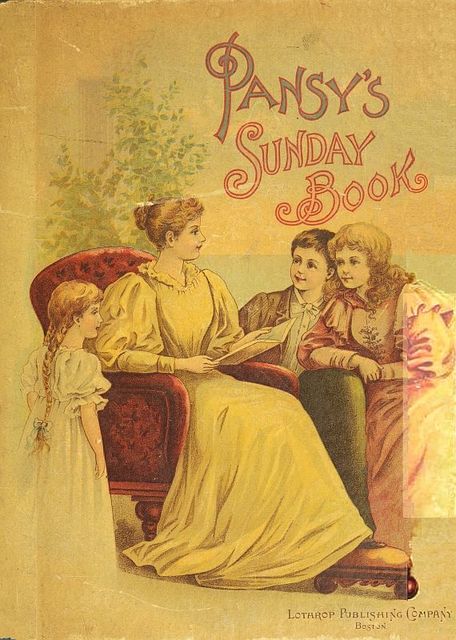



Читать бесплатно онлайн книгу Pansy's Sunday Book
PANSY’S SUNDAY BOOK


PANSY’S
SUNDAY BOOK
BY
FAMOUS AMERICAN WRITERS

FULLY ILLUSTRATED
BOSTON
LOTHROP PUBLISHING COMPANY
Copyright, 1886, by D. Lothrop & Co.
Copyright, 1888, 1893, by D. Lothrop Company.
Copyright, 1895, by Lothrop Publishing Company.
—————
All rights reserved.
J. J. Arakelyan, Printer, Boston.

N LATE NOVEMBER.
—————————
A STORY TO REMEMBER, IN NOVEMBER.
IF you’ll sit on my knee
As still as a stone,
And listen to me
While we’re all alone—
While the wind whistles cold,
And the snow falls so fast,
While the young and the old
Feel the chill of the blast—
I will tell you about
A poor little lad
Who now, without doubt,
Is smiling and glad.
(His picture.)
Brown and curly his head,
Bright blue was his eye,
His feet bare and red,
His look rather shy;
His face, somewhat soiled,
Unfamiliar with soap,
Was thin, while there curled
In his neck, like a rope,
Certain locks which had grown,
Unhindered by shears
That he never had known,
You would think, all his years;
His shirt was a sight,
You may think, to behold,
Through which shone the light
Unblushingly bold.
His trousers, in shreds,
His legs dangled round,
Long needing the threads
Which they never had found;
While his cap—what was left
Of the original pattern—
Of all shape was bereft,
And looked like a slattern.
Such, such was the creature
Who stood in the door;
In dress, form and feature—
Nothing less, nothing more.
May you love this, my lad
From the slums of the city;
Not think him all bad,
But regard him with pity.
(The name.)
Though nameless he stood
Clad in rags in that door,
Whether evil or good,
He is nameless no more.
We’ll call him hereafter,
If you make no objection,
In tears—or in laughter,
On further reflection—
Thomas Tinker, all told,
But “Tommy” for short,
Until he grows old—
Perhaps then, when in sport.
But I’ll tell you I think, sir,
Before saying more,
This is not the “Tom Tinker”
You’ve heard of before,
But another, whose fame
Is as worthy of mention
As the first of his name
Who claimed your attention.
(The story.)
We will trace him as we may, on his way
From that doorstep, where at play on that day;
We will see just how he earned
That for which his young heart yearned,
How from good he firmly turned not astray.
Selling papers he began, little man,
Then on errands often ran, like a “van”;
Then his matches he would sell,
Blacking boots the while, as well;
And with cheerful voice would tell all his plan.
Tried his courage was, I’m told; nor condoled
By humanity, which rolled, with its gold,
On its laughing, rushing way,
Like a crowd of boys at play,
Or a flock of sheep astray from the fold.
But his heart was brave and true, and he knew
That to flinch would never do; so say you?
Thus he bravely bore his part
With a true and loyal heart,
Never doubting from the start; “tried and true.”
The days seemed often long; but his song
Rang brave and strong; just the song
Of the wares he had to sell;
Of the news they had to tell—
Good and bad alike as well, for the throng.
And he worked, and worked away, every day,
With his heart as light and gay, as the May;
And he did his level best, late and early;
Never grumbling, never sad, and never surly;
With a smile ’neath his golden head and curly, as at play.
So he fought the fiends of hunger and of cold, true as gold;
Like a veteran tried and bold, I am told,
Was this soldier in life’s battle
’Mid the daily hum and rattle;
Driven forth like sheep or cattle, to be sold.
Many brave fall by the way, every day;
Some survive, their country’s stay; well they may;
But of all the rank and file
Grandly marching up the aisle
Of stern duty, all the while, who can say
Which the most deserve the name, writ in fame?
Those who fell ’mid shot and flame, on land or main,
Or those who in obscurer strife
Have given heart, and soul, and life
For husband ill, for child, or wife, in duty “tame”?
Well, Tommy stood, sturdy and grave—no slave—
His soul had what we well might crave; no knave
Was he; but faithful in the daily fight,
Cheerful, happy, eager, bright—
A nineteenth century valiant knight, youthful, brave.
Perhaps you’d like to know his foes, who arose
To strike him down with deadly blows. Who knows
But such as he? Who else can tell
The horrid shapes, the cruel spell
These demons from the pit of hell disclose?
“Hunger,” you say, “sickness and cold; no fold;
No home that such as he might hold, to mould
And make them good, and true, and wise?”
Ah, yes! and on the streets before his eyes
Were Satan’s minions in disguise; so bold!
These dens of ill, they grow, you know;
We find them everywhere as we go, ready to throw
Their snares with fiendish skill.
Almost ’twould seem, to suit their will,
They’d gorge earth’s prisons to their fill below.
God looked on Tommy in the fight for right,
Saw darkness struggling with the light, so bright—
That light which shone on Eastern plain
Where shepherds heard angelic strain
Such as will surely come again some night.
God knew about the thrall, the small,
Weak hands which yet might fall, the call
Which all too loud might prove to be
For one so young, so little helped as he,
So tempted oft, and yet withal so free to fall.
And so, one cold Thanksgiving Day, so gay
With jingling bells, and sleigh and play,
The father sent a messenger in love,
To take poor Tommy to his home above,
Where, clad in garments whiter than the dove, he’ll stay.
And now no more he’ll walk that street, where sleet
And slush so cruel hurt his feet; repeat
No more his song of paper vending,
Shiver no more while restless horse attending,
But join in song triumphant, never ending and sweet.
But on this day of this November, remember
Tommies there are, with feet as cold and tender, remember,
As his once were, who now on golden strand
Meet rich and poor, of this and every land.
These need your store, your love, your helping hand, remember!
R.
ROBERT TRUESDALE’S LOGIC.

THEY were great friends, Robert Truesdale and Claire Waterman. During the long, bright summer at the seashore they spent as much time together as possible, and discussed all sorts of questions. They had opinions concerning everything under the sun, and agreed so well, generally, that to find a subject upon which they totally differed only added interest to the summer.
One of these subjects was found one morning when they sat together on the beach. It began—that is, the discussion did—by Robert’s making the astonishing statement that he never went to circuses.
Claire stopped playing with the sand which she was letting run idly through her fingers, and turned so that she could see his face. “How very queer!” she said; “I thought all boys went to circuses. Did you never go?”
“I went once,” said Robert, low-voiced, “when I was quite a little fellow, and that was once too often. I never cared to try it again.”
“I cannot imagine why. I think circuses are splendid. We never go in the city, of course. Why, they don’t have circuses in cities, do they? But I go to my Auntie’s every summer for two months—I always have until this summer—and Uncle West takes us children to the circus just as regularly. That is the reason I like the country so much better than the city, you can go to such queer out-of-door things. And I think the little circus ponies are too cunning for anything; I have always wanted one for my own. Mamma laughs, and says she doesn’t know but I will be a circus rider when I grow up—and then the clown is so funny. Why don’t you want to go, Robert? What happened when you went once? Was there an accident?”
“No,” said Robert slowly, “I suppose not; I am afraid it was an every-day affair. It is a long story, Claire, and begins away back of that day. I have been brought up differently from you, you know. My father was a minister, and he and my mother did not approve of shows of that kind, and I was never taken to them when I was a small boy. I never heard nor thought much about them; we lived in a large town, but not too large for the traveling circus; but I got the idea, somehow, that only low people attended such places, and never coaxed to go.”
Claire exclaimed over this, “Why, Robert, where my Auntie lives everybody goes, only the minister and a few old dried-up people.”

“HOW VERY QUEER!”
“Yes, I know,” said Robert gravely; “some people in the country have different views from those which my father and mother had; but I did not know it when I was a little chap; I thought that all respectable people thought alike. The first time I changed my ideas any was when I had gone to spend the year with my Grandmother in the country—that was the summer after mother died, and my father had died the winter before. I found that a great many country people went to circuses. All the boys and girls who went to school with me in the little old schoolhouse were looking forward to going as a matter of course; and I heard more talk about the circus that summer than I had ever heard in my life before. I began to want to go very much. The more I talked with the boys, the more I became convinced that it was because my father was a minister that I had been held away from such places. ‘Of course ministers ought not to go,’ I told myself, ‘because’—and there I would have to stop; I knew no reason why they should not go where other people did, and could not reason about it any better than some grown people can nowadays; still I called it a settled point, and began to coax my grandmother to let me go to the circus. ‘Just this once,’ I said to her; ‘I want to see for myself.’
“I have never understood how she came to let me have my way, unless it was because she was a very indulgent grandmother, and pitied the orphan boy, and could not bear to say ‘No.’ Any way, I received permission, and the necessary quarter of a dollar, and started off in great glee.
“I ought to tell you,” he continued, after a slight hesitation—and the flush on his brown cheek deepened a little—“that although I was only a little fellow ten years old, I was a member of the church, and was trying to live my religion. There was a ragged little boy not much older than myself, very ignorant and neglected, but a leader in all sorts of mischief, whom I had had ambitions to help. I had been kind to him, instead of making sport of his rags, as the other boys did, until I had a certain sort of influence over him, and he had partly promised me to try to be a better boy.
“Well, I went to the circus, and saw the ponies, and heard the jokes, and was delighted; but as I stood around outside afterwards, open-mouthed and open-eyed, I saw two of the men whom I had most admired in the ring, fighting. They had been drinking just enough to make them quarrelsome, and such horrid oaths as they were using I had never even imagined possible before. I stood still with fright and horror and watched the blows, and listened to the vile language, until somebody touched my elbow, and there was little Pete, the ragged boy. He was grinning wickedly. ‘My eyes!’ he said, ‘was you in there?’ nodding toward the tent. ‘I was struck all of a heap when I see you come out. I didn’t think this kind was for you. I thought you belonged to the “goody-goodies,” you know. Miss Wheeler, she said when she was talking to us fellows about it, “O, no! Robert Truesdale won’t go to the circus, I am sure; he is his father’s own boy, and is walking the same road he did.” I guess you got off the road this time, didn’t you?’
“I do not believe I shall ever forget the wicked leer in the little fellow’s face as he said those words; and I am sure I shall never forget the feeling of shame which I had as I looked at those two dreadful men with the blood streaming down their faces, and the vile words streaming from their mouths, and realized that I had spent my afternoon in laughing at their speeches, and had been found out of the road in which my father had walked—so far out that this street boy had noticed it! I turned and ran away as fast and as far as I could, and I do not think I shall ever attend another circus.”
“How very strange!” said Claire; “but then, after all, Robert, bad men will swear and drink and fight. You did not make them any worse by going to see them ride.”
“I can’t be sure of that, Claire. What if my twenty-five cents helped to encourage them to live the life which kept them in the midst of such temptations? That is what good men who have studied and thought about these things say of the circus. Besides,” and here the boy’s face took on a little touch of lofty scorn, “I want to grow up to be such a character that the jokes and jumpings of evil men cannot amuse me; I want to learn to be above them. Then you see what the ragged little street boy thought?”
“Yes,” said Claire gravely; “I never thought much about it; I just went, of course, because the others did, but I shouldn’t like to be counted on that side, exactly. Robert, maybe I won’t go any more. I must think about it.”
Myra Spafford.
HOW THE DEER KNEW.

MY neighbor’s little boy one evening saw his teacher coming up the lane and called her in to take a look at his pet fawn.
“Well, if he didn’t get half a foot taller since I saw him last,” said the teacher; “if he keeps on like that, Tommy, he will be a big deer the first thing you know.”
“Yes, he’s growing,” said Tommy; “but I wanted to see you about something else. He seems to be sick, and we do not know what to do about it.”
“Why, he looks all right now; what seemed to be the matter with him?”
“He doesn’t eat,” said Tommy, “and he upset his water dish when I tried to make him drink. I went up on the hill to get him the best grass I could find, but it’s no use; he must be sick.”
“Let me see that grass,” said the teacher. “I thought so,” she laughed, when Tommy took her to the fawn’s fodder corner; “you got a lot of wormwood leaves mixed up with the grass, and one of the leaves got in that water dish.”
Tommy stared. “Oh! maybe that’s the reason he upset his water,” he burst out; “but I had no idea that would make any difference. What makes him so very particular about a few leaves, I wonder?”
“You will know if you taste them,” said the teacher; “and maybe your fawn wanted to get even with you for teaching him to jump through a hoop.”
“Why, he seems to like that,” laughed Tommy.
“That’s just what I mean,” said the teacher; “he felt so much obliged to you and wanted to pay you back—by teaching you a good lesson. An animal, you see, won’t touch any bad-tasting food if it is in good health, and if you give it the wrong kind of drink it doesn’t mind its thirst, but waits till it gets something better. And that’s an answer to the question you asked me a few weeks ago, when you wanted to know how people could help getting fond of drinks that make them drunk and sick. They should let such stuff alone altogether, if they find out it does not taste right at first. You found out something about that yourself, didn’t you?”
“About what—the ugly taste of bad drinks, you mean?”
“Yes; don’t you remember what you told me about that hotel where you got thirsty, and tried a glass of something you thought was lemonade, and found it was beer?”
“O, yes! I remember,” laughed Tommy; “I never tasted anything worse in my life. I don’t see how in the world people can get fond of such stuff.”
“That’s just it,” said the teacher; “they should do as your little deer did this afternoon, and never meddle with a drink that tastes very bad the first time they try it, unless they should be sick and need a bitter medicine for particular purposes. If a healthy person should try to drink big glasses full of ugly medicine just for fun every day he would soon be sick, and few medicines taste as bad as some of the drinks so many people get drunk on.”
“Cod-liver oil doesn’t, nor herb tea,” said Tommy. “I tried them, and know they are not half as ugly as beer. And they say beer isn’t the worst yet,” he added; “there are drinks that taste like burning fire, if you get a drop on your tongue. I don’t see how in the world anybody can get fond of such stuff.”
“Let me tell you,” said the teacher. “The first time they try it they cannot help disliking it, and they should take the hint to let it alone altogether. But if they keep drinking it in spite of their horror, it will lead to a very strange result. Their nature gradually gets changed, till a time comes when they cannot do without a drink that made them shudder when they tasted it first. It is that way with beer and brandy, and even with a drink made of that very wormwood that would have made your deer sick if it had eaten it. Just rub one of those leaves between your fingers, and then put the tip of your finger to your tongue. That is just exactly the taste of a stuff called absinthe, and brandy and strong beer are almost as bad.”
“You say people get fond of it if they drink it again and again,” mused Tommy, “but what makes them do that, I wonder? What makes them try it at all?”
“They see other people do it,” said the teacher, “and so they try it themselves, and keep on trying, because they think Mr. So-and-so ought to know better than nature. Their own nature warns them against it, but they do not mind that warning, and keep on till it is too late to turn back. Now you might ask me to tell you who first took it in his head to make himself sick with such a foolish habit. That seems a puzzle, indeed, but it has been explained in this way. Before people drank wine they drank the fresh juice of grapes—‘must,’ as they call it—and probably tried to keep some of it in bottles and jars. Now in warm weather sweet juices of that sort are very apt to spoil—they ferment, as it is called, and their pleasant taste becomes sharp and disagreeable. Some stingy housekeeper in old times may have forced his servants to drink that spoiled stuff rather than throw it away, and after a while they got fond of it, and the foolish habit spread all over the country. Now wine is nothing but fermented or spoiled must. Beer is fermented barley water. They let barley get soaked in water, and then mix it and stir till it gets that sharp taste that made you sick when you tried it by mistake in that summer hotel last year.”
“Yes; and on that same trip I once got in the wrong railway car,” said Tommy, “and that car was full of tobacco smoke enough to make my little brother cry, and I thought it would choke me before the train stopped and we got back in the right car. I know a boy who got so sick he had to go to bed when he first tried to smoke; but I am sure I shall never try it at all.”

SHE’S SUCH A DARLING!
“That’s right, Tommy; let such things alone altogether,” said the teacher. “It’s very easy never to begin, but if you should get fond of such bad habits you might find it hard to get rid of them.”
“I have a book about travels,” said Tommy, “and I read that the American Indians first taught white men to smoke. One of my cousins has been in Mexico, and when I asked him what made the Indians so fond of tobacco smoke, he said they first used it to drive mosquitoes out of their cabins. They burn tobacco leaves on a hot pan, and the gnats all fly out of the window.”
“I should not wonder,” laughed the teacher; “and that would show that mosquitoes have more sense than those Indians.”
Felix L. Oswald.
SOMETHING FOR MAMMA.

I GET the idea and most of the details from Harper’s Bazar. The article from which they are taken says the contrivance is for an invalid, but let me assure you that mamma will like it very much, or, for the matter of that, papa also, though they have not thought of being invalids.
First, contrive to get a nice pine board about twenty-five inches long and twenty-one wide (if you are making it for me I should like the board a little narrower, but perhaps mamma might not); cover it with felt of any color you please—perhaps it would be well to have in mind the furniture in the room where it is chiefly to live, and secure a color which will harmonize, or at least not “fight,” with the prevailing color there.
Perhaps, however, you will be in the condition in which I have sometimes found myself; namely, with a piece of felt of a certain color which obstinately refuses to turn into another, no matter how much I might desire it; in that case, if I were you I would go right ahead with my present; I feel sure mamma will find it useful, even though it is not just the shade which you and she like best. The same remarks will apply to material. I have used cretonne, or even calico, where I would have preferred felt if I could have got it. Well, we will pretend to cover this pine board with felt; we will have the felt so long and wide that it will reach say for six inches or so below the board at both ends, and on the front side. Then make neat little pockets for these ends and side, with a flap to button down over them when desired. These are to hold letters, envelopes, bits of poetry, scraps of prose, recipes, in fact anything which mamma desires to have convenient when she sits down to write. If mamma uses a fountain pen I think she will like exceedingly a little narrow pocket, just wide enough for her pen to slip in easily, and just deep enough for it to stand upright and put its head out for her to get hold of. If she does not, a “traveler’s inkstand,” leather covered, may be glued at the right end of the board; it has a “spring” cover, you will remember, and takes faithful care of the ink when closed. A stamp box of wood or paper may be glued at the other end.
What a delightful present that will be when you get it done! I am sure “mamma” will appreciate and enjoy it. The Bazar says a row of brass-headed nails should be driven all around the edges of the board, I suppose to hold the felt firmly in place; but a little girl who had no brass nails could very easily sew her felt or cretonne or calico around the under side of the board, and make her pockets separately, sewing them firmly to their places, if she wished.
In fact, there is room in this device for many changes and improvements. I can imagine an ingenious girl or boy—or perhaps it would be better to say girl and boy—putting their heads together, and making many variations which would be a comfort to the fortunate owner. Try it, and let me know the result.
Pansy.

SHE STRUGGLED WITH THE SLEEVES.
NANNIE’S THANKSGIVING.
IT was very early in the morning; earlier, in fact, than Nannie was in the habit of being up; but on account of Thanksgiving Day, and the fact that they were all going, to Aunt Cornelia’s to dinner, Nannie thought she ought to be on hand early. She was waiting for mamma to give her her bath, and sat down to pet Rosamond Catherine Lorinda in the meantime. The middle name, Catherine, was in honor of Grandma Patterson, but Nannie did not like it very well, and felt obliged to place it between two names which she called “delicious,” in order to tolerate it. A bright thought occurred to her; she might dress the child for the Thanksgiving dinner while she waited. It was while she struggled with the sleeve which did not want to go on that the thought came which caused all her trouble.
“This sleeve is too small,” she said; “I b’lieve my child’s arm must have grown a great deal since she wore this dress before; she ought to have had a new dress for Thanksgiving; she would look sweet in a white embroidered one trimmed with lace.” Just then the baby in the willow cradle at her side nestled in his sleep, and Nannie turned and looked at him.
“If Rosamond Catherine Lorinda only had one dress like what Teddy has so many of, I should be too perfectly happy,” she said. “Just think, I b’lieve he has as many as ’leven or eight! Mamma might borrow me one just for to-day; it would be too long, but I could cut it off at the bottom; it would be just as easy to sew it on again when Teddy needed it; and the sleeves I could loop up with pink ribbons, and she would look too perfectly sweet!”
The more she thought about it, the more the longing grew; at last it began to seem a positive injustice that Teddy should have so many clothes and not be willing to lend any to Rosamond Catherine Lorinda. “I know he would, if he understood,” said Nannie, looking approvingly upon the sleeping baby; “he loves my Rosamond, and kisses her just as cunning! And he has such a perfectly lovely lot of dresses! I just mean to look in the bruro drawer and count them.” Saying which, she tiptoed toward the bureau behind the cradle, and opened the second drawer. To be sure she was barefooted, and could not have made much noise; besides, if she was doing right why should she care if her footsteps were heard? Nevertheless, she instinctively tiptoed along, and opened the drawer as softly as she could; and it was not for fear of waking Teddy, either.
There lay the dresses in a fluffy white heap; on the top was the one which Nannie most coveted.
“Teddy hardly ever wears it,” she said reassuringly, as she drew it out; “I guess mamma doesn’t like it very much or she would put it on him oftener; and Rosamond Catherine will look too perfectly sweet for anything in it. I am most sure mamma would not care. I could cut it off right through all those little embroidery holes, then Grandma could sew them together again just as easy.”
I grieve to tell you that she did exactly that dreadful thing. Not immediately; she resolved to try the dress on first, and see if it would do; and despite the fact that the waist was many times too large, and the limp arms were altogether lost in the sleeves, the waxen-haired beauty looked so enchanting to her mother’s eyes, under those billows of white, that in a very short space of time the shining shears were making a long, crooked line through the costly embroidery with which Teddy’s best dress was trimmed.
O, me! the troubles which in this way were stored up for naughty, foolish Nannie. They began almost immediately; for despite the fact that Nannie had coaxed herself into the fancy that there was no harm in what she did, she found she was not willing to have her mother know about it, and crumpled the elegant dress into a small bundle and thrust it under the great rug at her feet when she heard her mother’s footsteps. All through the breakfast hour, and even at family worship, she was engaged in planning how she should get Rosamond Catherine Lorinda dressed and wrapped in her traveling cloak without any one having seen her; for fond as she was of exhibiting the beauty, she found that to-day she would rather her charms were hidden from all eyes.
She was still planning ways and means when the discovery came. She was not prepared for it, because when Teddy had so many dresses, how could she suppose that when her mother opened the drawer to select one she would exclaim, “Why, what has become of his dress? I laid it on top so as to get it without disturbing the others.”
A good deal of talk followed. Papa suggested that she had laid it in some other drawer, and Aunt Laura said perhaps Grandma had taken it to set a stitch in; and Grandma affirmed that she had not, and asked what Nannie was longing to: “Why don’t you take one of the others, daughter, and get the little fellow ready while he is good-natured?”
“Well, but where can it be?” asked the puzzled mother, closing the drawer. “I am sure I laid it here, on the top. I wanted Adelaide to see him in that dress, because she sent me the embroidery for it, you know, and it is more expensive than any I should have bought.”
Nannie caught her breath nervously over this; she had not supposed the embroidery was so choice; she might just as well have taken one of the other dresses if she had only known.
Just at that moment Susan, who was bustling about, packing Teddy’s traveling bag, stooped down and pulled at something white under the rug, as she said, “Shall I put in some playthings, Mrs. Walters? Why, what’s this?”
What was it, sure enough, but the lost dress cut in two, in a fearful zigzag manner, directly through the costly embroidery! Can you imagine what followed? I am sure you will not be surprised to learn that poor, naughty little Nannie had a whipping then and there. Her mother did not even wait for Susan to leave the room, as she generally did before punishing any of her children. It is true the whipping was not very severe, for Mrs. Walters was never severe; but the disgrace of it was terrible, for Nannie was very rarely whipped.
However, this was by no means the worst of her troubles; behold, mamma declared that she could not go to the Thanksgiving dinner, but must stay at home with Susan and the cat. Now when you reflect that they were to ride four miles in a beautiful sleigh drawn by two prancing horses, and meet a baker’s dozen of little cousins, some of whom Nannie had never seen, to say nothing of the delights of the Thanksgiving dinner, and the little pies with their names on, done in sugar plums, which were to be ready for each cousin, I am sure you will feel with Nannie that her punishment was greater than she could bear. In truth, the others thought so. Papa said, “My dear, couldn’t you reconsider, somehow?” Aunt Laura said, “Jennie, I think you are horrid!” And even Susan ventured to say, “I don’t think she knew it was his best dress, ma’am; and she says Grandma can sew it together, poor little heart.” But Mrs. Walters was very firm. She did not deign to answer Laura or Susan, but said to her husband, “Richard, I don’t know how I can change, now. I said she couldn’t, and you know I ought to keep my word. Besides, the child needs a serious lesson; it is quite as hard for me, I think, as for her,” and the mother’s lip quivered a little. Then the father said soothingly, that of course he knew she was doing it for Nannie’s best good, and he could trust her judgment where he couldn’t his own. But Aunt Laura remained indignant, and the whole household was in trouble. “Our Thanksgiving is spoiled,” said Aunt Laura; “I’ve a good mind not to go.”
Meantime, Grandma said not a word. It was nearly an hour afterwards, and the preparations for starting, which had gone on much more silently, were almost completed, when Grandma opened the door of Mrs. Walters’ room, dressed in her best black silk, with her beautiful white satin hair peeping out from under the soft laces of her best cap, and holding by the hand a little girl with very red eyes, and a red nose, who kept up a suspicious little sniffing, as though it was only by great effort she refrained from bursting into fresh tears. Grandma walked straight toward her daughter, and said, “Mamma, we have come to ask you if you will not forgive poor little Nannie, who is very sorry, and let her go to-day, for Grandma’s sake—not for hers at all, but for Grandma’s.”
And the handsome mother, with a sudden glad light flashing in her gray eyes, stooped and kissed the cheek of her sweet old mother, and then of her own little daughter, as she said, “Dear mother, you know what you ask for your own sake I could certainly never refuse.”
The years have rolled on since then, enough of them to make little Nannie twenty-six, and the mother of one Rosamond, who has golden hair like the dollie, her namesake, but who is mischievous, as Rosamond of old never was. And I heard the sweet mother say, last Thanksgiving morning, after having told this story of her past for the benefit of some young mothers, “I am thankful for two things: that I had a mother who taught me that wrong-doing must bring unhappiness, not only to myself, but to others; and that I had a dear Grandmother who taught me what it was to have a powerful friend to come between me and Justice, and say, ‘For my sake.’“
Pansy.

PAPA’S CHOICE.
HERE stands my baby,
On two little feet;
With her bushy brown head,
And her dimples so sweet.
Her arms are all ready
To give me a hug;
So give me my baby,
And you keep your pug.
R.
NOVEMBER.
WHAT is thy mission, November,
Thou link ’twixt the living and dead?
What message would’st have us remember,
Writ on thy dried leaves, to be read
As lessons to youth and to age,
To the simple, the student, the sage?
Stern duty, thy scepter of power,
The husbandman readily sees;
And takes up the tasks of the hour
As the limbs bear the buds on the trees;
For he sows not, ploughs not, nor reaps;
He laughs not, he frowns not, nor weeps.
The frosts, without cost, starch the ground;
Spread a mirror o’er river and lakes;
While nuts scattered thickly around,
More treasured than apples and cakes,
The children may gather with ease,
With the squirrels which hide in the trees.
The apples are now in the bins,
The pumpkins upon the barn floor,
Save those which, bereft of their skins,
Hang to dry on the biggest barn door;
The banking’s high piled ’gainst the house,
To keep it as snug as a mouse.
Thou wast wisely ordained for man,
For time was much needed, we see,
In which for cold winter to plan,
And prepare for the storms which must be;
So, while few may sing of thy praise,
We will welcome and treasure thy days.
Not all the best things of this grand old earth,
Not all the hours of the year around,
Are welcomed here with the songs of mirth,
Nor in fields of pleasure are ever found,
For cloudy are the days of welcome rain,
And sharp the sickle for the golden grain.
G. R. A.
The soul that perpetually overflows with kindness and sympathy will always be cheerful.

NOVEMBER.
BABY’S CORNER.
WHAT MADE BABY LAUGH?

BABY DALE’S mamma had a great many pictures of her little boy, but they were not pretty.
The trouble was, he would not sit still even for one little minute. He was always jumping or clapping his fat hands, or saying “Baa, baa!”
One of his pictures had three eyes, and one had no nose.
One funny one had his mouth wide open like a big O, for he was crying.
And there was one where he had his mouth shut, but he looked very cross. He had a frown between his eyes. Mamma said she would not know it was her sunny boy.
But by and by a man came who could take pictures whether babies kept still or not.
One day little Dale was in his high chair by the window. Outdoors it was snowing.
Baby thought the snowflakes were pretty white feathers coming down from the sky. Mamma and he played with a feather once that came out of his pillow. It was nice.
Such a lot of feathers! They made pretty white caps on the fence posts. And there were great heaps of them on the ground!
“Some day,” thought Baby, “I will go out that door, and I will creep right down the steps, and I will go to that big pile of feathers, and I will get my hand full, and I will throw them away up, up, back into the sky!”
Then baby laughed, and the man who had come to take his picture touched a button on a queer little box he had, and there was Baby just as you see him.
That is how Baby Dale came to have a picture that mamma loved.
All the aunties, when they saw it, said, “Oh! how sweet.”

“I WILL GET MY HAND FULL.”
Mamma sent a picture to the grandma down in Flor-i-da, and one to the grandma up in Maine. One went over the ocean to Uncle John who loves Baby Dale very dearly. One went out West to Auntie Lou, and one went to Boston, to be printed for you.
Mrs. C. M. Livingston.
SOMETIMES in the early springtime,
The sunbeams floating ’round
Are caught out in the showers,
And are washed into the ground.
But, ere the summer’s over,
They take root in the sod,
And grow up with fresh brightness
In the form of Golden Rod.
—Selected.
LORA’S SERMON.

IT was Sunday morning, and all the family except Lora and her mother had gone to church. As a rule they, or at least Lora, were the first to be tucked into the sleigh; but on this particular morning Mrs. Wheeler had said she was not going; that she had a little cold, she believed, and was “all tuckered out” with the week’s work, and just in condition to get more cold very easily; and Lora’s coat did look too ridiculous to wear to church, so she had better stay at home with her.
“By next Sunday you will have your new coat,” she said, to console the child, “and be all in order for church for the rest of the winter.”
Lora looked sober for a few minutes; she was very fond of riding to church tucked in among the great soft robes, and she did not mind the service so very much, though the sermon was pretty long. However, she was naturally a sunny little girl, and her face soon cleared as she buttoned her somewhat shabby coat, and went out to watch the snowbirds, who were gathering in great numbers near the barn doors.
Lora and the snowbirds were friends; indeed she made friends with all sorts of dumb animals, and had queer little ideas about them.
“You will fall,” she said gravely, addressing a fat bird who swung on a tiny branch almost at her side; “you have picked out a very slimsy branch; it looks as though it was almost broked off; maybe it will break while you are swinging on it—I most know it will—then you will fall down in the snow and hurt yourself. I falled off of a limb once, and it hurted.”
The bird paid not the slightest attention to this friendly warning, but Lora continued to stand still, looking at the swaying bush, her face full of earnest thought. She had already turned from the bird, and was thinking about the verse sister Nannie had taught her that morning. It was a long verse for a little girl, with some hard words in it; but Lora had mastered them, and said them over in her mind, revolving, meanwhile, the explanation which Nannie had made of them. “If a man abide not in me he is cast forth as a branch, and is withered.” “Branches do wivver as soon as they are broked off,” said Lora. “I’ve seen them; and papa and Moses burn them up—that is what it said.
“This stick is broked off,” she continued, carefully examining the one which she grasped with both chubby hands; “it used to grow, but it won’t ever any more. All the leaves have wivvered off it, and some day it will get burned up, I s’pose; it isn’t good for much.”
Words stopped just here, but that little Lora’s brain went on with the great thoughts which she could not express, was evident from the look on her face. The Bible verse and Nannie’s careful explanation of it had taken deep root in her heart. She went into the house presently; the thoughts had grown so large that she felt as though she must ask some more questions.
As a usual thing, Sunday quiet reigned in Mrs. Wheeler’s kitchen at this hour of the day. But this day was an exception. Mrs. Wheeler, bustling about doing up the last things connected with the morning work, had come across a bowl of mince meat and a lump of dough evidently left from pie crust. “I declare for it!” she exclaimed, “I thought Kate made up all the pies yesterday. What a careless thing, to leave this bowl of mince meat here over Sunday! It would make two good pies, and if all the folks come for Thanksgiving we may fall short; they set such store by my pies. I wonder what Kate was about? It must have got dark before she finished. These must be made up the first thing to-morrow—but there is pretty near everything to do to-morrow, too; it makes a great deal of work getting ready for such a house full; and pie crust is none the better for standing, either; I declare, I’ve a mind to slap this on to a couple of tins and set them in the oven; there is fire enough to bake them nicely, and it won’t take five minutes, hardly, and there are so many ways to turn to-morrow.”
There were more thoughts about it not put into words, but it ended in the moulding board being spread out on the table, and the flour jar and rolling-pin and pastry knife being laid beside it. I wonder they did not all blush for shame, for such a thing had never happened to them before on a Sabbath. Mrs. Wheeler’s cheeks were rather red, and she felt what she would have called “kind of queer”; but she flew about very fast, and meant to be soon seated in the best room in her Sunday dress.
It was just at that moment that Lora pushed open the kitchen door and entered, her eyes large with the thoughts about which she wanted to question. They grew larger as she took in the situation. Her mother rolling out pie crust! And it was Sunday! Such a thing had never happened in Lora’s experience. Nobody knows why the queer little brain put together the thoughts which had come to her outside, and the pie crust in the kitchen; but it did, and there came, presently, this question: “Did you get broked off, muvver?”
“Did I what?” said Mrs. Wheeler, her cheeks very red. There was something in Lora’s look and tone which made them redder.
“Get broked off. That is what Nannie said. She said folks that got broked off did things that Jesus did not want done; and kept doing them. Does he want you to make pies to-day, muvver?”
“If I ever saw such a child!” said Mrs. Wheeler, making the rolling-pin revolve over the board at railroad speed. “What does Nannie mean putting such notions into your head? Go into the other room, child, and take off your coat; I’ll be there in a few minutes. I’m not going to make pies; I shall wad up this dough and keep it until to-morrow.”
And she did.
Myra Spafford.
THAT RAINY DAY.
THE Stautenbergers were not rich, neither were they poor. Their house was not large, neither was it very little; but there was none too much room in it.
Mrs. Stautenberger was dead; had “fallen asleep,” as the father called it, that very autumn; so when he went to the shop for his day’s work, Pauline, the eldest, had to be both sister and mother to her three sisters, and one little brother.
The teacher of the school in their district was very kind, and after her first call at the “home without a mother,” she said to Pauline, “Do not stay at home to care for baby sister; bring her with you, and we will manage in some way. I think she will be a good little girl.”
Then Pauline felt sure she should love the teacher very much. When her father came home she told him what Miss Gilbert had said, and as he wiped a tear away, he, too, thought she would be a nice teacher, and must have a good heart to be so willing to help his motherless ones.
There are a great many things I would like to tell you about this little family and their splendid teacher, but all I will have time for now, is the story of one rainy day, and what they did about it.
The storm was so hard they could none of them venture out; certainly little Gretchen must not be taken out, so there seemed a prospect for a dull, dreary, lonesome day.
The few dishes were soon put away, and all were hungry for school.
“I know what to do,” said Pauline; “let’s play school. We can read and spell and make numbers, and maybe we can study geography a little; then when we go to school to-morrow teacher will be so s’prised to see how much we have learned; and then she’ll smile, and maybe she will kiss us, every one! Won’t that be fun?”
She didn’t try to rhyme, but in her eagerness it came of itself.
So they had school, and Metza played teacher, and Pauline sat by little Gretchen, and Fritz and Mary sat with them on the long lounge, and they had such a nice time they forgot that it was storming outside, and were much astonished when at noon papa came home to lunch, and so sorry they had forgotten to heat the water for his coffee.
But when they told him what a nice time they had had, he smiled, and said, “My Pauline has been a good mother to-day.” And she thought, “I have the best papa in the world.”
G. R. A.

“THIS STICK IS BROKED OFF,” SAID LORA.
PERFUMED GLOVES.
PERFUMED gloves were brought from Italy by Edward Vere, Earl of Oxford, after his exile, and his present to Queen Elizabeth of a pair with embroidered roses is mentioned in history. But the refinement of perfumed gloves had been known for three centuries in France before the days of the Virgin Queen, and in Spain the gloves were famous for the scent imparted to them long before her day. The luxurious court of Charles the Second used perfumed gloves, and those “trimmed and laced as fine as Nell’s,” you have no doubt read about. Louis the Fourteenth also issued letter patents of his “marchands maitres gantiers parfeumeurs.” In Venice, where the love of dress was conspicuous, perfumed gloves were introduced by a dogess as early as 1075.—Selected.

QUEEN ELIZABETH WHEN A PUPIL.
That day is best wherein we give
A thought of others’ sorrows;
Forgetting self, we learn to live,
And blessings born of kindly deeds
Make golden our to-morrows.
A SABBATH IN A BOARDING-SCHOOL IN TURKEY.
I.
IT was the dawn of a winter morning. Ding-dong-ding clanged the chapel bell. I sprang up and began to dress, while Marta went to the mission-house for a cup of coffee. As I fastened the last button, there was a rap at the door. “Come,” I called, and in walked the dear little maid with a cup of coffee carefully covered to keep in the steam, and a roll done up in a napkin, which the cook had insisted upon her bringing.
Ding-dong began the bell again. “Tell the girls not to wait for me,” I said; and soon the clatter of many feet on the stairs indicated their departure. The coffee must be swallowed, and the little roll must not be wholly neglected; then putting on bonnet and ulster, I started to follow. Fido, our little spaniel, was standing disconsolate in the hall below. Her eyes were full of entreaty, and wagging her tail persuasively, she accompanied me to the door.
“Go back, Fido. Can’t take little dogs to church!” I exclaimed. She knew it was no use to tease, and stood watching me as I opened the heavy door with difficulty, and slammed it after me—it would not latch unless slammed. As I reached the church door, I heard the organ—that meant the service had begun, and I was late! something I never meant to be, but this was so early to go to church! The Armenians are all accustomed in the Gregorian Church to a service even earlier, and when they become Protestant, or Evangelical, they still cling to the old way of making worship the first thing in the morning, and giving breakfast the second place.
Instead, then, of going up the men’s aisle, and sitting at the further end where we missionaries usually do, I went on to the door at the left—the women’s—and slipped into a back seat. A little girl just in front of me passed me her hymn book, so that I could join with the congregation in singing “Garode yem, voh garode yem”—“I need Thee, O, I need Thee.” Just as the hymn closed, the sun’s rays struck the eastern window and streamed in; then the preacher arose and read the epistle to Philemon, and also 1 Cor. vii. 22....
The benediction was pronounced, and the congregation slowly streamed out. The walk from the chapel to the street is narrow, and as it is not proper for women to crowd in among the men, we waited till they had mostly passed on. While standing outside, Shushan, one of our day pupils, came along with her mother; both were completely enveloped in the white crapy wrap which is worn by the Armenian women in this section. Shushan’s bright-colored dress showed through, and at the same time set off the figure in the wrap.
“Par-ee loo-is, Shushan; are you of the same mind as yesterday about going to Kozloo?”
She returned my good-morning, and said she was; yes, indeed!
“Why should we change our minds?” said her mother. “Are we not also Christ’s servants?” referring to the sermon we had just heard.
You see, Shushan’s brother was bitterly opposed to her going away to teach, and I thought it quite possible that he had influenced her to give it up. It was years after girls’ schools were opened before people were willing to send their children to a woman teacher—I mean a native—still worse if she was “only a girl.” They would far rather send them to a man, however ignorant and incapable. That long struggle has ended at last in victory, and we have no more trouble in finding work for our girls; but we have another difficulty now. Well-to-do parents and brothers consider it a disgrace—at least many of them do—to have their daughters and sisters work as though they were obliged to earn their support.
“Haven’t you food and clothes?” they ask indignantly, when a girl, filled with a desire to do something for her people, intimates a purpose to teach. Perhaps I may as well complete this little tale here and now, although it does not belong to the incident of the Sabbath I have been describing.
A few days later the (native) pastor came to me and asked anxiously, “Can’t you persuade Shushan, for the sake of peace, to give up going to Kozloo? Her brother is very violent, and talks terribly, declaring that even if she were mounted, and going through the most public street, he would drag her off the horse; if she should by any chance succeed in carrying out her plan, she should never come home again—he would never again acknowledge her as his sister.” The pastor went on to say that he thought the brother had offered to send her away to school if she would give up “this crazy scheme,” as he called it.
I sent for Shushan, and finding that her brother had made the offer referred to, advised her to accept it. The sacrifice of her will for the sake of avoiding scandal, would, I was sure, be as acceptable to the Master as the service she had intended. In less than a week thereafter, she was on her way to a distant school.
We passed out through the arched gateway, and then parted with a mutual “yer-tak par-rov”—“good-by.” How the sun sparkled on the snowy street, on the mountains which seemed to stand across it, so near they looked, and reared their dazzling summits into the brilliant blue of the winter sky.
The girls with their shawls modestly over their heads, crossed the street in a straggling little procession. Fido appeared in the window which she had pried open with her little black nose—windows are hung like doors—gave an eager and joyful bark or two, and rushed down to welcome them home. Then they sat down to their breakfast of tea and bread. The former was seasoned with white lump sugar (brown sugar is unknown), but there was no butter for the bread.
I doubt whether my readers would have recognized the thin, whity-brown sheets, or the rags placed before one of the girls who had elected to take the pieces, as bread, but so it was. They have many kinds in Turkey, and this thin kind, a little thicker than blotting-paper, is very popular here. In the autumn it is a very common thing for a girl to come and say, “Teacher, mother says will you please excuse me from school to-day?” And she explains that they are baking bread, and need her help.
“But why doesn’t your mother get some woman to help her?”
Then I find that it is a regular “bee”—a bread bee! The neighbors are already there, and they will work all night—it is no small job to roll it out so thin. There will be no more baking till the worst of the winter is over. It is stacked away in a dry place, and when wanted the requisite number of sheets (about two feet long by one wide) is taken, sprinkled as you would clothes for ironing, and after a few moments, folded once lengthwise and laid around the edge of the table. If, instead of being sprinkled, the bread is held over the fire a moment, it becomes crisp and really nice; but this is seldom done.
After the housework was done we had prayers, and then the girls were dismissed with a charge not to hang about the halls or stairways, as the boys were coming over again to sing, and to keep their doors closed. “Not ajar as last Sunday, to my mortification and your disgrace; most likely the boys thought you left them open on purpose so that they could look in.” Somehow the boys and girls are wonderfully interesting to each other all the world over.
Soon the young fellows filed in, looking half-pleased, half-shy—big, six-foot Isaac, and clever little Bo-ghos; Sumpad, with his bright, frank smile; poor, awkward Deekran, the best writer in school, and his brother Arsen. We practiced “Hold the Fort”; there were two bad mistakes with which we struggled for a while. Then we sang “What a Friend we have in Jesus,” “Sweet By and by,” “Almost Persuaded,” “Go Bury thy Sorrow,” “The Ninety and Nine,” and others—all in Armenian, of course.
Then I said just a word to Deekran about money I entrusted to him—merely a caution to be careful to return any money that might be left over. It was hardly the thing for the Sabbath, but I was not likely to see him for some days, and I wanted to prevent any carelessness—it is so important for boys that they learn to be careful and business-like.
Harriet G. Powers, in the Evangelist.
THE HARD TEXT.
(Matt. xii. 31, 32.)
MANY have been troubled over this text. Some have been in despair of being saved because they thought they had committed this unpardonable sin.
Probably many are mistaken. Any one that truly feels sorrow for his sins, and really longs for forgiveness and hungers for holiness, shows some of the best signs that he has not committed this. God will not cast out such a person, if he comes in Jesus’ name.
But there is a sin against the Holy Ghost so great that it cannot be forgiven, and probably when one has committed it he is so desperately wicked, so hard in heart, that he never asks to be forgiven.
You will wish to know what this awful sin is, so that you may never commit it. The thought of being doomed never to see heaven and Christian friends after death fills you with horror.
But then, why should you not tremble at committing any sin? One little sin leads to another, and so on, until the sin of sins is the end of it all. Take care!

A SELFISH KID.
But how is it—or was it—worse to sin against the Holy Ghost than against the Son of Man?
Well, the first might be done in ignorance. The Roman soldiers did not know what a dreadful thing they were doing when they nailed the dear Lord to the tree. They might be forgiven that. But the Holy Ghost comes to show one the truth; then that one has no excuse, you see. His sin is against light. It is most deliberate, willful, determined. It is much more. But remember it is sinning against light, great light.
L.
AN AMUSING ANECDOTE.
SOME time ago an amusing little anecdote was related about the German Crown Prince whilst having a lesson in grammar from his tutor. One is now being told about the second son of the imperial couple, Prince Eitel Fritz. The Emperor is exceedingly strict about his son’s behavior at table. Not long since little Prince Eitel Fritz, using his fingers instead of his knife and fork, was corrected by his father several times to no purpose. At last the Emperor’s patience was exhausted, and he said:
“Children who eat with their fingers are like little dogs that hold their food with their paws. If you use your fingers again you must go under the table, the proper place for little dogs.” The little Prince did his utmost not to forget this time, and used his knife and fork like a man; but all at once he forgot again and began using his fingers. “March under the table,” said his father. Prince Eitel Fritz crept under as bidden. After a little while the Emperor, thinking the Prince very quiet, lifted up the tablecloth and peeped underneath. There sat little Prince Eitel Fritz undressed. His father asked him what he meant by undressing himself. The child answered, “Little dogs don’t wear clothes; they only have skin.”—Selected.
A STRANGE GENERAL.

YEARS and years ago there was a busy housekeeper thrown into a fever of anxiety because she heard a certain famous general was coming, and that she would be expected to entertain him. She flew about in the greatest haste, pressing all the people around her into service to help make ready for the distinguished guest.
Among others was a man who, by his dress and general appearance, she took to be a neighbor’s servant. “Take hold and help us here a minute,” she said, and set him at some work in the kitchen. That being done the man volunteered to split some wood to a certain size, as it was greatly needed. While he was thus employed the lady’s husband, who had been absent, reached home, and was informed of the honor in store for him. He, too, set about helping with the preparations, and presently went to the kitchen, where the strange servant was just laying down an armful of the wood he had split.
Imagine the man’s stare of astonishment, mingled with dismay, when he recognized in the stranger the famous general in whose honor all this bustle of preparation was going forward.
In stammering confusion he approached the supposed servant, who, by the way, was slightly deformed, and asked for the meaning of such an extraordinary state of things.
“Why,” said the helper, with a broad smile on his face, “I am paying the fine for my deformity.”
I leave the Pansies to learn who this great man was, and who was the woman who in her haste to honor him mistook him for a house servant, and also what happened in consequence of this.
Pansy.
Crickets are bought and sold in various parts of Africa. People capture them, feed them, and sell them. The natives are very fond of their music, thinking that it induces sleep. Superstitions regarding the cricket’s chirp are varied. Some believe it is ominous of sorrow and evil, others consider it a harbinger of joy.

CASTLE QUEER.
BABY’S CORNER.
A HAPPY CHRISTMAS.

“CHRISTMAS is coming! Christmas is coming!”
That is what little Lucy sang as she went through the hall with a hop, skip and jump, clapping her hands for joy.
“And what is little daughter going to do to make somebody happy on Christmas day?”

ONE OF THOSE LOVELY ROSES.
Papa asked this as he came out into the hall. Then he kissed Lucy good-by, took down his hat from the rack, and went out of the front door before she had time to tell him.
Lucy stopped running, and looked out of the window and thought about it.
Then she went upstairs to mamma and said:
“Mamma, what am I going to do to make somebody happy to-morrow? What can little girls do?”
“You can be just as sweet as a rose all day, and obey mamma as soon as she speaks. That will make me very happy,” said mamma.
“But I want to give something to somebody to s’prise ’em and make ’em glad,” Lucy said.
“Who is there that you would like to surprise?” her mamma asked.
Lucy thought a minute, then she said:
“Mrs. Bly.”
Mrs. Bly lived in the “Home for Aged Women.” She was a nice old lady, and Lucy often went with her mother to call upon her.
“Very well, dear,” said mamma; “there is your gold dollar; if you want to give it you may.”
“May I buy ’zactly what I please, mamma?”
“Yes, dear.”
“O, how nice!” said Lucy. “Can’t we go now, right off, to buy it?”
Mamma said “Yes” again, and Lucy ran off to get her hood and cloak and mittens. In a few minutes she was out on the street with mamma, gazing into all the shop windows. “What shall I buy? What shall I buy?” she kept asking.
Mamma said a little shawl for Mrs. Bly’s shoulders would be nice, or a pair of warm stockings or some handkerchiefs. But Lucy shook her head.
“Wouldn’t she like a bu’ful dollie or a sweet little kitty better?” she asked.
Mamma had to laugh at that.
Just then Lucy cried out, “There it is! I see it! That is what I want.”
Guess what it was.

WHAT THEY NEED.
It was a beautiful large rosebush in a pretty pot. There were two roses on it and plenty of buds.
So they went in and bought it. The man said he would send it up right away.
Old Mrs. Bly was sitting in her rocking-chair knitting. There came a knock at the door. She opened it, and who should be there but Lucy and her mamma, and a boy with a rosebush!
How surprised Mrs. Bly was, and how pleased, when she knew that little Lucy bought the plant with her own money.
“You dear little lamb,” she said; “it will make me very happy. It is like the roses in my old home.”
When Christmas morning came Mrs. Bly cut off one of those lovely roses and put it in a vase. She carried it to a poor old lady across the hall who was ill in bed, and it made her glad.
So you see little Lucy made three people happy that Christmas day—the sick old lady, Mrs. Bly and herself.
Mrs. C. M. Livingston.
FROM THE HEART.
ON the eve of Christmas,
Ready each for bed,
And with heart most anxious,
Bends each little head,
While the prayer was whispered
Close to Grandma’s chair.
Were the angels bending
O’er a sight so fair?
“Dear Jesus, please to listen,
For Christmas comes to-morrow,
And we so much need some dollies,
So we needn’t have to borrow!
Please have them made of wax,
Wiv blue eyes, and pretty curls;
And we’ll love you more than ever!
We’re your own dear little dirls.”
R.
A LONG CHRISTMAS.

THERE had been the usual Christmas-tree, which the cousins from three homes had gathered to enjoy. There had not been a Christmas since the oldest of them could remember—and he was sixteen—that the cousins had not been together in one of the homes, and had a frolic around the Christmas-tree. It was always hung with bright-colored balls, and strings of popcorn, and all the bright and pretty and useless things which people from year to year have contrived for such trees. It always had clustered about it the various sorts of fruits which refused, because of their weight, to be hung upon the branches—dolls, and kites, and wagons, and swords, and books and baskets. Every year the fruit grew stranger in some respects, with a dreary sameness in others, which was actually beginning to weary the hearts of the cousins.
The first excitement was over. The fathers and mothers and maiden aunts, together with three grandmothers and two grandfathers, had retired to quieter parts of the house, and the young people were left to their enjoyment. It was not very noisy in the room, nor were most of the cousins absorbed in their gifts; in fact their faces were already sobering. Little Nell was still happy over her new building-blocks, and Dell, her other self, was trying to advise her concerning them, while Harold tried his new paints and brushes on the chair he occupied, his guardian sister leaning over the back of the chair, so absorbed the while in her own grave thoughts that she did not even notice the mischief he was doing.
“It is all over once more,” said Holly. He was the sixteen-year-old cousin, and he thrust his hands in his pockets, and said it with a yawn.
“Some of it is a good deal of a bore,” answered Tom, the cousin next in age, echoing the yawn. “I didn’t get the first thing I expected or wanted.”
“Neither did I; but then I don’t know what I wanted, I am sure, unless it was a bicycle, and you can’t put that on a Christmas-tree very well.”
“Why not, as well as the trumpery which is put on?” asked Tom contemptuously. “I tell you the whole thing is getting to be a bore. Even the small fry don’t care for it half so much as they think they do; there’s Nannie sulking this minute because her dollie, which she has deserted, is not so nice according to her notion as Lily’s is. And Ted has turned his back on the whole of it because he didn’t get a drum. This crowd needs something new.”
“I don’t know what it would be; we have had everything imaginable, and if the simple truth were told need presents less than any young folks in the kingdom, I do suppose. My father says there is nothing new to get for pampered young people like us; and I don’t know but he is about right.”
“There’s a whole lot of money spent about it every year, though.” This was from Hortense, the oldest of the girl cousins, and a sort of adviser of the two older boys.
“I know it,” said Holly; “and a good deal of it is wasted. Nannie, for instance, did not need another doll any more than the cat needs two tails, and as for me I have seven jack-knives now.”
At that moment Helen turned away from the paint brush which she had not noticed, and joined in the conversation.
“Isn’t it funny? I have five new balls, and I don’t care for any of them. They keep giving us the same things over and over.”
“They forget,” said Holly; “and there is nothing new for them to get us, anyhow.”
“I know something that would be new.” It was Hortense again, speaking with grave thoughtfulness. The boys turned and looked at her inquiringly. “Don’t you know what Mr. Briggs told about the children out in the Colorado mountains, who never had a Christmas present in their lives, and didn’t know anything about such times as we have? I was thinking what if we could make up a box and put into it all the dollies, and balls, and jack-knives, and things that we don’t want, and some books, and perhaps a little candy, and send it out there, wouldn’t it be nice?”

THEIR FACES WERE ALREADY SOBERING.
“Too late for this year,” said Tom promptly.
“Why, no, it isn’t; if we hadn’t had any Christmas at all, ever, we would be willing to have one come to us in January.”
The boys laughed, and Holly said heartily, “That’s so.” And Hortense began to tell a story that she had heard Mr. Briggs tell to her uncle, and the younger ones gathered about her, leaving dolls and paints, and the interest grew.
It was the very next day that Hortense and Tom and Holly went to Dr. Parsons’ house to see Mr. Briggs.
“Why, yes,” he said, looking perfectly delighted with them, when Holly explained; “let me tell you about a brave little chap out there, only eleven years old; his father was guide to the tourists who wanted to climb the dangerous and difficult mountains, and lost his life from exposure, hunting a party of men who had strayed away. Little Teddy is as brave as a soldier. He is a guide himself, though so young, and getting to be one of the surest and safest to be found in that region, only he is so young and small yet, that strangers are afraid to trust him. A dreary life Teddy leads; he and his mother live all alone in a little house at the foot of a mountain. The boy has only the clothes which his father left, made over for him the best way his mother can. He never had anything that fitted him; and he never had any playthings in his life, only what he picked up; as for knives, or balls, or any of the things which boys like him enjoy, I don’t know what he would think if one should happen to come to him. You needn’t suppose that he hasn’t heard all about Christmas; his mother used to live in a farmhouse in New York State, and the stories she has told have almost driven him wild. A few rods away from their cottage lives a family with five children—three little girls, and a four-year-old boy and a baby. I happen to know that Teddy set his heart this year on having some sort of a Christmas present for every one of those children—and failed! I did not mean that he should, but I was sick at just the wrong time after I reached home, and my plans did not work. I heard from there only last night, and poor Teddy’s plans did not work, either.”
Holly had his note book and pencil in hand. “Will you give us his full name and address?” he said.
Such a time as the cousins had packing that box! Every baby of them contributed, not only the toys which they did not want, but a few that they loved, and parted from with sighs. The same may be said of the elder cousins, especially when it came to books; Holly was a miser where these were concerned, and Hortense knew how to sympathize with him. It took these two several hours to be willing to pack in that box some of their handsomely bound volumes, written by favorite authors.
But they had to go; for Mr. Briggs, among other things, had said, “I never saw a boy so hungry for reading in my life as Teddy; and he has only scraps of old newspapers, which he has picked up from time to time among the tourists.”
And more than books and toys went into that box.
“It is a shame for a fellow to have no clothes that fit him!” declared Tom. “I’ve been there myself, and I know how it feels. I had to wear my brother Dick’s overcoat once, and it was too large for me. Mr. Briggs says he is about the size of Roger”—he meant Teddy, and not Mr. Briggs. “We must ask mother about that.”
They asked her to such purpose, and Aunt Cornelia as well, that two neat suits of Roger’s and Cousin Harry’s second best clothes went into the box.
The day in which it was finally packed was a jubilee. The cousins were all invited to Aunt Cornelia’s to supper, and packed the box in the large dining-room after supper, with a little of Aunt Cornelia’s and Uncle Roger’s help.
“I don’t know as I ever had so much fun in my life,” said Holly, looking up from the driving of the last nail to make the remark. “It is better than Christmas a dozen times; in fact it is a Christmas extension.”
“And won’t it be fun to hear from Teddy?” said Hortense.
But as for us, we cannot expect to hear from Teddy until January.
Pansy.
VOICES OF THE BELLS.


IN yonder tower high hangs the brazen bell,
Tolling, tolling;
Upon the frosty air its echoes heave and swell,
Tolling, tolling:
The bell has a tongue that is easily heard;
When it is swung many hearts may be stirred,
Though its tale it tells with never a word—
Tolling, tolling.


It swings and dings in the morning air,
Ringing, ringing!
Tells of the birth of a baby fair,
Ringing, ringing!
Tells the glad news so that all may know;
Those in the village asleep below,
Those on the streets moving to and fro—
Ringing, ringing!
Aloft it swings in the schoolhouse tower,
Dinging, dinging;
With brazen tongue it proclaims the hour,
Dinging, dinging:
Calls to the work of storing the mind
With useful knowledge of every kind,
Urging the laggards left far behind,
Dinging, dinging.
Gently it swings in the steeple high,
Pealing, pealing;
The steeple that points to the upper sky,
Pealing, pealing:
Calling to worship on hallowed day,
Calling the faithful to come and pray,
Even to those who are far away—
Pealing, pealing.
Again it calls in a joyful tone,
Ringing, ringing!
Hinting that man should not walk alone,
Ringing, ringing!
And so they throng with the bridal pair,
And the glad bells sound on the clear sweet air,
For the bells all ring for the belle so fair—
Ringing, ringing!
Ah, me! but that tongue will swing again,
Tolling, tolling;
Swing again with a solemn strain,
Tolling, tolling:
It will tell how some one beloved has died,
How the cold dark earth has claimed his bride;
And ’twill seem in its strains as though it sighed—
Tolling, tolling.
But the bells above may swing and ring,
Swinging, ringing,
In the temple towers of the Lord the King,
Swinging, ringing;
And the bells below, with the bells up there,
May sound their joys for this Child and Heir,
Who is called to heaven its joys to share—
Swinging, ringing.
G. R. A.

THE BELL HAS A TONGUE THAT IS EASILY HEARD.
EASTER LILIES.
A STALK of tall white lilies
Bloomed out in a garden fair;
Their breath, so sweet and fragrant,
Scented the ambient air.
As Easter day came on apace,
It seemed as if they tried
To grow still sweeter, for the morn
When rose the Crucified.
When dawned the holy Easter tide,
And they were full in bloom,
A sad-eyed woman gathered them
And laid them on a tomb.
And as she knelt in deepest woe
Beside the flower-decked mound,
And felt that all her hope was dead,
The lilies’ fragrance stole around.
It stole into her wounded breast;
The sacred odors seemed to be
A message for her bleeding heart—
“The Crucified pities thee.”
Caroline Stratton Valentine.

THE BELL HANGS IN THE TOWER.
CHARACTER STUDIES.
I.

EDWARD STEADMAN was at home for the Christmas holidays. Everybody was glad to see him, of course, particularly his mother; because in the first place mothers always are a little bit more glad over the home-coming of their boys than anybody else in the world can be, and secondly because she needed some help very much, and knew that he could give it. She explained matters to him that morning: “I want to get Grandma’s room all in order, Edward, and her new carpet down, and every thing, before Christmas, you know; and we shall have to work like bees. I’m so glad you came home this week, instead of stopping at your uncle’s first. To-day we can hang all her pictures, and put up the curtains and the wall-pockets, and do things of that kind; they will not make a speck of dust in putting down the carpet—it is new, you know. I want to get all those things done to-day, they are so puttering—take a great deal of time and judgment. I’m so glad to have you to depend upon; you are such a tall boy that you can reach where mother can’t; and Dick is so clumsy I hate to have him stumping about Grandma’s room. Your father was going to help me, though he did not know how to spare the time; he was as pleased as could be when I told him that you could do it all. ‘Sure enough!’ he said; ‘we have got a boy to depend upon once more; how good it seems!’”
The sentence closed with a fond smile, and such a look in the mother’s eyes as ought to have made a boy happy. Edward was happy; he whistled as he went down the stairs, and thought to himself that there were not many fellows who had such a mother as his, and that he would show her just how tall, and how handy and how wise he was.
She called after him as she heard the street door open.
“Where are you going, Edward? We ought to get right to work; it will be an all-day job, do the best we can, and the light is good in Grandma’s room now for hanging the pictures. Must you go to the post-office first? O, well! that is but a short distance; run along, and get back as soon as you can.”
“Halloo!” said Mr. Arkwright, the postmaster, who had known Edward ever since he was a little fellow in kilts and curls, “back again, are you? How you do shoot up, to be sure! I believe you are about a foot taller than you were in the fall. Here’s your mail; nothing but papers this time, but enough of them to snow you under!” And he pitched them through the little window so fast that they fell to the right and left.

“CERTAINLY, SIR,” SAID EDWARD.
“Catalogues, some of them,” said Edward, smiling; “I asked them to send me a number of the new ones; and the reports of our commencement and society exercises are in these papers.”
“Like enough,” said Mr. Arkwright; “had a grand time, I suppose? You carried off a first prize, I hear? Glad of it. I always knew it was in you. Do you happen to be going directly home? If you are, would you mind taking this letter and handing it in at Westlake’s as you pass? I see it is marked ‘Important,’ and it may save him some trouble to get it right away. He’s all alone in the office to-day; his boy is sick.”
“Certainly, sir,” said Edward, reaching for the letter, and dropping it into his jacket pocket. Then he walked away, looking steadily at one of the papers, which he had already opened.
“I do not see what in the world can have detained Edward!” said Mrs. Steadman, speaking as well as she could with her mouth full of tacks. She was mounted on a box which in its turn was mounted on a chair, and was trying to reach to fasten the curtain in Grandma’s room.
“I should think you would wait for him,” said her daughter Fannie anxiously. “You ought not to climb up like that, mother; father would not like it at all, and I’m afraid you will fall. You are not high enough yet to get it right.”
“I know it; and I can’t drive a nail away up here, either. I cannot understand why Edward doesn’t come; it seems as though something must have happened to him. I explained to him particularly what a hurry we were in, and how much there was in which he could help me.”
“What has happened to him is that he has found something to read, I suppose, and has seated himself somewhere to enjoy it.” Fannie spoke a little irritably; she was worried about her mother, and they had been waiting for Edward for more than two hours. The short December day was hurrying toward its noon, and nothing had been done of the many things in which he was to have been a central figure. Fannie was very fond of her brother, but she realized his besetments better than the others did, or at least she said more about them.
“O, no!” said the mother decidedly, taking a tack out of her mouth to enable her to speak plainly; “Edward wouldn’t do that, after all I said to him this morning. He knew how anxious we were to have everything ready for Grandma by Christmas. Something unusual has happened, I feel sure. I don’t know but Tommy would better run out and see if he can find him, only it seems rather absurd to be sending out in search of a big boy like Edward.”
“I should think so!” Fannie said, and they waited another half-hour. Then a sharp ring at the door-bell startled Mrs. Steadman so that she nearly lost her balance. Fannie screamed a little, and ran toward her.
“I didn’t fall,” she said, leaning against the window-casing for support; “but I think I shall have to get down. I don’t see what makes me so nervous. It seems all the time as though something was going to happen; I suppose it is because Edward doesn’t come. Did Jane go to the door?”
Yes, Jane had; and now they listened and heard Mr. Westlake’s, their neighbor’s, voice.
“Is Edward here?”
No, Jane said, somewhat shortly, he was not; and as to where he was, that was more than they knew. Jane had been called from her work three times that morning to help with something which Edward could have done, and she did not feel sweet-natured.
“Well, I wish you would ask your folks if they have any idea where I might find him,” Mr. Westlake said anxiously; “I have just come from the office—it was the first chance I had for going this morning—and Arkwright says he sent a letter to me marked ‘Important’—sent it by Edward nearly three hours ago, he should think. I have some business matters that are very important, and I thought this might be a summons to me to go away on the express, and there is but a half-hour or less before it goes.”
Before this long sentence was finished Mrs. Steadman was at the door; but she had no information to give, and could only tell the annoyed man that she was sorry, and that she could not imagine what had detained Edward.
“I can,” muttered Jane, as he turned hurriedly away; “his own sweet notion is detaining him; he’s enjoying himself somewhere, readin’ a book or paper, and letting others get along the best way they can.” But Jane was only talking to herself.
The Steadman dinner bell was sounding through the house when Edward, flushed and embarrassed, came bounding up the stairs two steps at a time, to assure his mother how sorry he was.
“I hadn’t the least idea how time was going,” he explained; “never was so astonished in my life as I was to hear the bell ring for noon! Why, you see,” in answer to her anxious questions, “I got a lot of papers at the office—all about our closing days, you know; of course I was anxious to see what they said about the examinations, and essays, and things, so I stepped into Dr. Mason’s office just to glance them over. The doctor was out, and I sat and read first one thing and then another, and talked a little with folks who kept coming in search of the doctor, until, to my utter astonishment, as I tell you, I heard the bell.”
“Then nothing detained you, Edward?”
“Why, no, ma’am; nothing but the papers, as I tell you. I had not the faintest idea”—
She interrupted him. “Have you seen Mr. Westlake?”
“Yes’m,” and now Edward’s face crimsoned; “I met him on the street and gave him his letter. I’m dreadfully sorry about that; almost as sorry as I am about keeping you waiting, mother.”
“He said it might want him to take the train; do you know if it did?”
“Yes’m, it did.”
“And he missed it?”
“Why, of course, mother dear; the train goes at eleven, you know. I’m awfully sorry. It is perfectly unaccountable what has become of this forenoon!”
Mrs. Steadman made no comment; she did not want to trust herself to do so just then. She turned away with a sigh so deep that it would have cut Edward’s heart, had he heard it.
And Jane nodded her gray head and muttered, “I told you so!”
Myra Spafford.
A TEN-DOLLAR CHRISTMAS.

ADELE CHESTER had never spent a Christmas in the country before; neither had she ever felt quite so desolate. Mother and father were in Europe, in search of health for the father, and Adele, who had been left in charge of Aunt Martha, had herself decreed that she would go nowhere for Christmas.
“I can’t be happy and frolic when papa is sick,” she said; “and as for the country, if Aunt Martha can live there all her life, I think I can endure one Christmas.” So she had staid; but it must be confessed that the world looked dreary to her that wintry morning, with nothing but snow to be seen from her window. She almost thought she would have been wiser to have joined the Philadelphia cousins. “At least there would have been a chance to spend my Christmas money,” she murmured gloomily, as she tapped on the frosty window pane with restless fingers. “I’m sure I don’t know what I can buy in this little tucked-up place.”
The “tucked-up place” was really a nice town with about five thousand people living in it, but to Adele, whose home was in New York City, it seemed absurd to call it a town. Aunt Martha’s farmhouse was only half a mile from some very good stores, where Adele had found a few things to suit her during the three months she had spent there, and on the whole she had managed to be quite happy. But she did not feel like being suited with anything this morning. Such a queer Christmas for her! She had had her presents, as usual—a new fur cap from Aunt Martha, a writing-desk well furnished from Uncle Peter, a lovely ring with a real diamond in it from mamma, and a new chain for her pretty watch from papa. What more could a reasonable girl want? Truth to tell, she wanted nothing but the dear home, and mamma’s kisses, and papa’s arms around her. The ring and chain were beautiful, but they did not seem like presents from them, when she knew they crossed the ocean weeks ago, and had been lying in Aunt Martha’s bureau drawer waiting for this morning. She valued the letter more which had arrived only the night before, and she drew it from her pocket and kissed it, letting a tear or two fall on the words, “My Darling Child,” as she read them once more. “Papa and I are so sorry to be away from you to-day,” the letter read; “we have tried to find something suitable to send on so long a journey, and planned to reach you on the very day, but have failed; papa has not been well enough to look about much for a few weeks, and I could not go alone. At last we decided to send you a fifty-dollar bank note and bid you go and spend it in the way which would make you happiest.”
“The idea!” said Adele, smiling through her tears, as she refolded the letter, “just as though I could find anything here to buy to make me happy! Mamma must have forgotten for the moment where I was. Yet I want a few things, some Christmas bonbons, at least, if they know the meaning of the word in this little place, and above all, I want a brisk walk in the snow. I shall take ten dollars of my fifty, and go out and spend it; I won’t waste another cent on this old town. I wonder what I can do with ten dollars to make me happy?” She laughed half scornfully. Ten dollars seemed so very little to this girl, who had always spent money as freely as water, and done as little thinking about it as the birds do over the spring cherries.
In a very few minutes she was wrapped in furs and out upon the snowy road. Aunt Martha offered her the sleigh and the driver, and her “leggings” and woollen mittens, but she would have none of them. She was a good walker, and had been used to miles in the city. She hid her nose in her muff, because the wind over this wide stretch of snow was very keen, and sped along “like a snowbird,” Aunt Martha said, watching her from the window. And then she sighed, this dear old auntie whom the country satisfied. She saw the shade on the face of her darling this morning, and was sorry for her, and wished so much that she could do something to brighten her Christmas day.
The little town was reached in due time, and the streets were gay with Christmas finery; the stores were open quite generally, to catch the belated Christmas buyers. In an hour or two they would close for the day; but the custom in this thriving manufacturing town was to give the tardy ones a Christmas morning chance. Adele went from one store to another, dissatisfied, disconsolate. Nothing suited her. The truth is, when a girl does not need an earthly thing, and is yet determined to spend some money, she is sometimes rather difficult to suit. She halted at last before a show window and looked at the bright fineries displayed there. So did little Janey Hooper, who had come out with ten cents to buy a soup bone for the day’s dinner. Adele, turning from the window, jostled against her, and looked down upon the mite. She seemed not more than eight, yet there was a wise, grown-up look in her eyes which held the homesick girl’s attention.
“Are you trying to make Christmas too? What do you see in the window you like?”
“Everything,” said the little girl simply.
“Do you? you are fortunate. Are you going to buy them all?”
“O, no! not a single one. I couldn’t.”
Adele, looking closely at her, was seized with a sudden impulse. “Suppose you could buy one thing, what would it be?” she asked.
The little girl’s eyes flashed. “Oh! I would buy that shawl—that soft gray one with pussy fringe—it looks just like mother.”
It was a dingy little shoulder shawl, of the kind which can be bought for two dollars. “Does your mother need a shawl?” asked Adele.
“O, yes’m! she needs it badly enough; but we are not going to get one, not this year; we can’t.”
There was decision and composure in the tone, like a woman who had settled the whole question, and put it beyond the range of argument. Her manner amused Adele.
“That was for your mother,” she said; “what would you choose for yourself?”
“Me?” said the child, surprised. “Oh! I don’t know. I might take that brown coat, maybe, or some mittens, or—I don’t know which I would take. What’s the use?”
She was turning away; but Adele’s gloved hand detained her. The little sack she wore was much too thin for so cold a morning.
“Wait a minute,” she said gently. “Tell me what your name is, won’t you, and where you live, and what you came out for this cold morning with so thin a sack?”
“I’m Janey Hooper; we live down there on Factory Lane. It wasn’t far to go, and my sack is worn out, that is why it is so thin; but it will do very well for this winter. I came out to buy the Christmas dinner.”
“Did you, indeed! Aren’t you very young to go to market?”
“O, no, ma’am! I’m turned nine, and the oldest of four, and father’s dead. Of course I have to do all I can. I know how to choose a lovely soup bone.”
“Do you? Are you going to have soup to-day?”
“Yes’m, a big kettle full; I’ve got ten cents to buy a bone with. I generally get a five-cent one; but we thought for Christmas we would have it fine. My brother is to be home to dinner; he is most twelve, and likes soup.”
There was a mist before Adele’s eyes that the frosty air did not make. She brushed it away and settled her plans.
“Come in here with me a minute,” she said; “I want your help about something.” The child followed her wonderingly, with eyes that grew every moment larger, as the thick brown coat which hung on a wire figure was taken down and deliberately tried by the smiling shop girl on her quaint little self.
“It fits to a T,” said the girl; “Janey has a pretty figure, and that just suits her.”
“It is warm, at least,” said Adele. “Did you say it was two and a half? What an absurd price! Keep it on, child; it is for you. This is Christmas, you know, and Santa Claus sent it to you. Now that shoulder shawl.”
A moment more, and it was in Janey’s astonished arms. Her eyes sparkled, but she made an earnest protest: “Oh! if you please, I don’t think I can; I am afraid mother would not”—
“Your mother cannot help herself,” interrupted Adele. “Don’t you know I told you it was Santa Claus? He does what he likes always. Come along, I’m going to market with you; I want to see you pick out a soup bone. Is it to go in that basket?”
She picked it out with grave care and with skill, Adele and the market man watching her the while. “Isn’t it a nice one, Bobby?” said the child, to a stout boy who had also stopped. Adele turned as the freckled boy nodded.
“Who is this? Is he a friend of yours? Well, Bobby, Santa Claus wants you to do an errand for him, will you? He will give you four of those red-cheeked apples if you will.”
The boy laughed good-naturedly, and said he didn’t know much about Santa Claus, but he would do whatever she wanted done.
“Very well,” said Adele merrily; “I want that market basket which hangs up there. Can you lend it to this boy for a little while?” The market man declared his entire willingness to do so, and kept Janey Hooper waiting for her bone while he filled that basket with everything which Adele’s eyes could discover, which might add to a Christmas dinner. There was a plump chicken, a roast of beef, a string of sausage, some potatoes, apples, onions, turnips, a great bunch of celery, and, in short, whatever the market man suggested, after the girl’s skill was exhausted.
“Is that too heavy for you?” said Adele.
“O, no, ma’am!” Bobby assured her.
“Very well; I want you to take it to this little girl’s mother’s house, and tell her Santa Claus sent it to go with the soup, and that it has given him a happy Christmas to do so. Will you remember?”
He nodded brightly, stuffing rosy-cheeked apples into his pocket the while, and they trudged away, Janey trying to murmur her bewildered protests, while Adele paid her bill.
“I’ve spent every cent of my ten dollars,” she told Aunt Martha an hour later. “I hadn’t even enough to buy you any Christmas bonbons; but I have obeyed mamma’s directions; I was to buy something to make me happy, and I haven’t felt so happy in weeks as I do this minute. When I get my things put away I’ll come down and tell you all about it.”
Aunt Martha watched her bound up the stairs, a glow on her cheeks and a sparkle in her eyes which they had lacked when she went out; and whatever the purchase had been, she was grateful.
As for Janey Hooper and her mother, to say nothing of Bobby, who took dinner with them, you must imagine how they felt.
Pansy.

MAKING THE SHEEP CLEAN.
MISS PARKER’S GIRLS.
THERE were thirteen of them, all told. An “unlucky number,” one of them said, and laughed; they were girls who did not believe in “luck.” They laughed a great deal during these days, and were very happy. They had as lovely a secret on their minds as thirteen girls, all of them between the ages of eleven and thirteen, ever had. They were also very busy, and held many committee meetings, and discussed plans, and went in companies of twos and threes to transact business. “We were never so busy before at this time of year, were we?” they said to one another. “And we never had so much fun in our lives!” some one would be sure to say. To this sentiment they all agreed.
“This time of year” was a few days before Christmas. The preparations for Christmas, so far as these girls are concerned, began two weeks before. It started on Sunday afternoon in the Bible class. Miss Parker had been even more interesting than usual that day. She succeeded in so filling their hearts with the lesson, especially with one thought in it, that Cora Henderson said, half enviously:
“O, dear! I can’t help wishing that we had lived in those times. Of course it was dreadful; but then, after all, it gave one such splendid opportunities! Think of John having a chance to take Jesus’ mother home and do for her. And to know that Jesus wanted him to, and was pleased with it! I think it would have been just lovely; there are no such chances nowadays,” and Cora, aged thirteen, sighed.
Miss Parker smiled on her brightly. “Are you sure of that, my dear girl? Remember we are talking about a history which is different from any other in the world, because Jesus is ‘the same yesterday, to-day and forever.’”
“O, yes’m!” Cora said civilly; “I know it; but then, of course, things are different. His mother is not here on earth for us to take care of; I should love to do it, I know I should,” and Cora’s fair face glowed, and her eyes had a sweet and tender light in them.
Miss Parker looked at her fondly. “My dear child,” she said, “I think you would; but do you forget how He said, ‘Whosoever shall do the will of my Father which is in heaven, the same is my brother and sister and mother’?”
Cora looked a little bewildered, and Miss Parker explained.
“I think we all forget that according to that verse Jesus has many ‘mothers’ on earth, in the persons of his dear old saints, who are poor, and weak, and tired, and are only waiting to be called home. There are so many things we could do for their comfort, if we only remembered that they were the same to Jesus as his own dear mother.”
The girls looked at one another wonderingly. This was a new way of putting it. Cora did more than look. “What a lovely thought!” she said; “I should never have thought it out for myself, but it must be so, because what would that verse mean if it were not? O, Miss Parker! couldn’t we girls do it? Do you know of any old lady whom we could help a little—make a pretty Christmas for, perhaps? Girls, wouldn’t you all like to do it?”
So that was the beginning. Yes, Miss Parker knew an old lady; had had her in mind all the week; had wondered how she could set to work to interest her dear girls in her. She needed a great deal of help, and Miss Parker had very little of this world’s goods. She knew that some of her girls came from homes where there was plenty. “But I do not like to be always begging,” she told her mother. Then she had asked the Lord Jesus to show her some way of interesting the girls in poor Grandmother Blakslee. And here they were asking for the name of an old lady whom they could help! What a lovely answer it was to her prayer.

“NOW LET US ASK A BLESSING.”
Grandmother Blakslee’s story was a sad one, though only too common. Her two daughters and her one son had died long years before, leaving a little granddaughter, who had grown to girlhood and married a worthless drunkard, who deserted her, and at last she died, leaving to Grandmother Blakslee the care of her poor little baby boy. In many ways life had gone hard with Grandmother Blakslee; and now in her old age, when she was too feeble to work, the thing which she had dreaded most in the world, next to sin, had come to her door. She could no longer pay the rent for her one little bare room, and must send her little boy to the orphan asylum, and go herself to the poorhouse. It seemed a very pitiful thing to Grandmother Blakslee that she should have had to plan to leave the bare little room on Christmas morning, but that happened to be the day when it was convenient for the man who had promised to take her and her old arm-chair. Poor little Johnnie was to go with her for that one day, and the next morning he was to be taken in the market wagon to the asylum. Poor Grandmother Blakslee! her heart was very sad and sore, but she tried to keep her face quiet and peaceful for Johnnie’s sake. She had not been able to make the little fellow understand that he was to be separated from her; the most he realized was that they were to take a ride together and spend the day in a big house, and he was happy. On the little three-cornered table was set a dish with baked potatoes and warm rolls, and the teapot stood near it; a neighbor only a little less poor than themselves had remembered them. Grandmother tried to have only thankfulness in her heart; but could she forget that she had lived in that town more than sixty years, and been a member of the church all that time? Occasionally she could not help feeling it was strange that there could have been no other way but to go to the poorhouse. “It won’t be long now for me,” she told herself, “and I should like to have kept Johnnie while I staid, poor little boy! But it was not to be.” Then she smothered a sigh and said, “Come, Johnnie, let us ask a blessing, then we will have our last breakfast alone together.”
It was while Johnnie stood with clasped hands, saying after Grandmother the words of blessing, that a knock was heard at the little door. “Come in,” said Grandmother Blakslee the moment the words of prayer were spoken, and a strange head was thrust in at the door.
“I can wait, ma’am,” said the owner of it respectfully. “I’m to take you in my rig, and my orders were to wait until you were ready.”
“Did Mr. Patterson send you?” asked Grandma, her voice all in a tremble. “I thought he meant to come himself, and I thought he said about ten o’clock; but we’ll hurry, Johnnie and me; we won’t keep you long. Can you take the chair, too?”
“Yes’m; them’s my orders; and no hurry in life, ma’am, take your time,” and he closed the door.
Johnnie stuffed in the buns and potatoes, and pronounced them good; but poor Grandmother Blakslee only swallowed a few mouthfuls of tea which almost choked her. Life was very hard.
She was soon ready; it would not do to keep Mr. Patterson’s team waiting. But she stared at it when she came out. It was not the market wagon; instead it was a handsome two-horse sleigh, with gay robes’ on the seats, and gay bells on the handsome horses. “You needn’t be at all afraid, ma’am,” said the strange man, “these horses is gentle as kittens, if they do love to go,” and he lifted her in as though she had been a kitten, tucked Johnnie under the robes beside her, and before she could get her breath to speak they were off. Just a gay dash around the corner, down one familiar street, up another, and they halted before a tiny white house set back among tall trees which staid green even in winter.
“There is some mistake,” faltered Grandma Blakslee, more breathless than ever. “I wasn’t to be brought here; I was to go to the asylum out on the Corning Road, near two miles; I don’t know the folks that live here; I didn’t know it was rented.”
The strange man chuckled. “I guess there’s no mistake,” he said, “and you’ll like to make their acquaintance; anyhow, I must do my duty and leave you here; I’m under orders.”
Trembling and bewildered, poor Grandma, because she did not know what else to do, let herself be set down in front of the door, which the man opened hospitably, saying as he did so, “Step right in; the folks that live here will be glad to see you.” Then he shut the door and went away. They were left, Grandmother and Johnnie, in a little hall opening into a pretty room at the right. The door was wide open, and a bright fire burned in a shining stove. There was a bright carpet on the floor; there was a rose in blossom in one window, and some geraniums in the other. There was a large easy chair in front of the stove, with a table beside it on which was set out a lovely breakfast for two. On the stove the tea-kettle sang, and some genuine tea in a little brown teapot on the right-hand corner back, sent out its delicious aroma. In an alcove, behind some pretty curtains which were partly drawn, waited a plump white bed; and Grandma Blakslee stood in the midst of all this luxury and stared.
“Grandma,” said Johnnie, “have we got there? Is this the big house? Where are all the folks? Where is this, and whose breakfast is that? Are we to eat it, Grandma? It is nicer than ours. Why don’t you sit down in that pretty chair? Here is a little one for me, with wed cushions. Can’t we stay here every day, Grandma?”
Grandma, feeling unable to stand another minute, tottered forward and dropped into the softness of the easy chair, and spied, tucked under the edge of a plate, a sheet of folded paper. Then she fumbled for what Johnnie called the “speticles that could wead,” and read:
Welcome home, dear Grandma Blakslee. Merry Christmas to you and Johnnie.
From Miss Parker’s Girls.
No, they hadn’t “done it every bit themselves.” There had been several fathers and mothers who were glad to help, as soon as they thought about it. Cora Henderson’s father had said, “Why, Grandma Blakslee might live in the little empty cottage this winter and welcome;” he wondered they had not thought of it before. Anna Smith’s mother said she would be glad to get rid of that carpet rolled up in the attic; she had no use for it, and it was a pattern she had never liked. Ella Stuart’s mother said the old arm-chair and the old lounge would do nicely if they were re-covered, and she was sure she did not want them. And so the plan grew and grew, and the girls were O, so busy and happy! It was the best Christmas of their lives, they all declared, especially after they made their call on Grandma, and found her almost too happy.
“It is almost pitiful,” said Anna Smith, “to see a poor woman cry for joy over one little room and a few old duds!”
And Cora Henderson, with her eyes shining like stars, said, “Isn’t it lovely? I’m so glad that verse is in the Bible, and Miss Parker thought it all out!”
Pansy.
A SABBATH IN A BOARDING-SCHOOL IN TURKEY.
II.
I MUST explain that some time before this I had learned that the boys in the boarding-school who had no pocket money, could not go to the bath as often as I thought they ought. While I was considering this problem, an Armenian gentleman gave me something over two dollars to use as I saw fit. Thinking “cleanliness next to godliness,” though the Bible does not say it in just those words, I used to give Deekran a quarter or so now and then to use for himself and the other poor boys.
When they rose to go, I asked Sumpad if he could stop a moment, I wanted to have a little talk with him. How glad I was to find that he had a hope in Christ, and was trying to live for him. It was a great privilege to speak a few words of sympathy and encouragement.
How can I believe the terrible news that has just come to me here in free America? How can I think of him in his young, Christian manhood as dead in a horrible Turkish dungeon! Why, what had he done? He had written a few lines of boyish admiration for the heroes of his own race, the Armenians. And so he must die alone of typhus fever after a four months’ imprisonment, utterly cut off from all his friends. Poor young martyr! No one could get access to him; yes, there was one Friend whose entrance neither bolts nor bars could prevent—the King of heaven and earth; what need of any other? Death has now unlocked the prison door, and opened the gate of heaven; no more tears should be shed for him—happy young martyr.
But I have wandered far, both as to place and time, far from that peaceful, happy Sabbath.
It was now lunch time; then came Sabbath-school. The men and boys met in the chapel, but as it was not large enough to accommodate more, the women’s, girls’ and the infant class met elsewhere. Isgoohe, a member of the senior class in the high school, took charge of the second of these. After going over the lesson, she began to ask personal questions:
“Now, girls, what have you done for Jesus this week?”
A hand was raised.
“What is it, Marta?”
“I let Funduk have my comb for Jesus’ sake. It was such a nice one, I did not like to have her use it; but Miss Goulding told me I ought to be kind to Funduk.”
Then Armenoohe said that going home from school one day, a girl she did not know very well called out, “Armenoohe, run and get me another clog; mine’s broken.” (The clog is a wooden sole with a heel at each end, as it were, and a leather strap to slip the foot into. These heels are from one to three or four inches in height, and raise the foot well out of the mud or snow.) “At first,” said she, “I thought that it was no affair of mine, and that the girl was rather impudent to ask such a thing. Then I remembered what you told us, Isgoohe, about not pleasing ourselves; so I asked her which was her house, and got the clog and brought it to her, and she never even thanked me!” (It was not so very long since Armenoohe herself had learned to say “thank you.”)
Two or three others told their little efforts at denying self; then the bell rang for the afternoon service.
In the evening I invited any who wished to talk with me to come to my room. Soon afterward Rakel came. She was rather a pretty girl, with bright red hair; she was full of fun, and a dreadful tease. She dropped on to the hassock at my side in a bashful sort of a way.
“Was there something you wanted to say, Rakel?”
“Yes,” came the whispered answer; “I want to love my companions.”
I enlarged a little upon the duty and privilege of loving others, and then waited for her to speak; but she was silent so long, that I finally asked if there was anything else she wished to say.
“Yes; how can I love those who make me angry?”
Well, that was a problem, to be sure! But then, the dear Saviour can help us solve every problem, so we knelt and prayed, both of us, for his help in this particular matter.
She had been gone but a minute, when her cousin Sarra came, Bible in hand, to ask the meaning of the verse, “Whether therefore ye eat, or drink, or whatsoever ye do, do all to the glory of God.” There were several other verses she wanted explained, and then by a little gentle questioning, I learned some more of the trouble between her and Rakel, who she said was always teasing her, using her books, and leaving them about carelessly. Then she hung her head and confessed that when she found her Bible on the divan, and Fido tearing out a leaf, she had at once blamed Rakel, and retaliated by getting her Bible and banging it on to the floor.
“Was that right, Sarra? Do you think that was one way to glorify God?”
“No,” she replied honestly, but her voice was low and husky. Then we talked of the way Christ bore with men and their cruelty and sins, and we asked him to make us gentle and patient, kind to others, even when they were unkind to us.
The retiring bell tinkled through the hall, and so ended the beautiful, blessed day.
Harriet G. Powers, in the Evangelist.


GOOD FUN!

THE BATTLE IS ON.

HE WAS COMING FROM THE OLD WELL.
“WHAT IF I HAD!”

NEW YEAR’S morning and the snow lying deep over all the paths, drifted even to the tops of the fences! Plenty of work for Stephen Watson; he frowned a little as he looked out of his attic window in the cold gray of the early morning and saw his nicely-made paths all carefully covered. But almost before the frown had cleared away he laughed, and broke at last into a cheery whistle. “No great loss without some gain.” He stopped to make this wise remark aloud, then went on with his whistling. What he longed for just now was a holiday—a chance to take a run across lots to Dick Wheeler’s home and see the new book which his uncle sent him for Christmas. A beautifully bound book with “oceans of pictures,” and telling all about a journey to Europe. “Not a stupid history,” Dick reported, “but a regular story, telling all about how some folks went and had jolly times, and saw no end of things, and described them.” Stephen’s brain was fairly whirling with a desire to examine this book. It may as well be owned that a book of almost any sort had wonderful attractions for this boy; and books and papers, and indeed reading matter of any kind, were painfully scarce in the country farmhouse where Stephen was chore boy. Mrs. Griggs, the mistress, did not more than half believe in them; she eyed even Stephen’s Geography with suspicion, and occasionally asked her husband “What sense there was in that boy’s learning where all the rivers and mountains in creation with outlandish names were to be found. What good would it do him? He would never find them outside of a book.”
Well, Stephen had smiled and whistled, because he saw that this heavy fall of snow was likely to further his plans for a holiday. If it had only drifted enough to make the roads to the ledge farm impassable then Mr. and Mrs. Griggs would stay at home and take care of the house, and when his chores were done, he might possibly be allowed to go over to Dick’s.
Everything seemed to be shaping according to his plans. Mr. Griggs remarked at the breakfast table that there “wouldn’t be no sense in trying to get to Mary Ann’s that day; the ledge road always drifted if it could get a chance, and the wind was still blowing in that direction.” Mrs. Griggs had sighed, it is true, and said that “Mary Ann would be dreadfully disappointed,” but she, too, had said that she supposed there was no use in trying to go.
Stephen went about his chores with a will, a trifle sorry for Mrs. Griggs, and a little curious over the idea that anybody in the world could be much disappointed over not receiving a visit from her and Mr. Griggs. “But then I suppose it is because they are her father and mother, and that makes a difference,” said this orphan boy, with a sigh. But he could not help being glad that they were not to go. What if he got the chores all done so early that there were several hours before dinner, and Mr. Griggs would let him go in the forenoon? Wouldn’t that be a lark worthy of the day! Dick Wheeler’s mother was always good-natured, and twice she had asked him to stay to supper with Dick; there was everything to be hoped for in that direction. He was coming from the old well with two brimming pails of water, when Mr. Griggs, out by the ash barrel, with his hands in his pockets to keep them warm, dashed the boy’s hopes to the ground. “Got about through, Stephen? Then I guess you may hitch up, after all. The wind has gone down, and Mis’ Griggs is disappointed, and she thinks we better try it. You may get things ready as fast as you can; we ought to be off if we are going; then you’ll have a long warm day in the kitchen. Don’t on no account leave the place; that wouldn’t do, of course.”
Not a word said Stephen, though he would like to have thrown the pails of water over Mr. Griggs, and kicked the empty pails into a snowdrift. He had never been so disappointed in his life! “A long warm day in the kitchen!” If there was any day which he utterly hated it was such an one; not even a new almanac to read—Farmer Griggs had been waiting for one to be sent to him from somewhere, and it had not come. Of course there was nothing to do but obey; but Stephen felt that he hated New Year’s dinners, and wished that “Mary Ann” lived fifty miles away, and hoped that Farmer Griggs would encounter a drift so deep that Mother Griggs would be rolled over in the snow! Oh! he was fierce enough to wish almost anything.
It was because of all this that a very glum-faced boy looked out of the small-paned kitchen window about two hours afterwards, and watched a single horse and cutter skim gaily along. Only one person in the sleigh, and he muffled in furs, and looking as though life was one long holiday. Stephen believed that everybody but himself was having a holiday. Suddenly the sleigh drew up in front of their gate. “Halloo!” said the man in furs, and Stephen ran out and down the snowy path. “Good-morning! Happy New Year,” said a pleasant voice. “Can you tell me whether this is the right road to Mr. Bennett’s farm?”
“Yes, sir, it is.”
“How far from here to Mr. Bennett’s?”
“Five miles, sir; but there are none of them at home.”
“They are not? How do you know that?”
“I know the boy who drives their horses, and he went by awhile ago; he was on his way back from Dr. Freeman’s, where he had been to take Miss Carrie—Mr. Bennett’s daughter—and the boy said his folks were all away for the day, and he was going to his grandmother’s to dinner.”
Stephen could not help adding that last, because it had been a very bitter drop in his cup of trouble. Mr. Bennett’s house could stay alone, it seemed, while the boy went to his grandmother’s to dinner, whereas this old farmhouse had to be watched as though there was danger of its running away.
“That is the state of things, is it?” said the stranger. “Thank you; I do not care to take a five-mile drive through these drifts to find a shut-up house. Can you tell me where Dr. Freeman lives?”
“He lives about a mile from here; but Miss Carrie Bennett isn’t there now, sir; she has gone with Miss Freeman to bring a Miss Banks, who lives two miles west, to eat dinner with them at the doctor’s.” Stephen told this story with an amused twinkle in his eye; it struck him as a queer thing that he should be so well posted concerning matters which evidently interested this handsome stranger. The stranger turned on him a keen, questioning glance. “You seem to understand your neighbors’ affairs very well indeed, my boy. How does it happen?”
Stephen laughed. “Why, Pete just happened to tell me about it, sir; he said he was in luck, and did not have to drive them there himself, because the doctor’s team drove up in just the nick of time and took them. Everybody is in luck except me.”
“Is that so?” asked the stranger, his face breaking into a genial smile. “I am certainly, since I have found a quick-witted boy who has saved me ten miles of useless driving. Can you do me another favor now, and let me come in and visit with you for awhile, until in your judgment the doctor’s team has had time to find Miss Banks and bring her back? I do not happen to be acquainted with any of the party save Miss Bennett, and would prefer waiting until she is there before I make my call.”
Mr. Griggs never refused travelers a chance to warm, and of course Stephen invited this one into the house and did the honors of the kitchen as well as he could. Somehow—he never quite understood how it was—he found himself telling the story of his bitter disappointment to this stranger—all about the wonderful book full of pictures and stories of travel. He was astonished afterwards to think how much he talked; but then, the stranger listened so kindly, and his eyes were so bright, and his smile so pleasant, and he asked so many questions, it seemed impossible not to confide in him.
“So you like books,” he said, as at last he arose; “and books of travel? Well, I do myself; and it happens curiously enough that I have a package of books in my sleigh at this moment, two of which I think you would enjoy. I was taking them to a nephew of mine, and missed seeing him; probably because it was intended that you should have them instead. I owe you a debt of gratitude; and I’ll exchange the information you gave me for whatever information you can find in the books, which are yours to keep, you understand. And now don’t you think Miss Banks may have arrived at the doctor’s by this time?”
Stephen helped him off in good style, but in such a flutter of excitement that he could hardly respond to the cheery “good-by,” for in his hands were two very large, very handsomely bound books, sparkling with pictures, and with the most inviting-looking reading. They must certainly be larger than Dick Wheeler’s one, for that had been minutely described to him. Besides, there were two of these; and besides, oh! besides, they were his very own, to keep!
As he turned the leaves, like one in fairyland, he said aloud, “What if I had got a chance to go to Dick Wheeler’s this morning and missed this? O, my! what if I had!”
Pansy.


LOOK OUT! WE’RE COMING.
BABY’S CORNER.
WHAT HAPPENED TO BUNNY.
BUNNY is the name of a squirrel with a very long tail.
When nuts were ripe Bunny worked hard to pick them and store them up for his family to live on through the cold winter.
His house was in a big hollow tree. The door to it was a little round hole. He had a nice large pantry.
All day long, in the pleasant Oc-to-ber weather, when children were playing, Bunny was picking nuts and scampering down the trees to put them safe in his pantry.
He had a good many kinds of nuts. There were butternuts and walnuts and chestnuts, and tiny beechnuts for the teeny weeny squirrels. At last Bunny’s pantry was full, and he was all ready for December with its cold winds and snowflakes.
One morning something happened! Just as Bunny started out he found a wire cage in front of his door. He thought it was a pretty little house, so he walked in.
Snap! went the door of this pretty little house, and shut itself tight.

“THEN HE SHALL GO.”
Bunny tried on every side to get out, but he could not. He was in a prison.
While he wondered what he should do a big boy came and looked at him.
“Hurrah!” he said.
Then big boy took up the cage and carried it off home.
He gave Bunny to his little sister Susie.
Susie was kind to Bunny. She put him in a basket with a soft bed and gave him cake and candy.
But Bunny was not happy. He was too warm in the house with his fur coat on, and he wanted to get back to his dear children. He would not play; he sat still and looked sad.
“Poor Bunny!” said Susie’s mamma; “he is used to being outdoors, and frisking about. He wants to see his little children and eat the nuts he laid up.”
“Then he shall go,” Susie said.
So she told him good-by, and carried the cage out in the garden and opened its door.
Away went Bunny! He scampered over the fence and whisked up a tall tree as quick as wink.
How happy he was to get to his hollow tree once more.
Was not Susie a nice little girl?
Mrs. C. M. Livingston.
A LONG CHRISTMAS.
PART II.
IT was a January night, very cold. The snow which was always on the mountains looked down on the snow which sometimes melted from the valleys, and seemed to smile at it in a hard, cold way, for supposing itself to be of any importance at all. The white cross made by the peculiar shape of the mountains, and the action of the sun on the snow, gleamed in the moonlight more beautiful than usual to Teddy Simpson, as he pushed back the overcoat several times too large for him, thrust his hands into his pockets, and leaned against the snow-covered hill to think. Hundreds of stars twinkled down upon him, brighter and more filled with jewels than they ever are in any other sky, I think; but Teddy’s thoughts were not of them.
He was waiting for the teamster whose route lay along this mountain side, and who always brought the mail from the distant settlement, as well as any supplies or packages which the miners might need. Not that Teddy expected any mail! Bless your heart, he had never received a letter in his life, nor even a paper through the mails. To have done so even once would have almost taken his breath away. Yet he was deeply interested in the teamster’s wagon; as he stood still in the moonlight to think, there was an eager look in his eyes, and he listened for the sound of the cracking whip with such an air of expectancy as his face did not often wear. The fact is, Teddy Simpson had planned a wonderful surprise for his mother which his friend the teamster was helping him to carry out. Very poor they were, he and his mother; she cooked for the miners, and washed for them, and mended their clothes, but the miners, too, were poor, and could pay but little. The truth is, the people who lived and worked in this beautiful, desolate region were all poor together. Teddy had had plans, beautiful plans, for the Christmas three weeks behind him, and had failed in them. He and his mother knew all about Christmas; had not she hung up her stocking every year of her life until she was a great girl fifteen years old? Teddy never had, because Santa Claus seemed never to get so far West as where he lived; but while the father was alive Teddy always had at least one Christmas present, if it was nothing but a picture cut from some of the illustrated papers of the tourists, and framed by his mother with some bits of bright paper laid away for such purposes. Teddy had been a man grown now for two years—at least he felt like one—with no time for such trifles; but he had longed to make a bright Christmas for the miner’s family with five little children, their nearest neighbors. If his mother had not had a sick day when he was obliged to do her work as well as he could, and in doing it wasted some of the material and lost a good deal of time, he thought he should have accomplished it. As it was, he could not get the Christmas treat ready for them, but promised himself that another year he would be on hand. Then he had turned his thoughts to a surprise for his mother. That, too, had been a Christmas plan, but failing then, he resolved that he would not wait for the next season. The surprise was nothing more nor less than a half-pound of the best tea which the silver half-dollar he had sent by the teamster could supply. The poor little overworked mother was very fond of tea; he had often heard her say that a good cup of it after a hard day’s work seemed to rest her as nothing else would; but since the father died, she had bravely put it aside as one of the luxuries which they could not now afford.
If there were time to tell you how long and hard Teddy had worked for that extra half-dollar, never taking a cent for it from the regular wages of the day which he earned as his share of the family support, you would not wonder that he had grown almost feverish in his anxiety as the weeks went on, lest he should fail in having the right amount. He had accomplished it, and the day had come for the teamster to go on his fortnightly trip, and the day and evening had arrived for his return, and here at a bend in the road Teddy waited for him.
Away in the distance on the still frosty air broke at last the sound of a cheery whistle, and Teddy held himself still and listened. Jim Coon, the teamster, was a friend of his, and Teddy did not believe he would whistle if anything so cruel had happened as that the supply grocer had been out of tea.
“Halloo!” said Jim, as he came with a flourish around the bend in the snowy road, “waitin’, be you? I thought it was a ghost froze stiff to the rocks. Climb up here, and we’ll be home in a jiffy. Beats all what a hurry this team has been in this afternoon—all owing to you, I s’pose. O, yes! I got it, safe and sound; the very best kind of tea ever brought to these parts, Joe Derrick says, and he put in a good big half-pound of it, I’m witness to that.”
Then Teddy drew a long breath, and immediately the longing which he had kept in the background came to the front; also the problem over which he had been studying for weeks. Wouldn’t it on the whole have been better to have gotten a quarter of a pound of tea and spent the rest of the money in sugar? mother did so like a little sugar with her tea. But then, a quarter of a pound seemed such a very little bit, and the winter was long in this mountain region, and there was no telling when he would have a chance to get any more. But he wished, O, so much! that he knew how to get just a little sugar; that would make the present complete.
“I got somethin’ else,” said Jim, with a curious note of suppressed excitement in his tones; “somethin’ for you.”
“For me?” echoed Teddy, amazed.
“Yes, sir, for you; Teddy Simpson is the name on the box, as large as life.”
“On the box!” In his astonishment and excitement all that Teddy could do was to echo Jim’s words.
“Yes, sir, on the box; a good-sized box, and as heavy as though it had been stuffed with lead. Come by freight; got there yesterday just about an hour before I drove into town; come all the way from New York State, too.”
After that, the quarter of a mile between Teddy Simpson and home seemed endless. A box by freight for him! What would mother think, and the neighbors! Above all, what could be in the box?
Before it was half-unpacked the question became what was not in it? Two suits of clothes for Teddy, two new dresses for his mother—or dresses quite as good as new—a warm, bright shawl, and a fur hood. Shoes, and stockings, and socks, and mittens, and oh! books, and papers, and pictures, and more books. Was ever anything so wonderful? Then there were toys—dolls, and balls, and tops, and wooden dogs, and wax cats, and cloth elephants—and some little bits of dresses and sacks which could fit only the children further down the mountain. Teddy felt this, even before he discovered that these were all labeled, “For Teddy to give to his friends, the little Perkinses.” Moreover, there was a little leather bag in the very bottom of the box, drawn together by a bright cord and securely tied, which when opened was found to contain seventeen bright silver dollars, the gifts of the cousins and aunts and uncles for Teddy to use as he thought best. Do you want to know what he thought of first? A whole pound of sugar to go with that half-pound of tea which was still lying snugly in his overcoat pocket, where Teddy meant to leave it until the next morning. Such a box as that, and a half pound of tea in the bargain, he considered altogether too much for his mother’s nerves in one evening.
Such a wonderful morning as it was—such a wonderful day, indeed! The Perkinses were hopelessly wild all day, and their poor little half-discouraged mother was not much better.
The next time teamster Jim went over the snow road between the mountains he carried a fat little letter written in Teddy’s best round hand—and he was by no means a bad writer; his mother had taught him. In this letter he described to the cousins just how he stood by the rocks and waited for Jim Coon’s team, just how surprised he was, just how the box was opened, just what he and his mother exclaimed as long as they had any breath for exclaiming, just how the Perkinses acted the next day—at least as well as language would do it—and altogether wrote so surprising a letter that Hortense said, drawing a long sigh of delight: “Isn’t it lovely? Hasn’t this been a long Christmas? It is better than the Christmas-tree a great deal, isn’t it?”
“It is the jolliest Christmas I ever had,” said Holly.
“And it has taught us how to have some more jolly ones,” said Tom.
As for Tom’s father, he said: “That boy Teddy is a smart fellow; he ought to have an education. There ought to be a good school out there. Why wouldn’t that be a good place for us to send Richard Winston? He would be a grand fellow to work among just such people.”
So the “long Christmas” is in a fair way to grow longer, you see, for every cousin in the three homes is interested in Tom’s father’s idea, and so is Richard Winston.
Pansy.

“HE STOOD STILL IN THE MOONLIGHT TO THINK.”
SOMETHING FOR MAMMA.
YOU want it for Christmas, of course; and you are a little girl who has very few pennies of your own to spend; and mamma, like other mammas, thinks that something which her daughter has made with her own hands is of far more value than an article, however fine, bought at a store. You have been disconsolate for several days because there are so few “things” which you know how to make, and because you have so little money with which to buy material. Take heart, my dear, there are happy surprises in store for mamma.
How much money have you for this particular gift? “Twenty-five cents,” and you blush and are troubled, and say in your heart, “Just as though anything worth having could be made for twenty-five cents!” Why, my dear, that is enough and to spare. Did you notice the table mats yesterday at dinner? They are made of bits of oiled wood ingeniously put together, and in their prime were pretty, and rather expensive; but they are sadly worn now—so much so, indeed, that Hannah declared only yesterday that she did not know what to do with the things; they were so much worn that she could not wash them any more. She knew what she would like to do with them; if she had her way she would “chuck” them into the fire.
What I propose is, that you plan your Christmas present so that Hannah can have the pleasure of doing just that thing.
What you want is a ball of macremé cord, of a delicate creamy tint, price fifteen cents, and a ball of candle wicking for three cents, or possibly five, though it ought not to be if your merchants are up with city prices. Positively that is all. O, yes! a crochet needle, large size; but that of course you have; or if not, I am almost certain that mamma, or better still grandma, will make you a present of one, because of the many useful things you can make with it; still, if you wish to be entirely independent, why, buy one, for five cents surely (a large price), and you are ready.
Hold the end of candle wicking over your left forefinger and crochet the macremé cord over it with what is known as the long stitch; it is very rapid work after you have once mastered the stitch, and before you realize it, you will have a long, long rope of creamy cord. Do not pull hard on the crochet cord, but let the work lie up loose and fluffy. When you think you have enough done to experiment with, get your neat little work box, thread a needle with strong cotton—number thirty being a very good size—curl the beginning of your cord into a graceful circle, and take firm stitches on the under side to hold it there; then another coil, and another, sewed neatly and firmly, and continue until you have a table mat large enough round to take the vegetable dishes, or the soup tureen, or whatever you wish to set on it. Then cut off the supply, fasten the end firmly, and finish the whole with a pretty crocheted scallop all around. Just compare that mat with the slippery, stained wood one with frayed edges! You admire it now, but what will it be when Hannah has washed and starched it until it holds its shape as firmly as the wooden one, and yet is flexible and graceful? More of them? Certainly, an entire set, varying in size to match the uses to which they are to be put.
Have I made a mistake? Are your vegetable dishes all oval? Well, my dear, your table water pitcher is not, I am sure. Just use this first one for it, and start your next sewing with an oval shape instead of a circle; it must be a very small oval for the beginning—not over three quarters of an inch in length—else your mat will grow too long for its width. Your best plan would be to experiment a little. Lay the work loosely, confined by a mere basting stitch, and see whether, when the mat has grown as long as your paper pattern, it will be of the proper width. You will not find the planning difficult; it merely needs the patience and carefulness which I feel sure you will bestow; and the result will be an entire nest of pretty and useful mats which will be a delightful surprise to mamma on Christmas morning, and a comfort to her as well as to Hannah throughout the year. Try it, and be sure to let me hear how you succeeded.
Pansy.

CHRISTMAS EVENING.
ETHEL CARLISLE’S FACE.
(Character Studies.)
I CAN see her now as she looked to me that winter morning wrapped in furs, ready all but her fur cap to brave the frosty air, when she held up in triumph a spray of brilliant bloom, and said: “Look, Aunt Myra, did you ever see anything prettier than that from a conservatory? And they blossomed in my window-seat!” I was not her auntie, but was so old and intimate a friend of the family that the children had adopted me.
“Hasn’t Ethel a beautiful face?” I said to Miss Margaret, another friend of the family, who, with myself, was a guest at the Carlisles’. “It is so very bright. Did you notice what a peculiar brightness there is to her eyes when she smiles? And she has a lovely smile.”
Miss Margaret looked grave, almost troubled. “It is a sweeter face than it will be in a few years, I am afraid,” she said, shaking her head, which already had threads of silver in it. Miss Margaret was a wise sweet woman, not given to croaking, so I waited somewhat anxiously to hear her words. “Ethel is cultivating habits which will spoil her face,” she said; “I have not been here before for two years, and I notice a very decided change in it since then. She was one of the sweetest little children I ever knew, but if you watch through only one day you will discover what I mean. Unless something occurs to change her habits, there will be another spoiled face in the world in a few years.”
I had been in the house but a day, and had been absent from the country for more than two years, so I knew very little of the younger Carlisles. Ethel had always been my favorite, and it made me sad and a trifle annoyed to hear Miss Margaret’s words. I felt sure she must have grown over particular.

ETHEL HELD UP A SPRAY OF BRILLIANT BLOOM.
Of course, with such a warning, it would have been impossible not to have watched. Long before night I knew what Miss Margaret meant.
“Where in the world is my French Grammar?” I heard Ethel’s voice, with a very sharp note in it, rasping through the hall. “I left it on the dining-room table while I ran out to speak to Nellie, and somebody has taken it. I declare, I cannot lay down a thing for a second and find it again. I do wish Ann could be taught to let my books alone!”
“Indeed, Miss Ethel, I have not touched a book this morning; I have not dusted in the dining-room yet.” This was Ann’s voice; then Ethel’s, by no means sweetened: “That is perfect nonsense, Ann; I left it here not two minutes ago, and now it is gone. What do you think could have become of it? It couldn’t walk off without hands.”
“Ethel!” from Mrs. Carlisle, in a reproving tone, “do not speak so to Ann, daughter; she has not been in the dining-room since breakfast.”
“Well, but, mother, my French Grammar is gone that I just laid there, and the bell is ringing; I shall be late, and I think it is just too bad!” There was an ugly frown all over the fair forehead, and a sharp and at the same time whining tone to the voice which had been so sweet but a little while before.
“Ethel,” called her older sister Nannie from the hall above, “here is your book; you left it on the hat rack a few minutes ago.”
Away went Ethel without a word of explanation to mother or to Ann, and we heard her voice, still sharp, saying to Nannie, “Why couldn’t you have told me before, and not kept me hunting half the morning?”
I heard the mother sigh, and was sorry for her, and glad that the alcove curtains shaded me from view, and that I had a book in my hand and could appear not to have heard.
Ethel came home at lunch time, and was out of sorts with the soup because it tasted of onions, and with the squash because it had been peppered. She said she wished anybody ever consulted her tastes, and she would just as soon think of puffing tobacco smoke in the face of people as of eating onions for them to smell afterwards. She scolded her brother Tom for forgetting the music he was to call for; and when he said he was very sorry, and it was because he had so many important errands for his father that he forgot it, she tossed her head and said sharply, “Oh! you needn’t explain; of course you would forget what I wanted; I’m of no consequence.”
In short, with my eyes opened as they had been by Miss Margaret I could not help seeing that Ethel spoiled the sweetness of almost every room she entered that day, and complained of unkindness or of discomforts at every turn. Yet at family worship, when she played,
“Sun of my soul, thou Saviour dear,”
and led the singing with a very sweet voice, she looked like an angel. It broke my heart to hear her, not ten minutes afterwards, scolding Baby Frank for overturning her spool basket. “You are just a little nuisance!” she said, sharp-voiced again; “I think mamma ought to whip you. Well, mamma, I do,” in response to a reproving look from her mother; “you are just spoiling him, I think.”
“Is it possible that this is a fair specimen of that child’s days?” I asked Miss Margaret, as we went down the hall together.
“I am afraid it is,” said Miss Margaret. “She is learning to frown and fret over the veriest trifles, and to answer even her mother rudely, as you noticed just now. How many years of such living will it take to utterly spoil the pretty face? Isn’t it strange that a young girl who believes herself such an ardent admirer of beauty, should deliberately undertake to spoil the lovely work of art which God gave her to take care of?”
Myra Spafford.
ORIGIN OF A NEW ENGLAND INDUSTRY.
IN 1798 Betsey Metcalf, of Dedham, Mass., made a bonnet out of oat straw, fashioning it after an English bonnet then very fashionable. She flattened the straw with the blade of her scissors, split it with her thumb nail, braided it into the requisite number of strands and bleached it by holding it over the vapor of burning sulphur. She afterward taught the young ladies of her vicinity how to do it, and thus laid the foundation of the extensive business now carried on in straw hats in New England.—Selected.
MOTHER DUNLAP’S STORY.
IF my father and mother had been at home it would never have happened, but they started in the morning as soon as they could see the road for my Aunt Margaret’s, taking Emeline with them. I remember just how I felt when I saw them drive from our gate with Emeline sitting between them; it seemed so terrible, somehow, to think of her sitting in my place, because I was the one who always sat between father and mother. But Cousin Emeline was Aunt Margaret’s little girl, and word had come that Aunt Margaret was very sick, and that Emeline must be brought home as fast as possible; so of course they started, though there was every sign of a storm, Uncle Peter said, and he hardly ever made a mistake in the weather. He was our “signal service” in those days. Cousin Edward was at our house, too; he was Uncle Edward’s son, and always spent his short vacation with us, because his folks lived too far away for him to go home. He was thirteen years old, and thought he knew all there was to know in life. He was a smart fellow, and would have been real nice if he had not felt so sure of it himself. Father and mother had not been gone an hour when he began to plan to drive to town to the New Year festival which was to be held in one of the churches, and take me along. Kirke said everything in the world to hinder us from going; he thought it was going to storm.
“Who’s afraid of a few snowflakes?” said Edward. “I want Nannie to have a cheery time for New Year’s; it is dreadful dull for her with Auntie and Uncle both gone.”
Kirke was a boy who did chores at our house for his board, and went to school; we lived two miles nearer the schoolhouse than his mother did, and they were pretty poor, and Kirke earning his board away from home helped them a good deal. We all loved Kirke; he was a good sensible boy, and stood at the head of his classes in school. But I did not approve of him that day; I wanted to go to town. I was a silly little thing in those days, not afraid of anything; I laughed at the storm just as Edward did.
“It will be more than a few flakes,” Kirke said, shaking his head gravely; “I think we are going to have the worst storm of the season.” Then Edward began to make fun of him—call him Uncle Peter, and ask what kind of a winter it was forty years ago; because Uncle Peter was always going back to old times and telling stories about the weather. Kirke kept good-natured, and laughed with me over Edward’s speeches, but for all that he did not stop trying to keep us from going to town.
“Look here,” he said, “I have a tip-top plan for this afternoon. Mrs. Baker gave me a jug of molasses and some splendid ears of pop-corn to take home: suppose you and Nannie walk out home with me, and we will pop some corn, and make candy with hickory nuts in? We’ve got a bushel of nuts stored away in the garret, and we’ll have no end of fun. Nannie can stay all night—she has done it before, you know—and sleep with my sister Mary, and you and I will turn in with little Billy up in the attic; he likes company.”
The picture looked quite inviting to me; I had often been out to Kirke’s house, for my father and mother liked their family very much, and were always willing to have me play with their children.
But Edward was not to be persuaded. “No, you don’t, old fellow,” he said; “candy and nuts are first-rate things for any night in the year but New Year’s; a fellow needs something extra then. I’ve set my heart on seeing the festival tables, and watching them give out the prizes, and I’m going; my uncle said three days ago that I could.”
“But he did not know that it was going to snow,” Kirke said, more and more anxious. “Really, Edward, I do not think Mr. and Mrs. Baker would like to have you take Nannie out when it looks so much like a storm.” Then Edward got angry and told Kirke to mind his own business, that we were not left in his charge at least, and that he should do as he liked; and Kirke was to remember that Mr. and Mrs. Baker were his own uncle and aunt, and that he might be supposed to know as much about what they would like as a stranger could. Kirke said no more, but he looked very much troubled. I was half-disposed to give up the plan, but Edward laughed at me. The good-natured housekeeper in whose care we were left never paid much attention to the weather, and made no objection to my going. I don’t know but that it would have come out all right even then, if Edward’s pride had not got the upper hand. He took a notion to drive to town by the old road.
“O, don’t!” I urged; “you do not know that way at all, and Uncle Peter said this morning that the wind last night must have drifted the snow on the old road.”
“Poh!” said Edward, “Uncle Peter is an old croaker; he’s an old man, Nannie, and always makes mountains out of molehills. The wind will be at our backs part of the time on the old road, and I’m going that way. What if I have not driven it? The horse won’t get lost, if you think I will.”
Well, we started, and for the first ten minutes everything was right; then we began to come to drifts, and I was dreadfully scared. We almost turned over two or three times. I kept squealing out, and that provoked Edward. “Keep still,” he would say; “I did not know you were such a little coward.” To make matters worse, it began to snow harder than I ever saw it before, and grew so dark that we could hardly see our way. We had been riding a good while, and ought to have reached the town, but no sign of a town was to be seen.
After a while Edward made up his mind that he must have taken the wrong turn, and said he was going back a little way to see if he had. He tried to turn around, but the wind blew so that the snow blinded his eyes; and it was not a good place for turning around, any way. The first thing I knew over went the sleigh, and I was in a snowdrift! That was not the worst of it, either; the runner of the sleigh snapped as if it had been a pipe-stem. Good old Jim stood still, fortunately. But there we were with a driving storm, with a broken sleigh! I do not think I was ever so glad of anything in my life as I was to hear Kirke’s voice above the roar of the wind.
“What in the world are you doing there?” he said, bounding along over drifts of snow. “Is Nannie hurt? If she is not all right never mind anything else. Oh! the sleigh is broken. How came you to be on this road? This is not the way to town; it is an old wood road that was used early in the winter, but it is all snowed up; you could not have got much farther; you ought to have turned to the right a mile below here; I thought you knew the way. Now I’ll tell you what will have to be done. Nannie must go to our house—it is less than a quarter of a mile from here—and I’ll get a rope and tie up that sleigh somehow, enough to get it and Jim back to the stable; then I’ll tell your folks that you are going to stay at our house all night—shall I?”

“THERE WE WERE, WITH A BROKEN SLEIGH!”
He seemed to have forgotten how disagreeably Edward had spoken to him, and was just as nice as could be. But Edward’s cheeks were pretty red. “No, sir,” he said firmly; “I started out to have my own way and ought to have the benefit of it. If you will take Nannie to your house I’ll get this rig home myself and take care of Jim; it is not fair that you should lose your New Year’s fun to help me out. I’ll foot it out to your house if it is not too late after I have been to see Mr. Ormstead about mending this sleigh; but I’m not going to let you go for me a single step.”
No amount of coaxing could turn him from his purpose. So at last Kirke, after helping him to tie up the runner with some twine which they found in their pockets, tucked me under his arm, and we marched off to their little house.
Their kitchen was the cleanest, brightest, cheeriest place you ever saw, and the molasses taffy was splendid. I had a lovely time; but there was such a dreadful storm that Edward could not get back that night, and Jim had lamed himself somehow in stumbling through deep drifts; and it cost four dollars to mend the sleigh, which Edward had to pay, because my father said he did not believe in boys having their own way and not being willing to take the consequences. To be sure he gave the money back again, and more too, when Edward’s next birthday came. But I don’t think Edward ever forgot the lesson. I ought to have been punished too, for I pretended to agree with Edward, even when I thought he was foolish; but some way I slipped through the trouble and had all the pleasure, just as girls often do, I think.

THEY STARTED FOR AUNT MARGARET’S. (“Mother Dunlap’s Story.”)
“Mother,” said little Cathie Dunlap, “father’s middle name is Kirke; did he have anything to do with the nice boy who took care of you?”
“Why, yes,” said Mother Dunlap, laughing, “come to think of it, his full name was William Kirke Dunlap.”
Myra Spafford.
HUNGER AND THIRST.
THERE is a story of a little boy who was very fond of angling, and who one day told his grandfather that he had caught a fish as large as a horse.
“Look here, Tom,” said the old man, “don’t you know it’s wrong for a little boy like you to tell such a big untruth? You are not six years, are you?”
“No,” said Tommy; “I am only five, and I’ll not do it again. After this I’m going to tell only little bits of fish stories.”
That boy often reminds one of people who talk about being “temperate” and “moderate” in the use of things which they ought to let alone altogether. A little glass of strong drink, a little cigar, are just as certainly wrong as a little untruth.
But how can we know what is good or bad for the body? The answer is, that our body itself will tell us. The body has a conscience as well as the soul. Put your hand into a potful of warm water, and your hand will at once let you know if the water is too hot. Go out sleigh-riding in a light straw hat on a cold winter morning, and your ears will soon ask for a warmer cover. After a laborer has been hard at work for eight or ten hours, his body will ask for rest. Make a child sit down in a chair without moving for six hours, and its body will ask for exercise. Our body soon lets us know if a coat or a shoe is too tight, or if a burden is too heavy. And it can just as certainly be relied upon to warn us against unwholesome food. It is true that we can silence that voice of our body’s conscience. After a man has swallowed a good many glasses of bad drink or smoked a cigar every morning for a couple of weeks, he at last gets “used to it,” as we call it; his nature gets changed, and at last he is unable to let such things alone. But at the first trial our sense of taste will plainly warn us against unwholesome food and drink. Before an apple is ripe it tastes sour. The taste of over-ripe or spoiled fruit gets more and more disagreeable.
An Italian naturalist, during his travels in Southern Africa, noticed that a little pet monkey of his never made a mistake in choosing its food, and could tell poisonous herbs and berries from good ones the moment he tasted them. The traveler made that little creature his kitchen master, as he called it, and always let it try a bit of every kind of food that was offered to him for sale. “If Jocko ate a spoonful of honey and stretched out his hand for more,” he writes, “I was satisfied that it was worth buying; if the little chap grinned and flung the sample away, I felt sure that the bees must have gathered their honey from poisonous flowers. Jocko never made mistakes in such things, and that our own people blundered so often might be explained by the fact that we have blunted our sense of taste with strong drink and hot spices.”
A boy who has been brought up on perfectly wholesome food can tell injurious things almost as quick as that little monkey. He will dislike the taste of sharp pepper sauces, of pickles, of strong cheese, of spoiled meat, and will not be apt to mistake a bitter swamp berry for a huckleberry.
Our stomach also lets us know when we should stop eating. In that case, too, it is not safe to disregard the warnings of our bodily conscience. If a boy keeps eating, just to while time away, after he feels that he has had enough, and after his stomach has asked him again and again to stop, his nature at last changes, and he wants to be stuffing himself all the time. I knew a little chap of ten years who seemed to think it a pity to lose a chance for gorging himself, and who had to be watched like a tricky cat to keep him from slipping into his mother’s pantry and helping himself to all the good things in sight. On his way to school he would stop to buy a package of peanuts or pick up a pocketful of apples on the outside of an orchard, and when he came home for dinner he ate away as if nothing had happened. All his schoolmates called him “Glutton Joe.”
Such gluttons are apt to think that they are getting more fun out of life than other people. The truth is, that they hardly ever know an hour of real happiness. They feel dull and weary; they become too sluggish to play; they take no interest in their studies, and drop a new book or new paper after a short look at the pictures; they would rather not know the end of a pretty story than go to the trouble of reading it through. They feel drowsy as soon as the weather gets a little warm, but when they go to sleep their rest is broken by ugly dreams. Glutton Joe had no friends; he was so cross and lazy that nobody wanted him for a playmate.
An old fisherman once told me that it was worth while going out sailing in bad, chilly weather, just for the fun of getting home again and taking a rest in a warm chimney-corner, and I have often thought that many people would find it worth while to fast once in a while, when they begin to complain that they cannot enjoy their meals. After a day’s exercise in the woods and mountains the plainest food tastes well. A supper of bread, milk and huckleberries tastes better to the poor Tennessee mountain boy, who has been out herding cows all day, than a banquet of thirty dishes tastes to a rich merchant who has not yet digested his last meal. There is no danger in an occasional fast, though some people seem to think it a misfortune to miss one of their three daily meals. There was a time when rich and poor thought it enough to eat one good meal a day. The old Romans and Greeks ate a biscuit and perhaps half a handful of dried fruit in the morning, and then did not eat again till they had finished their day’s work, when they took a bath, changed their dress, and then sat down to a good supper. An Indian hunter thinks nothing of going a day without any food at all. A few years ago an American physician thought it worth while to try how long a man could fast without hurting himself. People thought he was crazy, and told him he would kill himself in less than a week. He made no reply, and his friends changed their opinion when he had fasted forty days and nights. Few of those friends would have cared to try their own pluck in that manner, but they would certainly have been ashamed to complain of an accident that might lose them a dinner and oblige them to eat their principal meal in the evening.
But though there can be no harm in a day’s fast, it is never safe to suffer for want of drinking water. The same doctor who passed nearly six weeks without a mouthful of food, took a sip of cold lemonade every few hours, and it is a curious fact that in warm weather a glass of water served with our dinner is by far the most important part of the meal. Hunger, or what we call a “good appetite,” often stops after the mealtime has passed without a chance of getting a mouthful of food, but thirst cannot be put off in that way, and becomes at last so intolerable that a starved traveler, after a three days’ journey in the desert, would give a wagon-load of food for a drink of cold water.
Felix L. Oswald, M. D.
WOULD AND SHOULD.
A PUPIL in a quiet boarding-school in —— displayed some time since no small degree of industry in collecting autographs of distinguished persons. The late James Russell Lowell was one of the number addressed. The address to him was in substance: “I would be very much obliged for your autograph.” The response contained a lesson that many besides the ambitious pupil have not learned: “Pray do not say hereafter ‘I would be obliged.’ If you would be obliged, be obliged and be done with it. Say ‘I should be obliged,’ and oblige yours truly, James Russell Lowell.”—Selected.
WESTMINSTER ABBEY.
YOU see it is most beautiful to the eye, though you Pansies of the great cities may think some of your churches quite as handsome. But none of them has such a history. This church was founded—started, as some would say—more than a thousand years ago! Now where’s your pretty “meeting-house” which was built only last year?
Old King Siebert, a Saxon, built Westminster Abbey, and many of the Saxons really believed that the Apostle Peter dedicated it, though Peter had died nearly one thousand years before!

A VIEW OF WESTMINSTER ABBEY.
However, this building is not the very same that King Siebert put up. That one stood several hundred years, when Edward, “the Confessor,” as he was called, rebuilt it. Two hundred years later King Henry the Third enlarged it, making it look about as it now is.
For years and years the English kings and queens have been crowned here, and buried, too, nearly all. Here the great ones of the nation are buried—Shakespeare, Milton, Ben Jonson, Wordsworth, and many more, the poets in the “Poets’ Corner.”
Under the coronation (crowning) chair is the “Stone of Scone,” which some actually say is the very one Jacob laid his head upon when he dreamed! However that be, many kings have sat upon it when they were crowned.
Of course you will search out the “Jerusalem Chamber” when you visit Westminster. The Presbyterian Church began in this chamber. Here, too, the Bible was revised (re-translated from the Hebrew and Greek).
“Why do they call it the ‘Jerusalem Chamber’?”
Probably because its windows came from that old city, and the Cedar of Lebanon forms the wainscoting.
So this wonderful building has served many purposes besides that of a church. For some hundred years the House of Commons (something like our House of Representatives) made laws here, especially laws to secure the liberties of the people.
So you see this building is something like Faneuil Hall of Boston and Independence Hall of Philadelphia.
What a book Westminster Abbey could make if it only could write. But somehow, like Nineveh and such places, it will rise up in the Judgment; then what will it say of the people who have had to do with it?
L.
A NEW YEAR’S TRIP.
TO Africa! Yes; here it is ’92, January 1, early in the morning, and we are in the sleigh, and away we glide over the snow to Africa, to return to-night.
“Twenty thousand miles in twelve hours, pooh! and going to hot Africa in a sleigh!”
Suppose, then, we just think we are there, and we are there to all intents and purposes.
“Well, here goes; I think I’m in South Africa at the mouth of some diamond hole (tunnel), January 1, ’92. Of course I’m there picking up diamonds to bring back for New Year’s presents, eh?”
Indeed you—the best part of you, your soul, your thought—are. Just wake up your imagination, and it’s about the same. Now you step down into the dark hole. Deeper you descend, as down a steep hill, to the very bottom—eight hundred feet or more—through fields full of diamonds.
See, just before you dim forms. They are naked natives digging. They fill up the small car of dirt, dotted with the precious stones, and away it goes up and out. It dumps its load and returns. It’s a dirty, dreadful place. Every little while there’s a roar; the ground shakes. There’s dynamite blasting to loosen the earth.
Hurry out now; the tunnel may cave in, and you’ll be choked, as were several hundred a few years ago.
Here we are outside. See, the ground is two feet deep with the earth carted out. They are harrowing it, or the rain is falling upon it. It is crumbling fine. Ah! see the shining treasures. But look out! Don’t put one into your pocket without permission; you are watched.
Now back we come—in thought. There! have not we had one of the brightest New Year’s?
Thus brighten up your imagination and you need not be bothering yourself forever with cars and steamboats and ships and seasickness and such things to see foreign lands. With a good book of travels or newspaper you can just trip over there—to Europe, Asia and Africa—in a moment, and see all you can carry back in a few more moments, and be home to tea the same day to show (tell) your treasures!
L.
ON A VISIT TO GERMANY.

HERE we are. It is midwinter—
“In Maine or New Hampshire or Canada, I guess.”
Guess again, you mistaken Pansy.
“Norway, then.”
Nor Norway, but just simply in Germany.
“Such snow-storms in Germany?”
Yes, and that miss with umbrella and fat face trudging on is—
“Fräulein, I dare say. Isn’t that, or something like it, the name of all the German girls?”
Wouldn’t that mix things in a family of six girls? Think of a mother calling each one Fräulein!
But that girl is no other than Bessie—
“Bessie a German girl? Never heard one called that in all my life.”
Who said she was a German girl? Can’t one be in Germany and not be a German? Do you expect to turn into one as soon as you get to—“Sweet Bingen on the Rhine,” or Frankfort? Frankfort, once the home of the great poet, Goethe, some of whose sayings it may make your dear head ache to understand. Frankfort, once a free city, as free from any king or great ruler as—the United States is of Mexico; a queer, bright old city—
“Bessie! Bessie! what about Bessie? Won’t she be lost in Frankfort? Who is she, any how?”
A Pansy, quite likely from Boston, by that name, on a visit to Germany. She will spend a few months in Frankfort, studying German and seeing the German sights, among them Luther’s house.
“But you do not explain what Bessie is doing out in a Frankfort snow-storm.”
Maybe she is after red cheeks; she left Boston looking pale enough. Her mamma thought a sea voyage and a few months in France and as many more in Germany would color her face again with rose tints as formerly. You see how she has improved. Now the Christmas festival of Frankfort begins, lasting three days. There will be trees and trees, and so much more that paper can hardly hold it or ink write it.
Bessie is on her way to the festival to see the German of it with Yankee eyes.
L.

SIR WALTER SCOTT AND HIS BULL-TERRIER, “CAMP.”
(From the painting by Raeburn.)
A DELIGHTFUL WRITER.

STATUE OF SIR WALTER SCOTT, IN EDINBURGH.

WHEN you go to Edinburgh, Scotland—as some day go you may—you must not fail to visit one of the finest structures there, the monument of Sir Walter Scott.
Before you go it would be well to read some of his charming books: Ivanhoe, Old Mortality, Tales of a Grandfather, etc.
The Scottish folks are justly proud of Sir Walter. Few nations have produced so delightful a writer. So no wonder this grand monument was built. It is a Gothic edifice, the top of the spire of which is two hundred feet from the ground. The lower part is open, and here is a fine marble statue of Sir Walter, his favorite dog by his side.
Seventy-five thousand dollars have been put into this edifice! Many of you would be satisfied with a house costing one thousand. Young Walter Scott did not expect to become so great a man when he first took up his pen.
L.

OUT IN A SNOW-STORM.
A HERO.
AT Fort Smith, Ark., is Mrs. Edith M. Degen. She knows a great deal about Mr. “In.” If you will write her a letter saying you want to know something more about him, and if you will put in your letter a postal card addressed to yourself, it will soon get back to you with writing on the other side which you will like to read. Try it.
Now this man is really Mr. Lewis F. Hadley of Massachusetts. He has been many years among the Indians, studying their Sign Language.
You see the different tribes of Indians have different mouth or spoken languages, as do white people. To understand each other’s speech they must have an interpreter to give its meaning; but they all seem to have about the same sign speech; by using this the different tribes can understand each other when they meet.

MR. LEWIS F. HADLEY.
You know the deaf and dumb talk with their hands. So with the Indians of different tribes when they can’t understand each other’s speech.
Here is a specimen of the sign language:

Well, Mr. Hadley has been mastering these signs, and now, after many years’ hard study, you see he can write it.
“What for?”
To spread knowledge among the Indians. To give them the Gospel—the blessed good news about the Lord who came and died for them.
“But has not the Bible been put into Indian for them to read, and don’t the missionaries preach to them in their own language?”
Yes, indeed; but don’t you see that for each one of the many tribes it may be necessary to have just the Bible and missionary that each can understand? But if all the tribes now know this one Sign Talk, then all can read the Lord’s Prayer, and any other part of the Bible, if put in this sign talk. And all the more so because every one can understand a thing better if he can see the language as well as hear it.
Now to do this good work Mr. H—— lived among the Indians. He is a missionary unlike any other. He has suffered much living as the Indians do to learn this language. Read what Mrs. Degen says: “Would you like to go out to dine where all the family kneel on an earth floor around the tin dish-pan in which the dinner has been cooked, and grab for ‘a little white meat,’ or ‘a little dark meat,’ or a ‘little of both, if you please’? Would you like to see your fellow diners throw the bones they have picked back into the pan? Or would you like to have your food brought to you in a wash-basin?”
Now you can see something of what Mr. Hadley bears. He is a hero. You can help him. So write to Mrs. Degen.
L.
HIS GIFT.
A LITTLE boy in Russia lay dying. But a few months before he had heard of Jesus and his love, and given his heart to that wonderful friend. His greatest desire in life was to have other Russian children get acquainted with Jesus. He meant when he grew up to be a missionary among his people; but God wanted him in heaven. Just before he died he called his father, and told him how much he wanted to have the Bible sent to people who were not acquainted with Jesus. Said he: “I haven’t much money, you know, father, but if you would take what is in my box and send it to the house where they print Bibles, I think there might be enough to dot the I’s in the name of Christ. I feel sure there must be enough to do that in one Bible, and I would like it so much! Will you, father?”
You do not need to be told that the father carried out his boy’s last directions, and the little purse of money is helping to-day to “dot the I’s” in that blessed name.
Surely that little fellow ought to have had engraved upon his headstone, “He hath done what he could.”
WORK ENOUGH.

SOME years ago—
“Some years ago!” Why, it was as long ago as five times the age of your grandpapa—he was eighty, I think—a brave man and a few sailors got into a small ship on the coast of Spain, spread its sails, and away westward they sped, over the ocean wide and rough with waves. They found America at last. Others came. Villages grew up. Still they came.
About this time, three thousand miles away, walked two—
“Lovers, I guess.”
Indeed they did love each other, if that is what you mean. See them in the picture of the “Two Missionaries;” were there ever sweeter faces, purer and more pitiful? It is because the love of God is shed abroad in their hearts. Dress and feathers don’t make beauty so much as a right heart, you must know.
These two hearts were walking near the dear old church, and as they walked they thought of the sermon the day before about bearing the tidings—the Gospel—to the needy. They had heard of America, and their hearts bled for the people here.

ONE OF THE FIERCE SAVAGES.
“And did they go to a seminary, and learn how to teach and preach, and get ordained, and get married, and come over here and have a Sunday-school and church?”
They left all to follow Jesus—fathers, mothers, everybody, everything, “for Jesus’ sake,” for wild America.
“And how did most of the people in America look when they got here?”
How does this creature on the following page look? or that one?
“Now you don’t mean that the Americans then were such objects?”
The very same. And our two sweet, beautiful missionaries came to them and learned their language and lived among them, and taught them of the true God, and Jesus Christ, the Saviour.
“Did they stay more than a year that way?”
They lived and died among them. Then their children took up the work, and they have been carrying it on ever since!
“And what came of it all?”
Why, many of those fierce savages put off their war paint and wild ways, and settled down in good homes like nice Christian people, with churches and Sunday-schools and ministers of their own. Some of them now look almost as sweet as the two sweet faces of the Two Missionaries. That’s the way it often works when God puts his grace into a rough heart. It really changes the face too into beauty. God can make everything beautiful.
“But what about the picture on the next page?”
You mean that queer-looking man going ahead with a child in his arms and a big boy by his side?
“It is a family on a journey somewhere.”
The “somewhere” is America. They are peasants (the poor working folks) of—Denmark, maybe.

ANOTHER TYPE OF SAVAGES.
They have heard of America—what a goodly land it is for the poor and homeless, and where they can be free to worship God—so they have sold the cow and poultry and a few other things, and putting into bundles what they have over, and saying a sad good-by to the dear old hut where they have always lived, they are on their march to the sea. They will soon be aboard the ship, Safety; then, after two months—
“Two months! why, the Teutonic of the White Star Line has just crossed the Atlantic in five days, sixteen hours and a few seconds.”
Yes, but this was long ago.
But the two months are gone; they have landed at Castle Garden, New York, and now those nine have become ninety thousand. You see, no sooner had they got nicely settled upon a little spot of land, and in a neat cottage, and two or three cows about them, and a patch of potatoes growing near by, when away went a letter back to Denmark to their cousins to pack up and come too.
Well, ever since the ships have grown larger and faster, bringing loads and loads of peasants, five hundred thousand some years, from almost every nation on the other side of the ocean.
“And those two sweet-faced missionaries, did they teach all these low people the good ways of God?”

DO YOU THINK THEY LIVE IN A PALACE? (See “Work Enough.”)
Yes; they and their children. Don’t you see, they stand for all good missionaries whom Jesus sends? They are all beautiful in his eyes. Where in the Bible does it say something like “How beautiful upon the mountains are the feet of him that bringeth good tidings; that publisheth peace, etc?” If beautiful feet, beautiful everything—so beautiful that all among whom they go with these tidings become beautiful too!

GOING ON A JOURNEY.
See those children in the opening picture, coming down the road with bundles under their arms? Look them over, and say if you think they live in a palace, and if they wear silks or furs.
No, no, poor things! a sorry dinner they’ve had. A bed of straw for them to-night. But in a few years some cousins in America will send them some money; then they will be here, and somehow they must be made beautiful as those two sweet-faced ones. Oh! so much work in this land for Jesus, to meet these heathen at Castle Garden with the good news and make them beautiful. Oh! for more home missionaries. What say you?
L.
DOLLIES TO THE FRONT.
I CAME across an old paper which told a pretty story that ought not to grow old. It was about a “doll’s reception” which a certain Mission Band gave. The dollies were lent by the members and their friends, and the friends of their friends, until there was a great army of them. Then they were arrayed in choice robes and grouped with artistic skill. On the piano, under a lovely marriage bell of sweet-smelling flowers, were two bridal groups, dressed in satin and old lace regardless of expense. The friends of the bride and groom were numerous. Some of them were old, appearing in costumes of sixty years before; some were in Mother Hubbard dress, and one very large rag doll, with lips made of beet juice and eyes of black beads, came to the wedding in the little wooden cradle which had belonged to her mother’s grandmother.
There was an “old ladies’” group arranged on a round table, two of them dressed in Quaker attire, the others in the sweet old fashion of our great-grandmothers. Then there was a babies’ group, and a group of children fresh from the schoolroom; there was a German table, a French table, and I do not know what all.
One hundred and thirty dolls were lent for the occasion. The description of each group was printed in rhyme made by the friends of the Band, and from time to time, as a crowd gathered near any of the tables, one member stepped forward and recited the descriptive poem. Ten cents admission was charged, and the hall was thronged on two afternoons. There was not a cent of expense in the entire affair, and there was nothing to sell. Over forty dollars were taken in at the door, and the Mission Band went home happy in the thought that they and their dollies had enriched a certain school in Japan by that amount.
WHAT HAVE I DONE?
I LAY my finger on time’s wrist to score
The forward-surging moments as they roll;
Each pulse seems quicker than the one before;
And lo! my days pile up against my soul
As clouds pile up against the golden sun.
Alas! what have I done? What have I done?
I never steep the rosy hours in sleep,
Or hide my soul, as in a gloomy crypt;
No idle hands into my bosom creep;
And yet, as water-drops from house-eaves drip,
So, viewless, melt my days, and from me run;
Alas! what have I done? What have I done?
I have not missed the fragrance of the flowers,
Or scorned the music of the flowing rills,
Whose numerous liquid tongues sing to the hours;
Yet rise my days behind me, like the hills
Unstayed by light of mighty triumphs won;
Alas! what have I done? What have I done?
Be still, my soul, restrain thy lips from woe!
Cease thy lament! for life is but the flower,
The fruit comes after death; how can’st thou know
The roundness of its form, its depth of power?
Death is life’s morning. When thy work’s begun,
Then ask thyself—what yet is to be done?
Lillian Blanche Fearing,
In Home Mission Monthly.
WHEN ST. CHRYSOSTOM PRAYED.
’TWAS not enough to kneel in prayer,
And pur his very soul away
In fervid wrestlings, night and day,
For those who owned his shepherd care;
But faith and works went hand in hand,
As test of each petition made,
And saints were helped throughout the land
When St. Chrysostom prayed.
Within the closet where he knelt
A box of Bethlehem’s olive wood—
“For Christ” engraved upon it—stood;
And ever as he daily felt
The pressure of the church’s need,
Therein the daily gift was laid;
For word had instant proof of deed
When St. Chrysostom prayed.
Beneath his folded hands he placed
Whatever gold was his; and when
He travailed for the souls of men,
So long by pagan rites debased,
The more he agonized, the more
The burden on his spirit weighed;
And piece by piece went all his store
When St. Chrysostom prayed.
O, golden mother! let this thine alms
Rouse us to shame who daily bow
Within our sacred places now,
With outstretched yet with empty palms!
We supplicate indeed; but has
Our faith brought answering works to aid?
Have words by deeds been proven, as
When St. Chrysostom prayed?
Margaret J. Preston,
in Missionary World.
PUT TO SHAME.
THEY were sitting in the window-seat, Magdalene and Mabel, busy with their work, and talking. “The Mission Band meets this week, you know,” said Mabel.
“I know it,” Magdalene said, with a scowl on her face; “I’ve got to go, I suppose, but I don’t want to a bit; I haven’t any money to spare to give; I’m not going to give but a cent, anyhow, I just can’t afford it. Isn’t this blue silk sash lovely, Mabel? It just fits my dollie’s eyes. It was horridly expensive; I had to give twenty cents just for this little piece.”
“Nell is going to Mission Band,” said that small woman from the carpet, where she played with her dollie. “Nell knows all about it; mamma told her. Nell doesn’t want to be a selfish little girl and not give to the heathens; Nell is going to give her bestest thing.”
Magdalene nudged her friend’s elbow to call attention to what her darling little sister was saying, and the two listened.
“What are you going to give, Pet?” asked Magdalene at last, as the baby voice ceased its talking.
The little girl looked up with surprised eyes; she had not supposed anybody was paying attention to her.
“What are you going to give to the Mission Band for the heathens?”
“I’m going to give my bestest thing,” said the baby, with sweet gravity; “I shall give my wubber dollie, that I love.”
Mabel laughed, but Magdalene looked sober. Nobody understood better than she how the “wubber dollie” was loved, and she knew that Baby Nell meant what she said.
“I think I will give my twenty-five cents, after all,” she said, after a moment’s silence, “and let my doll go without a fur cape; there is a lovely fur cape for sale at the doll store for twenty-five cents, and I meant to have it; but I believe I won’t.”
“You want to match Nell’s ‘wubber dollie,’” said Mabel, with a good-natured laugh; “but I don’t believe you can.”

TEWEELEMA.
SOME summer day you may be in Saratoga, N. Y. Among other sights you may see Indian encampments. Thither they come to sell their curious manufactures—bows, arrows, bead bags and many other queer things.
The squaws (women) will be among them, dressed as Indian women have always dressed, but hardly so well as “Teweelema.”
If you wish to see her you can now find her on her goodly farm near Lakeville, Mass., or traveling among the neighboring villages selling her wares—moccasins, necklaces of shells and beads, etc. She can chop a tree down or spade up the ground, and do almost any man’s work. She and her sister manage the farm. Her name is Wootonekanuske.
At Oneida, N. Y., you may always see a few Indian women on the cars or at the station, looking something like Teweelema.
But in a few more years there may not be any Indians left east of the Mississippi River. The Gospel is now among them, and maybe you will never again read of so fierce a warrior as Sitting-Bull or King Philip, Teweelema’s great, great, greatest grandfather.
L.

EVERYTHING IS GAY AND HAPPY.
CARL HAMMOND’S LESSON.

FOR a boy who was usually happy, Carl Hammond certainly spent a very uncomfortable winter. It is true it was his first away from home, and some people thought he was young to be sent from home, but that was not the trouble. He was with Aunt Mary, which was almost the same as being with mother; and the schools where Aunt Mary lived were so much better than at Carl’s own home, that his mother had made the sacrifice, and sent him away.
His unhappiness had to do with a certain September day which was as bright and beautiful as a sunny day in early autumn can be. Carl remembered every little thing about that afternoon—just how his father’s desk looked, and what books were piled on the table at its left, and above all, just how Bunce looked when he bounded in at the window. He was writing to Aunt Mary then, he remembered, telling her on what train to expect him, and he had held the pen in hand and turned to laugh at Bunce because he was so ridiculously glad over having found him. He had leaned over and patted the dog’s eager head, and had asked him how he was going to manage to get along without his playmate all winter; and Bunce had begun to run around his chair in that absurd fashion he had when especially pleased, and had bumped against the table just as Carl had shouted to him to “take care!” The shout came too late. Bunce succeeded in jostling the table, so that a ponderous book set too near the edge tumbled off, taking the great cut-glass inkstand with it, and the contents of that dreadful inkstand spread itself not only over the costly book, but the handsome carpet as well. If it had happened but the day before, Carl could not have remembered every little particular more vividly.
Especially what followed; there is no denying that Carl was very much frightened. It seems a strange thing to say, but the truth is, he was not very well acquainted with his father. Mr. Hammond was connected with a business firm which sent him every year, and sometimes two or three times a year, to Europe; and between times he had to go South and West, and Carl hardly knew where else, on business; so that he was not often at home for many days together, and when there, was so crowded with business as to have little leisure for his family. Carl had once complained that whenever his father was at home for an hour or two it was always after he had gone to bed. Perhaps on this account he was the more frightened; for his father had great respect for books, and was particularly careful of the large one that Bunce had ruined. Carl could seem to hear his quick firm voice giving directions:
“Remember, my son, you are on no account to allow Bunce in the study; he is a dangerous fellow in such a place; he can hardly move without doing injury. Be careful always to close the sash window when you go there, lest he might follow you.” And Carl had been in the study on the day in question for a half hour, with the sash window wide open. Not that he had forgotten, but he believed Bunce to be a mile away taking a walk with his young mistress; and he said to himself: “It is very much pleasanter with the window open, and of course papa does not care when Bunce is away.” As if Bunce could not return at any moment! which he presently did. Even then Carl might have ordered him instantly out and closed the sash, but the dear fellow was so absurdly glad to see him, and ran around in such a funny fashion to show his joy that it seemed too bad to dismiss him at once. Therefore the result which I have given you.
But this was not the end of the story. Carl arose in great alarm, and without even attempting to repair damages, which indeed would have been beyond his skill, made all haste from the room, taking Bunce with him and closing the sash window carefully. Then, an hour afterwards, when his father’s stern voice questioned: “Carl, do you know anything about the accident in the study?” What did Carl do but ask: “What accident, sir?”
“The overturning and breaking of the large inkstand and the spoiling of a very valuable book. Did you have anything to do with it?”
“No, sir,” said Carl; “I had not.”
The poor fellow told his conscience that he really did not have a thing to do with it, that the dog did all the mischief while he sat perfectly still, and that his father was the one who had left the book open on the table so dangerously near the edge. But his conscience had been better taught than that, and would have nothing to do with such flimsiness. It told him plainly before he slept that night, that the name of such talk, in plain English, was lying!
Nobody questioned Carl further; his friends were in the habit of believing his word, and his father had been almost immediately called away by a telegram, so that indeed there had been no time to investigate. Two days afterwards, Carl himself left home. Now you know why his winter had been uncomfortable. The simple truth was, that he was an honorable, truth-loving boy, who had been astonished and dismayed at himself for telling what was not true, and who could not help despising himself for it. Moreover, he knew that if there was one sin more than another which his father hated with all his earnest nature, it was the sin of lying.
It may be surprising to think that a boy like Carl should be half the winter making up his mind to tell the exact truth; nevertheless such was the case. The longer he put it off, the more impossible it seemed to him to write to his father and explain his share in the mischief. But at last, one snowy winter day, only two weeks before the holidays, he did it. He felt better as soon as the letter was mailed. He told himself that no matter what his father said in reply, he knew he had at last done right, and should be glad over it. Still he watched for the home letter more anxiously than ever before. It was from his mother, with a little note enclosed, for Carl’s private reading, from his father.
“A fellow couldn’t have a better letter,” said Carl, wiping his eyes, and feeling a warm glow in his heart for the dear father who had been so kind and gentle, and yet honest and plain-spoken. Less than a week afterwards, Carl was on his way home. His mind was in a strange confusion as the train neared the home station. He could not help feeling just a little sorry that his father was at home. “Of course he will punish me,” thought the poor fellow. “I suppose he must; he always punishes disobedience. What if he should not let me see mother to-night! Or perhaps he will not let me go to Grandma’s with the family to-morrow. I’d most rather he would whip me, and perhaps he will!”
Over this thought the twelve-year-old boy’s heart almost stood still. His father had not often punished him in this way, but on the very rare occasions when it had to be done, it was managed in such a manner that Carl distinctly remembered it. By the time the train ran into the station he had succeeded in working himself up to such a pitch of excitement that he was almost tempted to run away, to avoid the disgrace of this home-coming. But his father was there, waiting.
“Here’s my boy!” Carl heard him say, and in a minute more the father’s arms were around him, and the father’s kiss was on his cheeks. Mother was waiting in the carriage, and not a word during the quick ride home, nor at the joyous supper table afterwards, was said to him about his fault. They went to Grandma’s the next day in great happiness, and the next day they went to Uncle Will’s. “I am having a holiday,” his father explained, “in honor of my boy’s home-coming. I am taking a longer vacation from business than I have had before in two years.” The days passed, and not a word was said to Carl about his disobedience and falseness. Nobody could be kinder or more thoughtful for his comfort and pleasure than his father, yet Carl could not help wondering when and how his punishment was to come. At last, one evening, when they were alone together for a few minutes, he resolved to discover. “Father,” he said, and his voice trembled a little, “when are you going to punish me?”
His father turned astonished eyes upon him. “Punish you, my dear boy! For what?”
Carl’s cheeks were very red. “Why, father, don’t you know—surely you remember? I wrote about it.”
“But surely, my boy, I wrote you about it! Did I not tell you I forgave you utterly?”
“O, yes, sir! but then I thought—that you would think”—Carl stopped in confusion.
“You thought I must remember the sin, and punish the sinner, even though I had forgiven him? Is that it?”
“Yes, sir,” said Carl, low-voiced and troubled.
“No,” said Mr. Hammond, and Carl noticed how tender his voice was; “I do not remember anything about it in the sense which you mean. Do you remember my telling you once that God meant fathers to be object lessons to their children, giving them some faint idea, at least, of what kind of a father God would be to those who trusted him?”
“Yes, sir,” said Carl.
“Very well, then, here on this card, which I would like you to keep in your Bible, is my answer to your question.”
The card was a lovely blue celluloid, and had printed on it in gold letters, the words, “I will forgive their iniquity, and I will remember their sin no more.”
One evening, when Carl was twenty years old, he repeated that verse in a Christian Endeavor prayer meeting, and said that his father’s commentary on it had made him understand it. Then he told, in brief, the story which I have given you.
Myra Spafford.

HE REMEMBERED JUST HOW BUNCE LOOKED.

THE STATE HOUSE AT BOSTON.
HOWARD’S WAY.
(Character Studies.)
THEY were all in the library after dinner, and were all talking at once, as the Edwards family were inclined to be. “I don’t see why we always have so much more to say than other people seem to,” Lora Edwards had once remarked, setting them all into shouts of laughter. Howard was not talking; his head was bent low over a Latin dictionary. They were waiting for some of the family, because they always gathered at this hour in the library for evening prayers; but Howard, while he waited, saved the minutes, remembering the hard lesson of the morning, and the liability to be interrupted in his study hour.
The back parlor door was pushed open and Uncle Edward’s handsome form appeared. “Where is Ashman Square?” he inquired.
Several voices at once attempted to answer him. “It is just off of Second Street,” said Lora. And Emma in the same breath said, “It is over by the river somewhere; near Park Street, isn’t it?” Then Dickie, “Why, Lora, it can’t be near Second Street, because Wyeth Avenue runs in there.”
“No, it doesn’t; Wyeth Avenue crosses at Third Street.”
Then exclamations from at least four: “Why, Lora Edwards! Wyeth Avenue isn’t near Third Street. I think Ashman Square is down by the Lincoln Statue; isn’t it, papa?”
“I am sure I don’t know,” said papa, who just then entered the room. “The city changes so rapidly and adds so many fancy names that I cannot keep track of it. Who wants to know—Edward? There is a map about somewhere. I shouldn’t wonder if Ashman Square was down near the old Ashman place, towards the river.”
“There!” said Emma, “I was sure it was near the river.”
“But the river is quite a stream, my dear niece,” Uncle Edward said, smiling.
“Yes; but Ashman Square is not very far down; it is near the Westfield car line.”
Then a perfect babel of voices ensued.
“O, Emma, no!”
“Emma Edwards! it is a quarter of a mile from the Eastman line, I am certain.”
“I don’t think Ashman Square is on this side at all; I think you are all confused.”
“Yes, it is; I pass it every day, but I don’t remember on which side of the avenue it is. I go down one way and come up another, and so get things mixed.”
“I don’t think any of you know much about it,” said Uncle Edward, and this time he laughed. Several voices began again in eager disclaimer, but Father Edwards silenced them: “See here, children, we must have prayers at once; I have an important engagement at seven. Afterwards, one of you can find a map and settle your discussion.”
Lora struck the chord and the entire family joined in:
“While Thee I seek, protecting Power,
Be my vain wishes stilled.”
In the momentary lull which there was as they rose from their knees, Howard spoke, for the first time that evening.
“Uncle Edward.”
“Yes.”
“About Ashman Square—do you know where the Station D post-office is?”
“Perfectly.”
“Well, Ashman Square begins two blocks east of that.”
“So it does!” declared Lora; “why in the world didn’t some of us think of the post-office? that would have located it.”
“I never noticed how near it was to the post-office,” said Emma. “What I would like to know is, why Howard did not speak before, and save us all this talk.”
“Sure enough!” said Dickie. “Did you find the answer to that conundrum in your Latin dictionary? Why didn’t you look up, old fellow, and join the colloquy?”
“Couldn’t get a chance,” said Howard, with a good-natured smile; “you all had a great deal to say, and were bent on saying it, all at once; I thought I would keep still until the shower was over, and in the meantime a grain of fact might be evolved out of it; but there wasn’t.”
“Howard always waits until there is clear sailing,” said Lora. “I’ve noticed that he is the only one in our family who isn’t apparently burning to speak at the same moment when some one else is.”
“And when he does speak it is to the point,” said Uncle Edward. “Much obliged, my boy; you have saved me a bewildering tramp in the effort to follow the directions of these voluble young ladies.”
Myra Spafford.
ABOUT BOSTON.
BY THE PANSIES.

MAMMA told me why it was named Boston. There was once in old England a man so good and kind to sailors, and to people in distress on the water, that he was named St. Botolph, because the word “Botolph” is made from two words, which mean boat help. After a while the word “Boston” grew out of the name, and the place where this man had lived and died was called so. And Boston in New England was named for it.
Lucy Stevenson.
I saw a picture of the first house that was ever built in Boston. It is very homely. There are only a few windows, and one door, I think; and it looks like some of the log cabins of the West. A man named William Blackstone lived in this house all alone. It was built on a hill, and the place where it stood is now part of a handsome street in Boston. But the town was not called Boston when William Blackstone lived there; it was Shawmut.
William Blake.
They used to have very strict laws in Boston about the Sabbath. From Saturday at midnight until six o’clock on Sunday evening no hired carriage could leave or enter the city, and during the hours of public service no wagon of any sort was allowed to move through the streets faster than a walk. Soon after the laws against using the bath-houses on Sunday were made, a person who thought himself witty had printed in the paper the following rhyme:
“In superstition’s day, ’tis said,
Hens laid two eggs on Monday;
Because a hen would lose her head
Who laid an egg on Sunday.
Now our wise rulers and the law
Say none shall wash on Sunday,
So Boston folks must dirty go,
And wash them twice on Monday!”
Reuben S. Benton.
I read about a town meeting which was held in Boston in 1789, in which they voted that there should be “One writing school at the south part of the town, one at the center, and one at the north part; and that in these schools the children of both sexes shall be taught writing, and also arithmetic in its various branches, including vulgar and decimal fractions.”
Another law passed at the same meeting was, that there should be “A reading school in the north part of the town and one in the south part, and that the children of both sexes should be taught to spell, accent and read, both prose and verse.” Girls were allowed to attend these schools only half the year—from April to October—but boys could go in winter. This latter rule was changed in 1828, and the girls were allowed to attend through the year until they were sixteen; boys could attend only until they were fourteen. The Bible was the only reader then in use.
Helen Westover.
I went to Boston once to visit my grandfather, and he took me to lots of places, and showed me the picture of Ann Pollard; she lived to be a hundred and five years old, and she was the first to jump from the boat when the colonists came over from Charlestown; she was only ten years old then, and she gave a spring from the boat just as it was touching the shore, and landed. Grandfather showed her to me, and told me about her, because my name is Annie Pollard, and he said I had a little of the spunk of my old ancestor.
Annie Pollard.
We have been studying in school about John Hancock and his times, and our teacher told us about his wife’s breakfast party at the old Hancock House. It was in 1778, and a French fleet came into Boston harbor. Governor Hancock proposed that the officers be invited to breakfast; so his wife had her table set for thirty officers, and instead all the under officers of the fleet came also—a hundred and twenty more than were expected! Mrs. Hancock must have been in a panic for a few minutes, but she got out of her difficulties. First, she ordered all the cows on the Common milked, and the milk brought to her; then she sent among her friends and borrowed cakes and other things to help out, and gave them all a very nice breakfast.

THE HANCOCK HOUSE.
The French count who commanded the fleet was very much pleased, and invited the governor and his wife to visit his fleet and bring their friends. This was Mrs. Hancock’s chance to be politely revenged upon him for bringing so many people to breakfast; she invited five hundred friends to go with her to the fleet! But they were politely received and entertained elegantly.
Fannie Brooks.
We have a picture in our library of the old Hancock House. It isn’t much of a house as those things go nowadays, but when Governor Hancock lived there I suppose it looked fine. I like old John Hancock; it is great fun to read about him. Of course it was all nonsense for him to think that Washington ought to call on him first, that time when Washington went to Boston to visit in 1789, but for all that I think it was awfully cute, the way in which Hancock finally backed down. He had the gout, you know, so he did himself up in flannel and had his men carry him on their shoulders to call on Washington. If he had got to make the first call he meant to do it in state, and he did.
John Stuart Winthrop.
When I was just eight years old, my father spent a week in Boston with me, and showed me the Museum, the Navy Yard, the School for the Blind (I remember Laura Bridgman), the Idiot School, etc. He took me to the top of Bunker Hill Monument; I remember I counted the two hundred and ninety-seven steps. Not every father thinks that a child of eight could appreciate such things. Many and many a time since then, have I thanked my father for helping me to enjoy the remembrance of things which I never expect to see again. During that visit to Boston a boy ten years old took from my grandfather’s library a copy of one of the “Jonas” books which he coveted. The book was never missed, but twenty years afterwards the boy returned it with compound interest and apologies; his heart had never been at rest about it.
Mrs. Olivia C. Warne.
My father was in Boston when the statue of John Winthrop was unveiled; he walked in that great procession, and heard the speech made in the Old South Church. I have been to Boston myself, and walked around that very statue. It is in Scollay Square. Governor Winthrop is dressed just as they used to dress in his time; he has a Bible in one hand, and a copy of the king’s charter in the other. There is a carved rope wound around a carved tree which stands for the ship that brought him over. I went to the beautiful State House, too. It is the one which was begun in Governor Hancock’s pasture! But it does not look much like a pasture where it stands now.
Harry Westfield.

THE STATUE OF WINTHROP.
Once I went to the old North Church in Boston. I went up the tower to the steeple, where General Gage stood and watched Charlestown burn. On the steeple is the date “1723.” The chime of bells on this church are just lovely! I heard them play. One of them has on it these words: “We are the first ring of bells cast for the British Empire in North America.” Another bell says: “Since generosity has opened our mouths, our tongues shall ring aloud its praise.” Inside the church are some queer wooden angels. The pews are very old-fashioned. The Bible in the desk was the one that George the Second gave to the church. After making this visit I learned “Paul Revere” and recited it at school; you know the signal lights which warned him shone from the steeple of the Old North.
Mary Winthrop Smith.

THE OLD NORTH CHURCH.
[For want of space, we must bring this very interesting bit of history about old Boston to a close. It is certainly not for want of material that we do so, and our hearty thanks are due the Pansies and their friends for the letters full of interesting items which have come to us. It is noticeable that the young people of to-day are interested in Boston’s past, which is a wise thing, for its history is full of suggestion for the future.
We earnestly hope that the city which we take up next, viz.: Washington, D. C., may call out as many items of interest from the young people.—Editors The Pansy.]
MAJOR’S AUTOBIOGRAPHY.
IF Bose and Fido and Sport and the rest will keep still long enough, I will tell you some things about myself which I should like you to remember.
I am growing old pretty fast, and if I had not the kindest master in the world I would stand a slim chance.
My smelling is good yet, and things taste nice enough, but my teeth are nearly gone. Bones which once would have been a luxury, now do me little good. The best I can do is to lap off a little of the meat and grease.
Yes, I can bark loud enough yet, but it vexes me terribly when I see the cattle in the field where they do not belong, or some wicked boys in the orchard stealing apples, to know that about all I can do is to bark.
I do not pretend that I have been a perfect dog, but I have had a great deal of experience in my day, and am not without the hope that you, my young friends, may profit by what I have seen and heard and felt myself, and known in the lives of others.
No, I shall not try to tell it all to-day; I have no wish to bore you with “long yarns,” as the sailors say. Besides, there would not be time before Fido might be wanted to go with his mistress across the pasture when she takes that beef tea to Willie Jones. She never seems afraid with her pet along. Bose, too, will be wanted to drive home the cows; so I will tell you only a little to-day, and more another time.
Where I was born I really do not know, but I am inclined to think it was a great way from here, perhaps in another country; we will never know, I suppose, though it seems to me it must be nice to know where one came into the world, and what kind of father and mother he had. But, dear me, I have seen some dogs, and folks too, who would have been happier if they had never known their parents!
I can just remember seeing my mother once. I think she must have been beautiful. The man who took me away from her often said in my hearing that I had her hair and eyes.
I can remember how mother cried when they carried me away. I had never seen her cry before, and though I was awfully frightened, yet I felt sorry for her.
I was petted enough, and had plenty to eat, but the journey was long, and shut up in that little box I was dreadfully lonesome.
But finally we reached home; then I had a warm bed, and a nice place; but some nights I was terribly scared there in the dark all alone. The boys had a pet donkey, and the first night I was there that fellow made his horrid bray. My! I thought I should die with fright. Well, when I had got a little used to the donkey, what should I hear in the tree over my head but a horrid “To hoo! to who?”
Yes, Sport, you may wag your tail and laugh; you know “who,” for you are a full-grown dog, and know all about the great staring owl, but with me it was a different matter.
As I remarked before, I think, my master was kind, and so was mistress, and they had no very small children to torment a little pup. Their little girl was so sweet and kind, it was always a pleasure to kiss her soft cheek; I do not believe she ever had any nice thing to eat that she did not wish to share with me.
Her brother was a noble fellow, too. Not always so thoughtful as his sister, and sometimes pretty rough; but so long as he did not mean to be ugly and hurt me, I could bear it.
The worst, I remember, was when their cousins and some of the neighbors’ children would come for the afternoon on a visit.
At first I was glad to see so many little children, but I soon found that all children had not such sweet dispositions as my master’s, or else their parents had not taught them so carefully.
We all ran and romped, and for a time it was jolly enough; but when my young master and mistress were out of sight, one of those rough boys would do something to torment me. He pulled my ears and my tail; once he boxed my ears so hard that I cried right out.
Then they put me on that donkey’s back, and while I was held there, the creature made one of those dreadful noises! Then I cried so loud my little mistress came and took me away.
Once I was so frightened by those rude children that I hid under the barn. I could hear them call my name and whistle for me, but I did not mean to come out till the children had gone.
It seemed a long time, but they finally went—I mean the visitors—and then I was only too ready to get out, for it was growing pretty dark where I was.
We were all very much frightened, but when master came home he took a big iron bar and pried a stone out, and made a hole big enough for me to crawl through as easy as need be.
I cannot make myself believe that those children remembered with pleasure what they had done to me that day. They never looked sweet and happy like little Lucy and her brother.
I long ago came to the conclusion that if one would be happy he must try to make others so; and I do not believe it makes much difference whether he walks upon two legs or four.
Another thing, I believe one’s usefulness depends very much upon whether he keeps his eyes open or not. Why, one does not need to be a full-grown dog to be able to make himself useful, and so thought a great deal of.
Take my case, for example: As I was saying, even when I was quite small the hired man used to take me when he went after the cows at night.
I suppose this was to give me the pleasure of a run in the pasture; they took old Sport along to do the work of driving. He, poor fellow, was getting pretty old, and could not run fast; but he was a good dog, and was well educated.
I did not at first understand how he could know so much—how he could tell the oxen from the cows, and the cows from the steers; and when there were other cattle mixed up with our master’s, on the road or anywhere, how he could know which ones to drive in, and which to leave or drive away.
One day as we were waiting for the hired man to fix a little place in the fence, Sport said something that astonished me greatly.
I think I had been saying how I wished I knew as much as he, and could do what he did. Then he gave me this hint. Said he, “I think our good master is planning to have you take my place in a few months. Soon I shall not be able to do the work, and if you watch out you will be able to do all that I have done. Even now,” said he, “you are beginning to save me a great many steps by starting up the cattle which are lagging behind, or that get out of the way.”
I shall never forget how pleased I was. I almost felt like another dog, and was so glad to think that I could do anything worth any one’s notice. I feel sure it was a great help to me to have him speak like that, and cannot but think that a great many others might be encouraged in the same way.
Proud little puppy that I was, I almost split my throat barking at the cattle that afternoon, and was much pleased to see that I could help.

OLD MAJOR.
Well, it was not many weeks after that, when one day the hired man went off fishing, and the master was all alone at home. It was late in the afternoon, and he was resting upon the front steps, looking very tired, for he was not well. I remember I had been wishing for the time to come when I could do something, and would be big enough to watch things. You see the fishing party had taken Sport with them to watch the wagon. I was thought too young to be taken off so far.
I had felt pretty sober all the morning, but the master had spoken very kindly to me several times, and while sitting there had called me to him and patted my head, and called me a nice little fellow. Finally he looked up from the paper he had been reading and said, “Well, Major, it is about time to go for the cows.”
“Now is your chance,” I said to myself, and off over the big stone wall I went. About the only thing I feared was that he would call me back, but he seemed too much surprised for that; so I ran away as fast as my four feet could carry me.
I did not know so well then where to look for the cows, but scampered around so fast that I soon caught sight of them and quickly had the whole lot on their way to the yard.
My only mistake was in doing my job too well, for I drove up the oxen and steers and yearlings as well as the cows.
When I had them all near the gate then I barked as hard as I could, and the master came and let down the bars, and drove in the cows and let the others go back.
Then I remembered how it was generally done, and felt much ashamed of my blunder. But master called me to him and petted me, and told me I had been a good fellow. Then late in the evening, when the others came home, he told them how I had surprised him by driving up the cows, and never said a word about my mistake in driving up the other cattle. I think that was so kind of him! I know a great many who would have been either so thoughtless or unkind as to have made fun of a youngster’s little blunder when trying to do his best. But he was not that kind of a man. You may be sure I never made that mistake again.
Then old Sport came over to my kennel, and congratulated me heartily on driving up the cows. All I could do was to thank him, and tell him it was because of the way he had encouraged me, helping me to think I might do something.
There have been many changes in farming since I can remember, but the cows have to be got and milked just as ever, only there seem to be more of them, and so I must not keep you any longer this time.
R.

OUR GRANDPARENTS AT SCHOOL.

MAKING THE DUST FLY.
BABY’S CORNER.
A HAPPY LITTLE GIRL.
BESSIE has good times. She lives in the country where the hills are white with snow.
Every morning after breakfast she puts on her long cloak and her warm hood and mittens, and goes to school with her brothers. The schoolhouse is half a mile away, but she loves to go.

BESSIE GIVES CARLO A RIDE.
Sometimes she runs and draws her sled. It is a new one, painted red, and is one of her Christmas presents.
Sometimes she sits on the sled, and her brothers give her a nice ride. They play they are ponies, and run very fast. Then Bessie shouts and laughs, and is happy.
Their home is in that little house beyond the hill. You can see the roof, and the smoke curling up from the chimney.
They are on their way home from school now.
Just as they got to the top of the hill Carlo came to meet them. He wagged his tail and licked Bessie’s hand, he was so glad to see her, for Carlo gets lonely without playmates all day.
The boys saw a rabbit run through the fence, and they went up to watch for it.
“Carlo shall have a ride,” said Bessie. So she took him in her arms and got upon the sled at the top of the hill.
She gave it a little push, and away they went, whiz! down the long hill so swiftly and smoothly. Oh! it was good fun.
Two more rides they took, then Charlie picked up the bag and said, “Come, Bess.”
When they get home mamma will have a nice warm supper ready for them.
After that they will go out and ride down hill until dark.
Mrs. C. M. Livingston.
THE SAND MAN.
EACH night a man goes round our town,
And into eyes of blue and brown,
He sprinkles, with a careful hand,
The finest, softest grains of sand.
Then as sweet blossoms close at night,
O’er shining eyes fall curtains white;
For all these precious grains of sand
Are gathered up in Slumber Land.
’Tis there the peaceful river gleams
Where children sail in happy dreams;
The Sand Man takes them in his boat,
So off my little pet must float.
Myra Goodwin Plantz.

TEDDY AND MARGARET CLIMBED INTO THE STRANGE WAGON.
“IF I ONLY HADN’T!”
NOBODY could have started out with better intentions than did Teddy Brockway that bright spring morning. It is true it was only March, but Teddy lived so far South that the month of March meant spring; he was dressed in a neat spring suit, had his little sister Margaret by the hand, and Sally Amelia, her dollie, under his special care, and was started for a trip all by themselves to old Auntie Blaikslee’s, almost a half-mile away!
“Aren’t you afraid to let those two babies go off alone?” Grandmamma asked, looking up from her knitting with a somewhat troubled face.
Mrs. Brockway smiled as she answered: “O, no! what could harm them? Teddy knows every foot of the way as well as I do, and every neighbor along the road; and everybody knows him. Besides, he is seven years old, and I must begin to trust him.” However, she went to the door and called after them: “Remember, Teddy, I trust Margaret to you. It isn’t every little boy of your age who can be depended upon to take care of his sister. And, Teddy, remember you are not to ride with any strange person who may ask you.”
“Course not!” said Teddy, with dignity; “not unless he is Uncle Ben or Deacon West. I can ride with Deacon West—can’t we, muvver?”
“O, yes!” said Mrs. Brockway, smiling. “He is not much more likely to meet Deacon West on this road than he is to meet the man in the moon,” she said laughingly to grandma, “but he has to provide for all the possibilities.”
Two hours afterwards Teddy and Margaret, with Sally Amelia somewhat the worse for being handled by all the grandchildren of old Auntie Blaikslee, were trudging back in triumph. The errand entrusted to them had been carefully done, and Teddy had said over the message he was to give his mother until he knew it by heart, and had bravely resisted two invitations from good-natured teamsters to have a ride. He was almost within sight of the corner where they turned into their own grounds, and Margaret had been good and minded beautifully. Truth to tell, Teddy’s heart was swelling with importance; he had never before been sent on so long a trip with only Margaret for company. He felt at least ten years old. At the top of the hill he came to a halt. There, just in front of them, jogging comfortably along, was Jake Winchell, Judge Aker’s hired man. Everybody knew Jake and his old horse and cart, but nobody, or at least Teddy, had ever happened to meet him in that direction before; his road always lay the other way.
“Halloo!” he said, getting out to fix something about the harness, and spying the children as he did so, “here’s luck; an almost empty cart and two nice passengers to have a ride in it down the hill. Don’t you want to jump in?”
Teddy never wanted anything worse. For a small minute he hesitated. What was that “muvver” had said? “You are not to ride with any strange person who may ask you.” “Course not!” said Teddy again, indignant with himself; “just as though Jake was a strange person.” But even while his heart said the words, a voice away down deep contradicted it: “Teddy Brockway, don’t you know she meant anybody you are not used to riding with? And you never had a ride with Jake.”
“What of that?” said Teddy’s other thought, still impatiently; “that’s because he never comes the way we live; but I’ve talked with him, and muvver said she thought he was kind to boys, and patient with them, and everything. Just as if she would care for Margaret and me to ride down hill to the gate! We’re most there; and it is a bad hard hill for Margaret; and she has had a long walk.”
“Yes, sir, thank you,” he said aloud to Jake, smiling and bowing like a gentleman. “I should like to ride ever so much, for Margaret’s sake; she is tired.”
“All right,” said Jake, with a good-natured chuckle; “climb in and I’ll tuck her in after you, and take you a few miles on your road as well as not.”
Little Margaret, who paid small attention to cautions, and who expected that everybody in the world was bound to be kind to her and help take care of her, took this ride as a matter of course, and was soon seated beside Teddy, with Sally Amelia tucked safely under her arm. Jake decided to walk down the hill. “It’s a pretty steep pitch for this part of the world,” he explained, “and the harness ain’t none of the safest; I guess I better walk.”
Teddy looked at the harness and trembled. What would his mother say if she could hear that? Even now it was not too late to ask Jake to set them back again on the dusty road, but how he would laugh and call him a coward! Teddy couldn’t, and the down-hill ride began.
What made that poor old half-blind horse stumble on a hidden root that particular morning and pitch the crazy old cart forward with such a sudden lunge as to send Teddy rolling down the hill faster than the horse could have traveled? Above all, how did it happen that Margaret did not fall out, but lay flat in the bottom of the cart and screamed? Nobody knows how any of it happened. They only know that when the almost distracted Jake had succeeded in getting the horse on his feet, and lifting Margaret in his arms, and trying his best to hush her had stumbled with all speed to the spot where Teddy had stopped rolling, the poor little fellow had fainted, and had to be carried by Jake to the very door of his mother’s house, Margaret trudging solemnly along by his side, occasionally asking pitifully why Teddy went to “s’eep,” and why he didn’t wake up.
Poor Teddy “waked up” almost too soon for his comfort. It had been a terrible pain, when he tried to pick himself up from the road, which had made him faint.
Days afterwards, as he lay in his white bed with his leg done in “splints,” whatever they were, and watched the long, bright spring days full of Southern sunshine and sweet smells, and thought how long it would be before he could run about again, he would sigh out wearily, “O, muvver! if I only hadn’t!” Of course his mother tried to comfort him. Once she said: “But, Teddy dear, you did not mean to do wrong. You supposed of course that because Jake was considered an honest, clean-souled man, mother would be willing to have you ride with him. It was what we call an error in judgment. If I were you I would be glad that you escaped with only a broken leg, and that dear little Margaret was not hurt at all, and then try to forget about it.”
Teddy considered this for some minutes with a grave face, and in his eyes an earnest longing to take the comfort to his heart. But at last he spoke, in the slow, old-fashioned way he sometimes had: “No, muvver, it was an error in want-to! I knew ‘not to ride with any strange person’ meant with any person that you had not let me ride with before; and I knew I wasn’t doing real heart right; so if Margaret had been hurt it would have been my fault. O, muvver! if I only hadn’t!”
Pansy.
ABOUT WASHINGTON.
BY THE PANSIES.
I READ a letter written by Mrs. President Adams in 1796. In it she complains that there are not nearly lamps enough to light the White House decently, and that the making of the daily fires in all the rooms, “to keep off the ague,” occupies the entire time of one or two servants. She says there are no looking-glasses in the house but “dwarfs.” I think Mrs. President Harrison must have found a very different state of things. It is just like women to complain about there not being looking-glasses!
John West.
My great-grandfather used to be in Washington in Congress, when Daniel Webster was there. My father has told me all about it; they had great speeches. Grandfather heard Henry Clay when he made his wonderful speech. I’d like to have been with him! Father read to us last night about the speech, and in the book it said there were at that time two little boys, one eight years old and the other ten, whom nobody knew anything about until afterwards. One of them went to a primary school in Boston and studied a primer, and the other didn’t go to school at all, but had to work hard. The primer boy was named Sumner, and the other boy was Abraham Lincoln. I guess if the people in Washington had known what those two boys were going to do a little later, they would have been astonished.
Lincoln Stevenson.

My father and mother lived in Washington in 1860. Father says it wasn’t much like a city then; there were no street cars, and they did not light the streets, only Pennsylvania Avenue, and they got their water from pumps or springs. There were no sewers, and the streets were not paved, and the parks were all full of weeds. He told me about it one day last spring when we were in Washington, and sat under the trees in beautiful Stanton Square. I could hardly believe that the lovely city ever looked as he described it. And to think that that was only a little over thirty years ago! Father says the changes seem like a dream to him.
Lilian Prescott.
In 1808 there were only about five thousand people in Washington, and lots of fun was made of the city. A great many people wanted the Capitol moved farther North, and the papers were filled with jokes about the “City in the mud,” “City of streets without houses,” “Capitol of huts,” and all that sort of thing. I wish some of those simpletons who wrote that way could ride down Pennsylvania Avenue now! But they can’t, because they are all dead.
Arthur Burkhardt.
My mother used to be in Washington when the Northwest, where so many elegant houses are, was just a great swamp! When we were there a year ago she took me to walk on Connecticut Avenue, and showed me where she and Aunt Nannie used to play hide-and-seek. The elegant building belonging to the British Legation stands there now, and in every direction the houses and lawns are lovely! I asked mamma how they came to be allowed to play on such an elegant street, and she laughed, and said nobody in those days thought of such a thing as its ever being elegant around there. It seems queer to think what changes there must have been in a few years. My Auntie lives on Connecticut Avenue now, and I think it is one of the prettiest streets in Washington.
Alice Barnes.
My brother Robert liked the great dome best, but I was very fond of the bronze door at the main entrance of the Capitol. I had just been studying all about Columbus when I went to Washington, and it was so interesting to see his history carved on the door. Then I staid in the rotunda a long time. I like round rooms when they are very large. The paintings are beautiful. There was one of Columbus landing, and one which showed the Pilgrims just starting, and one of Pocahontas being baptized. I like to look at pictures of things that I know about. Of course I went up the round-and-round iron stairway which leads to the dome. I stood under the statue of Freedom and looked down at the city. It was beautiful.
Carrie Foster.

VIEW OF THE CAPITOL.
We went, last winter, to the Library of Congress. My uncle went almost every day, and I had to go with him, because I had nowhere else to go while he was there; but I had a nice book to read, and I liked it. The room is made of iron—I mean the shelves and rafters and all those things are—and the roof is of copper. It is said to be the only library in the world that is entirely fire proof. There are more than six hundred thousand books, and thousands and thousands of pamphlets in this library. Every book which has been copyrighted has to send two copies to the library. It is about ninety years since books were first gathered there. It was in 1800 that Congress voted to use five thousand dollars toward buying books for a library. I suppose they thought that would get books enough to last for a century, but hundreds of thousands of dollars have been spent for them since. I saw the new library building going up. It is to cost nearly five millions. When it is finished they will have room for four million books! It is to have a gallery three hundred and fifty feet long, for pictures and beautiful things.
My uncle says this letter is too long; but I do not know what to leave out, so I will send it.
Margaret Winters.
I went to Congress two or three times last winter. They behave better in the Senate than they do in the House. In fact, I don’t think the people in the House were gentlemanly. They smoked, and they quarreled, and three or four tried to talk at once!
Anna Brooks.
[This by no means exhausts the items of interest about Washington, but the article grows so long that we must omit the others, sorry as we are to do so. It is certainly a great pleasure to find our Pansies so wide awake, and so successful in selecting items which cannot fail to interest others. Remember the next city, and be in time for us to make careful selections.—Editors.]
MAJOR’S AUTOBIOGRAPHY.
II.
ALTHOUGH I am a dog myself I do wonder how some of my race can afford to waste so much love upon masters who have so little love for them, or, it would seem, for any one else.
Now, for instance, there is Mr. Billings who lives on the hill; just think how he ill-treats and almost starves his dog, cuffing, scolding, licking him; and yet that poor fellow is just as glad to see him the next time as though he had been petted, and is ready to hunt, drive cows or sheep, or watch all night.
I have known that dog ever since he came into the neighborhood, and I knew old man Billings long before.
Being up that way I had a few words with friend Dash the day he arrived. I found him to be friendly—a dog that any man might love and be proud of. I was awfully sorry for him then, and have been ever since, for I did not think much of his master.
Sometimes, when I see the poor fellow coming, looking so lean and hungry, I run out into the road with the best bone I have on hand, for a bit of a lunch, and leave it where I know Dash will find it. My! it does me good to see him take it down.
I often think of him trotting for fifteen or twenty miles after that team, and as likely as not without a mouthful of breakfast before starting.
This is not mere surmise; he told me so one day—said he had been all day with nothing to eat but a scrap or two which he happened to find on the way; for he had not time to hunt for anything while in town, because he had to stay and watch the things in the wagon. It’s too bad, too bad!
Just think what Dash has done for that man!
You never heard about it?
Well, I will tell you. It was in the spring of last year—the time for washing sheep. When Mr. Billings went for his sheep, all his children who were big enough to help drive went along.
As he never pets anything that he has, so he never petted his sheep, therefore as soon as they heard him call they were much more afraid of him than they would have been of our master, I really believe, so away they went as fast as their legs could carry them.
If it had not been for Dash, Mr. Billings and all his boys could never have penned those creatures. But he seemed to know just what to do, and it was not long before they seemed to feel as though they had found a friend instead of an enemy in this dog; he worked like a good fellow, as he is.
After much skillful maneuvering, hard running and gentle barking, the sheep were all finally gotten into the pen, where Billings and his boys could take them one by one and wash them with the water which fell over the dam.
After the father and older boys were gone, little Bennie Billings, who is only a few months more than three years old, crawled through the garden fence and started after the others.
His mother did not miss him, thinking he had gone with his brothers. As it was, Bennie came trotting along while the rest were absorbed in the work of washing sheep, and so was not noticed by any one of them.
But faithful Dash had his eye upon him all the while, and felt that it was more important that he should look after the boy than the lambs.
He tried hard to keep between Bennie and the water, but this he was not long able to do.
Sliding down the bank the boy crawled out upon a slippery rock, and from that fell into the water.
It was deep, and Dash had all he could do to drag the little fellow to the land. He could not pull him out; but holding on as well as he could, he growled very loud.
Dash was getting pretty tired, and the case was growing desperate, when a neighbor hearing the growl, came to the rescue.
Poor Bennie was almost gone; he would not have lived much longer; but if help had not come, Dash would have died with the little chap he was trying to save.
Think of that father kicking Dash after that, or ever forgetting to give him all he needed to eat! You would think the boy’s mother would look after her child’s rescuer; but it is said she has little to do with.
It would not seem so strange if the faithful fellow were not all the time doing things worthy of being remembered.
It was only last fall, when the corn was well grown, that this hard master came home one rainy night and forgot to fasten the gate after him. There were a great many cattle upon the road, and Dash told me he could hear the bell upon one old cow dingling away as plain as day all the time the master was unharnessing the horses. He said he ran out by the gate and barked as loud as he could when Mr. Billings was going into the house; but it did no good. So there was nothing for him to do but go and stay there all night in the hard rain.
Telling me about it he said: “I wouldn’t have minded it, though it was so cold and wet, if master had noticed it; if he had just said, ‘Good faithful fellow, you saved our garden and cornfield!’ but he never noticed me except to scold me for getting in the way when I came into the kitchen to warm myself a little, though he knew there were more than twenty head of cattle which would have been in that garden and cornfield if I had not kept them out.”
But for all that he would do the same things over again, or anything else that he can do for the comfort and help of his hard master.
I suspect Dash misses these little kindnesses more for the reason that he has not always been used to such treatment.
You see he once had a good master; but the man was taken ill and had to go away, and for some reason could not take Dash with him.
One day when we met down town near the post-office he told me this story.
By some mishap the house of his former master took fire. How it happened he did not seem to know. The mistress had gone into a neighbor’s house for a few moments, and had left her baby asleep in the cradle, in charge of a little girl, while Dash watched at the front gate to see that no tramp came in.
Said he, “I smelt something, and looked around just in time to see that little girl as she ran out of the front door crying ‘Fire!’
“In a moment I thought of Baby, and saw that the girl had left it in the house; so I dashed through the door and into the thick smoke, and finding the cradle I caught the child by his frock, and pulling with all my might I got him out on the floor and dragged him to the door. Just as I got him to the first step, where we could breathe again, the mother arrived.
“But she came too late to have saved her baby if it had been in the cradle then, for that was already in full blaze. As it was, the poor thing was almost smothered with the smoke.
“How that mother hugged and kissed me! She made so much ado about it that I felt almost ashamed. Yet I must confess it was gratifying to know that the mother appreciated what I had done.
“Well, after that there was nothing in the house too good for me to eat, no place where I was not welcome, no kennel too nice for me to sleep in, nor was there any lack of petting.”
Just imagine what a change from a home such as that, to the miserable one he now has to endure.
I do feel so sorry for him!
Sometimes I feel as though I should not be as faithful as Dash is if I were in his place; yet I must not forget that duty is duty, and that one must not do wrong because he has not been treated as he should be.
If this poor fellow’s case were a solitary one, it would not seem so bad; but I am sorry to say that all over our land there are as faithful fellows as Dash treated no better than he.
Think of those dogs with drunken masters! Think how much they have to endure of hunger and cold and abuse, though they are as faithful as life. I can hardly keep from growling when I think of it!
But I must not talk in this way any longer to-day. I have spent the hour speaking of another, so we must wait till some other time before I can tell you anything more of my own experience.
Indeed I was not intending to talk all the time about myself; I would like to set before you a little of the lives of the best of our race, such as will afford you excellent examples for imitation, that your lives may be good and true.
R.

BENNIE’S FRIEND.

SILENT PARTNERS.
VESUVIUS.
NEARLY two thousand years ago there was a mountain, and its name was Vesuvius. From the foot of it to the very top it was almost like a garden.
At the bottom were two great cities, called Herculaneum and Pompeii. The mountain is there now, and near it is the city of Naples in Italy.
One day, when everything was going on in those great cities just as usual, an awful sound was heard like the firing of ten thousand of the biggest cannon; the earth shook as if it was going to pieces, then it grew dark like night. The sky was filled with flying cinders, or something like ashes; the air had a sulphurous smell. All the people wondered. Some ran into the street, some took to the boats and rowed away as fast as possible, some screamed. Children clung to their mothers, hiding their faces in their dresses. Animals broke away and ran furiously, dashing themselves against the rocks or plunging into the sea; the very birds sighed as they swept through the sky.

ERUPTION OF VESUVIUS, 1880.
The mountain—this Vesuvius—was on fire; the fire was spouting from its top in terrific forms. Smoke, such as you have never seen it, leaped as the darkest thunder clouds upward, while melted earth and rock ran down the sides of Vesuvius like a devouring flood. Before it, the gardens fled away. On it came, rushing, foaming, burning. It leaped upon the houses and buried them, whole streets at once. So suddenly it came that few of the people escaped. What a time was that!
Think of a whole city, like Philadelphia, buried ten or twenty feet deep, so that in the place of the grand palaces, stores and temples, nothing was seen but a smoking furnace—red-hot lava!
Not a great while since people began to dig. They dug and dug, and after years of digging there were the streets again and buildings, the merchant selling his goods, babies sleeping in their mamma’s arms, a bride and groom standing up to be married, a funeral procession coming from a house, a miser counting his money, a cruel father beating his child, a loving mother kissing her son, a marriage feast in this house, a dying parent in that. Just as the fierce, quick flood of lava found them, so it buried them, and so they were found after nearly two thousand years!
Since that awful day the volcano, Vesuvius, has been on fire again and again.
L.
AURORA LEIGH.
(English Literature Papers.)
HOW many of my Pansies are acquainted with her? She is “a woman in a book,” and the book was written by a woman of whom you have surely heard—Elizabeth Barrett Browning. I want you to know something about this story book and its author. There are those who think the story is too “grown-up” to interest children; but that is because they do not understand certain kinds of children very well. When I was a little girl of ten, I was very fond of narrative poems, and read some which were judged far above my understanding.
Would you like a picture of Aurora’s room, as she describes it? Listen:
“I had a little chamber in the house
As green as any privet hedge a bird
Might choose to build in. . . .
The walls were green, the carpet was pure green,
The straight small bed was curtained greenly,
And the folds hung green about the window,
Which let in the out-door world with all its greenery.
You could not push your head out and escape
A dash of dawn-dew from the honeysuckle.”
Poor Aurora lost her mother when she was four years old, and her dear, dear father when she was just a little girl. Then she sailed across the ocean from her home in Italy to her father’s old home in England. When she first saw English soil, this is the way she felt:
. . . “oh, the frosty cliffs looked cold upon me!
Could I find a home among those mean red houses,
Through the fog? . . . Was this my father’s England?
......
I think I see my father’s sister stand
Upon the hall-step of her country house
To give me welcome. She stood straight and calm,
Her somewhat narrow forehead braided tight
As if for taming accidental thoughts
From possible quick pulses. Brown hair
Pricked with gray by frigid use of life.
A nose drawn sharply, yet in delicate lines;
A close mild mouth ... eyes of no color;
Once they might have smiled, but never, never
Have forgot themselves in smiling.”
You cannot imagine, I think, any life more unlike what Aurora had been used to in her home in Florence, than the one to which she came in England. She describes her aunt’s life as—
“A sort of cage-bird life, born in a cage,
Accounting that to leap from perch to perch
Was act and joy enough for any bird.
Dear Heaven, how silly are the things
That live in thickets, and eat berries!
I, alas, a wild bird scarcely fledged,
Was brought to her cage, and she was there to meet me.
Very kind! ‘Bring the clean water; give out the fresh seed!’”
You wonder what sort of a little girl she was? She tells us:
“I was a good child on the whole,
A meek and manageable child. Why not?
I did not live to have the faults of life.
There seemed more true life in my father’s grave
Than in all England. . . . . .
At first I felt no life which was not patience;
Did the thing she bade me, without heed
To a thing beyond it; sat in just the chair she placed
With back against the window, to exclude
The sight of the great lime-tree on the lawn,
Which seemed to have come on purpose from the woods
To bring the house a message.”
So quiet was she, and pale, and sad, that her aunt’s friends visiting there, whispered about her that “the child from Florence looked ill, and would not live long.” This made her glad, for she was homesick for her father’s grave. But her cousin, Romney Leigh, a boy somewhat older than herself, took her to task for this. He said to her:
“You’re wicked now. You wish to die,
And leave the world a-dusk for others,
With your naughty light blown out.”
Well, she did not die, but lived to be a sweet, proud, brave, foolish, sorrowful, glad, happy woman! You think my words contradict one another? No; they may belong to one life, and often do.
I do not mean that you will be interested in all her story—hers and “Cousin Romney’s”—not yet awhile. Some day you will read it, study it, I hope, for the beauty of the language, and for the moral power there is in it. Just now, my main object is to introduce you, so that when you hear the name “Aurora Leigh,” you may be able to say: “I know her; she is one of Mrs. Browning’s characters—a little girl from Florence, who lived with an aunt in England.” Or when you hear Mrs. Browning’s name, you will say, or think: “She wrote a long poem once, named Aurora Leigh.”
Why should you care to know that? Because, my dear, it is a little crumb of knowledge about English Literature, a study which I am hoping you are going to greatly enjoy by and by.
Oh! Mrs. Browning wrote many other poems, though the one about which we have been talking is perhaps considered her greatest. There are some which I think you must know and love. For instance:
“Little Ellie sits alone
’Mid the beeches of a meadow,
By a stream-side on the grass;
And the trees are showering down
Doubles of their leaves in shadow,
On her shining hair and face.
“She has thrown her bonnet by,
And her feet she has been dipping
In the shallow water’s flow;
Now she holds them nakedly
In her hands, all sleek and dripping,
While she rocketh to and fro.
“Little Ellie sits alone,
And the smile she softly uses
Fills the silence like a speech;
While she thinks what shall be done—
And the sweetest pleasure chooses
For her future within reach.”
There are seventeen verses; of course I have not room for them, but you will like to find the poem and read for yourselves. It is entitled “The Romance of the Swan’s Nest.”
Then there is that wonderful poem of hers called “The Cry of the Children.” Surely you ought to know of that. It was suggested to her by reading the report which told about children being employed in the mines and manufactories of England. It is said that Mrs. Browning’s poem was the means of pushing an act of Parliament which forbade the employment of young children in this way. The poem has thirteen long verses, every one of which you should carefully read. Let me give you just a taste:
“Do you hear the children weeping, O, my brothers!
Ere the sorrow comes with years?
They are leaning their young heads against their mothers,
And that cannot stop their tears!
The young lambs are bleating in the meadows;
The young birds are chirping in the nest;
The young fawns are playing with the shadows;
The young flowers are blowing toward the west;
But the young, young children, O, my brothers!
They are weeping bitterly.
They are weeping in the playtime of the others,
In the country of the free.
......
“‘True,’ say the children, ‘it may happen
That we die before our time;
Little Alice died last year; her grave is shapen
Like a snowball in the rime.
We looked into the pit prepared to take her;
There’s no room for any work in the coarse clay;
From the sleep wherein she lieth none will wake her,
Crying ‘Get up, little Alice! it is day.’
If you listen by that grave in sun and shower,
With your ear down, little Alice never cries.
Could we see her face, be sure we should not know her,
For the smile has time for growing in her eyes.
And merry go her moments, lulled and stilled
In the shroud by the kirk-chime.
‘It is good, when it happens,’ say the children,
‘That we die before our time.’”
It will never do to take more room with this paper, and I have told you almost nothing about the dear lady who voiced the children’s cry so wonderfully, and to such purpose! Suppose you let me take her story, little bits of it, for the next Pansy. Besides, I want to introduce you to her dear “Flush.”
Pansy.

MRS. BROWNING’S AURORA LEIGH.
BABY’S CORNER.
A GOOD TIME.
THIS is Trudy. She is all ready to go with papa.
They are going up in the woods to the “sugar bush.”
It is April—a bright, sunshiny day, but the wind is cold, so she has to wear her warm coat and hood.
As Trudy ran along through the woods she saw a little bluebird singing on a branch, and she found yellow violets and tiny blue flowers with a long name. They had just poked up their heads through the snow. Brave little blossoms they were!


Wooden pails hung on all the maple-trees. The sap was running into them. When the pails were full of sap John, the hired man, brought it into the little sugar house and boiled it, and made nice cakes of maple sugar.
The house had a great fireplace. A bright fire was crackling there.
Trudy sat down on a stool and warmed her toes.
There was a big black kettle over the fire; it was almost full of sap. It bubbled and boiled and made a good smell.
John stirred it with a long wooden spoon. He stirred and stirred a long time, and the fire snapped and the sap boiled, and Trudy watched, and by and by it was done!

TRUDY.
Then papa got a pan of snow, and John dropped little bits from the spoon all over the snow.
When it was cool Trudy put in her thumb and finger, and plump! went one of the little brown balls into her mouth. Oh! but it was good. Trudy thought maple candy was ever so much better than the pink and white stuff she bought at the stores.
She ate and ate, till papa said, “No more, dearie.” So she carried the rest of it to little brother.
They rode home on the wood sled, drawn by two big oxen. Trudy said it was just the “beautifulest time” she ever had in her life.
She whispered to papa that she thought God was very good to make so many big trees full of candy just to please little girls and boys.
Mrs. C. M. Livingston.
The Little Queen


THERE you have a fine Holland house, a palace rather. Come, let us go in. Just think, you have a royal invitation. Well, here we are. In this elegant room is a kingly throne. In that beautiful chair sits the little Queen of Holland.
Doesn’t this Miss look like a wise sovereign, able to command armies and navies and make laws?
Now you laugh. But come out into her big back yard, and you shall see our little maid rule her subjects. See how obedient they are, running to her or fleeing from her as fast as their legs can carry them—and their wings too—
“Wings!”
Why, bless you, yes. This little Queen has one hundred and fifty cooing doves. She is their beloved mistress, feeding and fondling them, calling them by name, they laughing, singing, talking for her, after the dear dove fashion.
But look! there comes the Shetland pony, and quick as a cat she is on his back, and away they go down the road, gallopty, gallop, she tossing back a kiss to her mamma, the Queen Regent, who looks from the palace window. There she comes back, her face full of roses and laughter.
Twenty minutes more, and she is a student like any of you, with spelling-book, pen or geography, or thumbing the piano or reading aloud to her mother. She is her mother’s constant companion. She is up at 7 A. M., and kneeling at her mother’s knee, says her morning prayers.
She is often dressed completely in white, even to gloves and stockings. Watch and see what she will be in coming years.
L.
A WONDERFUL STONE.
A MR. MENINGER of New Orleans, while visiting in the town of Chilpanzingo, Mex., saw a rock there which he—and others—says foretells rain twenty-four hours in advance!
In fair weather it is grayish, very smooth and cold, but when it is going to rain it becomes a dingy red at the base, pink at the top, and it becomes warmer and warmer till the rain falls. If there is much lightning, the stone becomes charged (filled) like an electrical jar, so that you cannot safely approach it.
After the rain it goes back to its first state of color and coldness.
L.
THE FIRST CHRISTMAS.
WHY so soon with flocks returning?
O, dear father, tell us why:
Scarce the night lamps ceased their burning,
Scarce the stars dimmed in the sky
When we heard the distant bleating
Of the flock come o’er the lea;
While the stars were still retreating
Thou wert coming o’er the lea;
Home so early in the morning!
Sheep and lambs so fast you’re leading
To the fold at early dawning,
At the time of sweetest feeding!
Ill, dear father, art thou? Surely
Suffering art thou? Tell us true!
Has some lambie been unruly—
Wandered far away from view?
Must thou go across the mountain,
Starting in the morning gray,
Search by vale, and rock, and fountain
For the lost one, gone astray?
But thy face is bright and beaming,
And thy step is free and glad,
And thy eyes with joy are gleaming
Surely nothing makes thee sad!
Thus she chattered to her father,
Shepherd of Judean plain;
Eager for some reason given
Which might satisfy her brain;
But the father, heart o’erflowing
With the story he could tell,
Felt the spirit in him burning—
Felt his soul within him swell—
And, with tender touch, down bending
Gently drew her to his breast;
His life-calling sweetly lending
Skill for what he loved the best.
Then his home flock, like the other,
In the home fold where they dwelt—
Father, children, precious mother—
All before Jehovah knelt;
Knelt to thank the covenant-keeping
God of Jacob, who alone
In their waking and their sleeping,
Safely shelters all his own.
This—and then began the story
Of the night before that morn,
When the angels came from glory,
Telling that the Christ was born.
(The story.)
On the hillside near our flocks were sleeping,
While we, reclining by, our watch were keeping;
The sun had set in a glow of splendor,
And the stars looked down so pure and tender
That we felt a hush pervading
Every breast; for the fading
Of the day had been so slow,
And the twilight’s gentle glow
Had left the earth so still
That over plain and hill
A gentle sleep seemed holding all
As quiet as beneath a pall
Of death. When every heart
Was hushed, and sure to start
At slightest move or sound,
From sky or earth or ground,
We would not break with song
The silence, which so strong
Had reigned supreme the while,
But sought we to beguile
With word of prophecy the hour,
Talking of Him whose conquering power
Our fallen Israel should restore,
And make her glory as of yore.
The Lord seemed wondrous near us then;
As when our father Jacob dreamed, or when
The great law-giver stood on hallowed ground
And heard Jehovah speak in words profound;
When, suddenly, burst on the ravished ear
A voice like music, or like trumpet clear,
And words most wonderful did there proclaim:
Tidings, glad tidings of the glorious Name!
He bade us haste to Bethlehem away
To find the Babe there born to us this day;
And then, when Paradise I see complete,
May it such strains to these glad ears repeat!
Then as from cloud the pealing thunder breaks
Till ’neath its voice the very mountain shakes,
So burst in chorus the celestial choir,
Each tongue aflame with heaven’s own altar fire,
To celebrate, as by Jehovah sent,
The long foretold and now fulfilled event—
Our own Messiah’s birth in Bethlehem town!
The Christ of God from heaven to earth come down!
The singing ceased, and all was still again
Save the sweet echo of “Good-will to men”;
The choir had flown; our flocks were all at rest,
And could we, after such a vision blest,
Await the dawning to behold the Stranger
Which cradled lay in Bethlehem’s lowly manger?
If we forgot our flocks, in haste to see the sight
Revealed to us by angel hosts last night,
Was it so strange, when honored thus were we
To be the first of all our race to see,
Worship and welcome to this world the King
Of whom the Prophets old did write and sing?
And so we hastened, sped, and tarried not
Until we found, O, joy! the very spot
Where lay this lily from sweet Paradise,
Angelic beauty there, before our eyes!
We bent, we worshiped, kissed the Babe so fair,
Then hastened back through all the perfumed air
To find our flocks by angel guards attended,
Better by them than by our skill defended.
Then each with gladness homeward sped away
To tell the tidings of this wondrous day.
The questions asked as round the father’s knee
The children pressed in eager ecstasy,
I will not try to tell. I cease
My story of the “Prince of Peace,”
This only adding—though the talk was long—
There followed it this burst of sacred song:
(The song.)
O, thou Infant holy!
In thy cradle lowly,
Feeble stranger seeming,
Though almighty. Deeming
It thy pleasure,
Even in this measure,
In this casket fair
Human woe to share.
We thy praises sing;
To thy cradle bring
Love, and thanks and treasure,
Offerings without measure;
Just now come from glory,
We have heard thy story
Sung by angel chorus,
While God’s light shone o’er us.
O, thou Baby stranger!
Hiding in a manger,
By crowded inn rejected,
By pilgrims all neglected,
For thee our hearts are burning
With a holy yearning.
Be thou our guest;
Our arms would now enfold thee,
Our hearts would gladly hold thee;
We love thee best.
G. R. Alden.
THE SPOOL-COTTON GIRL.
PART I.
SHE stood before a little old-fashioned twisted-legged toilet stand putting the finishing touches to her hair, looking, the while, into a queer little old-fashioned mirror which had been in the family ever since she could remember. Almost everything had been in their family a long while. Especially, Marion sometimes thought, her dresses had. “They do not wear overskirts like this any more,” she had said to her mother that morning, as she was looping it.
“They do not wear overskirts at all,” said Renie, the younger sister, looking up from her book. Renie always knew what “they” did.
“I know it,” answered Marion, from whose face the slight cloud had already passed; “but we do, because, you see, it hides the pieced part of our dress, and the faded part, and various other blemishes. Why should not there be a what ‘we’ do, as well as to be always quoting what ‘they’ are about?”
Her mother laughed somewhat faintly. Marion’s quaint bright speeches were always restful to her; but the fact was undeniable that the dear girl’s clothes were old-fashioned and much worn, and the way to secure, or at least to afford new ones, was hedged.
You would not have called her pretty had you seen her as she stood before that little old-fashioned mirror, pushing in the old-fashioned comb into her knot of hair, and trying to make it hold the hair in the way the pretty new style fancy pins which the girls wore held theirs; but you would have liked her face, I think; nearly every one did. It was quiet and restful looking. She gave very little time to the hair, for she was late. There was so much to be done mornings that she was very apt to be late—I mean hurried. They never called her late at the store; she was always in her place before the great bell ceased ringing, but it required much bustling about and some running, to accomplish this. She was only thirteen, and most of the girls in her class in Sunday-school were students at the High School; but Marion had been for more than a year earning her own living. She had charge of the spool-cotton counter in one of the large stores.
It was a matter of some pride to her that she was a small saleswoman, instead of a cash girl. She had commenced, of course, in that way; but one happy day an unexpected vacancy had occurred at the spool counter, and she had fitted in so well that she had been kept there, although younger than most of the other salesgirls. Her face was quieter than usual this morning. Perhaps because it was such a rainy morning that she had felt compelled to wear the quite old dress, instead of the somewhat fresher one which had lately begun to come to the store on pleasant days. Marion had discovered that she needed special grace to help her through the rainy days and the old-fashioned gown.
Not very many people were abroad shopping; but Marion had her share of work, for those who came were in need of such commonplace useful things as spool cotton, or tape, or needles. She bent carefully over a drawer full of various colors, holding a tiny brown patch in her hand the while, trying to match the shade. “No,” she said, shaking her head, “that is not quite a match, but I am afraid it is the best I can do. If I were you I would take a shade darker rather than the lighter; my mother always does.”
The middle-aged woman, in a plain gossamer which covered her from head to foot, glanced up at the thoughtful young face and smiled.
“Does she?” she said. “I like to hear a young girl quote her mother’s judgment; it is apt to be wise judgment, I have noticed, as I think it is in this case. Show me darker shades, please.”
So another drawer was brought, and yet another, and the young head bent with the older one over them, and tried and tried again, and at last a satisfactory shade was found and the sale was made. Five cents’ worth of thread for fifteen minutes’ work!
“Why in the world did you putter so over that old maid and her patch? I should have told her I couldn’t match it and sent her about her business fifteen minutes ago.”
It was the girl whose stand was next to Marion who offered this bit of advice, while the “old maid” in question was but a few steps away from them looking at pin balls.
Marion turned a warning glance in her direction, and lowered her voice to answer: “Because I couldn’t find a match sooner. We went over all the thread drawers on that side, but I think we secured the exact shade at last.”
“What does it signify? Nothing but brown cotton. Wasn’t the patch part cotton? I thought so. The idea of making such an ado over a match for cheap goods like that! I wouldn’t fuss with such customers, I can tell you. Five cents’ worth of goods and fifty cents’ worth of bother. You couldn’t have done more for her if she had been your sister.”
Marion looked after the plain woman thoughtfully, then looked down at the tiny pin she wore. “I am not sure but she is. Anyhow, I was bound to endeavor to please her. I’m an Endeavorer, you know.” She gave the pin a significant touch as she spoke. It was very small—almost too small to attract attention—but the letters “C. E.” were, after all, quite distinct.
“O, bother!” said her neighbor, speaking contemptuously, “so am I; at least so far as wearing the pin is concerned. I wear it because it is pretty, and I have so few ornaments that I have to make the most of them; but as for putting sentiment into spools of cotton and balls of tape, I can’t do it; the things don’t match.”
“They ought to,” Marion said gravely. “If you and I don’t put our pledges into spools of cotton and balls of tape of what use are they? Because we spend our days in just such work.”
“I know it,” with a discontented yawn; “I’m sick and tired of it. It is a slave life; I’d get out of it if I could. If there was any chance of getting promoted it would be a little different. Belle Mason has been transferred to the ribbon counter, and she gets more wages and sees other sorts of people, and has lots of fun; she hasn’t been in the house as long as I have, either; it is just because she was put at a counter where she had a chance of pleasing people, and here we have just to poke over tape and cotton and pins, and such stuff. I think it’s mean!”
Pansy.

SAYING HER EVENING PRAYER.
HELEN’S “APRIL FOOL.”
“MAMMA, is an April fool different from any other kind of a fool?” cried Helen Palmer, rushing into the sitting-room on arriving home from school.
“Oh! good-evening, Mrs. Glenn,” she added, as she noticed a lady who sat sewing with her mother.
“What does the child mean?” exclaimed Mrs. Glenn, returning Helen’s nod, then looking her astonishment at Mrs. Palmer, who said: “What do you mean, Helen?”
“Why, the girls are all talking to-day about to-morrow being ‘April Fool Day,’ and they said a lot of things I don’t understand, about calling people ‘April fool.’ They all agreed to see who could make the most fools and tell about it Monday. They said I must too, and I didn’t want to tell them I did not know how to do it, or what it means.”
“You don’t mean to tell me, Helen Palmer, that you don’t know anything about April fool?” cried Mrs. Glenn, in surprise.
“No,” said Mrs. Palmer; “she doesn’t. This is her first year at school, you know; I have taught her at home, and in our country home she heard very little but what we told her. I never saw any sense or fun in the custom of fooling on the first day of April, and did not instruct her in it when I taught her of Thanksgiving, Christmas, New Year, St. Valentine’s Day, Washington’s Birthday, Decoration Day and Fourth of July.”
“But what is it?” insisted Helen.
“Well, my dear, it is a custom which I’ve read has come down hundreds of years, to send people on ridiculous errands on that day and call it an April fool. It is done all over Europe, and the Hindoos of India do exactly the same thing on the thirty-first of March. As I’ve always known it, people not only send others on foolish errands, but they often play practical jokes, silly and cruel, and actually lie to each other to fool them. It is a custom much better forgotten than kept.”
“I should think so,” cried Helen.
“But, mamma,” she continued, “what shall I do? The girls expect me to tell my share on Monday.”
“We’ll see, dear, by and by. Go and put away your things now.”
Mrs. Glenn went away after tea, and Helen began at once to coax her mother to tell her how to come up to the girls’ plans without doing anything silly or wicked.
“I think, if I were you, I would spend the day surprising people with something good. Do things to help or please, and when they show their surprise say ‘April fool!’”
“O, mamma! that will be delightful,” cried Helen. “Tell me some things to do.”
“No, my dear, that is your business.”
All that evening Helen was very thoughtful, and next day she was unusually busy. At night she declared she had never been so happy. Monday morning she met the girls, and they began to tell their jokes.
“I fooled everybody around the house,” said Carrie Andrews. “I filled the sugar-bowl with salt, and papa got a big spoonful in his coffee. You ought to have seen the face he made. He didn’t more than half like it, even when I called out ‘April fool!’ I sent George out to pick up a package of sand I had dropped near the gate. I rang the doorbell and got Ann to go to the door, and there I stood and said ‘April fool.’ I sent a letter to Louise, and tied mamma’s apron-strings to her chair.”
Helen listened in amazement, as one girl after another told of such silly tricks.
At last they turned to her. “Well, Helen, what did you do?”
“Oh! I fooled every one in the family, but I did a lot of new things,” said Helen.
“What were they?” cried the girls, in chorus.
“Well,” said she, in a low voice, “I got up real early, and crept softly downstairs and set the table in the dining-room, while Jane was starting breakfast in the kitchen. She ’most always has it set at night, but mamma and the sewing woman were using the long table to cut out goods when Jane went to bed. She was hurrying as fast as she could, and rushed in, and when she saw the table set she threw up both hands, and said: ‘Well, now, however did that table get set? Was it witches’ work?’
“Then I jumped out from behind the door and cried: ‘April fool!’
“‘So it is,’ she said; ‘an’ it’s a fine one you’ve given me; I’ll not forget it of you.’
“After breakfast mamma was just going to get Baby to sleep, and some one came to see her on business. She asked me to keep him till she could get back. I took him, and rocked and sung to him, and he went to sleep. I laid him down in his crib, and then hid to see what mamma would do. I heard her hurrying upstairs and into the room. Then she stopped and stared. I stepped up softly behind her and kissed her, and said, ‘April fool!’ She thought it was a nice one.
“Uncle Guy came in and asked mamma to mend his glove when she had time. As quick as I could I got my thimble and needle and silk and mended the glove; and when he came in again in a hurry and said: ‘Well, I can’t wait now for it to be mended,’ he drew it on and said, ‘Why, it is mended.’ Then I called out, ‘April fool, Uncle Guy!’
“‘O, you little rogue!’ he said; ‘I’ll pay you up.’
“Well, then I mended Frank’s sails to his boat when he started to do it and papa called him away, and”—
“What did you do for your father?” asked Marjie Day.
“Oh! papa said he must hunt up some papers in the library at lunch-time, so I looked them up and laid them on his plate, and when he said: ‘Why, how did these get here?’ I said: ‘April fool!’ And that’s all,” added Helen, with glowing cheeks and sparkling eyes.
“Well!” exclaimed Carrie Andrews, “if that don’t beat the Dutch.”
“Wasn’t it a good way?” asked Helen, almost crying.
“Of course, you little goose! but who else would ever have thought of it?”
“Mamma said she didn’t like silly jokes, and said I had better try surprising people with pleasant things. I like it so well I am going to do it every day in the year.”
“There’s the bell,” cried Belle Adams; “but hadn’t we all better try it?”
F. A. Reynolds.
ABOUT PHILADELPHIA.
BY THE PANSIES.
ITS first name was Coaquenaque. I am glad they changed it to Philadelphia, because it is easier to pronounce; but I like Indian names. I went to Philadelphia once with my uncle. I think Broad Street is one of the nicest places in the world. I went to Germantown to see where Charlie Ross used to live, but I was so small I don’t remember very much about anything, only Broad Street. I’m going again next year, and I’ll look around and write you what I see.
John T. Robinson.
I went with father to Philadelphia three years ago; we staid near Washington Square; it is beautiful there. The trees are just splendid. Father told me it used to be a great burying-ground. I could not make it seem possible. A great many unknown soldiers, father said, were buried there; it was in Revolutionary times. How sad it must have been to live then! I like the little parks in Philadelphia that they call “squares.” I saw the place where they held the Sanitary Fair, when they roofed over the entire square, and let the trees stand as pillars.
Laura Creedmore.
One of the most interesting places I visited in Philadelphia was Mr. Wanamaker’s store. I did not know a store could be so large. It takes a hundred miles of steam pipes to heat it.

FRANKLIN STATUE.
My uncle has a fruit farm of ten acres, and I used to think when I walked around it that ten acres was pretty big; but there are over fourteen acres of floor to walk around in Mr. Wanamaker’s store! The different departments are fixed up beautifully. They have lovely parlors and dining-rooms and bedrooms all rigged up with beautiful furniture, to show people how to furnish their rooms, and every few days they change and give you another style. But the most interesting part of the store, to me, was the way the money is sent to the cashiers. There are eighty-one pay-stations in the store; then there is a central cash desk where twenty-five cashiers are busy all day long receiving the money that is brought to them through the tubes. The clerk at a pay-station takes the money you give him, and starts it in one of the pneumatic tubes, and away it shoots to the central desk on the second floor; a cashier there looks at it, sees what change is needed, and shoots it back. I don’t understand it very well, but I mean to. I am going to study the principles of pneumatic tubing, and Chris and I are going to have one to reach from my window to his. We are only about fifty feet apart. In Wanamaker’s they have seven miles of tubing to carry their money around. We took dinner at the Wanamaker Dairy, right in the store; it was jam full, and it will seat eight hundred people at once. Chris and I are going into partnership when we get to be men, and are going to have a store just exactly like it.
Henry W. Gilmore.
I went to Philadelphia last winter and attended Mr. Conwell’s church on Broad Street. It is very big—the biggest in the world, I guess—or maybe I mean in this country. It will hold thousands of people. Mother says she thinks Dr. Talmage’s church is bigger, but I don’t see how it could be. The people can’t all get in; they have to have tickets and be let in by a door-keeper. The singing sounds just grand. There is a very large choir, and the organ rolls and rolls. I liked Mr. Conwell almost better than any minister I ever heard, except my own, of course. Then I went to Sunday-school; hundreds and hundreds and hundreds of children! I never saw so many together before. Of course I saw other things in Philadelphia, but what I liked the best was that church. It seemed so funny to see folks crowding into church on Sunday morning, and to have a big overflow meeting for those who couldn’t get in. Where I live they have to coax the people to come to church, and there’s lots of room always.
Fanny Pierce.
Once I went to “Old Swede’s” Church in Philadelphia. It is very old. There used to be a log church on the place where it stands; sometimes it was used for a fort. That was in 1677, but about three years afterwards the brick church was built, and that is the one I went to. In the churchyard are many very old graves, and some new ones. Some of the names on the grave-stones are so old I could not make them out. It seemed very strange to be in a church which was built almost two hundred years ago. Then we went to the queer little old house on Letitia Street where William Penn used to live. Great big buildings have grown up around it, and they make it look very odd. Then we went to the old London Coffee House; I had studied about that in my history, and I was disgusted to find it turned into a cigar store. It is a very queer old building. I saw the house where the first American flag was made; that is on Arch Street.
Helen Stuart Campbell.

VIEW OF INDEPENDENCE HALL, PHILADELPHIA. (See “About Philadelphia.”)
My sister Helen has written all about old places and never mentioned Carpenter’s Hall! She says that is because she knew I would. I went there with father and Helen. I think it is one of the grandest places in Philadelphia. It is the “Cradle of American Independence.” That was where the first prayer in Congress was made the morning after Boston was bombarded. Before that some of the people had objected to having Congress opened with prayer, but after that morning nobody ever objected again. The inscription on the wall says it was here that “Henry, Hancock and Adams inspired the Delegates of the Colonies with Nerve and Sinew for the toils of war.”
Then of course we went to Independence Hall, where the second Continental Congress gathered, and saw the old cracked bell which rung on the first Fourth of July. Helen says there was a Fourth of July every year before that time; but I mean the first one which was worth having.
Robert Stuart Campbell.
I think the prettiest place in all Philadelphia is Fairmount Park. If I lived there I should want to stay in the park all summer. The drive out is just as lovely as it can be. We crossed the Girard Avenue bridge, which is a thousand feet long. You can walk or ride across, just as you please. There is a sidewalk on each side of the carriage drive sixteen feet wide, and beautifully paved. The railing around this bridge is trimmed with flowers, vines and birds, made in bronze. We saw the old house which was built by William Penn’s son. And we went to the Zoölogical Gardens and saw the bear-pits and everything; then there is a part called the “Children’s Playground,” which is lovely.
James Hurst.

THE LIBERTY BELL.
[The above are some of the gleanings from the many letters received. Wish we had room for more. We are greatly pleased with your efforts to help on this department of The Pansy. The main difficulty is, that many letters come too late to be of use. Notice the list of cities published in the December Pansy, and make a start three months ahead, then you will be sure to be on time.—Editors.]
THE SPOOL-COTTON GIRL.
PART II.
“WHAT did you say?” This last sentence was addressed to a customer who had been standing for some seconds. “Green braid? No, we haven’t any to match that.”
“Are you sure?” questioned the young girl anxiously. “Haven’t you a little darker, then? that will do.”
“No, we haven’t!” sharp-voiced and spiteful.
“Saucy thing!” she added, as the girl turned away; “I told her I hadn’t; what business had she to ask again?”
“O, Nellie! I don’t think you are sure. I think I found some in your upper row of boxes yesterday which would answer for the sample.”
“Nonsense! as if you could tell without looking. I know I haven’t; I tumbled the whole lot over yesterday for a fussy woman, and I remember every shade in it. It is of no consequence, anyhow; a seven-cent braid!
“O, Jean! look here; let me see your photographs. Are they good?”
She had darted away to the counter below.
Marion stood for a moment irresolute, then moved toward the girl. “Let me see it, please; I think I can match it.”
The woman to whom she had sold a spool of thread turned at the sound of her voice and smiled on the girl. “Give it to her, Jennie, she will match it; she knows how,” she said. Marion answered the smile; her heart was warm over the simple words of commendation. She sought among the upper row of boxes for the one which her memory associated with yesterday’s shades, and found it. The girl made her seven-cent purchase and went away pleased, just as Nellie came back from her photographs.
“Such a stupid day!” she yawned toward its close. “Not a person of importance has even passed our counter. I’ve sold about a dollar’s worth of goods to-day. How much have you done?”
“Hardly that,” said Marion, smiling. “It has all been spools of cotton and darning needles. It has rained, you know, all day.”
The next morning’s sun shone brightly, and the large store was thronged early in the day with shoppers. Both Marion and Nellie were busy, the latter not much pleasanter than she had been the day before; it all seemed such trivial work to her.
“Are you sure you are not mistaken in the name?” one of the chiefs was saying, in a perplexed tone, to a lady who stood near Marion’s counter. “We have but one clerk of that name, and she is the youngest in the store.”
“This one is quite young, and she sells spool cotton,” said the lady, catching Marion’s eye and smiling a recognition. She had laid aside the long gossamer, and was carefully dressed. “I have a fancy to be waited on by her.”
“Marion,” said the chief, turning to her, “this lady wants to look at the light trimming silks; do you know anything about them?”
“Yes, sir,” said Marion promptly; “I know the shades and prices.”
“I thought so,” the lady said, and Marion moved down the archway at her side.
“I have a fancy that you can match silks,” the lady said; “at least I think you will patiently try. A girl who could do her best on a rainy day for a spool of cotton, can be depended upon for silk, I believe.”
From the silk department they went to the glove counter, and from there to the millinery, in each of which departments the young girl with wide-open eyes and deft fingers and careful taste gave satisfaction. “You ought to be in this room,” said the head milliner, smiling on her as she saw her select the right shade of velvet. “Where do you belong?” She laughed when told, and said that the spool-cotton department was fortunate.
“That Marion Wilkes,” said the chief on Saturday evening, “what about her?” The clerk told briefly what he knew about her.
“Promote her,” said the chief briefly. “Keep watch of her; if she succeeds in other departments as well, keep pushing her. She has been worth several hundred dollars to us this week. Miss Lamson told me she had expected to buy her niece’s outfit over at Breck’s, but was attracted here by that little girl selling her a spool of cotton on a rainy day. And Jennie Packard brought her mother here for the winter supplies for their family, because that girl matched a dress braid; in fact, I have heard half a dozen stories of the kind about her. She is valuable; we cannot spare her for spool cotton.”
It was four years ago that this true story happened. Last Saturday, as I stood near the spool counter in the fashionable store, I heard a voice ask: “And what has become of Marion Wilkes? She used to be here next to you, didn’t she, Nellie?”
“Why, yes, she was the spool-cotton girl; but she didn’t stay here long; she got to be a favorite with the proprietors somehow. I never understood it. She was a sly little thing; they promoted her all the while; you never saw anything like it. She gets the largest salary of any saleswoman in the store now, and I heard last week that they were going to put her at the head of the art department. That’s just the way with some people, always in luck. Here I have been at this tape and braid counter for years, and expect to be until my eyes are too dim to pick out the stupid things. I told you I had no tape of that width; what is the use in asking again?” This last sentence was addressed to a little girl who was waiting to be served.
Pansy.
THE SPOILED FACE.
(Character Studies.)
“ISN’T he lovely?” asked Miss Henderson, as we three stood in front of Charlie’s portrait, which had just come from the artist’s hand. “He has such great expressive eyes, so soft, and yet so full of intelligence. The artist has caught the very expression. I think I never saw a more beautiful boy.”
“I think I never saw a greater nuisance,” said Miss Maylie, speaking with a good deal of energy and with a slight frown on her face, as though some unpleasant memory was stirred by the sight of the lovely face in the frame. We both turned and looked at her in surprise.
“Nuisance!” repeated Miss Henderson. “Why, what can you mean? I have heard that his character is as lovely as his face. He is one of the most generous little fellows, always dividing his goodies with the children.”
“Oh! I don’t doubt it,” said Miss Maylie; “but there are other traits in children to be sought after besides that of dividing their goodies.” Then she laughed, as if half-ashamed of the warmth of her manner, and said: “I’ve been a recent victim to one of his habits, and feel somewhat deeply, perhaps. I had an important engagement with his mother yesterday—a business matter for which I had asked an interview—and told her I was pressed for time, and had but a half-hour. I suppose we had been together about two minutes when the door opened without the ceremony of a knock, and Charlie appeared to ask if he might go over to Uncle Harry’s. He was told that he could not, it looked too much like rain; and he argued the matter, assuring his mother that the wind had changed and was blowing from the west; that the cook said it was not going to rain any more; that he would put on his rubbers and bundle up, and I don’t know what else. He was listened to patiently by his mother, and impatiently by me, for my precious half-hour was slipping away. He shut the door at last with a frown on his face which, if it had been painted, would have made this picture much less beautiful, but I am afraid more natural.
“It was certainly not five minutes before he was back, and this time it was, ‘Mamma, may I call Jerry to bring in the kittens?’
“‘O, no, dear! not this afternoon; you are dressed for dinner, you know.’
“‘That won’t make any difference; I won’t soil my clothes. The kittens haven’t been out in the mud. Do, mamma, let me.’
“‘No, Charlie; I do not want them in the parlor, you know.’
“‘Then I’ll go to the kitchen and play with them; Jane won’t care.’
“‘Yes, Jane cares very much; the kittens annoy her. Charlie will have to get along without them this afternoon.’
“Another slam to the door, with the scowl deepened. But we were by no means to be left in peace. I was just in the midst of the most intricate part of my business explanation, when Charlie arrived again. Now he was hungry; could not wait another minute, and wanted some bread and butter and syrup, and a piece of cake and a glass of milk. It was carefully explained to him that dinner would be served within the hour, and that syrup was not good for him, the doctor said—to which he replied that he did not care what the old doctor said—and that cake would be given him at the table when it was passed to the others. To each of these explanations he returned an answer which had to be answered, and when all was settled, he began over again to coax for something to eat! The fourth time he came he wanted the gas lighted in the library, and the fifth he wanted a certain great book which he could not lift placed conveniently for him to look at the pictures. When at last even his mother felt the strain on her patience and told him he must run away and not interrupt her again, he burst into a loud howl, and slammed the door after him so that my nerves all shivered at the jar.
“I must say it would be difficult for me to admire his face to-day; my annoyances are too recent. Seven times during a single half-hour to be interrupted by a little boy, when you are trying to transact important business with his mother, has spoiled his face for me. If he had wanted one single thing which it was important to have at that moment, it would have made a difference.”
“They all seemed important to him, I suppose,” said gentle Miss Henderson, who always tried to apologize for everybody.
“Yes, they did,” said Miss Maylie; “that is just the trouble; he evidently considered himself a very important person, and thought that his mother should leave her business and her caller and attend to him. I should call him a spoiled child.”
Myra Spafford.

CHARLIE’S PORTRAIT.
MY LITTLE MAID.

EVA.
THIS is my little maid, Eva ——, though that is not her Chinese name. She will be a woman one of these bright days, and who knows but she may become a real princess or empress of great China?
“What of that?”
Much every way, if she now loves the Lord Jesus, and grows up a noble Christian woman. Can’t you see how she could help the Gospel among her people if she had the great power of an empress? I hope you remember how the good Queen of Madagascar led her nation to give up idolatry and choose the Bible. And now they are doing things so cruel to their neighbors who have become Christians we wish our little Eva were the grand good empress to stop these wicked Chinese doings.
L.
Think well over your important steps in life; having made up your mind never look behind.
SACRED ANIMALS.
SOME nations think certain animals sacred; that is, they are so much better than other animals that they must not be harmed; of course they must not be killed. If they can they treat them almost as if they were human beings, dressing them up nicely, even richly. Just think of one of our bull-dogs dressed and fed and housed almost as well as a king!
“Why do certain tribes of Africa almost worship the Lion of Lhiamba?”
Perhaps because he is so strong and wise and terrible. He seems like a very god to them, they fear him so.
“Now maybe,” they say to themselves, “if we respect this great, fierce beast, never lifting a hand to harm him, maybe he will not harm us.”
“Does he ever harm them?”
Always, if they cross his path when he is hungry.
“Are there any other sacred animals?”
Yes; the bull, the white elephant, the monkey, even the serpent, and how many more it is hard to say.
Maybe you can guess which is sacred to the Egyptians, Chinese, etc.
We should not needlessly harm any animal. Shooting birds for mere fun is wrong. Animals have a hard time in this world. Let us not make it harder. But we must worship God only.
They are mere creatures, passing away after a short stay here; God lives forever. “Thou shalt have no other gods before me.”
L.
Each one of us is bound to make the little circle in which he lives better and happier; each of us is bound to see that out of that small circle the widest good may flow; each of us may have fixed in his mind the thought that out of a single household may flow influences that shall stimulate the whole commonwealth and the whole civilized world.—Selected.

THE LION OF LHIAMBA.
SADIE’S “HEATHEN.”
NOBODY knew or even dreamed how large a thought was puzzling the brains of little Sadie Wilmot. It had begun at family worship that morning. Or no; perhaps it began back of that, at the meeting of “Cheerful Givers,” on Thursday. Mr. Wilmot said it was an absurd idea for such little dots as Sadie to be going to missionary meeting, but grandmamma quoted to him: “As the twig is bent, the tree is inclined,” and herself dressed Sadie for the gathering. Then Miss Harlowe, the leader, had told a story about a little heathen boy who prayed to an ugly little wooden image, with a hideous face; she showed a model of the little heathen’s god, and Sadie was shocked and distressed. She thought about the heathen a good deal that day. Now, this Saturday morning grandfather, at family worship, had read a Psalm. Sadie had not been listening very closely; in fact, it was hard for her to listen to Bible reading, some way, unless it had a story in it. This was not in the least like a story, and Sadie’s thoughts were, if the truth must be told, upon her dollie’s new hat and how she should make it, when she heard these words: “Ask of me, and I will give thee the heathen for thine inheritance.” It was that word “heathen” which caught her ear. Who was talking? To whom were the heathen to be given? Had some naughty king given them away to a bad man, and was that why they prayed to ugly wooden dollies? Sadie’s thoughts were in a turmoil; she could hardly wait until the prayer was over, before she was at grandpapa’s knee questioning.
“Why, child,” said grandpapa, with a puzzled air, for he was not used to explaining the Bible to little people, “it means what it says; the heathen are to be given to Jesus.”
“Given to Jesus!” said Sadie, amazed, “then why do they pray to ugly wooden dollies?”
“Because He hasn’t got them yet; they don’t know they belong to him.”
“Why doesn’t somebody tell them?”
“They do. People are at work telling them. Did you never hear about the missionaries, child? I thought you belonged to a Mission Band?”
Of course she did, and had heard about missionaries, and assured her grandfather that she gave five cents a month to support them. He did not say that that was a larger sum than he gave regularly for the same purpose; for some reason he did not care to do so; he only said:
“Very well, then, you understand all about it. The Bible says the heathen will be given to Jesus, and the missionaries have gone over there to tell them about it, and show them how to serve the Lord.”
“Has every single one of them heard it?” questioned Sadie, in great earnestness.
“Well, no,” said grandfather; “I believe they haven’t yet.”
“Why don’t they do it faster? Why don’t lots more missionaries go, and take Bibles, and hurry? Because maybe some of them will die before they hear it.”
Sadie was in intense earnest, but her father laughed, and said: “That’s the question, father. Puts some of you Christians in a tight place, doesn’t it?”
Sadie could not imagine what he meant; her grandfather sat at ease in his big leather-covered chair, and was not in a tight place at all. But she was disappointed at his telling her to run away and not ask any more questions for five minutes. If she only had a mamma, Sadie thought, she would ask her all the questions she pleased, for her friend Trudie Brown said that mammas never got tired of answering. But Sadie’s mamma went to heaven when she was a wee baby.
She went away to think it over, as she had to do with so many of her puzzles, only to have it added to presently by words from her grandmother.
“I declare!” said that good woman, coming in from the back yard, where she had been talking to Tony, the errand-boy, “that boy is a perfect heathen.”
Sadie nearly dropped her dollie with a china head on the floor, in her dismay. “Is he truly, Grandma?” she asked.
“Yes, he is,” said grandmamma, with emphasis; “I don’t believe there is a greater heathen in the depths of Africa than Tony. I have been trying to explain the simplest matter to him, and he does not understand me as well as a child of three ought to.”
“How should he?” asked grandfather, to whom this sentence was chiefly addressed; “he has never had any chance to learn. The whole settlement over there where he came from live like heathen, and know no better.”
Then came one of Sadie’s startling questions: “Grandfather, is he one of those who were given to Jesus?”

THINKING IT OVER.
“What?” asked grandfather, in astonishment. He had already forgotten the morning’s questions.
“Why, isn’t he one that you read about, out of the Bible, that was given to Jesus?”
“Oh!” said grandfather, “I suppose so; why, yes, child, certainly. Jesus came to save him, as well as other heathen.”
“Does he know it?”
“What a child you are!” said grandmother; but as this was no answer Sadie waited, looking at her grandfather.
“I doubt if he does,” he said at last, “or would understand if he was told.”
“Why, then he ought to be told over and over, ever so many times, as you said you had to do with Bruce before he understood that he was to stand on his hind feet and ask for a bone, oughtn’t he?”
Both grandfather and grandmother began to laugh, though Sadie had no knowledge of what there was to laugh about; she was often treated in this way, and did not understand it. She turned away with a dignified air, a trifle hurt that her logic should produce only laughter; but there was decision as well as dignity in the tone in which she said: “I mean to tell him.”
That was the beginning of effort for Tony Black, as he was called for convenience, though his full name was Antony Blackwell.
Faithfully did Sadie pour information on him and ply him with questions until, from staring and being stupidly amused, and then half-vexed with her, he at last became interested, and listened and asked questions himself, and began to think. “Sadie’s heathen,” he was familiarly called by certain amused friends, who were told the story.
He was called so long after the name had ceased to fit him; for this is a true story of something which happened years ago. The years went by, and Tony Black became so utterly changed that people forgot that they had ever called him heathen, or even Tony. “Young Blackwell” was the name by which he began to be known; then, after a time, “Mr. Blackwell.” And one evening, when there was a great meeting in one of the largest churches of a certain city, he was introduced as “The Rev. Mr. Blackwell, who is under appointment to go to Africa as a missionary.” Who do you think went with him? Sadie herself! He told on the platform something of his story; of the time when he was called “Sadie’s heathen,” and of his joy and pride in having the name altered, until now, by her friends, he was called “Sadie’s minister.” But by mere acquaintances they were spoken of as Rev. and Mrs. Antony Blackwell.
Myra Spafford.
QUEER CREATURES.
THIS is a scene in Africa. Those queer creatures scampering up the tree, are monkeys, to be sure; the other big lizards are crocodiles, you see. The way of it was that one of the crocodiles was sleeping—or pretending to sleep—on the bank of the river, when along came a careless little monkey, and his eyes were not where they should have been, or they did not look sharply at this thing that seemed to be but a log; when, before he knew what he was about, this “log” opened his big mouth, and with a sudden flap of his tail, in went the thoughtless monkey. That was the end of that young monkey. That’s about the way the saloons swallow folks. Don’t go near them!
“But tell the rest. What did the mother monkey say?”
She was mad as—“a setting hen.” She shouted at the top of her voice, and a great army of monkeys came galloping to her to know what was the matter. Now one monkey knows just how to tell the others what’s the matter; so they all set up such a hue and cry as you never heard. They scolded and insulted the crocodile, and twitched their faces and shook their fists at him, and jabbered such a bedlam that all the crocodiles ran together to see what was to pay. Upon the bank out of the water they climbed, and with open mouths and loud hisses, hurried after the scampering monkeys; but those spry creatures bounded up that big high tree, and from the lofty limbs looked down and scolded with all their might and main, and again shook their fists and snapped their long finger-nails to show how they would tear every hair out of the crock’s hide if they could get a chance—if there were any hair.
It would have been better if they all, monks and crocks, had come kindly together and asked one another’s pardon and settled their differences, and signed a pledge never to eat or scold one another any more. Read this:
“We had a grand temperance rally here last night. The children marched around the neighborhood, before the meeting, with banner and song. The church was beautifully decorated with vines, branches of palm-trees, maidenhair ferns, calla lilies, white orchid blossoms, etc. The place was filled.... There were songs, dialogues, temperance catechism, temperance stories and speeches. Over twenty came forward and took the blue ribbon. One had been a ‘hard case.’ Among the natives pledging is almost equal to coming to Christ. . . . Every day began with a sunrise prayer meeting. A chorus of young people, the girls dressed in white, occupied the platform. They enjoy music.”

SCAMPERING UP THE TREE.
So writes Rev. Mr. Dorward of Umzumbe, Africa. You see there is a difference between the young folks of Africa and the monks and crocks. What is the difference? And which of the two meetings do you prefer?
L.
THE HARD TEXT.
(Matt. xiii. 57.)
YOU would think people would be proud of a neighbor who does well. They are often jealous of him. When he becomes very great they often are all the more jealous, and say hard things about him, and he must sometimes actually get away to get peace and respect. When Columbus told his neighbors he was sure he could get to the East Indies by sailing westward they laughed him to scorn. He asked his own nation for ships and men to sail away on a voyage of discovery. He got nothing but opposition. He was compelled to go away to Spain for honor and ships.
Jesus’ neighbors ought to have been proud of him; but they drove him away. They tried even to kill him, so jealous were they of him. But he got honor elsewhere. So it usually is. Do you honor him or drive him away?
L.
WHAT HE COULD DO.
I READ not long ago of a little fellow who was employed in a Boston office as errand boy. Four young men had the office together, and liked to spend their leisure moments in teasing the boy, who was very small for his years.
One day, after they had been chatting together, and using many oaths, with which they were in the habit of mixing their conversation, one of them turned to the boy and said: “Dick, what do you expect to do for a living, anyhow? You can’t be a business man; there is no sort of business that you can do; you are too small. The fact is you’ll be a dwarf, and I don’t see how you are to get your living.”
Said Dick, “I can do something now which you four gentlemen can’t do.”
“You can, eh? What in the world is that?”
“I can keep from swearing,” said the boy, in a firm, clear voice.
One of the young men laughed, another whistled, and all turned and walked away, leaving Dick master of the situation.
EASTER.
LONG nights she wept!
Sad days and weary weeks went by,
And life resumed its routine mournfully;
The tasks that once were easy to perform
Did seem vast mountains to the strength so worn;
And if the sun did shine, or if it not,
In shadow’s dwelt her heart; no ray, no spot
Of light or hope did penetrate the gloom—
This life seemed sadder far than death or tomb.
And still she wept!
’Till to her tear-washed eyes there came,
Like “bow of promise” after summer rain,
A vision beauteous from that “other land”—
Sleep and a “maiden” walking hand in hand.
They passed among those homes of “silent dead,”
They found “her darling’s grave,” the “name” they read,
Then, bending on her soulful, tender eyes,
The “maiden” whispered: “Did our dear Lord rise?
Then wherefore fall these teardrops from thine eyes?
If ‘Christ is risen indeed,’ then shall not we,
His ‘friends,’ his ‘heirs,’ live through eternity?
“Why should the Christians fear, who thus believe?
Why will they not the ‘Comforter’ receive?
I come each year to raise the drooping head,
To whisper to the mourner, Is Christ dead,
That you so mourn your loved? Look upward, sing!
Behold yon butterfly on gorgeous wing!
Know that this grave is but the chrysalis—
Then light, and glory, where the Saviour is;
And ‘where I am, there ye shall also be’;
‘Come, weary, heavy laden, come to me!’”
The vision fled,
But to her heart there softly came
Abiding faith in Jesus’ precious name;
A joy, that all her sorrow she could rest
Upon her Saviour’s sympathizing breast,
And, in the place of gloom and fear, was born
A perfect trust—on that fair Easter morn.
—Exchange.

HAVE A BITE?

SHALL I BITE OFF THIS BUTTON?
QUEEN ELIZABETH.
ABOUT three hundred years ago England’s great queen died. She was not very beautiful. Some said this was a great trial to her, and that she took marvelous pains to “fix” herself up to look as well as any lady in the land. Fine feathers often make pretty birds, but all Queen Bess’ efforts failed to make her handsome. However, as she had royal power she had many admirers. They called her “charming,” “lovely,” “lily,” “rose,” and such other words to flatter her. She liked it, and persuaded herself that after all her features and complexion were nearly exquisite.
However that be she had not a few offers of marriage. But none suited her, or may be she, as a queen, did not want to be bothered with a husband, who would be continually interfering in the government.
It is sad to think of some things this woman did. Of course you will read about it. Sometimes she would have outbursts of anger so great that she would actually box the ears of those around her, no matter how distinguished they were.
The great stain upon her character was her treatment of Mary, Queen of Scots, her own relative. Mary was imprisoned eighteen years, then put to death on charge of conspiracy.
But England arose to extraordinary prosperity under the long reign of “Queen Bess.” There were great scholars in her day, and she encouraged all sorts of improvements. You Pansy girls must some day dress your P. S. President up in the Elizabethan style and say if you would like it nowadays.
L.
(Sent with the gift of a Canary Bird in Cage.)
In memory of the birdlings fair
Who from your nest have flown,
To try in Heaven’s serener air
The wings earth could not own.
M. S. B.

ELSIE’S PLAN.—I.
(Something for Mamma.)
THE thought grew in Elsie’s mind, nourished by three remarks made by her mother and sisters. They were all at work except Irma, who was trying to teach Leoline to jump gracefully from her shoulder, instead of giving such a rude bound. Leoline was the cat. Irma was not apt to be at work, if the truth must be told; she was the only one of the little household who did not seem to understand the need for being industrious. She was two years older than Elsie, but the grown-up sisters often said of her that Elsie was at least three years ahead of Irma in judgment. I have sometimes thought if they had said in conscientiousness it would have been nearer the truth.
At this particular time, while Irma struggled with the cat’s education, Elsie took neat stitches in the apron she was mending, her face looking thoughtful the while. Margaret, the oldest sister, was sewing swiftly on a dress of Irma’s, setting in new sleeves, and in other ways trying to make the half-worn garment look like a new one. Nannie came in, dustpan in hand, and with a handkerchief bound about her hair to protect it from the dust, just as her mother opened the door of the kitchen, with her hands filled with soiled napkins and towels.
“Mother, where can I put that roll of matting?” Nannie asked, a touch of irritation in her voice; “I have reached the end of my resources in tucking things away. If I ever do build a house I will have all the closets I want; good-sized ones, too—and if there is any space left for rooms, there may be a few tucked in; but the closets I will have.”
Mrs. Harding sighed. “Closets are certainly very scarce in this house,” she said wearily, “as well as many other things. I don’t know what to do with the soiled clothes; we need a clothes hamper very much. There is a corner in the upper back hall where one might stand, if we had it.” The sentence ended as it had begun, with a little sigh.
Irma echoed the sigh in a sort of groan. “I saw such a pretty one, mother, last night, at Turner’s. It was only two dollars; I thought of you when I saw them unpacking it. And to think that we cannot afford even two dollars for a basket!”
“There are worse trials in life than even that, I suspect,” said Nannie, darting an angry glance at Irma, as she saw the flush spread and deepen over her mother’s face. Margaret made haste to change the subject.
“We each have our perplexities, it seems,” she said, with a light laugh; “mine has to do with dress. I don’t know what to do with that light sateen of mine; it is too gay to wear about the house at work, even if it were long enough, which it isn’t. It is not worth giving away, it is too good to throw into the rag bag, and there isn’t room for it in my closet. Now what is to be done in such a case?”
Then Elsie spoke for the first time, eagerly, a bright look flashing over her face, as though some perplexity had just then been delightfully solved. “O, Margaret! will you give the dress to me to do just what I please with?”
“To you, child! what can you do with it? It isn’t just the thing for a dollie, I should say.”
“No,” said Irma scornfully, “I should think not. Do let us have our dolls dressed in good taste and decent style, even if we cannot afford anything for ourselves.”
“I don’t want it for my doll, Margaret. I have a plan, a real nice one, if you will let me have the dress, and if mother will give me the matting Nannie cannot find a place for. Will you, mother? There is only a little of it left.”
“Is it the yellow plaid, Nannie? Why, yes, dear, if there is any pleasure to be gotten out of that yard and a half of cheap matting, by all means use it; especially since there is no place to store it.”
Then Mrs. Harding left the room, giving Nannie a chance to say what she was longing to.
“I never saw such a girl as you are, Irma; you omit no opportunity to remind mother of our poverty. Even so trivial a thing as a soiled clothes hamper must draw from you a woe-begone sigh. Why can’t you remember that it is hard enough for mother, at the best, without trying to keep the thought of our troubles ever before her?”
“Why, dear me!” said Irma, “what did I say? Mother knew before I spoke of it that we could not afford even two dollars to buy a clothes hamper. I don’t think she is very likely to forget that we have lost our money.”
“Not if you are around,” answered Nannie angrily. “I think you are a selfish girl; you do nothing but groan and regret, for your share. Well, I can’t help it,” she added, in answer to Margaret’s warning look; “that child’s selfish frettings do try me so!”
“We must not expect old heads on young shoulders, remember,” Margaret said gently, as Irma put Leoline down with a decided bounce, and slammed the door the least bit after her, as she left the room.
“It is the contrast that makes one notice it so,” answered Nannie, with a significant nod of her head toward Elsie. But Elsie neither heard the words, nor saw the nod; her mind was busy elsewhere.
“O, Margaret!” she said eagerly, “I have the loveliest plan. You know to-morrow will be mother’s birthday, and I was all the evening wondering what I could give her; now I know. Nannie, I will take the matting out of your way. I mean to make a clothes hamper for mother out of that and Margaret’s dress.”
Nannie laughed outright, and even Margaret smiled as she said: “Why, dear child, how can you? I am afraid that is a very large undertaking.”
“No,” said Elsie positively; “I see just how I can do it. The plan flashed into my mind as soon as you and Nannie began to talk about the two things in the way. I almost know I can do it. If you will help to keep mother away from our room this afternoon, and she won’t give me anything special to do, I can make it and have it ready for to-morrow morning. I know just how to go to work.”
“Let her try it,” said Nannie, with a wise nod of her head. “The child will make something; I never knew her to fail when she had undertaken to do a thing, and mother’s birthday ought to be noticed in some way, even though we cannot do as we used. I’m going to fix over her sewing-chair; I believe in useful presents myself. We will agree to keep mother in order, Elsie, and the sooner the matting disappears from the front hall the better.”
So the little room occupied by the two younger girls was locked all the afternoon, while Elsie worked steadily, and Irma lounged on the bed with a book, encouraging her sister occasionally with: “You never can do it in the world, Elsie Harding! I don’t see any sense in trying. For my part I would rather give her no present than a bungling thing like that. You can’t sew matting decently; it ravels so.”
Pansy.

AN OLD-TIME MAY-DAY.

THE CUSTOM HOUSE, NEW YORK.
ABOUT NEW YORK.
BY THE PANSIES.

COOPER INSTITUTE.
I READ about it when it was called New Amsterdam. A thousand people, and it was just a straggling little town. Pearl Street they called “De Perel Straat.” The folks were very proud of this street; there were forty-three houses on it! One man thought his fortune was made because he had bought a lot two years before for fifty dollars, and was offered two hundred and fifty for it. And the lot was thirty feet wide and over a hundred feet deep! Think of a New York man to-day buying a lot of that size for two hundred and fifty dollars! My father says it would take a fortune to buy such a lot.
Henry Stuart.
My cousin and I had great fun reading about a family who took a long journey from New York to Albany. They went on a river steamer; started at daylight and reached Albany at sunset, and thought they had done a big thing. There were no railroads to ride on; not a single train going out of New York City! That was in 1827. It seems strange that such wonderful things can take place in one century. I think this is the grandest century we ever had.
Robert Campbell.
I spent a week in New York, and boarded very near Madison Square. I was on Twenty-third Street, pretty near to Fifth Avenue, and Broadway streaks across the city right there, so I had a chance to see almost everything; because those who know anything about New York City know that if you see what is on those streets, why, you have seen a good deal. It is Broadway and Fifth Avenue going criss-cross that make Madison Square. There are lots of hotels around there. The park is just magnificent; I like it better than Central Park, because it is right there, you know. There is a splendid fountain in the middle, and a drinking fountain somewhere else, and statues of Seward and Farragut. Seward is sitting down, and looks as though he didn’t care.
If I had room I could tell you lots of things about Madison Square; but since you only let us have a few lines, what will a fellow do? I’m going to the Christian Endeavor meeting in July, and that will give a good chance to study up that part of the city, because the meeting is to be in Madison Square.
David G. Dunlap.
My mother used to be a pupil in Cooper Institute, and when I went to New York a few months ago father took me to see it. It is very large; it cost more than six hundred thousand dollars. Peter Cooper built it about thirty-five years ago; and then he gave three hundred thousand dollars to keep the free library going which belongs to it. They have all sorts of schools in the building. You can learn how to telegraph, and to write on the type-writer, and how to draw and paint. My mother was in the painting school, and she paints beautifully. We went up to the reading-room; it is on the third floor; there are rows and rows and rows of books! It makes me dizzy to think of so many. The books are all covered, so they don’t look very pretty. There are long tables and lots of chairs; you are given a check made of brass, or tin, or something, when you go into the room; then if you want a book or magazine you go to the desk and ask for it, and give that check in return; you cannot get out of the room without that check, so you are apt to carry your book back when you are done with it, and get your check again. After all there are only about twenty thousand books on the shelves. I was disappointed; I thought there were millions.
Emmeline Andrews.