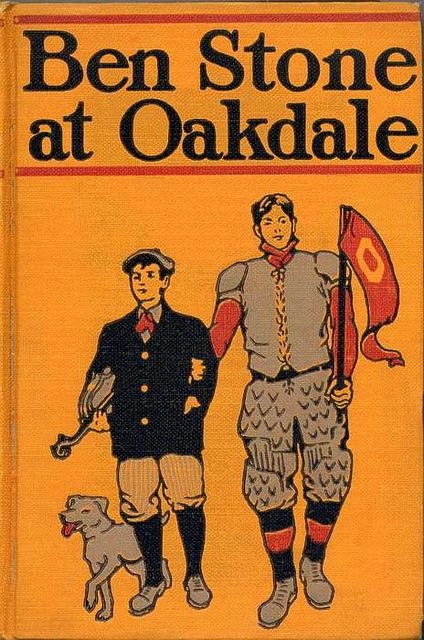
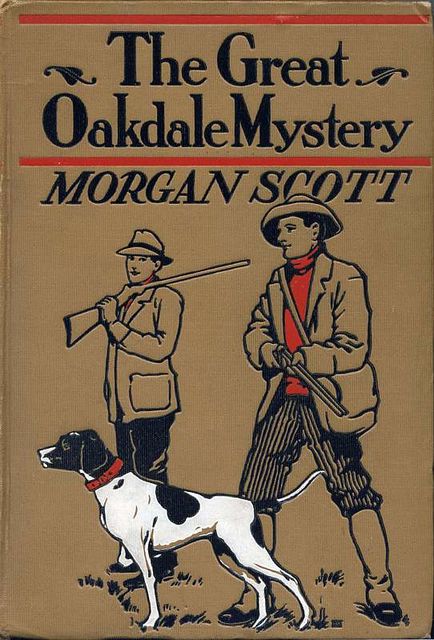
Читать бесплатно онлайн книгу The New Boys at Oakdale
Morgan Scott
The New Boys at Oakdale
CHAPTER I – AN ORDER DISOBEYED
Oakdale started the game by hammering Ollie Leach, the Wyndham pitcher, for three runs in the first inning. Indeed, it seemed that they would drive the schoolboy twirler from the slab in short order, and they might have done so only for a snappy, clean-cut double play which put an abrupt end to the fusillade of hits. When the Wyndham captain declined to make a change and sent Leach back to the mound in the second inning, the wondering Oakdalers told one another that they would finish the foolhardy southpaw then and there.
Leach, however, had steadied down a great deal, and the best the visitors could do was to squeeze in one more run, which they practically secured through a rank error by Pelty, the shortstop. At this point the successful batting of the visitors seemed to come to an abrupt end, for during the succeeding four innings Ben Stone was the only man who could hit the left-hander safely.
Meanwhile, Rodney Grant was doing some steady, clever pitching for Oakdale, which, with perfect support, would have prevented the locals from gathering a single tally. Ned Osgood committed the first costly blunder. Covering third for Oakdale, he attempted to make a fancy play on a grounder, and let it get through him, enabling a Wyndham runner to score from second after two were out.
In the fifth, with two Wyndhamites gone, Charley Shultz, in the middle garden, tried to pull down a fly with one hand when he could have easily reached it with both hands, and his muff gave the locals another valuable mark in the scorer’s book.
Jack Nelson, the Oakdale captain, reprimanded Shultz when, following a strike-out, the team trotted to the bench.
“You should have had that fly, Charley,” said Nelson sharply; “and you would have got it if you’d went after it with both hands instead of one. That’s the first time I’ve seen you drop a ball you could reach as easily as that one. Quit your grandstanding and play baseball.”
Shultz shot Nelson a sullen look. “Oh, what’s the use to holler?” he retorted. “I knew best whether I could reach it with both hands or one. I think I know how to play that field.”
Nelson’s teeth came together with a click, and for a moment, his cheeks burning hotly, it seemed that his annoyance and anger would master him, but he succeeded in holding himself in check.
“You can play the field all right, Shultz,” he said, “and it’s just because you can that I disapprove of that attempted fancy flourish. We’ve got to hold these chaps down somehow.”
“Oh, don’t worry,” laughed Osgood optimistically. “We’ve got them beaten now. We won the game in the first inning.”
“Mebbe we did, but we didn’t paound Lefty Leach off the slab,” reminded Sile Crane. “Gall hang that feller! I hit him once, but I’ll be switched if I can seem to do it ag’in. He’s sorter got me locoed!”
“He seems to have rattled everybody belonging to this whole bunch,” said Chipper Cooper. “We ain’t any of us doing ourselves proud – ’cepting old Stoney.”
Nor did they improve in the first of the sixth. Leach was working a sharp drop that had them all breaking their backs to the distasteful music of the Wyndham cheers. Grant was effective in the latter half, and the seventh opened with him at bat.
“Start us off, Rod,” implored Nelson, as the Texan secured his bat and left the bench. “Let’s sew this thing up with some more runs.”
The fellow from the Lone Star State made no reply, but he squared himself grimly in the batters’ box and took the measure of one of Lefty’s drops. The hit was, appropriately, a Texas leaguer, and the visiting spectators howled joyously as Rod capered to first.
Chipper Cooper, coaching on the line back of first, flapped his arms wildly and crowed like a rooster. As the cheering of the little knot of Oakdale Academy students died down somewhat, Chipper was heard whooping joyously:
“Here we go! The lucky seventh! Don’t try to steal second, Rod; that would be a base thing to do. We’re after old Lefty again, and now we’ll finish the job we started in the first round.”
On the opposite side of the diamond Phil Springer, likewise enthused and excited, was wildly stuttering at the same time:
“Gug-gug-great work, Gug-Gug-Grant. Some cuc-cuc-class to that little bub-bingle. Take a gug-gug-good lead. Shultzie saw how you dud-dud-did it. He’ll drive you round.”
There was in this contest between rival high school nines little of that calculation and method employed by professionals and generally termed “inside baseball.” Nevertheless, Jack Nelson knew the importance of team work and had done his best to drill his players in some of the rudiments. The deadly accuracy of the Wyndham catcher’s throwing to bases was well known to the Oakdale lads, and, with no one down, an attempt to steal seemed inadvisable to Nelson. Shultz, the next batter, had been hitting the ball hard, even though he had found it impossible to place his hits safely, and instantly Nelson spoke a word to him and signalled to the watchful Texan at first that it was to be a hit-and-run.
On previous occasions, with the situation similar, the visitors had seemed to prefer sacrificing; and so, as Shultz confidently took his position at the plate, the infield drew closer, every fellow on his toes to go after a bunt or a short grounder.
Leach made sure his support was prepared for action, and then, wetting his fingers, he handed up a high whistler that had a bit of a jump on it.
Even though the ball was on a level with his cap visor, Shultz managed to hit it, boosting a high fly toward the smiling sky.
Grant was half way down to second when he heard a shrill, warning cry from both coachers.
“Look out! Get back! Skyscraper!” shrieked Cooper.
“Hey! Bub-bub-bub-bub – ” Springer continued to “bub” even after the galloping Texan had plowed his spikes into the ground, brought himself to a halt and turned to race desperately back to the initial sack.
Little Pelty got under that high one and reached for it eagerly in his great desire to make the catch and turn it into a double play by a throw that should reach first ahead of the returning runner. For the moment, with the exception of the still shrieking coachers, every spectator seemed breathless and silent. Pelty got the ball, froze to it and made a beautiful throw, but Grant’s amazing promptness in stopping and getting back at high speed saved him by a yard or more, and he was declared safe at first.
“Pretty close, pretty close,” cried Baxter, the Wyndham captain.
“Missed by a mile,” contradicted Cooper, intensely relieved. “You can’t rope this wild Texas steer; he’s never been branded.”
“Cuc-cuc-come on, Osgood,” implored Springer, as the next hitter was seen to rise from the bench; “you’re the boy to do the trick.”
Already Nelson had given Ned Osgood his instructions.
“Bunt, Osgood,” were his swift words. “They may look for us to follow up with a hit-and-run. Sacrifice Grant along on the second ball pitched. Stone is the next batter.”
That he was right in his judgment concerning the locals was proven by the fact that the infielders resumed their regular positions, while the outfielders fell back a little. Persistent plugging at the hit-and-run game is frequently resorted to by teams having poor success through other methods, and the action of Baxter in signaling his players to fall back showed that he believed an attempt would be made to repeat the play that had been foiled through Shultz’s high infield fly.
Leaning forward in a natural position, with his elbows on his knees and the fingers of his hands interlocked, Nelson thus telegraphed to Grant that the hitter would let the first ball pass and try to sacrifice on the next.
Jack’s foresight seemed excellent, for, fancying the visitors would be eager to continue the hit-and-run attempt, Leach “wasted one” on Osgood, who did not even remove his bat from his shoulder.
“Let him do it again,” piped Cooper. “Let him put himself in a hole, Osgood, then pick out a good one when he has to put it across.”
Osgood, although he liked the game, was both obstinate and conceited, having a great deal of confidence in himself as a batter and believing that he knew as much about baseball as any fellow on the team.
Therefore, perceiving that the next ball was coming over slightly more than waist high and apparently just where he wanted it, he declined to bunt and swung with all his force, hoping to make a long, sensational drive which would go safe and cover him with glory. Instead of doing this, he smashed a hot grounder straight into the hands of Foxhall, the second baseman.
Grant, fully expecting a sacrifice, was again racing down the line from first, and now he had no time to turn back. Without delay, yet with a deliberation that made for sureness, Foxhall turned and threw to first, completing an easy double play that was brought about directly through the batter’s perverseness in declining to follow the instructions of his captain.
CHAPTER II – THE SCORE TIED
Jack Nelson sprang up from the bench, his face pale, his eyes flashing with anger. Osgood had stopped abruptly on his way to first, realizing that the double play sent Oakdale back to the field, and turned to cross the diamond to his position at third base. Nelson met him near the pitcher’s position.
“What do you mean, Osgood,” he demanded hoarsely – “what do you mean by disobeying my order? I told you to sacrifice.”
“But it was a fine chance to hit the ball out and make some runs,” returned the disobedient player defendingly. “Sacrificing with one man down didn’t look like good baseball to me.”
“It makes no difference how it looked to you; your place was to follow my instructions. Stone has been hitting Leach hard and safely, and, with Grant on second, even a long single might have given us another score.”
“I beg your pardon,” said Osgood haughtily, “but I played baseball before I ever saw Oakdale, and I know something.”
“That will do,” interrupted the wrathy captain. “I don’t care how much baseball you know, you’ll have to obey me if you play on this team, and you may as well understand that at once. You can see that you threw away a chance for a run by hitting into that double play.”
Ned Osgood was not the sort of fellow to relish this style of talk even from the captain of his nine, and for a moment he was tempted to make a sarcastic rejoinder. Something prevented him from doing this, however, and he walked onward toward third, shrugging his shoulders. His manner was so irritating to Nelson that for the moment, even though Osgood had shown himself to be the best available man for the position he filled, Jack was tempted to bench him instantly. This temptation was put aside, but it was followed by an immediate decision to stand no more foolishness from Osgood.
The alarm that had been awakened in the bosoms of the Wyndhamites by Grant’s safe drive was dissipated in joy over the defensive work of the home team, which had prevented the Texan from advancing further. Boys and girls of Wyndham High cheered in concert and waved their banners, while the crowd of older sympathizers made a great uproar.
Like Nelson, Grant had been extremely annoyed by Osgood’s pigheaded action, and the Oakdale pitcher was somewhat disturbed as he resumed his position on the firing line.
“Hard luck, Rod,” said Stone, the somewhat taciturn catcher, as he buckled on the body protector.
“It wasn’t luck,” denied Grant; “it was mulish foolishness, nothing less.”
Laughing and well satisfied, the Wyndham lads capered to their bench, where Leach, seeking for his bat, listened and nodded as Captain Baxter gave him a word of instruction.
“Don’t try to kill that wild and woolly Texan’s speed, Lefty,” said Baxter. “He’s burning ’em over like bullets, and we’re swinging our heads off. Just try to meet ’em, that’s all.”
Grant’s annoyance was made still further apparent when he opened with a weirdly wild heave over Stone’s head that would have counted against him as a wild pitch had there been a runner on the sacks.
“Going up,” shouted some one from the Wyndham bleachers; and, in an effort to rattle the pitcher, the crowd redoubled the racket it was making.
Seeing that the pitcher was unsteady, Stone began to fuss over his mask strap, which had suddenly become unsatisfactory and needed adjustment. The entire Oakdale team felt the tension of the moment, and Stone’s subterfuge met their approval. On the other hand, it led their opponents to protest against the delay and urge the umpire to make them play.
Apparently getting the mask strap fixed at last, Ben resumed his position behind the pan and squatted to signal between his knees. Rod shook his head, and the catcher changed the signal. Then Grant nodded and pitched.
Faithful to instructions, Leach took a short grip on his bat and brought it round quickly to meet the ball. There was a ring of wood against leather, and an instant later Nelson, flinging himself to one side, reached for the grounder. It struck his gloved hand and carromed off to the left. He went after it instantly, scooped it up and shot it to Crane at first, but it arrived a bare second too late.
The Wyndham crowd cheered as madly as if Leach had reached the initial sack on a clean hit instead of an error. Out in center field, Shultz laughed with the satisfaction of a player who, lacking whole-souled interest in his team, feels that his own bad work has been minimized by that of a teammate. In this case his satisfaction was made the greater by the fact that the minimizing error had been contributed by the chap who had criticized him a short time before.
Nelson stood still for an instant, then held up his hand for the ball, which Crane threw to him. Turning, the captain made a signal, which caused Cooper to take his position on second. Tossing the sphere to Chipper, Jack walked into the diamond and spoke in a low tone to Grant.
“Don’t let that rattle you, old man,” he said. “I reckon we’re both hot under the collar, and we’d better cool off a bit. Take your time with these chaps; they can’t hit you.”
“I’d like to punch Osgood’s head!” growled the Texan.
“So would I, but that wouldn’t help us win the game. Look out for a sacrifice now. They’ve found they can’t steal on Stone.”
“Play ball! play ball!” howled the crowd.
“Play ball,” said the umpire sharply.
On first, Leach was seeking to add to the opposing twirler’s unsteadiness by uproarious laughter and the repeated declaration: “We’ve got him going! We’ve got him going!”
Nelson was most deliberate about returning to his post, and not until he was there did he nod for Cooper to give Grant the ball. Like a flash Rodney shot it to first, and the laughter of Leach was cut short by a gasp as he barely ducked under Crane’s reaching hand.
“Almost gug-got him then!” shouted Springer from right field.
“Here’s the head of the list,” called a coacher, as Crispin squared himself in the batters’ box. “Keep up the good work.”
In order to make it difficult for Crispin to bunt, Grant put one over high and close – too high and too close. Crispin caught himself in his swing and then pretended that he had been hit on the shoulder; but the pretense was so palpably a fake that the umpire behind the pitcher, who chanced to be an Oakdale man, refused to let him take first. Naturally, the other umpire, who was in charge of the bases, said nothing, but somehow his manner seemed to denote that he disagreed on the decision. This led to a kick by the Wyndham captain, who dropped it quickly, however, when reminded by a fellow player that the delay was giving Oakdale a chance to steady down.
Again Grant attempted to put the ball over high and close, but he simply got it across the inside corner slightly below the batter’s shoulders, and Crispin made a successful bunt that rolled along just inside the first base line. Jumping over the ball, the hitter sprinted hard for first.
Grant scooped up the rolling sphere and heard Nelson’s sharp cry to put it to first. It whistled past Crispin’s ear and spanked into Crane’s mitt.
“Out at first,” said the Wyndham umpire, with something like a touch of regret.
“Good work, Crispin,” gleefully called Baxter, giving the player a slap on the shoulder. “That was a beauty bunt, old boy. Now we’ve got ’em where we want ’em.”
Even as he spoke he signaled from his position on the coaching line for Foxhall to hit the ball out; and Foxhall was liable to do it if anybody could.
Grant worked carefully with this batter, meanwhile holding Crispin as close to first as possible. Nevertheless, Foxhall swung uselessly only once. The second time he whipped his bat round he connected with the horsehide and sent the sphere skimming along the ground straight at Cooper.
Eager and anxious, Chipper booted it beautifully. Like a cat he chased it up and made a futile effort to get the hitter. The throw was a case of bad judgment as well as a wild heave, which even long-geared Sile Crane could not reach.
So while Crane was chasing after the ball, Foxhall, who should have been out, romped on to second, and Leach scored amid a tremendous tumult.
Grinning broadly, Sam Cohen, Wyndham’s heavy-hitting left-fielder, danced out to the plate, determined to keep things moving. Surely, it looked like Wyndham’s opportunity, and, besides the desire to prevent the visitors from settling down, there was a legitimate excuse for the continued uproar of the home crowd. Although they well knew that Grant was little to blame for the turn of affairs, the Wyndham coachers were trying hard to “get him going” by pretending that it was his fault, and behind Rodney’s back Foxhall capered on second, clapping his hands and making gestures intended to encourage the shrieking spectators.
Never in his life had Chipper Cooper been more chagrined and ashamed. His face beet-red, he begged Nelson to kick him.
“Get back to your position and play ball, Cooper,” said the captain, as calmly as he could. “We’ve got to stop this foolishness right here. They mustn’t make another run.”
Grant’s teeth were set and his under jaw looked grim and hard. He knew well enough that Cohen was especially dangerous at this stage of the game, for the nervy Hebrew was one of those rare batters who hit better in a pinch than at any other time, the necessity seeming always to prime him properly.
Trying Cohen out with a bender that went wide in hopes that in his eagerness he would be led to reach for it, Rodney delivered a ball. The next one was high and likewise wide, for Stone had seen Foxhall taking a dangerous lead off second and called for a pitch that would put him in easy position to throw. Nelson, awake to precisely what was transpiring between the battery men, made a leap for the sack before the ball reached Stone’s hands, and Ben lined it down with a wonderful short-arm throw, which saved time and yet was full of powder.
Only for the warning shouts of the wide-awake coachers, who had seemed to divine the move in advance, Foxhall might have been caught napping. As it was, he barely succeeded in sliding back to the sack, feet first, and the Wyndham umpire instantly spread his hands out, palm downward. Foxhall drew a breath of relief.
A moment later Baxter shouted:
“Got him in a hole, Cohen! Make him put ’em over now! Make him find the pan!”
Steady as a rock, Grant did put the next one over, and Cohen, “playing the game,” let it pass for a called strike.
“He can’t do it again!” cried Baxter. “Make ’em be good!”
Grant used a drop, starting the ball high so that it shot down past the batsman’s shoulders and across his chest. Even as the umpire called, “Strike two,” the Oakdale players shouted a warning to Stone. It was needless, for Ben had seen Foxhall speeding along the line in a desperate and seemingly ill-advised attempt to purloin third. Craftily Cohen fell back a step to one side, as if to give the catcher room to throw, but with the real purpose of bothering him as much as possible without bringing, by interference, a penalty upon the runner. Possibly this was the reason why Stone threw high, forcing Osgood to reach to the full length of his arms in order to get the sphere. Almost invariably the Oakdale catcher put the ball straight and low into the hands of the baseman, so that the latter could tag a sliding runner quickly and easily; and had he been able to do this now, Foxhall doubtless could not have slid safely under Osgood, which, however, was precisely what he did succeed in doing.
“Who said we couldn’t steal on old Stoney?” shouted Pelty from the coaching line back of third. “Great work, Foxy, old man. You put that one across on him.”
With only one local player gone and but a single run needed to tie the score, the tension of the moment was intense. No one realized the danger better than Grant, and when he pitched again he made another clever effort to “pull” Cohen; an effort that almost succeeded, for Sam caught himself just in time to prevent his bat from swinging across the plate.
“Ball three,” came from the umpire.
“He’s going to walk you, Cohen; he’s afraid of you,” came from Baxter.
It must be admitted that Grant had considered the advisability of handing Cohen a pass, but knowing Wolcott, the fellow who came next, was almost as dangerous a hitter, he had decided that such a piece of strategy would be ill advised. Taking into consideration the batter’s ability to meet speed, Rod shook his head when Stone called for a straight one on the inside corner. Ben knew at once that the Texan wished to try to strike Cohen out, and so he swiftly changed the signal.
Now Cohen had brains in his head and was also a good guesser. Moreover, he knew that Grant relied largely upon his remarkable drop when a strike-out was needed. And so it happened that, seeing Rod decline to follow the first signal, he was convinced that the pitcher would hand up one of those sharp dips.
Having guessed right, the batter judged the drop beautifully and hit it a tremendous smash. Away sailed the ball toward center field, some distance to the right of Shultz, who stretched his stout legs to get under it.
“He can’t touch it!” was the cry.
Nevertheless, when Foxhall started off third, Pelty, defiant of coaching rules, sprang forward, grabbed him and yanked him back.
“Get on to that sack!” the little shortstop panted. “Get ready to run! You can score anyhow; you don’t need a start.”
Thus advised, Foxhall leaped back to the cushion, upon which he planted his left foot with the right advanced, crouching, his hands clenched, his arms hooked the least bit, ready to get away like a sprinter starting from his mark.
Shultz made a splendid run, leaping into the air at the proper moment and thrusting out his bare right hand. The ball struck in that outshot hand and stuck there.
An instant before the catch was made Pelty shrieked, “Go,” and Foxhall raced for the plate.
It was impossible to stop that run. Cohen’s long sacrifice fly had tied the score, in spite of the strenuous and sensational one-handed catch in center field; and the crowd leaped and yelled, with arms up-flung and caps hurled into the air.
CHAPTER III – BENCHED
In moments like this the baseball fan of any age goes wild with frenzy; especially is this true of the enthusiastic schoolboy fan who has watched his team fight an uphill game and come neck-and-neck with a worthy and much-feared rival in one of the late innings of the contest. The youthful Wyndhamites shrieked until their faces were purple and their eyes bulging, flourishing their banners and frantically pounding one another over heads and shoulders. At the bench the players laughingly danced around Foxhall and then cheered Cohen as the latter came walking back from first, muttering to himself that the catch had been “a case of horseshoes, nothing less.”
In the midst of this excitement Nelson ran up to Grant, whose face was pale, but grim and set as ever.
“You couldn’t help it, Rod,” said the Oakdale captain soothingly. “They won’t get any more. The bases are clean now.”
“But they’ve tied the score,” growled the Texan. “That’s the first time Cohen has touched one of my drops to-day.”
“Hold them where they are, and we’ll win it yet,” declared Jack optimistically. “We didn’t expect a walk-over with this bunch.”
Wolcott’s courage was high as he faced Rodney. Heedless of the uproar, the Texan burned the air with his speed, and Wolcott fouled.
“Strike one,” called the umpire.
Another smoker followed with a slightly different twist, and this time the batter missed cleanly.
“That’s two of them, old Maverick,” called Stone, breathing on his smarting right hand. “Some speed, old man – some speed there.”
Seemingly with precisely the same movement and snap, Rodney made the third pitch; but this time the ball lingered astonishingly on its way, as if held back by some subtle force, and, as a result, the befooled batter struck too soon, not even fouling it. This gave the little bunch of loyal Oakdalers a chance to cheer.
“I don’t suppose you’re going to call me down for that one-handed catch, are you?” said Shultz insolently, as he came jogging to the bench.
Nelson shot him a look and turned away without answering. Not satisfied, the fielder turned to Cooper. “A man can usually tell whether he can reach the ball best with one hand or two,” he declared loudly enough for the captain to hear. “I didn’t make that muff intentionally.”
Ben Stone walked out to the plate and watched Lefty Leach waste two benders, which led Springer stammeringly to prophesy that Leach, being afraid, would give the stocky catcher a pass. The next one, however, was over the outside corner and precisely where Ben wanted it, whereupon he smashed a terrific drive over second and took two sacks on it amid further enthusiasm by Oakdale.
Nelson could not refrain from calling Osgood’s attention to the fact that this hit would have given the visitors a score had his instructions regarding sacrificing been obeyed.
“Perhaps you’re right,” admitted Ned in his blandly polite and tantalizing manner; “but it’s no dead sure thing that Stone would have made just that kind of a hit in the other inning. Anyway, we ought to get some runs now.”
Sile Crane ambled awkwardly forth to the plate and hit into the diamond the first ball pitched, giving Stone, who had a good start, plenty of time to reach third, for Foxhall juggled the grounder a moment. Realizing he could not stop Ben, Foxhall snapped the sphere to first in time to get the lanky batter.
“The squeeze, Cooper,” hissed Nelson in Chipper’s ear, as the little shortstop rose from the bench. At the same time Jack assumed a pose that told Stone what was to be tried.
Ready to play his part, Ben crept off third, intending to dash for the plate and rely upon Cooper to hit the ball into the diamond somewhere.
Leach placed himself in position, nodded in response to his catcher’s signal, hunched his left shoulder a bit, and, whirling like a flash, threw to third. Stone had started forward with that shoulder movement by the pitcher, and was caught off the sack. Instantly, even as he sought to get back without being touched, he called for judgment on a balk.
The umpires had changed positions, and now the Wyndham man was behind the pitcher. In response to that demand for a decision on Leach’s movement he grimly shook his head.
“It was a balk – a plain, cold balk,” cried Nelson, on his feet.
“No balk,” denied the umpire, still shaking his head.
“In that case,” said the other umpire slowly, “Stone is out at third.”
Nelson ran into the diamond and confronted the Wyndham man. “It was as rank a balk as I ever saw,” he asserted hotly. “What kind of a deal are you trying to give us?”
“I saw no balk, and I was looking at the pitcher,” returned the umpire. “Get back to your bench.”
Nelson argued in vain, while the crowd made the air ring with hoots and cat-calls. Presently the umpire threatened to pull his watch and forfeit the game, whereupon the disgusted and angry Oakdale captain walked slowly back to the bench.
“You shouldn’t let him get away with it,” said Osgood. “It was a balk all right.”
“Why didn’t our man call Stone safe?” rasped Grant.
“Ben was caught off the sack by five feet,” said Nelson. “Two wrongs don’t make a right. But it’s hard medicine to swallow.”
Thus far Chipper Cooper had not made a hit; but now, as if he, too, was fired with resentment by the injustice of the decision, he landed on the second ball pitched to him and drove it out for a clean single.
“G-g-good bub-bub-boy, Chipper!” shouted Springer. “It’s a wonder he didn’t call it a fuf-foul, though.”
Sleuth Piper, solemn and savage, took his place at the plate, grabbing his bat and shaking it as if he meant to make a dent in the ball as surely as Leach got it within reach. Not once did he swing, however, and the left-handed twirler looked disgusted when he had presently handed up the fourth ball in succession and thus given one of the weak batters of the visiting nine a pass.
“Get the next man, Lefty,” urged Baxter. “He’s fruit for you.”
With the head of the list following Springer, the Oakdale boys hoped for the best; but Phil put up a dead easy infield fly that was smothered, and the visitors had lost another splendid opportunity.
Never in his life had Grant pitched better than he did in the last of the eighth. Only three batters faced him, and two of these fanned, the third putting up a foul which Stone took care of with ease.
“Steady, fellows,” cautioned Baxter, as his men started for the field. “We’ve only got to hold them. Old Grant can’t keep that steam up. We’ll get to him.”
Leach started the ninth as if he meant to duplicate the last turn of the Texan, fanning Captain Nelson with apparent ease.
Once more Rod Grant came to bat, and once more, with his pet club in his hands, he out-guessed the southpaw twirler, banging a clean single into center.
At Osgood’s elbow Nelson quickly said:
“Sacrifice him to second. That will give him a possible chance to score if Shultz hits safe.”
Osgood made no retort. He saw Grant looking toward the bench and placing himself in position to get away swiftly on the bunt. At the plate, he beheld the first ball pitched to him apparently coming over just where he wanted it, and instantly he felt that he could hit it out safely. Furthermore, he had not changed in his conviction that it was bad policy to sacrifice with one man down, even though the next two hitters were supposed to be the best stickers on the team, and one of them, Shultz, was his especial chum. Therefore he swung on the ball and met it. Instead of a drive, it proved to be a grounder that went clipping over the skin diamond straight into the hands of Pelty. Like a flash Pelty snapped it to Foxhall, who had leaped on to second, and, turning, Foxhall lined the sphere to first, again completing a fast double play.
Nelson was on his pins, and he intercepted Osgood as the latter, without looking toward him, attempted to pass on the way to his position at third.
“Go to the bench,” said Jack, his voice hoarse and husky. “You’re out of the game, Osgood.”
“I beg your pardon,” said Osgood. “What did you say, sir?”
“I said you’re out of the game. I won’t stand for such rank disobedience.”
“Oh, very well,” said Osgood, coolly turning toward the bench. “You’re the autocrat – at present.”
“What’s the matter?” demanded Shultz, running up. “What’s the trouble, Ned?”
“Nothing,” was the reply, “only I’m benched because I didn’t make a safe hit.”
“If he benches you I’ll quit myself,” threatened Shultz.
“You won’t quit,” said Nelson instantly. “You’re fired. The bench for you, too. Get off the field.”
“Well, wouldn’t that choke you!” gulped Shultz, astonished to have his bluff called so promptly. “How will he fill both our places?”
Nelson showed them in a moment by placing Roy Hooker, one of the spare pitchers, at third, and sending Chub Tuttle to fill center field.
Osgood and Shultz retired to the bench, where they sat talking, the latter showing by his manner that he was thoroughly enraged against his captain, while his friend, more politic and suave, accepted the situation with pretended indifference and disdain.
Although the team had been weakened by the removal of these two players, for the substitutes surely could not fill their positions with an equal amount of skill, Grant betrayed no sign of weakening himself. Pelty and Leach were retired by the strike-out route, and even Crispin’s best performance was a weak grounder on which he perished in a hopeless dash to first.
The tenth inning opened with Tuttle at bat. Chub had never been a hitter, but he did succeed in rolling a weak one to Leach, who threw him out.
“Now, Stoney,” implored Cooper, as the catcher again came up, “you’ve got to do it. He’s been a mark for you. One run is all that we need to take this game. Lace it out.”
Leach was very glad that the bases were empty. Even under those circumstances he began as if he meant to pass this dangerous slugger. After pitching two balls, however, he got one across, and Ben fouled it. Then came another ball, which was followed by a high, speedy shoot.
Stone smashed the horsehide again, bringing every spectator up standing. It was a splendid drive, but Cohen took it on the run and held fast to it.
“Ah-ha! Oh-ho!” whooped Baxter joyously. “Old Eat-’em-alive is finished. Now you have things your own way, Lefty.”
Although Shultz was grinning as Stone came walking back, Osgood politely declined to smile.
Sile Crane sighed as he picked up his bat.
“By Jinks!” he muttered. “I’d sartainly like to make one more hit off that feller. I don’t seem able to touch him no more.” After which he walked to the plate and swung at the first ball pitched with all the strength of his long, sinewy arms.
There was a tremendous ringing crack, and the ball went sailing away, away, far over the center-fielder’s head. The little Oakdale crowd screamed like lunatics, but the Wyndhamites were distressingly silent as the long-geared lad raced over first, second, third, and on to the plate, which he reached ere the ball could be returned to the diamond.
CHAPTER IV – WYNDHAM’S LAST DESPERATE STAND
Charley Shultz sneered openly, with his full red upper lip curved high and exposing his broad teeth, as the delighted Oakdale players congratulated their comrade who had made that opportune home-run drive.
“Look a’ that gangling country jay,” he muttered in Osgood’s ear. “See him grin like a baboon. See him distend his flat chest. Probably he thinks himself a Lajoie or a Wagner.”
“Hush, Charley!” cautioned Osgood gently. “Don’t be too open in your feelings; it’s bad policy. Besides, I’ve got Crane on the string. He’s astride the fence now, and doesn’t know which way he’s going to fall.”
“Oh, all right,” returned Shultz; “but I don’t see what use you can have for him. He hasn’t any money, and his influence doesn’t amount to much.”
“Even the support of the weakest chap may prove of some value when the break comes.”
“After to-day you ought to force things in a hurry. I hope you’re not going to stand for the rotten deal that swell-head Nelson has handed out to us.”
“Have patience, old man – have patience,” soothed Osgood. “I’ll strike when the iron is hot. When possible, a good general always avoids going into an engagement before his plans are properly prepared and his forces strengthened to the full limit.”
The fact that these two disgruntled fellows took no part in the rejoicing of their team seemed to be overlooked at the time; for this was a game in which a run in the tenth inning was of tremendous importance, and, taking into consideration the recent course of the contest, almost an assurance of victory. A triumph over the always formidable Wyndhamites in the season’s first meeting between the two teams would give Oakdale a much desired advantage in the High School League.
“Oh, why can’t I do something like that?” cried Cooper. “It makes my solitary little tap look like ten below zero, and I always get cold feet in that sort of weather.”
Nevertheless, he faced Lefty Leach like a chap exuding confidence from every pore. Leach was frowning and savage in his bearing, but Chipper returned the Wyndham pitcher’s dark look with a cheerful smile, threatening to start the stitches in the horsehide if Lefty dared to put one over.
The thunderstruck and dismayed Wyndham crowd awoke from its benumbed condition and resumed cheering, although there was plainly a disheartened note in the volume of sound, something which the players themselves must have recognized. On the other hand, the Oakdale spectators were once more jubilant with restored confidence in their team and the conviction that Crane’s wonderful wallop had practically decided the result.
Despite Cooper’s aggressive attitude of assurance, Leach unhesitatingly slanted the ball across and continued to do so while the Oakdale shortstop rapped out foul after foul.
“You’ll get him in a minute,” encouraged Baxter. “He never was any good with the war-club.”
Much to Cooper’s sorrow, this prophecy came true, for Chipper finally hoisted a short one back of first for Turner, the baseman, to gather in.
“Only three more men, Grant,” said Nelson. “Get them, and we hang up a scalp.”
“I’ll sure do it if it’s in me,” whispered the Texan to himself, as he made his way to the diamond.
Baxter rushed to the bench to have a few words with his players.
“Don’t be too eager, fellows,” he cautioned; “and still, don’t let him sneak any good ones across. He’s pitching for his life now, but he’ll try to pull you all. If you can start us going, Foxy, we’ll crawl out of this hole right here.”
Making no retort, Foxhall stepped into the batters’ box and watched the Oakdale pitcher make the situation more difficult for himself by failing to find the pan with the first two pitches. An in-shoot followed, and, remembering Baxter’s words, Foxhall picked it off the inside corner with a sharp swing that sent it grass-cutting ten feet inside of third.
Roy Hooker, who was filling Osgood’s position, was not an infielder, and, although he leaped in front of the ball, he failed to keep his feet together, which allowed the humming sphere to go through him cleanly.
“Ha! Look a’ that!” cried Shultz, giving Osgood a nudge. “That would never have happened if you’d been there.”
“Don’t make comparisons – don’t,” said Osgood quickly. “They are odious. He’s going to stretch it into a double.”
Sent onward by the coacher, Foxhall raced over the initial sack and stretched himself for second. It chanced, however, that Sleuth Piper was in position to back Hooker up, and, rushing forward, he took the ball on a favorable bound and threw it to second while still in his stride. It was one of the cleanest pieces of fielding, and perhaps the best throw, Piper had ever made in his baseball career, for it came straight into the hands of Nelson, who disregarded the dangerous spikes of the sliding runner and tagged Foxhall so cleanly and effectively that the locals had not the slightest excuse for a kick on the decision of “out.”
“Well, wouldn’t that cramp you!” muttered Shultz disgustedly. “Why in thunder did the man try to make a double of it?”
“Once more,” said Osgood, “I must caution you not to show your feelings so plainly. Even if we’re benched, we’re still members of the team and – ”
“I don’t know whether I am or not,” rasped the resentful Shultz. “I don’t propose to play on any team where I’m handed a raw deal by a thing like Jack Nelson.”
“Now look here,” said his companion, “you’ll stick on the team unless you’re fired off it, for as members of the nine we’ll have more pull with the bunch than otherwise. You’re too brash, Charley. You haven’t any policy or subtleness. Don’t think for a minute that I’m not just as sore as you, but as injured yet still loyal Oakdalers we can win more sympathy than by open rebellion.”
“I s’pose you’re right,” admitted Shultz; “but I never could control myself the way you can.”
That the Wyndham boys realized how desperate the situation was became manifest through an undisguised quarrel which now arose between Foxhall and two of his teammates who attempted to criticize him.
“What’s the matter with you?” snapped the bitterly disappointed chap. “Pelty sent me down. Chew the rag with him if you’re going to jump on any one. How’d I know that fielder was in position to back up and get the ball to second so soon?”
“Cut that out, all of you,” interposed Baxter. “Stop fussing and play ball. This game isn’t over yet.”
“But it’s pretty well over,” cried Cooper gleefully. “It’s all over but the shouting.”
Cohen, who seemed never troubled by a weak heart, predicted that he would get a hit and begged Wolcott to advance him with a duplicate. Then the nervy young Hebrew stood forth and demonstrated that he had a good eye by refusing to bite at the coaxers and compelling Grant to put the pill across. When this was done, he hit it hard and fair, the resounding crack bringing a shout from the Wyndham crowd.
That shout was abruptly cut short when Cooper shot into the air and pulled Cohen’s drive down with one hand. From the opposite side of the field burst the sudden relieved shrieks of the Oakdalers, whose hearts had been choking them an instant before.
“Keep quiet, Charley,” said Osgood, placing a hand on his friend’s knee. “It looks like it’s really all over. Take your cue from me and pretend you’re happy.”
“You’re asking just a bit too much, Ned,” said Shultz huskily. “You know I’m a poor bluffer in any kind of a game.”
“But you’re usually lucky, just the same; I’ve seen you hold some great cards.”
“Some catch, Chipper – some catch,” Grant was saying happily. “You raked the clouds for that one.”
“I had to do something to make up for my last raw play,” returned the beaming little chap.
Nelson was laughing. “We’re backing you up now, Rodney, old boy. That kind of support ought to give you courage to take a fall out of Wolcott.”
To tell the truth, although he made a pretense of being undismayed and confident, there was really little hope left in Wolcott’s heart. Nevertheless, it was always Wyndham’s way to play a game out without let-up, and the batter showed that he was trying for a hit by fouling the ball several times. Presently, however, the Texan deceived him with one of his most effective drops, and Wolcott’s fruitless slice at the air brought the game to an end with the score 4 to 3 in Oakdale’s favor.
CHAPTER V – THE DIPLOMACY OF OSGOOD
Shultz sullenly watched his teammates giving the losers a complimentary cheer; he could not take his cue from Osgood and join with the slightest pretense of rejoicing in this cheering. And when the happy players gathered up their trappings and started for the adjacent academy, where in the basement gymnasium the Wyndhamites had given them a room in which to change their clothes, Shultz trailed along behind, listening with persistent bitterness to the chattering fellows who were still rejoicing over the result.
“Oh, Craney!” cried Cooper, as he playfully banged Sile with an open hand. “That measly little tap of yours in the last round was certainly a soporific wallop.”
“Here, yeou better let Sleuth slaughter the language that fashion,” grinned Crane. “Soporific! What’s it mean, anyhaow?”
“Why, soothing, sleep-producing; it’s what a prize-fighter hands his antagonist when he gives him a two-ton jolt on the point of the jaw. It put Wyndham down and out, all right.”
“Oh, that didn’t end the game by a long shot. If old Texas hadn’t pitched some in the last half – ”
“Great centipedes!” interrupted Grant. “If you fellows hadn’t given me Big League support they’d corralled the game after all. The way you raked down Cohen’s drive was sure some playing. And that little turn by Piper plugged their promising start right handsomely.”
“I was frightened when Hooker let Foxhall’s grounder get through him,” declared Ned Osgood; “but Sleuth was right on the job. It was a splendid victory.”
Jack Nelson shot the speaker a quizzical glance, but said nothing.
In the gymnasium they continued to discuss the game while peeling off their soiled uniforms and getting into the heavy clothes which would be so necessary to their comfort on the long homeward drive; and, unable to keep still, Shultz cut in with an occasional sarcastic remark. For a time no one seemed to notice him, but suddenly Grant, unable to hold himself longer in restraint, turned on the disgruntled fellow.
“Quit your beefing,” he exclaimed. “Why don’t you try to follow Osgood’s trail and make a pretense of being decent, whether you feel that way or not?”
The blood which suffused Shultz’s face turned it almost purple, and he glared at the Texan as if he longed to seize the fellow by the throat and smash his head against the wall.
“I’ve got a right to open my mouth,” he snarled, “and I propose to say what I please, regardless of any common, cow-punching – ”
They would have been at it in a twinkling had not Nelson promptly leaped between them.
“Stop, Grant! Hold up!” he cried, seizing the pitcher, whose face was beginning to take on that awesome and terrible look which indicated that his fiery temper was mastering him. “Don’t start a scrap. It will be bad – bad business.”
“I certainly won’t allow anybody to shoot off his mouth at me that fashion,” said Rodney, his voice vibrant with the passion he could scarcely restrain. “He’s been sneering and hollering like the sorehead he is, and it’s sure getting too much for me.”
“It’s my affair, if it’s anybody’s,” asserted the captain. “I’m the one’s he’s sore on.”
“And only for a lucky piece of work by Piper, you’d lost the game by putting Hooker in Osgood’s place,” said Shultz. “Just because he disagreed with you about sacrificing when he got the kind of a ball he knew he ought to hit out, you show your authority by benching him. Sacrificing in such a game, with one man down and a good hitter at bat, would be laughed at by – ”
“That will do for you,” Nelson cut him short. “No man on the team can talk to me this way, much less a new player like you. If you and Osgood came to Oakdale with the idea that you’re going to run the nine or ruin it, you may as well get that out of your noddles right away.”
By this time Osgood had his friend by the arm.
“Cool down, Charley,” he advised in his most pacifying manner. “You’re giving a wrong impression by letting yourself get excited. I’m sure we were both just as eager to help win that game as any one. In fact, I will assert that it was my eagerness which led me to try for a hit when Leach put the ball over just where I like ’em best. It’s true it seemed to me we’d be weakening ourselves by a sacrifice with one man down, but still, I meant to follow instructions when I went to the plate. It was only when I saw that ball coming across the pan so nicely that I forgot everything and tried to land on it for a safe drive. Even though in that moment I was led to forget instructions, I must insist that my heart was right. I’ve played the game ever since I was old enough to toss a ten-cent ball, and I learned something of its fine points at Hadden Hall. I’m not blaming Captain Nelson if his ideas and mine are not fully in accord, for baseball down here in this country can scarcely be as advanced as it is – ”
At this point Nelson suddenly threw back his head and laughed, although perhaps it was not a laugh of simple amusement.
“That has been your pose ever since you came to Oakdale,” he said. “Your pity for us poor, ignorant countrymen is wholly appreciated, Osgood. It may be that we’re very shortsighted in failing to perceive the splendid opportunity we have for learning something about real baseball from you and Shultz, but it seems that you might find a more delicate and less egotistical method of opening our sleepy eyes.”
For a single breathless moment it seemed that Osgood was on the verge of permitting this sarcasm to lead him into a touch of temper, at least; but he was crafty and far too clever not to realize that such a thing would be likely to put him at a disadvantage in the eyes of some members of the team whom he had reasons to think were inclined to sympathize with him.
“I didn’t come to Oakdale to teach baseball or anything else,” he asserted. “I think I’ve stated before this that Oakdale Academy was a school of my mother’s choice, not mine, and mothers who are fearful of the temptations which their sons may encounter in large and really efficient schools sometimes have peculiar ideas.”
“Fathers, too,” put in Shultz, with a curl of his red lips. “My old man was determined that I should get my preparatory education far from the evil influences of the really wide-awake world, and so he buried me in a forsaken graveyard.”
“Too bad abaout yeou poor fellers,” Sile Crane could not refrain from observing.
“I enjoy baseball,” Osgood hastily went on. “I love the game. I was glad when it seemed assured that I’d have a chance to play on the academy nine. However, I scarcely fancied it would be considered a fault or a detriment that I happened to know something about the game as it’s played to-day not only in big schools and colleges, but in big leagues. I’ve never missed an opportunity of seeing a Big League game and trying to wise up on the methods of the players. I’d like to see Oakdale win out this season, and my interest in our success is so great that if I thought for a moment I would produce discord and disaffection on the team I’d voluntarily withdraw.”
This assertion was made with an air of earnestness and sincerity, but the fellow had spoken craftily, with the design of spiking Nelson’s guns, being certain that the captain suspected him of the very purpose which he so ardently disclaimed. Shultz, who knew his friend’s secret motives better than any one else, really found it difficult to suppress a grin, while inwardly he was telling himself that Osgood certainly was a “slick duck.” Why, Nelson was not only flanked, but his line of defense was cut off completely!
In a vague way the captain seemed to feel something of this, but still his quick perception told him that to a large extent Osgood had created a favorable impression, which would only be increased were his motives doubted.
“Well, that’s all right,” said Jack, a bit bluffly. “That’s all we can ask of any chap. You’ve both shown that you can play baseball, and if you show a willingness to respect the wishes of your captain that should be sufficient. We want players loyal to the team and to the school.”
Right here Shultz made another break. “The school!” he laughed. “We’ll be loyal to the team all right if we’re given a show, but you must know that the school is almost a joke. It’s taught by a dead one, with a lot of decayed back numbers as directors. Right here at Wyndham they have got a professor who’s alive and who takes interest in some things besides books. Old Prof. Richardson has outlived his usefulness as a teacher. He’s let the times pass on and leave him about thirty years behind. Who ever saw him at a baseball game, or any similar sport? The Wyndham prof was out here to-day watching the go, and he seemed as interested as any one. When Professor Richardson gets through with the day’s session he toddles home to dressing-gown, slippers and tea. How a school with such a head can stand as well in athletics as Oakdale does certainly gets me.”
“It’s true,” admitted Nelson, “that Professor Richardson has never taken any real genuine interest in outdoor sports, but he’s a good principal and does his work well in the class room. His health isn’t always the best. Everyone who knows him well respects him, at least, and I’m sorry to hear you say what you have, Shultz.”
“I’ve simply stated a fact. Some day Oakdale will wake up to it, too, and the old man will lose his job. Some day before long you’ll see a younger, more up-to-date principal filling his shoes. It will be a mighty good thing if that time comes soon.”
“Let’s not discuss that,” interposed Osgood. “Whether Professor Richardson is efficient or not has nothing to do with the matter that threatened to produce a disturbance and some hard feelings on the team. That business is all settled now, and I think we understand that we’re a nine united and anxious to do our best to win the championship. Come, fellows, let’s forget it all. I’m going to.”
This magnanimity had its effect, and, as they completed dressing for the jaunt home, the boys were again chattering and jesting, as if no threatening cloud had risen.
CHAPTER VI – THE SUSPICIONS OF SLEUTH
Osgood’s manner during the tedious homeward jaunt would not have led any one unaware of what had taken place to fancy that there had been the slightest unpleasantness. He was polite and affable to every one upon the buckboard, and when the boys sang, as they did once or twice, his fine baritone voice was sufficient to command admiration and applause.
This fellow had entered Oakdale Academy in the midst of the term of the previous autumn, and had maintained for a time a certain reserve which prevented his schoolmates from seeking to pry into his personal affairs. It was some time, indeed, before the naturally curious boys learned from him that he was a native of New York, but that, on account of his mother’s health, his parents had removed to California some years before, where his father had suddenly passed away from an attack of heart disease. Of this bereavement he continued to be disinclined to say much, and it was noticeable that while he seemed distinctly proud of his mother, his father was never mentioned in that manner.
Nevertheless, Edwin Osgood took pains to impress upon his associates that there was genuine blue blood in his veins, and his claim was that he was upon his mother’s side a direct descendant of Lord Robert Percival, Earl of Harcourt. Little by little at various times he let drop a few words which, pieced together, told of the banishing of a younger son of Lord Percival, who had brought upon his head the displeasure of the old Earl through his wild and wayward ways. This younger son had come to America, where he married, and Ned asserted that he was of the third generation in this country.
All this was apparently dragged reluctantly from his lips, and he even made some pretense of disdain for ancestry, although his stationery bore a crest, and those chaps who were favored by invitations to his rooms stated that they had seen various portraits of Osgood’s noble forebears.
Unlike other students at Oakdale who came from out of town, Ned did not simply room or board; he lived in the home of a widow by the name of Mrs. Chester, who had been induced to take him in through what was said to be a surprisingly liberal money consideration. In Mrs. Chester’s house he had a sitting-room and a bedroom with an adjacent bath, and it was said that the widow, perhaps a bit impressed by having such a young swell in her home, permitted him to do about as he pleased in his rooms.
Now a fellow like this might through snobbery easily make himself unpopular in a country school, but Osgood’s seeming whole-souled, manly boyishness, combined with an unusual knack at all-round sports and baseball in particular, had overcome the prejudice of many chaps who were inclined at the outset to regard him with disfavor. His staunchest friend, however, was Charley Shultz, with whom he had taken up almost immediately, and who seemed so remarkably different from him in every way that wonderment over their chumminess was justified. Shultz was rough and brusque and not infrequently positively boorish; furthermore, he was something of a bully, although, finding this bent disapproved by Osgood, he plainly sought to hold the inclination in check.
Among the village girls Ned was greatly admired, but with the boys a strong point in his favor was the fact that, although always pleasant and polite, he rarely attempted to play the gallant. He seemed to prefer fellows of his own age and with similar tastes in sports to the prettiest girl of the village or the school, and, although some of the misses were miffed over this, he rarely wasted time in their company.
Another point in his favor was the fact that, although he was known to have a pocket full of spending money and sometimes spent it generously on his companions, he managed to avoid patronism, and did not make the fellow less supplied with coin feel small or mean on that account. In short, he was generally sized up as “a jolly good fellow,” and, although they had not ventured to say as much, several members of the nine had thought that Nelson was rather too hasty and harsh in sending Osgood to the bench for his disregard of orders. Besides Jack Nelson, Rodney Grant and Ben Stone were almost the only ones who had not fallen powerfully beneath the spell of Osgood’s personality.
During the most of the homeward trip Shultz sat silent on a seat which also held Tuttle and Piper. Once or twice he had a few words to say, and he endeavored in saying them to give the impression that he, like Ned, had dismissed the incident of the game which had so nearly led to a personal encounter in the Wyndham gymnasium. But Shultz was no diplomat; subterfuge to him was a most difficult thing.
The result of the game had been telephoned to Oakdale, and the boys were welcomed with cheers as the buckboard rolled up the main street toward Hyde’s livery stable. At the stable they piled out with their bats and bags, shivering a little from the raw cold of the spring evening, which had crept into their bones in spite of overcoats.
At the door of the stable Osgood paused a moment, and, Springer, Hooker and Cooper joining him, he was heard to say:
“See you later, fellows. Don’t forget. So long. I’m hungry as a bear, and I won’t do a thing to Mrs. Chester’s grub to-night.” Carrying the bag that contained his uniform and mitt, he swung off with a vigorous, buoyant stride, whistling cheerfully.
A few low words passed between the trio left behind, after which they dispersed in starting for their various homes.
Jack Nelson was not the only one to perceive something mysterious in the action of these fellows; Sleuth Piper’s eyes and ears were wide open. When Shultz had likewise departed Nelson spoke to Grant.
“I don’t suppose it’s any of my business, but I’d really like to know what’s in the wind. Those fellows are up to something.”
“I reckon so,” nodded Rodney; “but I opine it’s no concern of mine.”
Both were startled as Piper noiselessly appeared beside them.
“There are things going on in this town,” said Sleuth, his voice discreetly lowered, “of which the general public is wholly unaware.”
“Hello!” laughed Rodney, lifting his eyebrows. “The great detective is on the job. I judge you have inside information, Pipe?”
“Very little,” answered Sleuth; “but if I set out to get it I’ll not be balked. Once I take up a case worthy of my attention, I am relentless as Fate.”
“Do you have an idea this matter is a case worthy of your attention?” asked Nelson, winking slyly at Grant.
“That I can’t answer,” confessed Sleuth; “but it’s my theory that persons whose movements are secretive and mysterious deserve to be watched. Possibly I can tell you one little fact of which you are unaware.”
“Let flicker,” invited Jack. “We’re listening, all agog.”
“For some little time,” said Sleuth, in answer to this invitation, “certain fellows have been meeting regularly every Saturday night in the rooms of Ned Osgood.”
“Is that all?” exclaimed Grant, disappointed. “Why, I suppose, as Osgood happens to be such a popular chap, they merely drop in on him for a social call.”
“Is there any reason why a fellow who is merely making a social call should shroud his movements in secrecy?” questioned Sleuth instantly. “If you were going to drop round to see Osgood for a little pleasant chat of a Saturday evening would you take pains to prevent the fact from becoming known? Or would you, if meeting a friend on your way, openly and frankly tell him where you were going?”
“I don’t opine I’d be covering up my tracks any whatever.”
“Not unless it was to be something more than a mere social call,” nodded Sleuth decisively. “By apparent chance it has happened that I have met on different occasions two or three of these fellows who were on their way to call upon Osgood, and when I asked them where they were going they either lied or begged the question. Ha! Now you perceive that there must be some hidden motive for this secrecy. A man who takes extreme pains to conceal his motives should be watched.”
“There’s certain some logic in that,” admitted the Texan; “but I’ll allow I don’t see what those fellows could be up to that would concern anybody but themselves.”
Nelson, however, was thoughtful, frowning the least bit.
“It may not concern any one else,” he said presently, “and, then again, it may. It may be my fault, but I can’t quite trust Osgood. I’ll admit that he acted pretty decent in practically acknowledging that he was wrong to-day; but all the time I couldn’t help feeling that he was playing policy, while thoroughly satisfied that he had been in the right and that I was a chump to call for the sacrifice. As a matter between us three, there’s a feeling of dissension on the team as well as in the school, and I’m sure that Osgood and Shultz are behind it. When I benched Osgood it wouldn’t have surprised me in the least if some of the players besides Shultz had made an objection. He has got a grip on them, and they think he knows more baseball than I or any of the old players. I’ve seen them imitating his methods and his style of play. When a ball team loses confidence in the judgment of its captain, that team soon gets into a bad way.”
“I didn’t like the talk Shultz made about Prof. Richardson,” said Grant. “The old boy may not take a natural modern interest in athletics, but you sure hit the nail on the head, Nelson, when you said that he does his work well in the class room and therefore makes a good principal. But I suppose I’d likely object to almost anything coming from Shultz. There’s something about that fellow that certain rubs my fur the wrong way.”
“He’s irritating,” agreed Jack; “but I can’t help thinking that Osgood is the more dangerous man. If there’s trouble, you’ll find that he will really be the leader.”
“Oh, I don’t judge there will really be any trouble,” said Rodney optimistically. “If there was any brewing, I think you nipped it in the bud, captain. I’ve got to hike home, or Aunt Priscilla will begin to worry; she always does if I’m late to meals. Good night.”
Sleuth pulled at Nelson’s sleeve. “Wait a minute,” he requested in a low tone. “I’ve a powerful suspicion that you’re right in thinking there’s trouble brewing – there’s something going on beneath the surface. I’m going to investigate. I’m going to take this matter up professionally. I’ll pierce the dark depths of the plot. I’ll lay it bare in all its heinous nakedness.”
“Go as far as you like, Sleuth,” smiled Nelson. “As far as I’m concerned you have free rein, but don’t drag me into it in any way.”
CHAPTER VII – YOUNG SPORTS
After shivering for more than half an hour beneath a tree across the street from Mrs. Chester’s home, Sleuth Piper finally decided to make a move. Since seeking the hiding shelter of that tree he had seen four boys ascend the widow’s steps, ring the bell and obtain admission. It was now some time since the last one had disappeared within the house, and Piper believed no more were to follow.
There was a light in Osgood’s room on the second floor, but the shades were closely drawn at the windows. Sleuth would have given much had he been able to look through those windows, but being prevented from doing so, he had decided on a bold move.
Swiftly crossing the road, he softly mounted the steps and hastily gave a single ring at the bell. After a few moments the summons was answered by a maid, and the boy boldly entered the moment the door swung open.
“I’m to see Osgood,” he said in a low tone. “I’m a little late. I presume the other fellows are ahead of me?”
“Mr. Osgood has several friends with him in his room,” said the girl. “He’s expecting you, isn’t he?”
“Why, sure,” returned Piper, although even in his “professional capacity” his conscience was troubled by the falsehood, which surely was something quite surprising in a detective.
By the muffled hall light the boy deliberately mounted the carpeted stairs. He heard the maid retire, and the sound of the door closing behind her was most gratifying to his ears.
There was little trouble in finding the door of Osgood’s room, for from behind it came the subdued murmur of voices; and, listening, Piper heard at intervals a queer, soft, irregular clicking sound. But when he would have taken a peep through the keyhole, he was much disappointed to find it either plugged or covered on the inside by something that baffled him.
“And that proves there’s something queer going on,” he whispered to himself. “They’re not talking loud, either; they’re keeping their voices down. A lot of fellows who get together and chat free and easy don’t bother to talk that way. Wish I could hear something more.”
After a time, growing desperate through the intensity of his increasing curiosity, he placed his hand gently on the knob of the door with his ear close to the panel, and, when the talk seemed to be a bit more general inside, he softly and slowly turned the knob.
The door was locked!
“That settles it,” he mentally exclaimed. “There’s something off color taking place here.”
Still with the utmost caution, he permitted the spring slowly to force the catch back into place and removed his hand from the knob.
“There’s just one thing to do now,” he decided; “I’ve got to put on a bold front. It’s the only play for me to make.”
Lifting his hand, he knocked softly upon the door.
Immediately the hum of voices ceased, and after a little Sleuth fancied he heard some one whisper within the room.
He knocked again.
There was the sound of a person stirring, and the key turned in the lock. The door was opened the tiniest crack, and the voice of Osgood asked:
“Who is it? What’s wanted?”
“Hello, Ned,” called Sleuth, as he again grasped the knob and gave the door a push which flung it wide open. “Thought I’d come round for a little call this – Why, you’ve got company! Excuse me.”
The scene beheld by Piper’s eyes caused them to grow unusually big and round. Within the room four boys remained seated around a table covered by a green cloth and lighted by a shaded suspension lamp. On that table were red, white and blue poker chips and some cards. In each fellow’s hand were also the cards which he had held when play had been interrupted by Sleuth’s knock. The young gamesters looked somewhat startled, an expression which gave way to annoyance as they recognized the unwelcome caller.
“How the dickens did you get into the house?” exclaimed Osgood, in a manner that was, for him, unusually rude.
“Why,” returned Sleuth instantly, “I just said I came round to make you a little call. But if I’m not welcome – ”
“Old Pipe always has his nose into everything,” laughed Chipper Cooper, one of the quartet at the table. “As long as he’s here to call, bring him in and let him do his calling in the game.”
The other three were Charley Shultz, Roy Hooker and Phil Springer. Shultz was scowling darkly and Hooker did not seem exactly pleased; but, like Cooper, Springer appeared to accept the situation good-naturedly.
“Bub-bub-bet he hasn’t any coin with him,” said Phil.
“Come in, Billy,” invited Osgood. “Your unexpected appearance rather upset us. I thought it might be Mrs. Chester or the maid, although we haven’t been making any noise.”
Piper was only too willing to accept the invitation. “You seem to be having a rather nice little game,” he said, as he entered the room and Osgood relocked the door. “What’s the limit?”
“Oh, we’re just playing for amusement,” assured the host. “It’s nothing but penny-ante, with a ten-cent limit; just enough to make it interesting, you know. Do you play?”
Now one of Sleuth’s weaknesses was cards, although his limited finances had never allowed him to play much for money. On this particular occasion, however, he happened to have in his pocket between two and three dollars, and, although he protested that he did not wish to butt in, he was more than willing to take a hand.
“It will get me on the inside with this bunch,” he thought, “and if there’s anything going on likely I’ll catch a hint of it.” So, to the surprise of Springer, he displayed his money, announcing that a ten-cent limit just suited him. A place was made for him between Osgood and Springer, and he sat down at the table.
“We’ll play this hand off,” said Ned; “you can come in on the next. You’re dealing, Cooper, and the pot is all level. I’ll take three cards.”
When that hand was played off Piper was given a dollar’s worth of chips, together with some advice about maintaining silence concerning what was taking place in Osgood’s room.
“The people in this village are so straightlaced and narrow,” said Ned blandly, “that they would regard a little game of this sort, played merely for amusement, as we play it, as something bordering on the criminal. I’m sure you won’t say a word about it, Piper.”
“Better impress it on him harder than that,” broke in Shultz offensively. “I’m not so sure.”
“What do you take me for?” exclaimed Piper, with a touch of indignation. “I’m playing in this game, ain’t I? Don’t I know what folks around here are? Think I’d take a hand and then go out and shoot my face off?”
“He thinks,” explained Osgood smoothly, “that you might let a careless word drop among the fellows, not realizing that they would be likely to spread it. That’s the way such things leak out; a fellow tells a friend under pledge of secrecy, and the friend tells another, and soon the secret is public property. We’ve taken pains to keep our little social gatherings very quiet.”
Sleuth was quite aware of this, and their efforts to keep the matter quiet had awakened his natural suspicions and led him to that room.
“If I’m fool enough to blow about it after playing,” said he, “any one or the whole of you will have the liberty to kick me good and hard. I think I can keep a secret when it’s necessary.”
“Sleuthy won’t pup-pup-peach when he talks like that,” said Springer. “Go on with the gug-game.”
Even though it seemed that he had done some bad guessing regarding the object of these quiet meetings in Osgood’s rooms, Piper was, after the first throb of disappointment, rather glad of it; for, in a way, he was not very popular with the boys of Oakdale. At one time they had regarded his aspirations to become a detective with considerable amusement and had taken no little pleasure in joshing him. But of late his ability to uncover secrets and lay bare unpleasant facts concerning people with whom he came in contact had changed ridicule to a certain respect that was not wholly free from apprehension, causing him to be avoided.
In desiring companionship and friends, Piper was perfectly normal, and he had felt the coldness and slights of his fellows. Even Nelson, although regarding him valuable as an outfielder on the nine, had seemed to hold him at a distance. And so, when the turn of affairs and the singular behavior of the Osgood clique had seemed to point to scheming of some sort, Sleuth had not hesitated to make a bid for Jack’s appreciation and gratitude by offering to discover and reveal what crookedness those chaps were planning.
It now appeared that he had been misled in his reasoning, for the secrecy of the boys who did not wish it generally known that they were playing poker seemed, in the light of his discovery, perfectly natural and excusable.
As Ned skilfully rippled the cards, passed them to Cooper to cut and began dealing, Sleuth sat back on his chair, feeling that Fate had served him a good turn by getting him in with this little gathering of “sports.” In these days nearly every fellow who really amounted to anything played cards, and it was surely far more interesting and shocking to play poker for pennies and dimes than to play it for matches or beans.
The room was rather warm, and both Shultz and Hooker were in their shirt-sleeves. Osgood wore a handsome house coat, with a collar, lapels and cuffs of purple plush. He was really a fine-looking chap, with his clean-cut face and his curly dark hair, a lock of which had strayed over his forehead. His hands were shapely and well formed, and a rich seal ring adorned the one that held the pack of cards. He had lighted a fresh cigarette. Shultz was smoking a cigar. A thin haze of blueish tobacco smoke floated like incense in the room.
Sleuth’s swift appraising eyes had taken in the general appearance of that room as it could dimly be seen beyond the circle of light thrown over the table by the shaded hanging lamp. The furnishings were unusually excellent. Beneath his feet there was a thick carpet, soft and pleasant to the tread. There was a bookcase, a couch piled with cushions, and heavy portieres hung parted at the entrance to the adjoining bedroom. There were pictures on the walls and many photographs and knick-knacks belonging to Osgood upon the old-fashioned marble mantel, which had been hidden by a drapery. There were likewise banners, boxing-gloves, dumb-bells and a tennis-racket, disposed in various ways with a seeming carelessness that was really effective. Above the mantel hung some dim old portraits, which Sleuth immediately fancied must be the pictures of Osgood’s titled ancestors.
“It’s great,” Piper thought. “It was a streak of luck that threw me in with this bunch. I’ll be one of the gang after this.”
He was aroused by the unpleasant voice of Shultz. “Come, wake up there, Vidocq; you haven’t even anted. Shove out a white chip before you look at your cards.”
CHAPTER VIII – A HOT GAME
As the game progressed Piper found himself losing steadily, and, what was most annoying, almost always he was beaten by Shultz, who himself was having bad luck and growling over it.
“Good thing for me you came into the game, Eagle Eye,” said Shultz, laying down three Jacks, which topped Piper’s three tens, and pulling in the chips. “These other sharks would have had me skinned to the bone by this time, only for you.”
“Oh, my turn will come,” declared Sleuth. “Give me another stack, Ned; that one’s gone.”
Osgood counted out another dollar’s worth of chips and received Billy’s money, which he deposited in the handsome chip case.
“You’re the right sort after all, Sleuthy,” he smiled. “You’re a good loser. I realize that I haven’t known you very well up to date.”
“A man,” said Piper loftily, “should take his losings without squealing.”
“What do you mean by that?” snapped Shultz. “Are you knocking me?”
“Oh, no – no, not at all,” Piper hastened to disclaim, aware that the fellow’s bad fortune had aroused his belligerent nature.
“Because if you are,” warned the ruffled gamester, “you’d better cut it out. I don’t like it, and I won’t stand for it.”
“Oh, come, Charley,” protested Osgood; “don’t be so raw. I’ve seen you lose twice as much without growling.”
“But I can’t afford to lose to-night,” was the retort. “I’m not very flush, and my old man thinks I’m blowing too much geldt, anyhow. That’s the worst of having a close-fisted father. If I were in your shoes, Ned, I could stand a loss; but you’re usually lucky, and you seldom quit behind the game.”
“I’ve been having a streak, that’s all,” explained Osgood. “Luck runs that way occasionally, but it usually turns in time. You fellows will get into me if you keep at it; you’re sure to.”
Hooker, likewise a loser, was keeping quiet and attending strictly to business. Unlike Shultz, he had not shown an inclination to force his luck, and doubtless he was waiting for his turn to come. Springer was also slightly behind, while Cooper was a small winner and therefore cheerful. The large pile of chips in front of Osgood denoted how the game was running.
With the suspicion that was characteristic of him, Piper had watched Osgood’s playing closely to discover, if possible, whether or not Ned was winning legitimately, and he had arrived at the conclusion that there was nothing underhanded about it. Moreover, he was falling beneath the subtle spell of the young fellow’s influence, which had been so strangely felt by others. Surely Ned was a whole-souled, genial chap that any one might be proud to claim as a friend; surely Nelson’s suspicions were unfounded; not a word concerning baseball or the management of the team had been spoken by any of these lads since Sleuth entered the room.
It was Hooker’s turn to deal, and Roy tossed the pasteboards around. Piper, picking up his hand, was surprised and delighted to find it contained two pairs, aces up, and while he was secretly congratulating himself Osgood chipped.
“Come on, Mr. Good Loser,” invited Shultz. “What are you going to do? Play faster. You make the game drag.”
“Oh, I’ll come in,” said Sleuth, “and I think – I think I’ll raise it.”
“What do you know a-bub-bub-bout that!” exclaimed Springer. “Sleuth is plunging! Well, he can’t frighten me; I’ll peg along.”
“Oh, let’s make it interesting,” said Shultz, tossing several chips into the middle of the board. “I’ll boost it some more.”
“Well, just to keep the pikers out,” announced Hooker, “I’ll give it another lift.” And he did.
Cooper whistled. “That’s about all I can do for my little measly ante,” he remarked. “I’ve got a small pair, but you chaps are making it too stiff for me. I’ll drop out.”
“Well, really,” murmured Osgood, who had placed his cards face downward before him, “this begins to look like some poker game. I’ll raise ten.”
Piper swallowed and hesitated again. “What do you fellows think you’re doing before the draw?” he inquired, with a touch of whimsicality. “I’ve just got to come in.”
“You don’t raise, eh?” questioned Shultz.
“No, I’m satisfied.”
“I’m more than sus-satisfied,” faltered Springer. “This is ruinous, but I suppose I’m partly to blame. I’ll stay.” He put in the amount needed to make himself level.
“Wait a minute, Hooker,” said Shultz, perceiving that Roy was nervously fingering his chips. “It’s my turn. You boosted me, and now I’m coming back with another limit raise.”
Hooker found that he did not have enough chips, and so before betting he procured another dollar’s worth from Osgood. Then he raised Shultz.
“Oh, my!” sang Cooper. “I’m glad – I’m glad I staid out. It cost me only my little snow-white ante.”
“H’m!” said Osgood, picking up his cards and glancing at them. “It seems that it’s going to cost me more than that. There’s a pair of Indians sitting over at the other side of the table. Well, fellows, I’m coming. I’m playing on your money, and you’re welcome to take it away from me if you can.”
At this point Piper, suddenly getting cold feet, dropped his two pairs. “I’m out,” he said. “This sort of raising before the draw makes it too stiff for me.”
Springer seemed to be perspiring freely, and his hands were not quite steady. “If it’s a game of dud-dud-drive out,” he said, “I’m going to stick to the last gug-gasp. Here I go. That makes me level.”
Without saying a word, Shultz pushed out two blue chips.
“Do you raise again, Charley?” asked Osgood.
“Money talks,” was the answer; “I put in two blue ones.”
Hooker immediately raised again, whereupon Cooper chuckled still more gleefully over his cleverness in declining to be drawn in to defend his ante.
Osgood and Springer met the raise, and Shultz, after giving Hooker a slantwise glance, pushed out a final blue one and announced that he was “content.”
“Very well,” said Roy, picking up the pack. “Call for your cards.”
“I’ll take one,” said Osgood.
Springer called for two, and, glancing over Phil’s shoulder, Piper saw what he held.
“Why, he had me beat,” thought Sleuth. “What can those other fellows hold?”
“How many do you want, Shultz?” asked Hooker.
“I’ll play these,” was the announcement.
“And I’ll play mine without drawing,” said Roy, a touch of excitement creeping into his voice in spite of himself.
“Fine! fine!” laughed Osgood. “I had a fine chance, didn’t I! You’ve got all of my chips that you’ll get. I’m going to drop.”
Springer swallowed once more. “Gee!” he breathed. “I cuc-can’t drop; I’ve got to bet. I make it a white chip.”
Shultz and Hooker did some betting that caused Springer’s eyes to bulge.
“Great fish-hooks!” spluttered Phil. “You’re a pup-pup-pair of robbers! Guess I’ve been fool enough. I’ll lay down, too.”
Shultz gave the player at his left a long, hard look. “I wonder if you’re trying to bluff,” he speculated.
“You’ll find out presently,” answered Roy.
“I ought to raise it again, but I’m going to call, and here’s my hand. Can you beat it?”
“The pot is mine,” said Hooker, spreading out his cards for all to see. “My cards are better.” He reached out with both hands and raked the pile of chips toward him.
“Well, of all infernal luck!” snarled Shultz, flinging his cards fiercely down upon the table. “I thought my flush was good. It looks queer to me. You dealt the cards, Hooker.”
Instantly Roy bridled. “What do you mean by that? I hope you don’t insinuate that there was anything crooked about that deal? You cut.”
“I know I did, but some fellows can – ”
“Hold on, Charley,” interrupted Osgood. “There’s no one here that’s going to play crooked. You haven’t any right to think such a thing. I was watching, and I’ll guarantee the deal was on the level.”
“Oh, well, if you guarantee it – ”
“You might apologize, Shultz,” said Hooker, his voice hard and his face full of wrath.
“Now don’t you fly off the handle, Roy, old fellow,” entreated Osgood. “You see, Charley has had rotten luck, and he didn’t really realize what he was saying. Come on, let’s play the game like gentlemen. You didn’t mean it, did you, Charley?”
“No, I guess I didn’t,” said Shultz, with apparent reluctance. “I was half-joking. Forget it, Hooker.”
“All right,” agreed Roy readily enough. “That little pot sort of put me on my feet, and I’m not anxious to make a disturbance.”
The tension of the moment relaxed somewhat, and the game was resumed, Cooper giving out the cards.
Piper was heartily glad that Hooker had won, and he felt that Roy was generous in his willingness to overlook Shultz’s innuendo. He believed that an encounter between the two boys had been narrowly averted.
For some ten or fifteen minutes the game went on smoothly, nothing but small hands coming out, which produced little betting. Eventually, however, four “fighting hands” were dealt, and Piper and Springer sat back to watch the others, dropping their cards. There were a number of raises before the draw, in all of which Hooker and Shultz took part.
As if they felt that it was to be a serious struggle, none of the players ventured to jest or make many comments.
Cooper remained in until the cards were drawn and then he dropped out.
Osgood hung on a while longer, although Shultz and Hooker kept raising alternately.
“You each took one card,” said Ned at last, “and, as you’re running wild, I’m going to quit. Fight it out between you.”
“Will you lend me some money, Ned?” asked Shultz.
“Sure,” was the answer. “How much do you want?”
“Well, let me have two dollars’ worth of chips. I may want more.”
“You’re pretty sure, aren’t you?” said Hooker. “You must think you’ve got this pot cinched.”
“My chips talk,” said Shultz.
“Well, mine talk, too,” snapped Roy.
They made several bets.
“You must have a big hand,” muttered Hooker. “Well, so have I.”
“Oh, go as far as you like,” sneered Shultz. “You can bet all night if you wish, and I’ll stick by as long as I can get any chips.”
“What have you got?”
“Four bullets,” announced Shultz triumphantly, as he lay his cards down, exposing four aces.
Hooker took a deep breath. “Well, that beats. I thought I had a pretty good hand. It’s your pot, Shultz.”
“Hold on! Hold on!” spluttered Piper, his eyes bulging. “Just wait a minute. There’s something queer here.”
Every one turned to him, Shultz savagely asking what was the matter.
“There’s something queer about this,” reiterated Sleuth. “Why, I – I’m sure I held an ace in my hand when I laid it down.”
“Go on! you’re dotty!” snarled Shultz. “There are only four aces in the pack.”
But Sleuth had grabbed the discards, and, turning part of them face upwards, he exposed to view the fifth ace!
CHAPTER IX – THE BLOW AND AFTERWARDS
There was a moment of stunned and breathless silence as the young gamesters stared at the fifth ace thus exposed to view – the ace of spades. This silence was broken by Hooker, who, glaring at Shultz, suddenly snarled:
“You sneaking, cheating robber!”
With that cry, he leaped up, overturning his chair, and made a grab for Shultz’s throat. The latter had likewise risen, and with a sweep of his arm he brushed aside Hooker’s clawlike hand, at the same time driving his fist hard and straight at Roy’s face.
The blow landed with a sickening smack, and Hooker was hurled backward by the force of it, tripping over his upset chair. Both his arms were flung wide in an effort to save himself. His head struck with a thud against the marble mantelpiece, the shock being sufficient to knock one or two bits of bric-a-brac to the floor. Beneath one end of the mantel he collapsed in a heap, with his shoulders against the wall, his head dropping limply over on one of them.
Springer, having failed to seize Shultz in time to check that blow, now grabbed him with both hands and clung fast, panting in his ear:
“For the lul-lul-love of goodness, what have you dud-done?”
With a hissing sound, Shultz drew his breath through his clenched teeth, exposed by his parted lips. His nostrils were dilated, and the rage of an aroused animal blazed in his eyes.
“A fight here!” fluttered Cooper. “Don’t start a fight here!”
“Start one!” said Shultz hoarsely. “I didn’t. He started it. He called me a cheat and a robber. I’ll teach him to apply such words to me!”
“Keep Charley away,” commanded Osgood, quickly kneeling beside the silent figure of the boy who had been struck down. “This is very bad business. Come, Hooker, brace up.” But when he sought to arouse the stricken youth, Hooker’s body simply slid over sidewise with a little scraping sound against the wall, one arm rolling lifelessly across his breast to allow his knuckles to drop with a faint, soft knock upon the thick carpet.
“For the love of goodness!” repeated Springer in a horrified voice. “He lul-looks like a dud-dead one!”
Fiercely Shultz jerked away from Phil’s restraining hands. “You don’t have to hold me,” he rasped. “What do you think I’d do, hit him again when he’s down?”
Betraying the alarm he could not repress, Osgood made one more effort to arouse the limp fellow on the floor. Then he spoke swiftly, excitedly to the others.
“Somebody bring some water from the bathroom,” he directed. “Roy’s stunned. I’ll loosen up his collar so he can breathe. Help me place him on his back. Bring the water quick!”
Trembling and sick at heart, Piper found his way to the bathroom, drew a glass of water from the lavatory faucet, and hurried back with it.
Osgood and Springer were kneeling on either side of the prostrate lad, while Cooper, pale and agitated, stood looking on as if he could not bring himself to offer assistance or did not know what to do. Shultz, his jaws hard set, his breast heaving, stood at a little distance, watching.
“Give me the water, Piper,” requested Osgood, plainly trying to maintain as much calmness as possible. “Hand Phil a book or magazine or something to fan him with. Some one open a window and let some of this smoke out. Make as little noise as you can. Perhaps they didn’t hear him fall, and if we can bring him round all right, nobody must ever know what happened.”
Hooker’s tie had been removed and his collar and neckband unbuttoned. He lay quite still – horribly still, Piper thought. There was a bruise on his almost ghastly cheek where Shultz’s fist had struck. His eyes were closed, and the lids did not even seem to flutter. In his white shirt-sleeves, he seemed fearfully deathlike to the staring eyes of Billy Piper.
“Get that window open, I tell you!” ordered Osgood almost fiercely, as he began pouring water into the palm of his hand and bathing Hooker’s temples. “Fan him, Springer.”
“This is horrible!” Sleuth whispered to himself, as he opened a window. “I wish I’d never come here to-night.”
After a few minutes Shultz began to betray concern. “Isn’t he coming round?” he asked.
“If you’ve killed him,” said Piper bitterly, “you won’t be the only one to suffer for it. Nobody in this bunch ever will be able to hold his head up again in Oakdale.”
“Oh, he’ll come round all right. I didn’t even hit him on the jaw. I don’t see how he was knocked out so easy.”
“It was the bump he got against the mantel,” said Osgood, his dripping hand in Hooker’s hair. “Here’s the spot on his head. It’s swollen almost as big as a hen’s egg.”
“Perhaps – perhaps his skull is fractured,” muttered Piper.
“He brought it on himself,” asserted Shultz in self-defense. “I don’t know where that extra ace came from. I got all of mine honestly and squarely. He had no right to call me a cheat.”
“I sus-saw his eyelids move,” stammered Springer, still fanning. “He’s coming round! He’s breathing!”
“Yes, he’s coming round, thank fortune!” said Osgood in great relief. “He ought to be all right in a few minutes.”
Although these signs of reviving probably gave Shultz the most satisfaction, he now attempted to hide his feelings behind an air of sullen defiance and self-justification. Apparently, with the exception of Osgood, he was the calmest person in the room.
Presently Hooker’s breast heaved and he gave a heavy sigh. Then his eyes opened.
“You’re all right, old man,” said Osgood. “You got a fierce old bump when you fell, but you’ll be on your pins in a minute or two now.”
Hooker looked at him strangely without speaking. After a little time they lifted Roy and placed him on the big leather-covered Morris chair, following which they stood around and tried to get him to say that he was feeling better. He continued to stare at them, one after another, in that same puzzled, bewildered way, and all their efforts to draw a word from him were fruitless. Once his eyes rested on Shultz, but in their depths there was no gleam of light in the slightest way different from that aroused by sight of the others.
“He’s dazed,” whispered Sleuth. “His mind is befogged.”
“If we let him alone a few minutes he ought to come out of it,” said Osgood. “Let’s settle up. We can’t play any more to-night.”
“I’d like to know where that fuf-fifth ace came from,” said Springer, as he turned all the aces over and looked at the backs of the cards. “They’re alike, every one of ’em.”
“I had two packs alike,” explained Osgood. “The extra ace must have gotten into this pack by accident.”
“If we’ve been playing with it all the time,” ventured Cooper timidly, “it’s mighty funny we didn’t discover it before.”
“I’d like to know what you mean by that,” growled Shultz, glaring at Chipper in a manner that made the little fellow draw back a bit. “I hope you don’t insinuate – ”
“I’m not insinuating anything,” was the hasty disclaimer. “I just said it was funny, that’s all.”
“Fuf-funny is hardly the word,” muttered Springer.
“I’m sure,” said Osgood quickly, “that no one in this crowd would play a dishonest game. The cards got mixed, and I made up that pack myself. If anybody is to blame, I am. Count up your chips, fellows, and let’s square things right away.”
They did as directed, and he settled up with each of them, turning last to Hooker, who was behind the game. Counting the few chips left to the unfortunate gamester, Osgood announced how many there were and offered their value in change to Roy, who, however, made no attempt to accept the coins.
“This is what’s coming to you, Roy,” said Ned. “Take it.”
Hooker looked at him blankly. In Cooper’s ear Piper whispered:
“He don’t understand. What if he never comes out of it?”
“He will; he must,” Chipper whispered back.
Ned slid the coins into Roy’s pocket. “Now,” he said, “I think this party had better break up. Somebody will have to see Hooker home, and I think the outside air will revive him. This affair must be kept strictly private. If any one breathes a word about it, he will brand himself as a – Oh, but I know there’s no need of saying such a thing, and I won’t say it.”
“You don’t have to so far as I’m concerned,” asserted Piper promptly. “Any one here would be a chump to tattle.”
As Billy was the only one Osgood had feared, Ned immediately showed his relief and satisfaction.
Hooker, still sitting supinely on the Morris chair, permitted them to readjust his collar and tie. When they lifted him to his feet he stood still while they actually pushed his arms into his heavy, reefer-like coat.
“There you are,” said Osgood, slapping him on the back. “We’re all mighty sorry it happened, Roy, but it was a mistake. As I provided the cards, I must shoulder the blame, if any one. You’ve been a game loser, old chap. Do you need some money? I’ll lend you what you want.”
“Queer,” whispered Piper. “He doesn’t seem to understand a word.”
“I’m going,” said Shultz suddenly. He removed from the doorknob his cap, which had been hanging there, and turned the key in the lock. As if he realized that something more was expected of him, he stopped and forced himself to turn until he could look back at them, though it was plainly with a great struggle that he did so. “Perhaps some of you fellows blame me,” he flung at them. “If you do, just try to put yourselves in my place. Just try to think of yourselves as holding four aces, getting them squarely and fairly, and then being called a cheat and a robber. Perhaps I wouldn’t have hit him if he hadn’t tried to choke me.”
“You’re sorry it happened, aren’t you, Charley?” said Osgood.
“I’m sorry – for your sake, anyhow; but I had to defend myself. Any other fellow would have done the same. Good night.”
“Go out quietly,” cautioned Ned, as Shultz was disappearing.
A few moments later they heard the departing fellow’s footsteps coming up from the sidewalk.
“I’ll let the rest of you out myself,” said the host. “Don’t talk as we go downstairs, and step quietly. Come on, Hooker.”
He took Roy’s arm, and, like guilty creatures, they stole out of the room and tiptoed down the stairs. It was necessary for Osgood to caution Hooker about descending in the dim light of the hall lamp. At the outer door Ned made them wait while he took a look into the street.
“Nobody in sight,” he announced in a low voice. “It’s a good time to get away, fellows. Good night.”
With muttered good nights they left the house and descended the steps, Springer having taken Hooker’s arm. The air was damp and raw, and Piper’s teeth chattered a little.
“Too bad our little pup-party busted up that way,” muttered Phil; “but we were lucky to gug-gug-get out without anybody getting wise. Osgood’s a fine chap, but if people knew about our playing in his rooms and this scrap to-night, they’d think him a regular pirate. Every old gossip in town would gug-gabble.”
“What worries me most,” ventured Cooper, “is about Hooker. Don’t you feel all right now, Roy?”
“Perhaps he doesn’t want to speak,” whispered Piper. “S’pose he can get home all right?”
“Somebody had bub-better go with him,” said Springer. “It’s out of my way, but it’s on your road, Cooper. He’s all right, only he doesn’t talk. You see that he gets home, will you?”
“Yes, you see that he gets home, Chipper,” urged Sleuth quickly. “I’ll be late now. If the folks are still up, I’ll have to make excuses. Good night, fellows.” Turning into a side street, he set off at a run.
CHAPTER X – THE LIE
All night long, when he slept at all, Billy Piper played poker in his dreams, tossing and muttering and clawing at the bedding with his hands. But there were several protracted periods in those dark hours when he lay awake, thinking wretchedly of the almost tragic end of that game in Osgood’s rooms. Never had he spent a worse night, and when the gray light of “the morning after” came stealing in at his bedroom window he prayed sincerely that he might never experience another like it.
Dawn brought him some relief from those distressing dreams and haunting visions of Hooker’s prone, coatless figure and ghastly face; and, utterly worn out, he finally sank into a heavy doze. From this he was awakened by the sound of his mother’s voice calling that it was time for him to get up if he wished any breakfast.
Her call had startled him and caused him to jerk himself partly upright in bed, where he remained propped upon his elbow as he answered that he would be down directly. This start had caused a throbbing in his temples, and after a bit he dropped back on the pillow, huskily muttering:
“What a night – what a horrible night!”
Lying there, he somewhat reluctantly reviewed the events of the previous evening, and as he thought it all over he regretted most heartily that curiosity and a desire to delve into the private doings of others had led him to become a member of that card party. For the first time he fully realized that the person who attempts to pry into the affairs of others without authority or a sufficiently good reason almost invariably brings upon himself no end of trouble and is sure in time to be regarded as a spy, a meddler and a nuisance. His eyes were opened at last to the real reason for the aversion with which his former friends and chums had seemed to regard him of late.
“This being a detective isn’t half as fine as it seems in stories,” he muttered; “and, anyhow, I don’t believe I was ever cut out for one. I’ve made a mistake. I’m too sensitive, too conscientious. My feelings are too easily stirred for me ever to make a success in that line. I’m going to quit it. Perhaps I can write stories, and I’m sure I’d like that better. They say an experienced crook often makes the most efficient detective, and I despise crooks. I’m done with the game.”
That final word, although he had been thinking of something else, again brought vividly to his mental view a picture of the green-covered table bearing chips and cards and the young players sitting around it engaged in what they chose to call “a little friendly game.” A few short hours before this had seemed to him all very fine and sporty, and it had attracted him as the magnet attracts the steel. Now, in the somber light of a dull spring Sabbath morning, the glamour was swept away, leaving only a bitter after-taste that was remorse.
They had said that they were playing penny poker with a ten-cent limit simply to make the game interesting; but as he recalled their intentness upon the run of the play, the ill-concealed bitterness with which some of them accepted defeat, and their greedy, eager joy in winning, the truth smote him hard and convincingly. They had been gambling! The reason why they chose to play so small a game lay in the limited condition of their finances. Had they all possessed more money, penny-ante with a dime limit would have seemed tame and unsatisfactory, and therefore games of this sort were but the first steps to something bigger and worse.
“Ned Osgood started it here in this town,” thought Piper. “He’s naturally a fine fellow, and he doesn’t realize what he’s doing. I was not the only one who couldn’t afford to play, putting aside the question of its being real gambling. In that whole bunch Osgood was the only one who really could afford it, and he was a winner.”
At that time Sleuth did not know that in ninety-nine genuine gambling games out of a hundred the majority of the players cannot, from financial reasons alone, afford to participate. If not openly, they take part in such games with the secret hope that they will come forth winners, and one of the bad features of it all is the fact that their winnings, when made, seldom do them any real, substantial good; for money easily acquired is rarely rated at its real value and is almost as elusive as quicksilver. The winning gambler regards his gains as “velvet,” forgetting his losses of yesterday and disregarding the assured certainty that he must lose again to-morrow or at some future time. He spends freely and foolishly, making doubly certain the time of deprivation and need which must come in future reverses.
The faint clatter of dishes, coming up from the dining-room, roused Sleuth from his unpleasant reveries, and, with a strange feeling of lassitude and weariness in his limbs, he dragged himself out of bed. The night had exacted its penalty in physical enervation as well as mental torment.
“No more,” he kept repeating – “no more of it for me.”
Breakfast over, he was drawn by an intense desire, not unmingled with dread, to learn something of Roy Hooker’s condition. Not a word had Roy spoken after that blow, and Piper was haunted by the memory of the dazed, uncomprehending look in the boy’s eyes.
“He’s probably all right now,” Sleuth told himself; but he could not dismiss the fear that Roy might not be all right.
Thus worried, he found an early opportunity of getting away from the house, his footsteps leading him toward Hooker’s home. The streets of the village bore the deserted appearance usual upon Sunday morning, but to him they seemed ominously silent and lonely. The early church bells began to ring, but the sound was hateful, for it seemed to add to that oppressive loneliness.
On the corner of Main and Middle streets, a block from where Hooker lived, he met Phil Springer, and a single glance told him that here was a companion in misery. For Springer also appeared downcast and troubled, and there was in his eyes an expression that told of sleep denied.
“Huh-hello, Sleuthy,” faltered Phil. “What bub-brings you out so early?”
“Same thing that brought you out, I guess. Heard anything from Roy?”
“Not a word. You?”
“No; just came from home.”
“You took your chance to skin out and leave him on our hands, dud-didn’t you?” said Phil resentfully. “Cooper just mum-made me stick by till we got him home.”
“That was a mean trick of mine,” admitted Piper instantly. “I’m sorry I did it, but I was nervous and excited, and I didn’t stop to think. How was he? How did he appear? Did he talk any?”
“Not a word. Couldn’t seem to gug-get any sense into him. Why, Pipe, he actually acted as if he didn’t know wh-where he lived. What do you think of that?”
“I don’t know what to think of it. I don’t like to think of it. What did you do? How did you get him into the house?”
“We took him to the door; it was locked. I pounded until we saw a light through the glass and heard some one coming. Then, like the two cheap sus-sus-skates we were, we up and dusted – ran away.” Springer was not inclined to spare himself.
Suddenly Sleuth made a grab at his companion’s arm. “Look! Here comes Dr. Grindle now! I’ll bet he’s been to see Roy! Let’s ask him.”
“Yu-yu-you ask,” gurgled Phil, getting pale around the mouth. “It would tut-tut-take me tut-tut-too long.”
Medicine-case in hand, the doctor approached, and, assuming as far as possible a natural air, Piper bade him good morning and inquired if there was some one ill “over that way.”
“Singular case,” said the physician, pausing a moment and regarding the two boys keenly. “It’s Roy Hooker. He came home rather late last night and seemed to be dazed and stunned. There’s a bruise on his cheek and another bad one upon the back of his head. His folks got him to bed, thinking he’d be all right, although his mother was frightened and worried. This morning when they tried to question him he wouldn’t talk. Then they ’phoned for me.”
“Roy Hooker?” exclaimed Piper, making a pretense of astonishment, which, however, gave him a throb of self-scorn. “Why, what do you suppose happened to him, doctor?”
“He may have been in a fight, or perhaps he was hurt some other way. I don’t know, but I feel sure one or more persons, probably his intimate friends or companions, must know. Unless he recovers soon and settles it himself, they will be called on to come forward and speak up.”
Springer found it impossible to keep still. “Cuc-couldn’t he say anything at all, doctor?”
“Just two words were all I’ve been able to draw from him, and they seem to cast no light whatever upon the matter. I decided it was not best to try to press him further in his present condition.”
“Two words!” muttered Phil.
“Yes, if I understood correctly, he said, ‘two spades.’ Now what connection with his condition two spades can have I don’t understand, unless one of those bruises upon his head may have been inflicted by such an implement. The bruise on his cheek, I’m sure, was not made in such a manner; and, considering the fact that the one on the back of his head is low down toward the base of the skull, I’m wholly disinclined to believe it was inflicted by anything resembling a spade. Are you boys particular friends of Roy?”
“Oh, not – not particular friends; at least, I’m not,” Sleuth hastened to reply. “For some reason, he hasn’t seemed to like me very well.”
“Then you can’t throw any light on this odd affair? You weren’t with him last evening?”
“I saw him at the pup-post-office a-bub-bout half past seven,” faltered Phil huskily.
“And you didn’t see him after that?”
“I don’t – remember. I don’t th-think so.”
“How about you, Billy? Did you see him later in the evening?”
“I wasn’t at the post-office,” said Piper, finding it impossible to meet the doctor’s steady eyes. “I didn’t see Hooker there.”
“Nor anywhere else?” persisted the physician.
“Nor – anywhere – else.”
“Well, he must have been with some one nearly three hours later, and we’ll find out who it was when he gets able to talk, if not sooner.” The doctor glanced at his watch. “If you hear anything, let me know.”
When Dr. Grindle was gone Piper and Springer stood there, looking anywhere but at each other. Presently, however, their eyes met, and then, with the bitterest self-contempt, Billy muttered:
“Two miserable liars, that’s what we are!”
CHAPTER XI – PIPER SURPRISES HIS FRIENDS
Utterly miserable and ashamed, even feeling themselves abased, the two boys again remained silent for some moments following Piper’s self-denunciatory words.
“We juj-just had to do it,” Springer finally faltered in an effort at self-justification.
“We didn’t have to,” returned Billy sharply; “but we didn’t have the courage to do anything different. We might have told the truth.”
“And bub-been branded as two black sheep by every sus-stiff-necked, straightlaced – ”
“Of course; but that would have been no more than what’s due us for our part in that affair last night.”
“I fuf-fuf-fail to see it,” snapped Springer in sudden anger. “We weren’t to blame for what happened. We were only juj-just playing a little quiet, friendly game of poker, and – ”
“We were just gambling, nothing different. You know it, Phil. I’ve thought the whole thing over, and this fiction about a little friendly game was shown to me in its true light. Now wait; don’t get excited. I was tickled almost sick when I blundered into that game last night. I thought it was simply great. I felt that I was doing something real sporty, and it seemed a corking fine thing to sit down with a bunch like that and play cards for money. It wasn’t what I lost that opened my eyes, I tell you that right now. If I’d simply lost my money, I suppose I’d been grouchy over it to myself, but, nothing worse happening, I’d been ready enough to get into the next game, with the hope of winning it back. That’s the way it goes; when a fellow loses he’s bound to play again to get even; if he wins, he can’t quit should he want to, because the other fellows would sneer at him and call him nasty names. So when you’re once started gambling for money, you’ve got to keep it up. Friendly game! Is it friendliness, trying to get the loose cash of another fellow who needs it as much as you do, and perhaps more?”
“I won’t argue a-bub-bout that. Perhaps you’re right, but the point doesn’t interest me now, with Roy Hooker in his pup-present condition. I didn’t like the way the doctor looked at us. Do you thu-think he suspects us, Pipe?”
“Wouldn’t wonder a bit,” answered Sleuth. “But then, it would be natural for him to be suspicious of any fellow who is friendly with Roy.”
“What are we going to do?”
“I dunno. Let’s not stand here any longer; let’s walk up the street. I’ve got to move; I can’t keep still.”
They were on the point of moving when they saw Chipper Cooper hurrying toward them almost at a run.
“Wait!” called the approaching boy. “Where you fellows going?” And then, as he joined them, he asked in a low tone, “Heard anything this morning?”
“I should say we had,” answered Billy. After which he hastily told Cooper what they had learned from Dr. Grindle.
“Oh, my Jinks!” muttered Chipper, aghast. “I was hoping Roy’d be all right this morning. I was hoping he’d explain to his folks – tell them he had a fall or something to account for the bumps he got.”
“You were hoping he’d lie,” said Billy, with a short, bitter laugh. “We had to lie to the doctor when he cornered us. You can see what the business forces us into – lies! It makes me sick to think of it.”
“I’ve worried all night,” sighed Cooper dolefully. “Kept waking up every ten minutes, it seemed, thinking about that scrap and Roy. What was it the doctor said that he said?”
“Just two words, ‘two spades.’ Of course he meant the two aces of spades in that crooked pack.”
“That seems to indicate that he’s coming round, don’t it? He remembered something.”
“And when he cuc-comes round,” said Springer, “he’ll be liable to tell the whole business.”
They were walking up the street toward the Methodist Church, the bell of which had ceased to sound the first call from the steeple. In less than an hour the church-goers would be hurrying along that street. As they approached the church the sexton, who lived across the way a short distance beyond, came out and hobbled toward home, leaning on his cane.
“Where will we go?” asked Springer. “Hadn’t we bub-better take a walk outside the village?”
“I’m not going far,” said Piper. “I mean to hang around so that I won’t miss any news about Roy. It will be half an hour now before people begin to come to church. Let’s go into the old sheds out behind it.”
In one of those sheds at the rear of the church they were hidden from the view of any one who might pass upon the street.
“Wish I hadn’t ever got to playing in that game,” confessed Chipper, who on this morning showed no signs of his usual light-hearted ways and flippancy in conversation.
“I reckon we all feel the same about that,” said Piper; “but it’s no use to cry. We shouldn’t be thinking so much of ourselves. What if Roy is permanently hurt? What if he never comes round right?”
“Shu-Shultz will be to blame for that.”
“Principally; but it wouldn’t have happened if Shultz and Osgood hadn’t found fellows enough to make up a game, so you see, in a way, we’re to blame, too.”
“But if Roy does come round all right and tells everything, we’re all in the soup,” groaned Cooper. “Oh, I’ll catch it at home! My father will be furious if he finds out that I ever played cards for money. You know we’re not rich – far from it.”
“There are others,” reminded Piper sharply. “But when it comes out, if it does, Charley Shultz will have to shoulder the most of the blame.”
“He dud-don’t live in Oakdale. He can get out any tut-time he wants to.”
“Shultz won’t tell,” said Cooper. “Nobody will tell, unless it’s Roy. If somebody could get to see him and talk with him privately – ”
“I’ve thought of that,” cut in Piper. “If he comes round, he may talk before he realizes what it will mean to the rest of us. Now if somebody could see him and make him remember things, he might be warned to keep mum. Who’s going to try it?”
“Why dud-don’t you?” suggested Springer.
“Why don’t you?” flung back Billy. “I’ve never been real chummy with Roy.”
“I’d mum-make a mess of it,” said Phil, the idea causing him to shrink.
“Somebody has got to do it,” declared Piper, “and there shouldn’t be much time wasted. The fact that Roy spoke to the doctor shows he’s coming out of his daze. He’s liable to remember everything all at once. Perhaps the sight of one of us would make him remember. Besides Osgood and Shultz, of course we’re the only ones in the game who can go to him, and those fellows couldn’t do it without rousing suspicion. It’s up to us. Who’s going?”
No one volunteered, and after a time Springer feebly suggested that they should draw lots. They were about to do so, when of a sudden Piper commanded all his resolution.
“I’ll go,” he announced. “We won’t draw; that would be gambling, in a way, and I’m done with anything of the sort. I’ll go.”
They looked at him in wonderment, vaguely realizing that this prying chap, who had succeeded in making himself rather unpopular at school, was the possessor of a certain determination and resolution with which he had never been credited.
“That’s the stuff, Sleuthy,” applauded Chipper. “Good old Sleuthy!”
“Now cut that name out,” requested Piper in a manner that was more like a command. “I’m done with that, too. I’ve been rather proud to have fellows call me Sleuth, but it makes me sick now, and I’m liable to fight any one who chucks it at me in future. If you want to do me a favor, you’ll tell the fellows so. Perhaps it will make them worse; perhaps they’ll think it fun to keep that nickname stuck on to me. But there’ll be fights – I tell you there’ll be fights!”
“Gee!” breathed Springer, staring at the speaker’s flushed face. “You’re a regular bub-bantam, Pipe. Well, if you dud-don’t like it, I’ll never call you that again.”
“Me, too; witness my solemn pledge,” said Cooper, lifting his left hand and jerking it down to put up his right. “Phil and I owe you that much for what you’ve offered to do just now.”
“Perhaps I won’t get in to see Roy,” said Billy; “but I’m going to ask the privilege. Even if I do get in, maybe I won’t have a chance to talk with him without anybody round.”
“Report as soon as you can,” urged Chipper.
“Do,” begged Phil. “We’ll go up to my house, Cooper and I; you’ll find us there.”
They left the sheds, and Piper set forth along High Street toward Willow, on which Hooker lived. He had not reached Willow when he met Jack Nelson.
“What are you doing, Sleuth?” asked Jack “You were striding off like a man with a mission. Is the great detective on the trail this – ”
“Now that will be enough, Nelson, old man – that will be enough,” interrupted Piper. “I’ve just given certain parties notice that this detective gag is played out and I’m done with it. Also, my friends aren’t to call me Sleuth any more if they wish to remain friends. Grin – grin if you want to. I mean it. I’ll prob’ly be carrying around black eyes and body contusions for a while, but as soon as it becomes generally known in this town that I don’t want to be called Sleuth and I won’t stand any more for the detective joke, I’m going to begin punching anybody who disregards the warning.”
“Well, I’ll be blowed!” breathed Nelson. “I thought you were proud of it. Only last night you offered to do a little piece of detective work for me. What did you find out?”
“Nothing,” was the instant answer – “nothing that concerns you in any way.”
“And you’re disgusted over your failure, eh? I didn’t suppose you’d get down-hearted so easy. No great detective ever – ” But the look on Billy’s face caused Jack to stop short. “Oh, say!” he exclaimed; “have you heard about Hooker? I was just told that he – ”
“I’ve heard about it,” said Piper, preparing to pass on. “I’m going to see him now, if they’ll let me. Dr. Grindle told Springer and me all about it.”
“It’s queer,” said Nelson. “Aren’t you quitting your professional career at a moment when there’s a case that would really justify your investigation? Perhaps that’s why you’re going to see him. Perhaps you mean to – ”
“No, that’s not the reason. Guess I’ll skip along.”
“If you find out anything, let a fellow know,” Nelson called after him.
“If you only knew what I know now!” muttered Piper, as he turned down Willow Street.
CHAPTER XII – DREAD
Much to his disappointment, Billy Piper was not permitted to see Roy Hooker. At the door Roy’s mother, who was plainly in a deeply distressed and anxious state of mind, told him that the doctor had given orders that Roy was not to be disturbed and had administered a mild opiate to quiet the unfortunate lad, who had grown fearfully excited when questioned concerning the cause of his injury.
“It’s a dreadful thing, Billy Piper, – a dreadful thing!” she exclaimed. “I don’t know why any one should hurt my poor boy like that. Some one must have done it. It was a wicked thing – a wicked, wicked thing! What if he never recovers? What if he is always wrong in his head? He doesn’t seem to remember anything, and maybe he never will.”
“It can’t be as bad as that, Mrs. Hooker,” said Billy, in an effort to cheer her up. “We – I talked with the doctor a short time ago, and he seems to think Roy will come round all right very soon. Don’t you think he fell, or something, and hurt himself that way?”
“How could he fall and hurt his face and the back of his head at the same time? I’m sure some one struck him, and it was a wicked blow. But we’ll find out who it was; such things always come out in time. You know all the boys, Billy Piper. Do you know anything about it? Have you heard anything?”
“Of course not, Mrs. Hooker,” answered Piper, feeling cheap and mean and miserable. “Do you think I wouldn’t tell you if I knew anything?”
“Not unless – Oh, but of course you weren’t concerned in it. But perhaps you can find out, Billy. Roy says you’re a real wonder at finding out anything you want to know, and we all remember how you and Roy caught one of those bank robbers. Roy gave you all the credit. He said that you tracked the man, and that you even knew all about Fred Sage’s brother being alive before any one else was aware of it. Now, if you can do things like that, why can’t you find out who hurt my boy? The scoundrel who did it should be punished. Won’t you try to find out the truth and tell us about it?” Entreating him thus, she placed her hand on his shoulder, and it was with the greatest difficulty that he refrained from shrinking beneath her touch.
“I’ll do all I can,” he promised in a low tone. “I’m awful sorry this happened, Mrs. Hooker, but, believe me, I can’t really think any one hurt Roy maliciously and with deliberate design. It must have been an accident.”
“If it was that, wouldn’t the person who did it come forward and own up?”
“Perhaps not. Perhaps he’s frightened. Roy has a temper, you know, and maybe he got into a fight with some one who struck him in self-defense.”
“Any boy who would do such a thing, and then keep still about it with his victim in a dangerous condition, is a bad, bad fellow. There are some very bad boys in Oakdale, Billy, and you must know it. Roy has said more than once that you’re a regular detective. Here is something for you to detect – something worth while.”
“I’ve been a chump,” acknowledged Piper, with an unmistakable intonation of self-scorn. “I’ve played that detective game for my own amusement, and made lots of trouble by it. I’m done with it now, Mrs. Hooker, for it’s sneaky, cheap, underhand business. Any one who wants to become a detective may do so for all of me – I never shall.”
“Then you won’t try to find out? You won’t help us any?”
“I’ve promised already to do all I can, and I shall keep my promise, Mrs. Hooker. But I’m sure you’re unnecessarily worried. Roy will be all right to-morrow. Of course he will tell you everything.”
He departed with his head hanging and his feet dragging, a spiritless, downcast chap.
“Another lie,” he muttered. “What will she think of me when she knows? And she’ll find out. She was right, things like this always come out. Well, I see where some fellows in this town will have something to live down, and I’m one of them.”
Springer and Cooper received his report with disappointment.
“You made a fuf-fizzle of it,” said Phil. “You didn’t do anything.”
“Nothing except tell a lie. I led Roy’s mother to believe that I didn’t know a thing about it.”
“You couldn’t do anything else,” said Cooper.
“I could have told the truth, couldn’t I?”
“That would have been peaching; that would have been blowing on us all. You couldn’t do that.”
“If you fellows have got the notion that we’re going to hide and escape through lying and deception, you’d better give it up. We’ll have to shoulder our part of the blame, sooner or later.”
“That’s fine!” sighed Chipper dolefully. “My father hasn’t used the strap on me for some time, but I’m going to pad my trousers in preparation for the coming walloping.”
“I’d like to pup-punch old Shultz!” rasped Springer. “He’s the one that’s to bub-blame for it all.”
“No,” contradicted Piper promptly, “we can’t duck behind any such excuse. If we hadn’t been there it never would have happened, for it takes more than two or three to make up a decent game of poker. We were all doing something on the sly – something that we didn’t wish respectable people to know about, and something we mortally dread to have them find out about.”
“Dread it!” groaned Chipper. “I should say I do!”
“It wasn’t a cuc-crime,” spluttered Springer, in an attempt at justification.
“I don’t know about that,” snapped Billy. “Gambling is illegal, and so it was a crime.”
“Oh, but we wasn’t gug-gambling; we were just playing for fun.”
“And we’re getting a lot of fun out of it, aren’t we? Perhaps you enjoy it!”
At this point Phil’s anger blazed and he raged at Billy, calling him chicken-hearted. Piper refused to listen; shrugging his shoulders, he walked hastily away, heedless of the calls of the two lads, who begged him to come back.
The church bells were sounding the second call and people in their Sunday clothes were passing on their way to services when Piper rang at Mrs. Chester’s door. The maid appeared, and, answering his inquiry, informed him that Ned Osgood had already departed for church.
“He goes every Sunday reg’ler,” she said, with a touch of pride. “The misses calls him ‘a most exempl’ry young man.’ Maybe you’ll see him at the church if you go, too.”
“Thank you,” said Billy, descending the steps.
As soon as possible, he struck off across lots, to avoid the church-goers. “A most exempl’ry young man!” he muttered, with a short laugh. “He’s got her fooled. She doesn’t know what’s been going on in his rooms every Saturday night. I wonder if she’s heard about Roy? Don’t s’pose she’d have an idea anything happened to him in her house if she has heard.”
He next thought of finding Shultz, but, from lack of courage or an aversion for facing the fellow, could not bring himself to look for the prime cause of all the trouble.
Returning home, he found the house deserted, his folks being away to church, and his manner of wandering restlessly about through the empty rooms made him think of the old simile about the caged tiger. It was practically impossible for him to keep still. He wanted to do something, and his tortured conscience bade him do the right thing; but what that was, he could not for the life of him decide. Gradually his restlessness wore away, but still dread, like a bird of evil omen, seemed to hover near.
His parents returned, and, as usually happened when he remained away from church, which, it must be confessed, was often, he was sharply scolded by his father. Mr. Piper was much given to scolding, but only when especially aroused did he attempt to exert genuine parental authority over his son. In fact, Billy, like far too many boys of the present day, was permitted to do practically as he pleased as long as he did not worry his folks by getting into “scrapes.”
The day wore slowly away without further information concerning Hooker until near night, when it was learned that some one had made inquiries about him over the phone, and that his mother had said his condition seemed unchanged.
At dusk Piper met Chipper Cooper at the end of the upper bridge. They looked at each other inquiringly, and, after some moments of silence, Chipper said:
“Well?”
“Well?” returned Billy with precisely the same inflection.
“I’m pretty near sick,” declared Cooper. “I hear Roy is no better. It’s bad, Pipe – bad.”
“Rotten,” agreed Billy, leaning against the railing.
Cooper leaned at his side, and their tongues seemed chained. Beneath the bridge the water gurgled and whispered. In the gathering shadows a robin called plaintively from a treetop some distance away. The village appeared almost as deserted and lonely as the hamlet of Goldsmith’s immortal poem. A heavy weight, like lead, seemed to weigh upon the souls of the two unhappy boys.
After a time Cooper heaved a sigh.
“It’s bad,” he repeated – “bad!”
“Rotten,” said Piper again.
CHAPTER XIII – THE PROFESSOR’S APPEAL
Looking careworn and old, Professor Richardson called the first session to order on Monday morning. The scholars and the two assistant instructors were assembled in the big main room. Every one seemed to feel that there was something unusual impending, and all eyes were turned upon the sober face of the aged principal as he pushed his gold-rimmed spectacles up upon his forehead and tapped gently but authoritatively upon his desk.
“It becomes my duty to speak of an unpleasant matter,” said the professor, in a voice a trifle husky from the effect of a cold. “For some time I have felt that I would have to face this necessity. I have held my present position with this institution for eighteen years, which is a trifle more than one-fourth of man’s alloted span of life, three score and ten – a very long time. When I took up my work here I scarcely fancied it would continue so long, and at least twice in the earlier years of my stay I had opportunities to go elsewhere in the same capacity. One of these opportunities, the second which presented itself, was very tempting, and I debated not a little with myself regarding the advisability of accepting. At that time, however, I had just begun to feel myself bound to Oakdale Academy by strong yet tender ties, and it was my heart rather than my head which led me at last to decline the alluring offer. I have now been here so long that Oakdale, more than any other place I know, seems like home, and it is my hope to remain here among my many kind friends as long as I live.
“Necessarily, there have been some unpleasant features in connection with my services as principal of this academy, but, for the most part, I am happy to say that pleasant memories predominate. Having felt that my life work was to be teaching, I have ever sought to perform that work as faithfully and thoroughly and conscientiously as possible. Nor do I think I have neglected striving to enter into sympathy with my pupils; I have always sought to understand their varying natures, to make allowances for their natural faults and failings, and to encourage all their worthy desires and ambitions. This is by far a more difficult thing for a teacher than may seem possible to the youthful mind. The difference in years, which must necessarily exist between instructor and pupils, is bound to produce a pronounced difference in habits, methods of thought and the viewpoint from which life in general is regarded, and that instructor who has the ability always to put himself in sympathy with the young mind beneath his guidance is indeed fortunate.
“In the last eighteen years athletics and allied sports, as relating to schools and colleges, have made amazing progress. I will not enter into a discussion as to whether such things have not obtained too powerful a hold upon our modern institutions of learning, for that really has little bearing upon what I wish to say. In my boyhood, baseball was, indeed, a very crude sort of a game, and football was practically unknown in this country. At the present time there is in America no school or college of importance attended by males that does not have its baseball and football teams; and other similar games, such as ice hockey and basketball, have become amazingly popular, the latter even being played by teams made up of girl students.
“I am aware that many young school instructors have fostered and encouraged such tendencies, some of them even taking part in the coaching of teams made up from their pupils. Nevertheless, had I myself at one time been an enthusiast in such sports, I sincerely doubt if I ever should have felt it either my duty or my place to follow the example of such instructors. For it seems to me that there is, or should be, a distinct dividing line over which the conscientious principal of a school may not wisely step.
“I maintain that I am not prejudiced against any healthy, beneficial sport or pastime in which students may indulge, unless it is carried to that excess which threatens physical injury or infringes upon and retards mental advancement. When, however, a student becomes so wrapped up and absorbed in baseball that he neglects his studies and can seem to think of nothing save the game that has fixed its subtle but damaging grip upon him, I am of the firm belief that it is high time something should be done. When I see naturally bright students falling back in their classes, recklessly refusing to give a proper amount of time to studies and openly declaring their resentment at the old fogy idea that mental training is first and foremost the great object of all schools for the young, I unhesitatingly assert that those boys are being injured by the present craze for sport.
“It has been my purpose, as far as possible, to restrain such mistaken fanaticism. As far as possible I have always tried to appeal directly to the misguided boy himself, and up to the present term I pride myself that I have succeeded fairly well. This spring, however, my task has become more difficult, and my efforts have, I regret to say, produced results far from satisfactory to me. I am aware that behind my back I have been more or less derided by certain scholars. It has been all too apparent that a new feeling of rebellion against interference from me has crept into the school. This feeling has steadily increased, until of late it has developed into downright defiance of my authority and desires. It has affected discipline. It has led me at last to make this direct appeal to you, scholars, as a body.
“Even if the day of corporal punishment had not practically passed, I am sure, were I physically capable, I would not resort to such measures in order to maintain discipline. Nevertheless, I will admit that there are scholars to-day who cannot be reached by appeal or moral suasion, yet who doubtless would be led to see the error of their ways by physical suasion. They are generally the leaders in defiance of discipline; such fellows as smoke upon the grounds and in the building, regardless of rules or requests to desist; such as use bad language, absent themselves from classes, or repeatedly appear in classes only to declare themselves unprepared. With pernicious ingenuity they devise all sorts of methods to break rules and regulations and to defy their instructors, whom they foolishly seem to regard not as their friends but as their enemies.
“There are such boys in this school. They are fostering dissension, defiance of authority, and are priming themselves and their associates for downright and open rebellion. I think I know them all. If I chose, I could give their names, but I will not do so – now. Not only is their influence harmful in the classroom, but it is seriously injurious to those with whom they associate outside the confines and hours of school. One such lad may do an incalculable amount of injury to others. The example of every human being is bound to have some effect upon those with whom he associates, and they will be polluted, just as a clear river is polluted by a foul tributary. Some of his worst self such a lad pours into those with whom he comes in contact.
“There’s an old saying that boys will be boys. Boys can be boys and still be decent. There is nothing reprehensible in the natural boisterous high spirits of a vigorous young animal; it is only when such high spirits and vigor is misdirected, that it becomes injurious. Many a time, as I have watched a band of youngsters frolicking naturally in the sheer joy of bounding youth, I have felt a tugging at my heartstrings and a regret for that which the years have taken from me. Always, however, when they have been my scholars, there has been a sort of deep pleasure and satisfaction mingled with that regret; for it has seemed that, in a way, they were a part of my life, and that my association with them repaid me in a measure for the loss of that splendid thing which time had filched from me.
“But when I have known that certain scholars were breaking rules and defying authority with malicious perverseness, I have felt more than resentment or anger – I have felt sorrow. When I have seen, as has sometimes happened of late, my boys banding together at night upon street corners, behaving offensively, moving surreptitiously, betraying by unmistakeable signs that they were engaged in stealthy and secret purposes, my alarm and distress has overcome both anger and sorrow. I have not known just what was taking place, but I have felt that there were things happening which ought not to happen. I have felt sure, likewise, that something bad was bound to come of it.
“This brings me to speak of Roy Hooker. I am sure you all know about him. Roy is not a bad boy, his inclinations are not pernicious, yet I am aware that he has been associating with those who could do him no good. On Saturday night, at a late hour, he met with an injury – an injury from which, perhaps, he may never recover. This injury was inflicted by one or more blows upon the head, and it seems to have deprived him of the power of speech and memory. Since that time he has scarcely spoken half a dozen coherent words. It is not at all probable that Roy was injured in this manner while alone, yet up to the present time no associate of his has had the manhood to come forward and tell precisely how it happened.
“This seems to me evidence enough that Roy was hurt in a manner that was regarded as shameful, if not actually criminal. Otherwise, why should the person or persons with him at the time take so much pains to prevent the truth of the matter from becoming known? Whoever they were, they have shown a lack of courage that seems absolutely cowardly. I’m certain there’s not one of them who does not carry in his breast a tortured conscience, and this is one of the most certain punishments for wrong-doing. The evil-doer, if he possesses any of the finer human sensibilities, must always endure the writhings of a wounded conscience. If Roy Hooker should not recover, those responsible for his condition must bear all through life a sickening burden.
“Let us, however, hope for the best. I have talked with Dr. Grindle this morning, and he encouraged me to believe that Roy would come through all right. It is not impossible that he may recover sufficiently to-day to tell precisely what happened. In that case, unless others come forward without delay, it will be too late for them to escape the brand of cowardice. It may require an amount of moral courage to confess the truth, but such a confession will partly atone for the silence so far maintained. Time is fleeting.”
But if Professor Richardson expected any of his scholars to come forward at once with a confession he was disappointed; and, after several minutes of waiting, during which he busied himself by pretending to arrange some papers on his desk, he slowly returned his spectacles to their usual place astride his thin nose and regretfully announced that the regular course of the session would be taken up.