


Читать бесплатно онлайн книгу Memorabilia Mathematica; or, the Philomath's Quotation-Book
MEMORABILIA MATHEMATICA

THE MACMILLAN COMPANY
NEW YORK · BOSTON. · CHICAGO · DALLAS
ATLANTA · SAN FRANCISCO
MACMILLAN & CO., Limited
LONDON · BOMBAY · CALCUTTA
MELBOURNE
THE MACMILLAN CO. OF CANADA, Ltd.
TORONTO
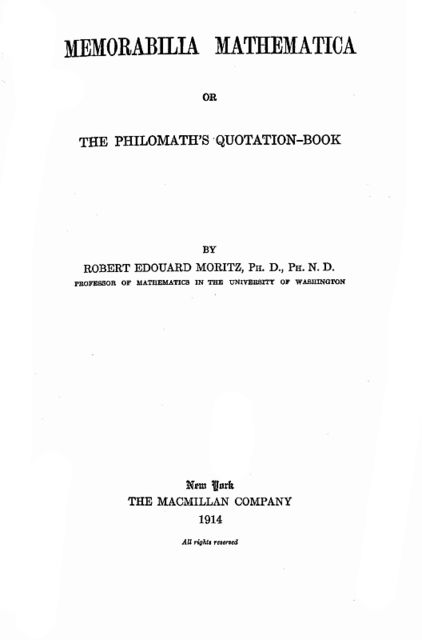
MEMORABILIA MATHEMATICA
OR
THE PHILOMATH’S QUOTATION-BOOK
BY
ROBERT EDOUARD MORITZ, Ph. D., Ph. N. D.
PROFESSOR OF MATHEMATICS IN THE UNIVERSITY OF WASHINGTON
New York
THE MACMILLAN COMPANY
1914
All rights reserved
Copyright, 1914, by
ROBERT EDOUARD MORITZ

PREFACE
Every one knows that the fine phrase “God geometrizes” is attributed to Plato, but few know where this famous passage is found, or the exact words in which it was first expressed. Those who, like the author, have spent hours and even days in the search of the exact statements, or the exact references, of similar famous passages, will not question the timeliness and usefulness of a book whose distinct purpose it is to bring together into a single volume exact quotations, with their exact references, bearing on one of the most time-honored, and even today the most active and most fruitful of all the sciences, the queen-mother of all the sciences, that is, mathematics.
It is hoped that the present volume will prove indispensable to every teacher of mathematics, to every writer on mathematics, and that the student of mathematics and the related sciences will find its perusal not only a source of pleasure but of encouragement and inspiration as well. The layman will find it a repository of useful information covering a field of knowledge which, owing to the unfamiliar and hence repellant character of the language employed by mathematicians, is peculiarly inaccessible to the general reader. No technical processes or technical facility is required to understand and appreciate the wealth of ideas here set forth in the words of the world’s great thinkers.
No labor has been spared to make the present volume worthy of a place among collections of a like kind in other fields. Ten years have been devoted to its preparation, years, which if they could have been more profitably, could scarcely have been more pleasurably employed. As a result there have been brought together over one thousand more or less familiar passages pertaining to mathematics, by poets, philosophers, historians, statesmen, scientists, and mathematicians. These have been gathered from over three hundred authors, and have been grouped under twenty heads, and cross indexed under nearly seven hundred topics.
The author’s original plan was to give foreign quotations both in the original and in translation, but with the growth of material this plan was abandoned as infeasible. It was thought to serve the best interest of the greater number of English readers to give translations only, while preserving the references to the original sources, so that the student or critical reader may readily consult the original of any given extract. In cases where the translation is borrowed the translator’s name is inserted in brackets [] immediately after the author’s name. Brackets are also used to indicate inserted words or phrases made necessary to bring out the context.
The absence of similar English works has made the author’s work largely that of the pioneer. Rebière’s “Mathématiques et Mathématiciens” and Ahrens’ “Scherz und Ernst in der Mathematik” have indeed been frequently consulted but rather with a view to avoid overlapping than to receive aid. Thus certain topics as the correspondence of German and French mathematicians, so excellently treated by Ahrens, have purposely been omitted. The repetitions are limited to a small number of famous utterances whose absence from a work of this kind could scarcely be defended on any grounds.
No one can be more keenly aware of the shortcomings of a work than its author, for none can have so intimate an acquaintance with it. Among those of the present work is its incompleteness, but it should be borne in mind that incompleteness is a necessary concomitant of every collection of whatever kind. Much less can completeness be expected in a first collection, made by a single individual, in his leisure hours, and in a field which is already boundless and is yet expanding day by day. A collection of great thoughts, even if complete today, would be incomplete tomorrow. Again, if some authors are quoted more frequently than others of greater fame and authority, the reason may be sought not only in the fact that the writings of some authors peculiarly lent themselves to quotation, a quality singularly absent in other writers of the greatest merit and authority, but also in this, that the greatest freedom has been exercised in the choice of selections. The author has followed the bent of his own fancy in collecting whatever seemed to him sufficiently valuable because of its content, its beauty, its originality, or its terseness, to deserve a place in a “Memorabilia.”
Great pains has been taken to furnish exact readings and references. In some cases where a passage could not be traced to its first source, the secondary source has been given rather than the reputed source. For the same reason many references are to later editions rather than to inaccessible first editions.
The author feels confident that this work will be of assistance to his co-workers in the field of mathematics and allied fields. If in addition it should aid in a better appreciation of mathematicians and their work on the part of laymen and students in other fields, the author’s foremost aim in the preparation of this work will have been achieved.
Robert Edouard Moritz,
September, 1913.
CONTENTS
Chapter
Page
I.
Definitions and Object of Mathematics 1II.
The Nature of Mathematics 10III.
Estimates of Mathematics 39IV.
The Value of Mathematics 49V.
The Teaching of Mathematics 72VI.
Study and Research in Mathematics 86VII.
Modern Mathematics 108VIII.
The Mathematician 121IX.
Persons and Anecdotes (A-M) 135X.
Persons and Anecdotes (N-Z) 166XI.
Mathematics as a Fine Art 181XII.
Mathematics as a Language 194XIII.
Mathematics and Logic 201XIV.
Mathematics and Philosophy 209XV.
Mathematics and Science 224XVI.
Arithmetic 261XVII.
Algebra 275XVIII.
Geometry 292XIX.
The Calculus and Allied Topics 323XX.
The Fundamental Concepts of Time and Space 345XXI.
Paradoxes and Curiosities 364 Index 385Alles Gescheite ist schon gedacht worden; man muss nur versuchen, es noch einmal zu denken.—Goethe.
Sprüche in Prosa, Ethisches, I. 1.
A great man quotes bravely, and will not draw on his invention when his memory serves him with a word as good.—Emerson.
Letters and Social Aims, Quotation and Originality.
MEMORABILIA MATHEMATICA
MEMORABILIA MATHEMATICA
CHAPTER I
DEFINITIONS AND OBJECT OF MATHEMATICS
101. I think it would be desirable that this form of word [mathematics] should be reserved for the applications of the science, and that we should use mathematic in the singular to denote the science itself, in the same way as we speak of logic, rhetoric, or (own sister to algebra) music.—Sylvester, J. J.
Presidential Address to the British Association, Exeter British Association Report (1869); Collected Mathematical Papers, Vol. 2, p. 659.
102. ... all the sciences which have for their end investigations concerning order and measure, are related to mathematics, it being of small importance whether this measure be sought in numbers, forms, stars, sounds, or any other object; that, accordingly, there ought to exist a general science which should explain all that can be known about order and measure, considered independently of any application to a particular subject, and that, indeed, this science has its own proper name, consecrated by long usage, to wit, mathematics. And a proof that it far surpasses in facility and importance the sciences which depend upon it is that it embraces at once all the objects to which these are devoted and a great many others besides; ....—Descartes.
Rules for the Direction of the Mind, Philosophy of D. [Torrey] (New York, 1892), p. 72.
103. [Mathematics] has for its object the indirect measurement of magnitudes, and it purposes to determine magnitudes by each other, according to the precise relations which exist between them.—Comte.
Positive Philosophy [Martineau], Bk. 1, chap. 1.
104. The business of concrete mathematics is to discover the equations which express the mathematical laws of the phenomenon under consideration; and these equations are the starting-point of the calculus, which must obtain from them certain quantities by means of others.—Comte.
Positive Philosophy [Martineau], Bk. 1, chap. 2.
105. Mathematics is the science of the connection of magnitudes. Magnitude is anything that can be put equal or unequal to another thing. Two things are equal when in every assertion each may be replaced by the other.—Grassmann, Hermann.
Stücke aus dem Lehrbuche der Arithmetik, Werke (Leipzig, 1904), Bd. 2, p. 298.
106. Mathematic is either Pure or Mixed: To Pure Mathematic belong those sciences which handle Quantity entirely severed from matter and from axioms of natural philosophy. These are two, Geometry and Arithmetic; the one handling quantity continued, the other dissevered.... Mixed Mathematic has for its subject some axioms and parts of natural philosophy, and considers quantity in so far as it assists to explain, demonstrate and actuate these.—Bacon, Francis.
De Augmentis, Bk. 3; Advancement of Learning, Bk. 2.
107. The ideas which these sciences, Geometry, Theoretical Arithmetic and Algebra involve extend to all objects and changes which we observe in the external world; and hence the consideration of mathematical relations forms a large portion of many of the sciences which treat of the phenomena and laws of external nature, as Astronomy, Optics, and Mechanics. Such sciences are hence often termed Mixed Mathematics, the relations of space and number being, in these branches of knowledge, combined with principles collected from special observation; while Geometry, Algebra, and the like subjects, which involve no result of experience, are called Pure Mathematics.—Whewell, William.
The Philosophy of the Inductive Sciences, Part 1, Bk. 2, chap. I, sect. 4. (London, 1858).
108. Higher Mathematics is the art of reasoning about numerical relations between natural phenomena; and the several sections of Higher Mathematics are different modes of viewing these relations.—Mellor, J. W.
Higher Mathematics for Students of Chemistry and Physics (New York, 1902), Prologue
109. Number, place, and combination ... the three intersecting but distinct spheres of thought to which all mathematical ideas admit of being referred.—Sylvester, J. J.
Philosophical Magazine, Vol. 24 (1844), p. 285; Collected Mathematical Papers, Vol. 1, p. 91.
110. There are three ruling ideas, three so to say, spheres of thought, which pervade the whole body of mathematical science, to some one or other of which, or to two or all three of them combined, every mathematical truth admits of being referred; these are the three cardinal notions, of Number, Space and Order.
Arithmetic has for its object the properties of number in the abstract. In algebra, viewed as a science of operations, order is the predominating idea. The business of geometry is with the evolution of the properties of space, or of bodies viewed as existing in space.—Sylvester, J. J.
A Probationary Lecture on Geometry, York British Association Report (1844), Part 2; Collected Mathematical Papers, Vol. 2, p. 5.
111. The object of pure mathematics is those relations which may be conceptually established among any conceived elements whatsoever by assuming them contained in some ordered manifold; the law of order of this manifold must be subject to our choice; the latter is the case in both of the only conceivable kinds of manifolds, in the discrete as well as in the continuous.—Papperitz, E.
über das System der rein mathematischen Wissenschaften, Jahresbericht der Deutschen Mathematiker-Vereinigung, Bd. 1, p. 36.
112. Pure mathematics is not concerned with magnitude. It is merely the doctrine of notation of relatively ordered thought operations which have become mechanical.—Novalis.
Schriften (Berlin, 1901), Zweiter Teil, p. 282.
113. Any conception which is definitely and completely determined by means of a finite number of specifications, say by assigning a finite number of elements, is a mathematical conception. Mathematics has for its function to develop the consequences involved in the definition of a group of mathematical conceptions. Interdependence and mutual logical consistency among the members of the group are postulated, otherwise the group would either have to be treated as several distinct groups, or would lie beyond the sphere of mathematics.—Chrystal, George.
Encyclopedia Britannica (9th edition), Article “Mathematics.”
114. The purely formal sciences, logic and mathematics, deal with those relations which are, or can be, independent of the particular content or the substance of objects. To mathematics in particular fall those relations between objects which involve the concepts of magnitude, of measure and of number.—Hankel, Hermann.
Theorie der Complexen Zahlensysteme, (Leipzig, 1867), p. 1.
115. Quantity is that which is operated with according to fixed mutually consistent laws. Both operator and operand must derive their meaning from the laws of operation. In the case of ordinary algebra these are the three laws already indicated [the commutative, associative, and distributive laws], in the algebra of quaternions the same save the law of commutation for multiplication and division, and so on. It may be questioned whether this definition is sufficient, and it may be objected that it is vague; but the reader will do well to reflect that any definition must include the linear algebras of Peirce, the algebra of logic, and others that may be easily imagined, although they have not yet been developed. This general definition of quantity enables us to see how operators may be treated as quantities, and thus to understand the rationale of the so called symbolical methods.—Chrystal, George.
Encyclopedia Britannica (9th edition), Article “Mathematics.”
116. Mathematics—in a strict sense—is the abstract science which investigates deductively the conclusions implicit in the elementary conceptions of spatial and numerical relations.—Murray, J. A. H.
A New English Dictionary.
117. Everything that the greatest minds of all times have accomplished toward the comprehension of forms by means of concepts is gathered into one great science, mathematics.—Herbart, J. F.
Pestalozzi’s Idee eines A B C der Anschauung, Werke [Kehrbach], (Langensalza, 1890), Bd. 1, p. 163.
118. Perhaps the least inadequate description of the general scope of modern Pure Mathematics—I will not call it a definition—would be to say that it deals with form, in a very general sense of the term; this would include algebraic form, functional relationship, the relations of order in any ordered set of entities such as numbers, and the analysis of the peculiarities of form of groups of operations.—Hobson, E. W.
Presidential Address British Association for the Advancement of Science (1910); Nature, Vol. 84, p. 287.
119. The ideal of mathematics should be to erect a calculus to facilitate reasoning in connection with every province of thought, or of external experience, in which the succession of thoughts, or of events can be definitely ascertained and precisely stated. So that all serious thought which is not philosophy, or inductive reasoning, or imaginative literature, shall be mathematics developed by means of a calculus.—Whitehead, A. N.
Universal Algebra (Cambridge, 1898), Preface.
120. Mathematics is the science which draws necessary conclusions.—Peirce, Benjamin.
Linear Associative Algebra, American Journal of Mathematics, Vol. 4 (1881), p. 97.
121. Mathematics is the universal art apodictic.—Smith, W. B.
Quoted by Keyser, C. J. in Lectures on Science, Philosophy and Art (New York, 1908), p. 13.
122. Mathematics in its widest signification is the development of all types of formal, necessary, deductive reasoning.—Whitehead, A. N.
Universal Algebra (Cambridge, 1898), Preface, p. vi.
123. Mathematics in general is fundamentally the science of self-evident things.—Klein, Felix.
Anwendung der Differential- und Integralrechnung auf Geometrie (Leipzig, 1902), p. 26.
124. A mathematical science is any body of propositions which is capable of an abstract formulation and arrangement in such a way that every proposition of the set after a certain one is a formal logical consequence of some or all the preceding propositions. Mathematics consists of all such mathematical sciences.—Young, Charles Wesley.
Fundamental Concepts of Algebra and Geometry (New York, 1911), p. 222.
125. Pure mathematics is a collection of hypothetical, deductive theories, each consisting of a definite system of primitive, undefined, concepts or symbols and primitive, unproved, but self-consistent assumptions (commonly called axioms) together with their logically deducible consequences following by rigidly deductive processes without appeal to intuition.—Fitch, G. D.
The Fourth Dimension simply Explained (New York, 1910), p. 58.
126. The whole of Mathematics consists in the organization of a series of aids to the imagination in the process of reasoning.—Whitehead, A. N.
Universal Algebra (Cambridge, 1898), p. 12.
127. Pure mathematics consists entirely of such asseverations as that, if such and such a proposition is true of anything, then such and such another proposition is true of that thing. It is essential not to discuss whether the first proposition is really true, and not to mention what the anything is of which it is supposed to be true.... If our hypothesis is about anything and not about some one or more particular things, then our deductions constitute mathematics. Thus mathematics may be defined as the subject in which we never know what we are talking about, nor whether what we are saying is true.—Russell, Bertrand.
Recent Work on the Principles of Mathematics, International Monthly, Vol. 4 (1901), p. 84.
128. Pure Mathematics is the class of all propositions of the form “p implies q,” where p and q are propositions containing one or more variables, the same in the two propositions, and neither p nor q contains any constants except logical constants. And logical constants are all notions definable in terms of the following: Implication, the relation of a term to a class of which it is a member, the notion of such that, the notion of relation, and such further notions as may be involved in the general notion of propositions of the above form. In addition to these, Mathematics uses a notion which is not a constituent of the propositions which it considers—namely, the notion of truth.—Russell, Bertrand.
Principles of Mathematics (Cambridge, 1903), p. 1.
129. The object of pure Physic is the unfolding of the laws of the intelligible world; the object of pure Mathematic that of unfolding the laws of human intelligence.—Sylvester, J. J.
On a theorem, connected with Newton’s Rule, etc., Collected Mathematical Papers, Vol. 3, p. 424.
130. First of all, we ought to observe, that mathematical propositions, properly so called, are always judgments a priori, and not empirical, because they carry along with them necessity, which can never be deduced from experience. If people should object to this, I am quite willing to confine my statements to pure mathematics, the very concept of which implies that it does not contain empirical, but only pure knowledge a priori.—Kant, Immanuel.
Critique of Pure Reason [Müller], (New York, 1900), p. 720.
131. Mathematics, the science of the ideal, becomes the means of investigating, understanding and making known the world of the real. The complex is expressed in terms of the simple. From one point of view mathematics may be defined as the science of successive substitutions of simpler concepts for more complex....—White, William F.
A Scrap-book of Elementary Mathematics, (Chicago, 1908), p. 215.
132. The critical mathematician has abandoned the search for truth. He no longer flatters himself that his propositions are or can be known to him or to any other human being to be true; and he contents himself with aiming at the correct, or the consistent. The distinction is not annulled nor even blurred by the reflection that consistency contains immanently a kind of truth. He is not absolutely certain, but he believes profoundly that it is possible to find various sets of a few propositions each such that the propositions of each set are compatible, that the propositions of each such set imply other propositions, and that the latter can be deduced from the former with certainty. That is to say, he believes that there are systems of coherent or consistent propositions, and he regards it his business to discover such systems. Any such system is a branch of mathematics.—Keyser, C. J.
Science, New Series, Vol. 35, p. 107.
133. [Mathematics is] the study of ideal constructions (often applicable to real problems), and the discovery thereby of relations between the parts of these constructions, before unknown.—Peirce, C. S.
Century Dictionary, Article “Mathematics.”
134. Mathematics is that form of intelligence in which we bring the objects of the phenomenal world under the control of the conception of quantity. [Provisional definition.]—Howison, G. H.
The Departments of Mathematics, and their Mutual Relations; Journal of Speculative Philosophy, Vol. 5, p. 164.
135. Mathematics is the science of the functional laws and transformations which enable us to convert figured extension and rated motion into number.—Howison, G. H.
The Departments of Mathematics, and their Mutual Relations; Journal of Speculative Philosophy, Vol. 5, p. 170.
CHAPTER II
THE NATURE OF MATHEMATICS
201. Mathematics, from the earliest times to which the history of human reason can reach, has followed, among that wonderful people of the Greeks, the safe way of science. But it must not be supposed that it was as easy for mathematics as for logic, in which reason is concerned with itself alone, to find, or rather to make for itself that royal road. I believe, on the contrary, that there was a long period of tentative work (chiefly still among the Egyptians), and that the change is to be ascribed to a revolution, produced by the happy thought of a single man, whose experiments pointed unmistakably to the path that had to be followed, and opened and traced out for the most distant times the safe way of a science. The history of that intellectual revolution, which was far more important than the passage round the celebrated Cape of Good Hope, and the name of its fortunate author, have not been preserved to us.... A new light flashed on the first man who demonstrated the properties of the isosceles triangle (whether his name was Thales or any other name), for he found that he had not to investigate what he saw in the figure, or the mere concepts of that figure, and thus to learn its properties; but that he had to produce (by construction) what he had himself, according to concepts a priori, placed into that figure and represented in it, so that, in order to know anything with certainty a priori, he must not attribute to that figure anything beyond what necessarily follows from what he has himself placed into it, in accordance with the concept.—Kant, Immanuel.
Critique of Pure Reason, Preface to the Second Edition [Müller], (New York, 1900), p. 690.
202. [When followed in the proper spirit], there is no study in the world which brings into more harmonious action all the faculties of the mind than the one [mathematics] of which I stand here as the humble representative and advocate. There is none other which prepares so many agreeable surprises for its followers, more wonderful than the transformation scene of a pantomime, or, like this, seems to raise them, by successive steps of initiation to higher and higher states of conscious intellectual being.—Sylvester, J. J.
A Plea for the Mathematician, Nature, Vol. 1, p. 261.
203. Thought-economy is most highly developed in mathematics, that science which has reached the highest formal development, and on which natural science so frequently calls for assistance. Strange as it may seem, the strength of mathematics lies in the avoidance of all unnecessary thoughts, in the utmost economy of thought-operations. The symbols of order, which we call numbers, form already a system of wonderful simplicity and economy. When in the multiplication of a number with several digits we employ the multiplication table and thus make use of previously accomplished results rather than to repeat them each time, when by the use of tables of logarithms we avoid new numerical calculations by replacing them by others long since performed, when we employ determinants instead of carrying through from the beginning the solution of a system of equations, when we decompose new integral expressions into others that are familiar,—we see in all this but a faint reflection of the intellectual activity of a Lagrange or Cauchy, who with the keen discernment of a military commander marshalls a whole troop of completed operations in the execution of a new one.—Mach, E.
Populär-wissenschafliche Vorlesungen (1908), pp. 224-225.
204. Pure mathematics proves itself a royal science both through its content and form, which contains within itself the cause of its being and its methods of proof. For in complete independence mathematics creates for itself the object of which it treats, its magnitudes and laws, its formulas and symbols.—Dillmann, E.
Die Mathematik die Fackelträgerin einer neuen Zeit (Stuttgart, 1889), p. 94.
205. The essence of mathematics lies in its freedom.—Cantor, George.
Mathematische Annalen, Bd. 21, p. 564.
206. Mathematics pursues its own course unrestrained, not indeed with an unbridled licence which submits to no laws, but rather with the freedom which is determined by its own nature and in conformity with its own being.—Hankel, Hermann.
Die Entwickelung der Mathematik in den letzten Jahrhunderten (Tübingen, 1884), p. 16.
207. Mathematics is perfectly free in its development and is subject only to the obvious consideration, that its concepts must be free from contradictions in themselves, as well as definitely and orderly related by means of definitions to the previously existing and established concepts.—Cantor, George.
Grundlagen einer allgemeinen Manigfaltigkeitslehre (Leipzig, 1883), Sect. 8.
208. Mathematicians assume the right to choose, within the limits of logical contradiction, what path they please in reaching their results.—Adams, Henry.
A Letter to American Teachers of History (Washington, 1910), Introduction, p. v.
209. Mathematics is the predominant science of our time; its conquests grow daily, though without noise; he who does not employ it for himself, will some day find it employed against himself.—Herbart, J. F.
Werke [Kehrbach] (Langensalza, 1890), Bd. 5, p. 105.
210. Mathematics is not the discoverer of laws, for it is not induction; neither is it the framer of theories, for it is not hypothesis; but it is the judge over both, and it is the arbiter to which each must refer its claims; and neither law can rule nor theory explain without the sanction of mathematics.—Peirce, Benjamin.
Linear Associative Algebra, American Journal of Mathematics, Vol. 4 (1881), p. 97.
211. Mathematics is a science continually expanding; and its growth, unlike some political and industrial events, is attended by universal acclamation.—White, H. S.
Congress of Arts and Sciences (Boston and New York, 1905), Vol. 1, p. 455.
212. Mathematics accomplishes really nothing outside of the realm of magnitude; marvellous, however, is the skill with which it masters magnitude wherever it finds it. We recall at once the network of lines which it has spun about heavens and earth; the system of lines to which azimuth and altitude, declination and right ascension, longitude and latitude are referred; those abscissas and ordinates, tangents and normals, circles of curvature and evolutes; those trigonometric and logarithmic functions which have been prepared in advance and await application. A look at this apparatus is sufficient to show that mathematicians are not magicians, but that everything is accomplished by natural means; one is rather impressed by the multitude of skilful machines, numerous witnesses of a manifold and intensely active industry, admirably fitted for the acquisition of true and lasting treasures.—Herbart, J. F.
Werke [Kehrbach] (Langensalza, 1890), Bd. 5, p. 101.
213. They [mathematicians] only take those things into consideration, of which they have clear and distinct ideas, designating them by proper, adequate, and invariable names, and premising only a few axioms which are most noted and certain to investigate their affections and draw conclusions from them, and agreeably laying down a very few hypotheses, such as are in the highest degree consonant with reason and not to be denied by anyone in his right mind. In like manner they assign generations or causes easy to be understood and readily admitted by all, they preserve a most accurate order, every proposition immediately following from what is supposed and proved before, and reject all things howsoever specious and probable which can not be inferred and deduced after the same manner.—Barrow, Isaac.
Mathematical Lectures (London, 1734), p. 66.
214. The dexterous management of terms and being able to fend and prove with them, I know has and does pass in the world for a great part of learning; but it is learning distinct from knowledge, for knowledge consists only in perceiving the habitudes and relations of ideas one to another, which is done without words; the intervention of sounds helps nothing to it. And hence we see that there is least use of distinction where there is most knowledge: I mean in mathematics, where men have determined ideas with known names to them; and so, there being no room for equivocations, there is no need of distinctions.—Locke, John.
Conduct of the Understanding, Sect. 31.
215. In mathematics it [sophistry] had no place from the beginning: Mathematicians having had the wisdom to define accurately the terms they use, and to lay down, as axioms, the first principles on which their reasoning is grounded. Accordingly we find no parties among mathematicians, and hardly any disputes.—Reid, Thomas.
Essays on the Intellectual Powers of Man, Essay 1, chap. 1.
216. In most sciences one generation tears down what another has built and what one has established another undoes. In Mathematics alone each generation builds a new story to the old structure.—Hankel, Hermann.
Die Entwickelung der Mathematik in den letzten Jahrhunderten (Tübingen, 1884), p. 25.
217. Mathematics, the priestess of definiteness and clearness.—Herbart, J. F.
Werke [Kehrbach] (Langensalza, 1890), Bd. 1, p. 171.
218. ... mathematical analysis is co-extensive with nature itself, it defines all perceivable relations, measures times, spaces, forces, temperatures; it is a difficult science which forms but slowly, but preserves carefully every principle once acquired; it increases and becomes stronger incessantly amidst all the changes and errors of the human mind.
Its chief attribute is clearness; it has no means for expressing confused ideas. It compares the most diverse phenomena and discovers the secret analogies which unite them. If matter escapes us, as that of air and light because of its extreme tenuity, if bodies are placed far from us in the immensity of space, if man wishes to know the aspect of the heavens at successive periods separated by many centuries, if gravity and heat act in the interior of the solid earth at depths which will forever be inaccessible, mathematical analysis is still able to trace the laws of these phenomena. It renders them present and measurable, and appears to be the faculty of the human mind destined to supplement the brevity of life and the imperfection of the senses, and what is even more remarkable, it follows the same course in the study of all phenomena; it explains them in the same language, as if in witness to the unity and simplicity of the plan of the universe, and to make more manifest the unchangeable order which presides over all natural causes.—Fourier, J.
Théorie Analytique de la Chaleur, Discours Préliminaire.
219. Let us now declare the means whereby our understanding can rise to knowledge without fear of error. There are two such means: intuition and deduction. By intuition I mean not the varying testimony of the senses, nor the deductive judgment of imagination naturally extravagant, but the conception of an attentive mind so distinct and so clear that no doubt remains to it with regard to that which it comprehends; or, what amounts to the same thing, the self-evidencing conception of a sound and attentive mind, a conception which springs from the light of reason alone, and is more certain, because more simple, than deduction itself....
It may perhaps be asked why to intuition we add this other mode of knowing, by deduction, that is to say, the process which, from something of which we have certain knowledge, draws consequences which necessarily follow therefrom. But we are obliged to admit this second step; for there are a great many things which, without being evident of themselves, nevertheless bear the marks of certainty if only they are deduced from true and incontestable principles by a continuous and uninterrupted movement of thought, with distinct intuition of each thing; just as we know that the last link of a long chain holds to the first, although we can not take in with one glance of the eye the intermediate links, provided that, after having run over them in succession, we can recall them all, each as being joined to its fellows, from the first up to the last. Thus we distinguish intuition from deduction, inasmuch as in the latter case there is conceived a certain progress or succession, while it is not so in the former;... whence it follows that primary propositions, derived immediately from principles, may be said to be known, according to the way we view them, now by intuition, now by deduction; although the principles themselves can be known only by intuition, the remote consequences only by deduction.—Descartes.
Rules for the Direction of the Mind, Philosophy of D. [Torrey] (New York, 1892), pp. 64, 65.
220. Analysis and natural philosophy owe their most important discoveries to this fruitful means, which is called induction. Newton was indebted to it for his theorem of the binomial and the principle of universal gravity.—Laplace.
A Philosophical Essay on Probabilities [Truscott and Emory] (New York 1902), p. 176.
221. There is in every step of an arithmetical or algebraical calculation a real induction, a real inference from facts to facts, and what disguises the induction is simply its comprehensive nature, and the consequent extreme generality of its language.—Mill, J. S.
System of Logic, Bk. 2, chap. 6, 2.
222. It would appear that Deductive and Demonstrative Sciences are all, without exception, Inductive Sciences: that their evidence is that of experience, but that they are also, in virtue of the peculiar character of one indispensable portion of the general formulae according to which their inductions are made, Hypothetical Sciences. Their conclusions are true only upon certain suppositions, which are, or ought to be, approximations to the truth, but are seldom, if ever, exactly true; and to this hypothetical character is to be ascribed the peculiar certainty, which is supposed to be inherent in demonstration.—Mill, J. S.
System of Logic, Bk. 2, chap. 6, 1.
223. The peculiar character of mathematical truth is, that it is necessarily and inevitably true; and one of the most important lessons which we learn from our mathematical studies is a knowledge that there are such truths, and a familiarity with their form and character.
This lesson is not only lost, but read backward, if the student is taught that there is no such difference, and that mathematical truths themselves are learned by experience.—Whewell, W.
Thoughts on the Study of Mathematics. Principles of English University Education (London, 1838).
224. These sciences, Geometry, Theoretical Arithmetic and Algebra, have no principles besides definitions and axioms, and no process of proof but deduction; this process, however, assuming a most remarkable character; and exhibiting a combination of simplicity and complexity, of rigour and generality, quite unparalleled in other subjects.—Whewell, W.
The Philosophy of the Inductive Sciences, Part 1, Bk. 2, chap. 1, sect. 2 (London, 1858).
225. The apodictic quality of mathematical thought, the certainty and correctness of its conclusions, are due, not to a special mode of ratiocination, but to the character of the concepts with which it deals. What is that distinctive characteristic? I answer: precision, sharpness, completeness,1 of definition. But how comes your mathematician by such completeness? There is no mysterious trick involved; some ideas admit of such precision, others do not; and the mathematician is one who deals with those that do.—Keyser, C. J.
The Universe and Beyond; Hibbert Journal, Vol. 3 (1904-1905), p. 309.
226. The reasoning of mathematicians is founded on certain and infallible principles. Every word they use conveys a determinate idea, and by accurate definitions they excite the same ideas in the mind of the reader that were in the mind of the writer. When they have defined the terms they intend to make use of, they premise a few axioms, or self-evident principles, that every one must assent to as soon as proposed. They then take for granted certain postulates, that no one can deny them, such as, that a right line may be drawn from any given point to another, and from these plain, simple principles they have raised most astonishing speculations, and proved the extent of the human mind to be more spacious and capacious than any other science.—Adams, John.
Diary, Works (Boston, 1850), Vol. 2, p. 21.
227. It may be observed of mathematicians that they only meddle with such things as are certain, passing by those that are doubtful and unknown. They profess not to know all things, neither do they affect to speak of all things. What they know to be true, and can make good by invincible arguments, that they publish and insert among their theorems. Of other things they are silent and pass no judgment at all, choosing rather to acknowledge their ignorance, than affirm anything rashly. They affirm nothing among their arguments or assertions which is not most manifestly known and examined with utmost rigour, rejecting all probable conjectures and little witticisms. They submit nothing to authority, indulge no affection, detest subterfuges of words, and declare their sentiments, as in a court of justice, without passion, without apology; knowing that their reasons, as Seneca testifies of them, are not brought to persuade, but to compel.—Barrow, Isaac.
Mathematical Lectures (London, 1734), p. 64.
228. What is exact about mathematics but exactness? And is not this a consequence of the inner sense of truth?—Goethe.
Sprüche in Prosa, Natur, 6, 948.
229. ... the three positive characteristics that distinguish mathematical knowledge from other knowledge ... may be briefly expressed as follows: first, mathematical knowledge bears more distinctly the imprint of truth on all its results than any other kind of knowledge; secondly, it is always a sure preliminary step to the attainment of other correct knowledge; thirdly, it has no need of other knowledge.—Schubert, H.
Mathematical Essays and Recreations (Chicago, 1898), p. 35.
230. It is now necessary to indicate more definitely the reason why mathematics not only carries conviction in itself, but also transmits conviction to the objects to which it is applied. The reason is found, first of all, in the perfect precision with which the elementary mathematical concepts are determined; in this respect each science must look to its own salvation.... But this is not all. As soon as human thought attempts long chains of conclusions, or difficult matters generally, there arises not only the danger of error but also the suspicion of error, because since all details cannot be surveyed with clearness at the same instant one must in the end be satisfied with a belief that nothing has been overlooked from the beginning. Every one knows how much this is the case even in arithmetic, the most elementary use of mathematics. No one would imagine that the higher parts of mathematics fare better in this respect; on the contrary, in more complicated conclusions the uncertainty and suspicion of hidden errors increases in rapid progression. How does mathematics manage to rid itself of this inconvenience which attaches to it in the highest degree? By making proofs more rigorous? By giving new rules according to which the old rules shall be applied? Not in the least. A very great uncertainty continues to attach to the result of each single computation. But there are checks. In the realm of mathematics each point may be reached by a hundred different ways; and if each of a hundred ways leads to the same point, one may be sure that the right point has been reached. A calculation without a check is as good as none. Just so it is with every isolated proof in any speculative science whatever; the proof may be ever so ingenious, and ever so perfectly true and correct, it will still fail to convince permanently. He will therefore be much deceived, who, in metaphysics, or in psychology which depends on metaphysics, hopes to see his greatest care in the precise determination of the concepts and in the logical conclusions rewarded by conviction, much less by success in transmitting conviction to others. Not only must the conclusions support each other, without coercion or suspicion of subreption, but in all matters originating in experience, or judging concerning experience, the results of speculation must be verified by experience, not only superficially, but in countless special cases.—Herbart, J. F.
Werke [Kehrbach] (Langensalza, 1890), Bd. 5, p. 105.
231. [In mathematics] we behold the conscious logical activity of the human mind in its purest and most perfect form. Here we learn to realize the laborious nature of the process, the great care with which it must proceed, the accuracy which is necessary to determine the exact extent of the general propositions arrived at, the difficulty of forming and comprehending abstract concepts; but here we learn also to place confidence in the certainty, scope and fruitfulness of such intellectual activity.—Helmholtz, H.
Ueber das Verhältniss der Naturwissenschaften zur Gesammtheit der Wissenschaft, Vorträge und Reden, Bd. 1 (1896), p. 176.
232. It is true that mathematics, owing to the fact that its whole content is built up by means of purely logical deduction from a small number of universally comprehended principles, has not unfittingly been designated as the science of the self-evident [Selbstverständlichen]. Experience however, shows that for the majority of the cultured, even of scientists, mathematics remains the science of the incomprehensible [Unverständlichen].—Pringsheim, Alfred.
Ueber Wert und angeblichen Unwert der Mathematik, Jahresbericht der Deutschen Mathematiker Vereinigung (1904), p. 357.
233. Mathematical reasoning is deductive in the sense that it is based upon definitions which, as far as the validity of the reasoning is concerned (apart from any existential import), needs only the test of self-consistency. Thus no external verification of definitions is required in mathematics, as long as it is considered merely as mathematics.—Whitehead, A. N.
Universal Algebra (Cambridge, 1898), Preface, p. vi.
234. The mathematician pays not the least regard either to testimony or conjecture, but deduces everything by demonstrative reasoning, from his definitions and axioms. Indeed, whatever is built upon conjecture, is improperly called science; for conjecture may beget opinion, but cannot produce knowledge.—Reid, Thomas.
Essays on the Intellectual Powers of Man, Essay 1, chap. 3.
235. ... for the saving the long progression of the thoughts to remote and first principles in every case, the mind should provide itself several stages; that is to say, intermediate principles, which it might have recourse to in the examining those positions that come in its way. These, though they are not self-evident principles, yet, if they have been made out from them by a wary and unquestionable deduction, may be depended on as certain and infallible truths, and serve as unquestionable truths to prove other points depending upon them, by a nearer and shorter view than remote and general maxims.... And thus mathematicians do, who do not in every new problem run it back to the first axioms through all the whole train of intermediate propositions. Certain theorems that they have settled to themselves upon sure demonstration, serve to resolve to them multitudes of propositions which depend on them, and are as firmly made out from thence as if the mind went afresh over every link of the whole chain that tie them to first self-evident principles.—Locke, John.
The Conduct of the Understanding, Sect. 21.
236. Those intervening ideas, which serve to show the agreement of any two others, are called proofs; and where the agreement or disagreement is by this means plainly and clearly perceived, it is called demonstration; it being shown to the understanding, and the mind made to see that it is so. A quickness in the mind to find out these intermediate ideas, (that shall discover the agreement or disagreement of any other) and to apply them right, is, I suppose, that which is called sagacity.—Locke, John.
An Essay concerning Human Understanding, Bk. 6, chaps. 2, 3.
237. ... the speculative propositions of mathematics do not relate to facts; ... all that we are convinced of by any demonstration in the science, is of a necessary connection subsisting between certain suppositions and certain conclusions. When we find these suppositions actually take place in a particular instance, the demonstration forces us to apply the conclusion. Thus, if I could form a triangle, the three sides of which were accurately mathematical lines, I might affirm of this individual figure, that its three angles are equal to two right angles; but, as the imperfection of my senses puts it out of my power to be, in any case, certain of the exact correspondence of the diagram which I delineate, with the definitions given in the elements of geometry, I never can apply with confidence to a particular figure, a mathematical theorem. On the other hand, it appears from the daily testimony of our senses that the speculative truths of geometry may be applied to material objects with a degree of accuracy sufficient for the purposes of life; and from such applications of them, advantages of the most important kind have been gained to society.—Stewart, Dugald.
Elements of the Philosophy of the Human Mind, Part 3, chap. 1, sect. 3.
238. No process of sound reasoning can establish a result not contained in the premises.—Mellor, J. W.
Higher Mathematics for Students of Chemistry and Physics (New York, 1902), p. 2.
239. ... we cannot get more out of the mathematical mill than we put into it, though we may get it in a form infinitely more useful for our purpose.—Hopkinson, John.
James Forrest Lecture, 1894.
240. The iron labor of conscious logical reasoning demands great perseverance and great caution; it moves on but slowly, and is rarely illuminated by brilliant flashes of genius. It knows little of that facility with which the most varied instances come thronging into the memory of the philologist or historian. Rather is it an essential condition of the methodical progress of mathematical reasoning that the mind should remain concentrated on a single point, undisturbed alike by collateral ideas on the one hand, and by wishes and hopes on the other, and moving on steadily in the direction it has deliberately chosen.—Helmholtz, H.
Ueber das Verhältniss der Naturwissenschaften zur Gesammtheit der Wissenschaft, Vorträge und Reden, Bd. 1 (1896), p. 178.
241. If it were always necessary to reduce everything to intuitive knowledge, demonstration would often be insufferably prolix. This is why mathematicians have had the cleverness to divide the difficulties and to demonstrate separately the intervening propositions. And there is art also in this; for as the mediate truths (which are called lemmas, since they appear to be a digression) may be assigned in many ways, it is well, in order to aid the understanding and memory, to choose of them those which greatly shorten the process, and appear memorable and worthy in themselves of being demonstrated. But there is another obstacle, viz.: that it is not easy to demonstrate all the axioms, and to reduce demonstrations wholly to intuitive knowledge. And if we had chosen to wait for that, perhaps we should not yet have the science of geometry.—Leibnitz, G. W.
New Essay on Human Understanding [Langley], Bk. 4, chaps. 2, 8.
242. In Pure Mathematics, where all the various truths are necessarily connected with each other, (being all necessarily connected with those hypotheses which are the principles of the science), an arrangement is beautiful in proportion as the principles are few; and what we admire perhaps chiefly in the science, is the astonishing variety of consequences which may be demonstrably deduced from so small a number of premises.—Stewart, Dugald.
The Elements of the Philosophy of the Human Mind, Part 3, chap. 1, sect. 3.
243. Whenever ... a controversy arises in mathematics, the issue is not whether a thing is true or not, but whether the proof might not be conducted more simply in some other way, or whether the proposition demonstrated is sufficiently important for the advancement of the science as to deserve especial enunciation and emphasis, or finally, whether the proposition is not a special case of some other and more general truth which is as easily discovered.—Schubert, H.
Mathematical Essays and Recreations (Chicago, 1898), p. 28.
244. ... just as the astronomer, the physicist, the geologist, or other student of objective science looks about in the world of sense, so, not metaphorically speaking but literally, the mind of the mathematician goes forth in the universe of logic in quest of the things that are there; exploring the heights and depths for facts—ideas, classes, relationships, implications, and the rest; observing the minute and elusive with the powerful microscope of his Infinitesimal Analysis; observing the elusive and vast with the limitless telescope of his Calculus of the Infinite; making guesses regarding the order and internal harmony of the data observed and collocated; testing the hypotheses, not merely by the complete induction peculiar to mathematics, but, like his colleagues of the outer world, resorting also to experimental tests and incomplete induction; frequently finding it necessary, in view of unforeseen disclosures, to abandon one hopeful hypothesis or to transform it by retrenchment or by enlargement:—thus, in his own domain, matching, point for point, the processes, methods and experience familiar to the devotee of natural science.—Keyser, Cassius J.
Lectures on Science, Philosophy and Art (New York, 1908), p. 26.
245. That mathematics “do not cultivate the power of generalization,” ... will be admitted by no person of competent knowledge, except in a very qualified sense. The generalizations of mathematics, are, no doubt, a different thing from the generalizations of physical science; but in the difficulty of seizing them, and the mental tension they require, they are no contemptible preparation for the most arduous efforts of the scientific mind. Even the fundamental notions of the higher mathematics, from those of the differential calculus upwards are products of a very high abstraction.... To perceive the mathematical laws common to the results of many mathematical operations, even in so simple a case as that of the binomial theorem, involves a vigorous exercise of the same faculty which gave us Kepler’s laws, and rose through those laws to the theory of universal gravitation. Every process of what has been called Universal Geometry—the great creation of Descartes and his successors, in which a single train of reasoning solves whole classes of problems at once, and others common to large groups of them—is a practical lesson in the management of wide generalizations, and abstraction of the points of agreement from those of difference among objects of great and confusing diversity, to which the purely inductive sciences cannot furnish many superior. Even so elementary an operation as that of abstracting from the particular configuration of the triangles or other figures, and the relative situation of the particular lines or points, in the diagram which aids the apprehension of a common geometrical demonstration, is a very useful, and far from being always an easy, exercise of the faculty of generalization so strangely imagined to have no place or part in the processes of mathematics.—Mill, John Stuart.
i.e., in terms of the absolutely clear and
indefinable.
An Examination of Sir William Hamilton’s Philosophy (London, 1878), pp. 612, 613.
246. When the greatest of American logicians, speaking of the powers that constitute the born geometrician, had named Conception, Imagination, and Generalization, he paused. Thereupon from one of the audience there came the challenge, “What of reason?” The instant response, not less just than brilliant, was: “Ratiocination—that is but the smooth pavement on which the chariot rolls.”—Keyser, C. J.
Lectures on Science, Philosophy and Art (New York, 1908), p. 31.
247. ... the reasoning process [employed in mathematics] is not different from that of any other branch of knowledge, ... but there is required, and in a great degree, that attention of mind which is in some part necessary for the acquisition of all knowledge, and in this branch is indispensably necessary. This must be given in its fullest intensity; ... the other elements especially characteristic of a mathematical mind are quickness in perceiving logical sequence, love of order, methodical arrangement and harmony, distinctness of conception.—Price, B.
Treatise on Infinitesimal Calculus (Oxford, 1868), Vol. 3, p. 6.
248. Histories make men wise; poets, witty; the mathematics, subtile; natural philosophy, deep; moral, grave; logic and rhetoric, able to contend.—Bacon, Francis.
Essays, Of Studies.
249. The Mathematician deals with two properties of objects only, number and extension, and all the inductions he wants have been formed and finished ages ago. He is now occupied with nothing but deduction and verification.—Huxley, T. H.
On the Educational Value of the Natural History Sciences; Lay Sermons, Addresses and Reviews; (New York, 1872), p. 87.
250. [Mathematics] is that [subject] which knows nothing of observation, nothing of experiment, nothing of induction, nothing of causation.—Huxley, T. H.
The Scientific Aspects of Positivism, Fortnightly Review (1898); Lay Sermons, Addresses and Reviews, (New York, 1872), p. 169.
251. We are told that “Mathematics is that study which knows nothing of observation, nothing of experiment, nothing of induction, nothing of causation.” I think no statement could have been made more opposite to the facts of the case; that mathematical analysis is constantly invoking the aid of new principles, new ideas, and new methods, not capable of being defined by any form of words, but springing direct from the inherent powers and activities of the human mind, and from continually renewed introspection of that inner world of thought of which the phenomena are as varied and require as close attention to discern as those of the outer physical world (to which the inner one in each individual man may, I think, be conceived to stand somewhat in the same relation of correspondence as a shadow to the object from which it is projected, or as the hollow palm of one hand to the closed fist which it grasps of the other), that it is unceasingly calling forth the faculties of observation and comparison, that one of its principal weapons is induction, that it has frequent recourse to experimental trial and verification, and that it affords a boundless scope for the exercise of the highest efforts of the imagination and invention.—Sylvester, J. J.
Presidential Address to British Association, Exeter British Association Report (1869), pp. 1-9.; Collected Mathematical Papers, Vol. 2, p. 654.
252. The actual evolution of mathematical theories proceeds by a process of induction strictly analogous to the method of induction employed in building up the physical sciences; observation, comparison, classification, trial, and generalisation are essential in both cases. Not only are special results, obtained independently of one another, frequently seen to be really included in some generalisation, but branches of the subject which have been developed quite independently of one another are sometimes found to have connections which enable them to be synthesised in one single body of doctrine. The essential nature of mathematical thought manifests itself in the discernment of fundamental identity in the mathematical aspects of what are superficially very different domains. A striking example of this species of immanent identity of mathematical form was exhibited by the discovery of that distinguished mathematician ... Major MacMahon, that all possible Latin squares are capable of enumeration by the consideration of certain differential operators. Here we have a case in which an enumeration, which appears to be not amenable to direct treatment, can actually be carried out in a simple manner when the underlying identity of the operation is recognised with that involved in certain operations due to differential operators, the calculus of which belongs superficially to a wholly different region of thought from that relating to Latin squares.—Hobson, E. W.
Presidential Address British Association for the Advancement of Science (1910); Nature, Vol. 84, p. 290.
253. It has been asserted ... that the power of observation is not developed by mathematical studies; while the truth is, that; from the most elementary mathematical notion that arises in the mind of a child to the farthest verge to which mathematical investigation has been pushed and applied, this power is in constant exercise. By observation, as here used, can only be meant the fixing of the attention upon objects (physical or mental) so as to note distinctive peculiarities—to recognize resemblances, differences, and other relations. Now the first mental act of the child recognizing the distinction between one and more than one, between one and two, two and three, etc., is exactly this. So, again, the first geometrical notions are as pure an exercise of this power as can be given. To know a straight line, to distinguish it from a curve; to recognize a triangle and distinguish the several forms—what are these, and all perception of form, but a series of observations? Nor is it alone in securing these fundamental conceptions of number and form that observation plays so important a part. The very genius of the common geometry as a method of reasoning—a system of investigation—is, that it is but a series of observations. The figure being before the eye in actual representation, or before the mind in conception, is so closely scrutinized, that all its distinctive features are perceived; auxiliary lines are drawn (the imagination leading in this), and a new series of inspections is made; and thus, by means of direct, simple observations, the investigation proceeds. So characteristic of common geometry is this method of investigation, that Comte, perhaps the ablest of all writers upon the philosophy of mathematics, is disposed to class geometry, as to its method, with the natural sciences, being based upon observation. Moreover, when we consider applied mathematics, we need only to notice that the exercise of this faculty is so essential, that the basis of all such reasoning, the very material with which we build, have received the name observations. Thus we might proceed to consider the whole range of the human faculties, and find for the most of them ample scope for exercise in mathematical studies. Certainly, the memory will not be found to be neglected. The very first steps in number—counting, the multiplication table, etc., make heavy demands on this power; while the higher branches require the memorizing of formulas which are simply appalling to the uninitiated. So the imagination, the creative faculty of the mind, has constant exercise in all original mathematical investigations, from the solution of the simplest problems to the discovery of the most recondite principle; for it is not by sure, consecutive steps, as many suppose, that we advance from the known to the unknown. The imagination, not the logical faculty, leads in this advance. In fact, practical observation is often in advance of logical exposition. Thus, in the discovery of truth, the imagination habitually presents hypotheses, and observation supplies facts, which it may require ages for the tardy reason to connect logically with the known. Of this truth, mathematics, as well as all other sciences, affords abundant illustrations. So remarkably true is this, that today it is seriously questioned by the majority of thinkers, whether the sublimest branch of mathematics,—the infinitesimal calculus—has anything more than an empirical foundation, mathematicians themselves not being agreed as to its logical basis. That the imagination, and not the logical faculty, leads in all original investigation, no one who has ever succeeded in producing an original demonstration of one of the simpler propositions of geometry, can have any doubt. Nor are induction, analogy, the scrutinization of premises or the search for them, or the balancing of probabilities, spheres of mental operations foreign to mathematics. No one, indeed, can claim pre-eminence for mathematical studies in all these departments of intellectual culture, but it may, perhaps, be claimed that scarcely any department of science affords discipline to so great a number of faculties, and that none presents so complete a gradation in the exercise of these faculties, from the first principles of the science to the farthest extent of its applications, as mathematics.—Olney, Edward.
Kiddle and Schem’s Encyclopedia of Education, (New York, 1877), Article “Mathematics.”
254. The opinion appears to be gaining ground that this very general conception of functionality, born on mathematical ground, is destined to supersede the narrower notion of causation, traditional in connection with the natural sciences. As an abstract formulation of the idea of determination in its most general sense, the notion of functionality includes and transcends the more special notion of causation as a one-sided determination of future phenomena by means of present conditions; it can be used to express the fact of the subsumption under a general law of past, present, and future alike, in a sequence of phenomena. From this point of view the remark of Huxley that Mathematics “knows nothing of causation” could only be taken to express the whole truth, if by the term “causation” is understood “efficient causation.” The latter notion has, however, in recent times been to an increasing extent regarded as just as irrelevant in the natural sciences as it is in Mathematics; the idea of thorough-going determinancy, in accordance with formal law, being thought to be alone significant in either domain.—Hobson, E. W.
Presidential Address British Association for the Advancement of Science (1910); Nature, Vol. 84, p. 290.
255. Most, if not all, of the great ideas of modern mathematics have had their origin in observation. Take, for instance, the arithmetical theory of forms, of which the foundation was laid in the diophantine theorems of Fermat, left without proof by their author, which resisted all efforts of the myriad-minded Euler to reduce to demonstration, and only yielded up their cause of being when turned over in the blow-pipe flame of Gauss’s transcendent genius; or the doctrine of double periodicity, which resulted from the observation of Jacobi of a purely analytical fact of transformation; or Legendre’s law of reciprocity; or Sturm’s theorem about the roots of equations, which, as he informed me with his own lips, stared him in the face in the midst of some mechanical investigations connected (if my memory serves me right) with the motion of compound pendulums; or Huyghen’s method of continued fractions, characterized by Lagrange as one of the principal discoveries of that great mathematician, and to which he appears to have been led by the construction of his Planetary Automaton; or the new algebra, speaking of which one of my predecessors (Mr. Spottiswoode) has said, not without just reason and authority, from this chair, “that it reaches out and indissolubly connects itself each year with fresh branches of mathematics, that the theory of equations has become almost new through it, algebraic geometry transfigured in its light, that the calculus of variations, molecular physics, and mechanics” (he might, if speaking at the present moment, go on to add the theory of elasticity and the development of the integral calculus) “have all felt its influence.”—Sylvester, J. J.
A Plea for the Mathematician, Nature, Vol. 1, p. 238; Collected Mathematical Papers, Vol. 2, pp. 655, 656.
256. The ability to imagine relations is one of the most indispensable conditions of all precise thinking. No subject can be named, in the investigation of which it is not imperatively needed; but it can be nowhere else so thoroughly acquired as in the study of mathematics.—Fiske, John.
Darwinism and other Essays (Boston, 1893), p. 296.
257. The great science [mathematics] occupies itself at least just as much with the power of imagination as with the power of logical conclusion.—Herbart, F. J.
Pestalozzi’s Idee eines ABC der Anschauung. Werke [Kehrbach] (Langensaltza, 1890), Bd. 1, p. 174.
258. The moving power of mathematical invention is not reasoning but imagination.—De Morgan, A.
Quoted in Graves’ Life of Sir W. R. Hamilton, Vol. 3 (1889), p. 219.
259. There is an astonishing imagination, even in the science of mathematics.... We repeat, there was far more imagination in the head of Archimedes than in that of Homer.—Voltaire.
A Philosophical Dictionary (Boston, 1881), Vol. 3, p. 40. Article “Imagination.”
260. As the prerogative of Natural Science is to cultivate a taste for observation, so that of Mathematics is, almost from the starting point, to stimulate the faculty of invention.—Sylvester, J. J.
A Plea for the Mathematician, Nature, Vol. 1, p. 261; Collected Mathematical Papers, Vol. 2 (Cambridge, 1908), p. 717.
261. A marveilous newtrality have these things mathematicall, and also a strange participation between things supernaturall, immortall, intellectuall, simple and indivisible, and things naturall, mortall, sensible, componded and divisible.—Dee, John.
Euclid (1570), Preface.
262. Mathematics stands forth as that which unites, mediates between Man and Nature, inner and outer world, thought and perception, as no other subject does.—Froebel.
[Herford translation] (London, 1893), Vol. 1, p. 84.
263. The intrinsic character of mathematical research and knowledge is based essentially on three properties: first, on its conservative attitude towards the old truths and discoveries of mathematics; secondly, on its progressive mode of development, due to the incessant acquisition of new knowledge on the basis of the old; and thirdly, on its self-sufficiency and its consequent absolute independence.—Schubert, H.
Mathematical Essays and Recreations (Chicago, 1898), p. 27.
264. Our science, in contrast with others, is not founded on a single period of human history, but has accompanied the development of culture through all its stages. Mathematics is as much interwoven with Greek culture as with the most modern problems in Engineering. She not only lends a hand to the progressive natural sciences but participates at the same time in the abstract investigations of logicians and philosophers.—Klein, F.
Klein und Riecke: Ueber angewandte Mathematik und Physik (1900), p. 228.
265. There is probably no other science which presents such different appearances to one who cultivates it and to one who does not, as mathematics. To this person it is ancient, venerable, and complete; a body of dry, irrefutable, unambiguous reasoning. To the mathematician, on the other hand, his science is yet in the purple bloom of vigorous youth, everywhere stretching out after the “attainable but unattained” and full of the excitement of nascent thoughts; its logic is beset with ambiguities, and its analytic processes, like Bunyan’s road, have a quagmire on one side and a deep ditch on the other and branch off into innumerable by-paths that end in a wilderness.—Chapman, C. H.
Bulletin American Mathematical Society, Vol. 2 (First series), p. 61.
266. Mathematical science is in my opinion an indivisible whole, an organism whose vitality is conditioned upon the connection of its parts. For with all the variety of mathematical knowledge, we are still clearly conscious of the similarity of the logical devices, the relationship of the ideas in mathematics as a whole and the numerous analogies in its different departments. We also notice that, the farther a mathematical theory is developed, the more harmoniously and uniformly does its construction proceed, and unsuspected relations are disclosed between hitherto separated branches of the science. So it happens that, with the extension of mathematics, its organic character is not lost but manifests itself the more clearly.—Hilbert, D.
Mathematical Problems, Bulletin American Mathematical Society, Vol. 8, p. 478.
267. The mathematics have always been the implacable enemies of scientific romances.—Arago.
Oeuvres (1855), t. 3, p. 498.
268. Those skilled in mathematical analysis know that its object is not simply to calculate numbers, but that it is also employed to find the relations between magnitudes which cannot be expressed in numbers and between functions whose law is not capable of algebraic expression.—Cournot, Augustin.
Mathematical Theory of the Principles of Wealth [Bacon, N. T.], (New York, 1897), p. 3.
269. Coterminous with space and coeval with time is the Kingdom of Mathematics; within this range her dominion is supreme; otherwise than according to her order nothing can exist; in contradiction to her laws nothing takes place. On her mysterious scroll is to be found written for those who can read it that which has been, that which is, and that which is to come. Everything material which is the subject of knowledge has number, order, or position; and these are her first outlines for a sketch of the universe. If our feeble hands cannot follow out the details, still her part has been drawn with an unerring pen, and her work cannot be gainsaid. So wide is the range of mathematical sciences, so indefinitely may it extend beyond our actual powers of manipulation that at some moments we are inclined to fall down with even more than reverence before her majestic presence. But so strictly limited are her promises and powers, about so much that we might wish to know does she offer no information whatever, that at other moments we are fain to call her results but a vain thing, and to reject them as a stone where we had asked for bread. If one aspect of the subject encourages our hopes, so does the other tend to chasten our desires, and he is perhaps the wisest, and in the long run the happiest, among his fellows, who has learned not only this science, but also the larger lesson which it directly teaches, namely, to temper our aspirations to that which is possible, to moderate our desires to that which is attainable, to restrict our hopes to that of which accomplishment, if not immediately practicable, is at least distinctly within the range of conception.—Spottiswoode, W.
Quoted in Sonnenschein’s Encyclopedia of Education (London, 1906), p. 208.
270. But it is precisely mathematics, and the pure science generally, from which the general educated public and independent students have been debarred, and into which they have only rarely attained more than a very meagre insight. The reason of this is twofold. In the first place, the ascendant and consecutive character of mathematical knowledge renders its results absolutely insusceptible of presentation to persons who are unacquainted with what has gone before, and so necessitates on the part of its devotees a thorough and patient exploration of the field from the very beginning, as distinguished from those sciences which may, so to speak, be begun at the end, and which are consequently cultivated with the greatest zeal. The second reason is that, partly through the exigencies of academic instruction, but mainly through the martinet traditions of antiquity and the influence of mediæval logic-mongers, the great bulk of the elementary text-books of mathematics have unconsciously assumed a very repellant form,—something similar to what is termed in the theory of protective mimicry in biology “the terrifying form.” And it is mainly to this formidableness and touch-me-not character of exterior, concealing withal a harmless body, that the undue neglect of typical mathematical studies is to be attributed.—McCormack, T. J.
Preface to De Morgan’s Elementary Illustrations of the Differential and Integral Calculus (Chicago, 1899).
271. Mathematics in gross, it is plain, are a grievance in natural philosophy, and with reason: for mathematical proofs, like diamonds, are hard as well as clear, and will be touched with nothing but strict reasoning. Mathematical proofs are out of the reach of topical arguments; and are not to be attacked by the equivocal use of words or declaration, that make so great a part of other discourses,—nay, even of controversies.—Locke, John.
Second Reply to the Bishop of Worcester.
272. The belief that mathematics, because it is abstract, because it is static and cold and gray, is detached from life, is a mistaken belief. Mathematics, even in its purest and most abstract estate, is not detached from life. It is just the ideal handling of the problems of life, as sculpture may idealize a human figure or as poetry or painting may idealize a figure or a scene. Mathematics is precisely the ideal handling of the problems of life, and the central ideas of the science, the great concepts about which its stately doctrines have been built up, are precisely the chief ideas with which life must always deal and which, as it tumbles and rolls about them through time and space, give it its interests and problems, and its order and rationality. That such is the case a few indications will suffice to show. The mathematical concepts of constant and variable are represented familiarly in life by the notions of fixedness and change. The concept of equation or that of an equational system, imposing restriction upon variability, is matched in life by the concept of natural and spiritual law, giving order to what were else chaotic change and providing partial freedom in lieu of none at all. What is known in mathematics under the name of limit is everywhere present in life in the guise of some ideal, some excellence high-dwelling among the rocks, an “ever flying perfect” as Emerson calls it, unto which we may approximate nearer and nearer, but which we can never quite attain, save in aspiration. The supreme concept of functionality finds its correlate in life in the all-pervasive sense of interdependence and mutual determination among the elements of the world. What is known in mathematics as transformation—that is, lawful transfer of attention, serving to match in orderly fashion the things of one system with those of another—is conceived in life as a process of transmutation by which, in the flux of the world, the content of the present has come out of the past and in its turn, in ceasing to be, gives birth to its successor, as the boy is father to the man and as things, in general, become what they are not. The mathematical concept of invariance and that of infinitude, especially the imposing doctrines that explain their meanings and bear their names—What are they but mathematicizations of that which has ever been the chief of life’s hopes and dreams, of that which has ever been the object of its deepest passion and of its dominant enterprise, I mean the finding of the worth that abides, the finding of permanence in the midst of change, and the discovery of a presence, in what has seemed to be a finite world, of being that is infinite? It is needless further to multiply examples of a correlation that is so abounding and complete as indeed to suggest a doubt whether it be juster to view mathematics as the abstract idealization of life than to regard life as the concrete realization of mathematics.—Keyser, C. J.
The Humanization of the Teaching of Mathematics; Science, New Series, Vol. 35, pp. 645-646.
273. Mathematics, like dialectics, is an organ of the inner higher sense; in its execution it is an art like eloquence. Both alike care nothing for the content, to both nothing is of value but the form. It is immaterial to mathematics whether it computes pennies or guineas, to rhetoric whether it defends truth or error.—Goethe.
Wilhelm Meisters Wanderjahre, Zweites Buch.
274. The genuine spirit of Mathesis is devout. No intellectual pursuit more truly leads to profound impressions of the existence and attributes of a Creator, and to a deep sense of our filial relations to him, than the study of these abstract sciences. Who can understand so well how feeble are our conceptions of Almighty Power, as he who has calculated the attraction of the sun and the planets, and weighed in his balance the irresistible force of the lightning? Who can so well understand how confused is our estimate of the Eternal Wisdom, as he who has traced out the secret laws which guide the hosts of heaven, and combine the atoms on earth? Who can so well understand that man is made in the image of his Creator, as he who has sought to frame new laws and conditions to govern imaginary worlds, and found his own thoughts similar to those on which his Creator has acted?—Hill, Thomas.
The Imagination in Mathematics; North American Review, Vol. 85, p. 226.
275. ... what is physical is subject to the laws of mathematics, and what is spiritual to the laws of God, and the laws of mathematics are but the expression of the thoughts of God.—Hill, Thomas.
The Uses of Mathesis; Bibliotheca Sacra, Vol. 32, p. 523.
276. It is in the inner world of pure thought, where all entia dwell, where is every type of order and manner of correlation and variety of relationship, it is in this infinite ensemble of eternal verities whence, if there be one cosmos or many of them, each derives its character and mode of being,—it is there that the spirit of mathesis has its home and its life.
Is it a restricted home, a narrow life, static and cold and grey with logic, without artistic interest, devoid of emotion and mood and sentiment? That world, it is true, is not a world of solar light, not clad in the colours that liven and glorify the things of sense, but it is an illuminated world, and over it all and everywhere throughout are hues and tints transcending sense, painted there by radiant pencils of psychic light, the light in which it lies. It is a silent world, and, nevertheless, in respect to the highest principle of art—the interpenetration of content and form, the perfect fusion of mode and meaning—it even surpasses music. In a sense, it is a static world, but so, too, are the worlds of the sculptor and the architect. The figures, however, which reason constructs and the mathematic vision beholds, transcend the temple and the statue, alike in simplicity and in intricacy, in delicacy and in grace, in symmetry and in poise. Not only are this home and this life thus rich in æsthetic interests, really controlled and sustained by motives of a sublimed and supersensuous art, but the religious aspiration, too, finds there, especially in the beautiful doctrine of invariants, the most perfect symbols of what it seeks—the changeless in the midst of change, abiding things in a world of flux, configurations that remain the same despite the swirl and stress of countless hosts of curious transformations. The domain of mathematics is the sole domain of certainty. There and there alone prevail the standards by which every hypothesis respecting the external universe and all observation and all experiment must be finally judged. It is the realm to which all speculation and all thought must repair for chastening and sanitation—the court of last resort, I say it reverently, for all intellection whatsoever, whether of demon or man or deity. It is there that mind as mind attains its highest estate, and the condition of knowledge there is the ultimate object, the tantalising goal of the aspiration, the Anders-Streben, of all other knowledge of every kind.—Keyser, C. J.
The Universe and Beyond; Hibbert Journal, Vol. 3 (1904-1905), pp. 313-314.
CHAPTER III
ESTIMATES OF MATHEMATICS
301. The world of ideas which it [mathematics] discloses or illuminates, the contemplation of divine beauty and order which it induces, the harmonious connection of its parts, the infinite hierarchy and absolute evidence of the truths with which mathematical science is concerned, these, and such like, are the surest grounds of its title of human regard, and would remain unimpaired were the plan of the universe unrolled like a map at our feet, and the mind of man qualified to take in the whole scheme of creation at a glance.—Sylvester, J. J.
A Plea for the Mathematician, Nature, 1, p. 262; Collected Mathematical Papers (Cambridge, 1908), 2, p. 659.
302. It may well be doubted whether, in all the range of Science, there is any field so fascinating to the explorer—so rich in hidden treasures—so fruitful in delightful surprises—as that of Pure Mathematics. The charm lies chiefly ... in the absolute certainty of its results: for that is what, beyond all mental treasures, the human intellect craves for. Let us only be sure of something! More light, more light! Ἐν δὲ φάει καὶ ὀλέεσσον “And if our fate be death, give light and let us die!” This is the cry that, through all the ages, is going up from perplexed Humanity, and Science has little else to offer, that will really meet the demands of its votaries, than the conclusions of Pure Mathematics.—Dodgson, C. L.
A New Theory of Parallels (London, 1895), Introduction.
303. In every case the awakening touch has been the mathematical spirit, the attempt to count, to measure, or to calculate. What to the poet or the seer may appear to be the very death of all his poetry and all his visions—the cold touch of the calculating mind,—this has proved to be the spell by which knowledge has been born, by which new sciences have been created, and hundreds of definite problems put before the minds and into the hands of diligent students. It is the geometrical figure, the dry algebraical formula, which transforms the vague reasoning of the philosopher into a tangible and manageable conception; which represents, though it does not fully describe, which corresponds to, though it does not explain, the things and processes of nature: this clothes the fruitful, but otherwise indefinite, ideas in such a form that the strict logical methods of thought can be applied, that the human mind can in its inner chamber evolve a train of reasoning the result of which corresponds to the phenomena of the outer world.—Merz, J. T.
A History of European Thought in the Nineteenth Century (Edinburgh and London, 1904), Vol. 1, p. 314.
304. Mathematics ... the ideal and norm of all careful thinking.—Hall, G. Stanley.
Educational Problems (New York, 1911), p. 393.
305. Mathematics is the only true metaphysics.—Thomson, W. (Lord Kelvin).
Thompson, S. P.: Life of Lord Kelvin (London, 1910), p. 10.
306. He who knows not mathematics and the results of recent scientific investigation dies without knowing truth.—Schellbach, C. H.
Quoted in Young’s Teaching of Mathematics (London, 1907), p. 44.
307. The reasoning of mathematics is a type of perfect reasoning.—Barnett, P. A.
Common Sense in Education and Teaching (New York, 1905), p. 222.
308. Mathematics, once fairly established on the foundation of a few axioms and definitions, as upon a rock, has grown from age to age, so as to become the most solid fabric that human reason can boast.—Reid, Thomas.
Essays on the Intellectual Powers of Man, 4th. Ed., p. 461.
309. The analytical geometry of Descartes and the calculus of Newton and Leibniz have expanded into the marvelous mathematical method—more daring than anything that the history of philosophy records—of Lobachevsky and Riemann, Gauss and Sylvester. Indeed, mathematics, the indispensable tool of the sciences, defying the senses to follow its splendid flights, is demonstrating today, as it never has been demonstrated before, the supremacy of the pure reason.—Butler, Nicholas Murray.
The Meaning of Education and other Essays and Addresses (New York, 1905), p. 45.
310. Mathematics is the gate and key of the sciences.... Neglect of mathematics works injury to all knowledge, since he who is ignorant of it cannot know the other sciences or the things of this world. And what is worse, men who are thus ignorant are unable to perceive their own ignorance and so do not seek a remedy.—Bacon, Roger.
Opus Majus, Part 4, Distinctia Prima, cap. 1.
311. Just as it will never be successfully challenged that the French language, progressively developing and growing more perfect day by day, has the better claim to serve as a developed court and world language, so no one will venture to estimate lightly the debt which the world owes to mathematicians, in that they treat in their own language matters of the utmost importance, and govern, determine and decide whatever is subject, using the word in the highest sense, to number and measurement.—Goethe.
Sprüche in Prosa, Natur, III, 868.
312. Do not imagine that mathematics is hard and crabbed, and repulsive to common sense. It is merely the etherealization of common sense.—Thomson, W. (Lord Kelvin).
Thompson, S. P.: Life of Lord Kelvin (London, 1910), p. 1139.
313. The advancement and perfection of mathematics are intimately connected with the prosperity of the State.—Napoleon I.
Correspondance de Napoléon, t. 24 (1868), p. 112.
314. The love of mathematics is daily on the increase, not only with us but in the army. The result of this was unmistakably apparent in our last campaigns. Bonaparte himself has a mathematical head, and though all who study this science may not become geometricians like Laplace or Lagrange, or heroes like Bonaparte, there is yet left an influence upon the mind which enables them to accomplish more than they could possibly have achieved without this training.—Lalande.
Quoted in Bruhns’ Alexander von Humboldt (1872), Bd. 1, p. 232.
315. In Pure Mathematics, where all the various truths are necessarily connected with each other, (being all necessarily connected with those hypotheses which are the principles of the science), an arrangement is beautiful in proportion as the principles are few; and what we admire perhaps chiefly in the science, is the astonishing variety of consequences which may be demonstrably deduced from so small a number of premises.—Stewart, Dugald.
Philosophy of the Human Mind, Part 3, chap. 1, sect. 3; Collected Works [Hamilton] (Edinburgh, 1854), Vol. 4.
316. It is curious to observe how differently these great men [Plato and Bacon] estimated the value of every kind of knowledge. Take Arithmetic for example. Plato, after speaking slightly of the convenience of being able to reckon and compute in the ordinary transactions of life, passes to what he considers as a far more important advantage. The study of the properties of numbers, he tells us, habituates the mind to the contemplation of pure truth, and raises us above the material universe. He would have his disciples apply themselves to this study, not that they may be able to buy or sell, not that they may qualify themselves to be shop-keepers or travelling merchants, but that they may learn to withdraw their minds from the ever-shifting spectacle of this visible and tangible world, and to fix them on the immutable essences of things.
Bacon, on the other hand, valued this branch of knowledge only on account of its uses with reference to that visible and tangible world which Plato so much despised. He speaks with scorn of the mystical arithmetic of the later Platonists, and laments the propensity of mankind to employ, on mere matters of curiosity, powers the whole exertion of which is required for purposes of solid advantage. He advises arithmeticians to leave these trifles, and employ themselves in framing convenient expressions which may be of use in physical researches.—Macaulay.
Lord Bacon: Edinburgh Review, July, 1837. Critical and Miscellaneous Essays (New York, 1879), Vol. 1, p. 397.
317. Ath. There still remain three studies suitable for freemen. Calculation in arithmetic is one of them; the measurement of length, surface, and depth is the second; and the third has to do with the revolutions of the stars in reference to one another ... there is in them something that is necessary and cannot be set aside, ... if I am not mistaken, [something of] divine necessity; for as to the human necessities of which men often speak when they talk in this manner, nothing can be more ridiculous than such an application of the words.
Cle. And what necessities of knowledge are there, Stranger, which are divine and not human?
Ath. I conceive them to be those of which he who has no use nor any knowledge at all cannot be a god, or demi-god, or hero to mankind, or able to take any serious thought or charge of them.—Plato.
Republic, Bk. 7. Jowett’s Dialogues of Plato (New York, 1897), Vol. 4, p. 334.
318. Those who assert that the mathematical sciences make no affirmation about what is fair or good make a false assertion; for they do speak of these and frame demonstrations of them in the most eminent sense of the word. For if they do not actually employ these names, they do not exhibit even the results and the reasons of these, and therefore can be hardly said to make any assertion about them. Of what is fair, however, the most important species are order and symmetry, and that which is definite, which the mathematical sciences make manifest in a most eminent degree. And since, at least, these appear to be the causes of many things—now, I mean, for example, order, and that which is a definite thing, it is evident that they would assert, also, the existence of a cause of this description, and its subsistence after the same manner as that which is fair subsists in.—Aristotle.
Metaphysics [MacMahon] Bk. 12, chap. 3.
319. Many arts there are which beautify the mind of man; of all other none do more garnish and beautify it than those arts which are called mathematical.—Billingsley, H.
The Elements of Geometrie of the most ancient Philosopher Euclide of Megara (London, 1570), Note to the Reader.
320. As the sun eclipses the stars by his brilliancy, so the man of knowledge will eclipse the fame of others in assemblies of the people if he proposes algebraic problems, and still more if he solves them.—Brahmagupta.
Quoted in Cajori’s History of Mathematics (New York, 1897), p. 92.
321. So highly did the ancients esteem the power of figures and numbers, that Democritus ascribed to the figures of atoms the first principles of the variety of things; and Pythagoras asserted that the nature of things consisted of numbers.—Bacon, Lord.
De Augmentis, Bk. 3; Advancement of Learning, Bk. 2.
322. There has not been any science so much esteemed and honored as this of mathematics, nor with so much industry and vigilance become the care of great men, and labored in by the potentates of the world, viz. emperors, kings, princes, etc.—Franklin, Benjamin.
On the Usefulness of Mathematics, Works (Boston, 1840), Vol. 2, p. 28.
323. Whatever may have been imputed to some other studies under the notion of insignificancy and loss of time, yet these [mathematics], I believe, never caused repentance in any, except it was for their remissness in the prosecution of them.—Franklin, Benjamin.
On the Usefulness of Mathematics, Works (Boston, 1840), Vol. 2, p. 69.
324. What science can there be more noble, more excellent, more useful for men, more admirably high and demonstrative, than this of the mathematics?—Franklin, Benjamin.
On the Usefulness of Mathematics, Works (Boston, 1840), Vol. 2, p. 69.
325. The great truths with which it [mathematics] deals, are clothed with austere grandeur, far above all purposes of immediate convenience or profit. It is in them that our limited understandings approach nearest to the conception of that absolute and infinite, towards which in most other things they aspire in vain. In the pure mathematics we contemplate absolute truths, which existed in the divine mind before the morning stars sang together, and which will continue to exist there, when the last of their radiant host shall have fallen from heaven. They existed not merely in metaphysical possibility, but in the actual contemplation of the supreme reason. The pen of inspiration, ranging all nature and life for imagery to set forth the Creator’s power and wisdom, finds them best symbolized in the skill of the surveyor. “He meted out heaven as with a span;” and an ancient sage, neither falsely nor irreverently, ventured to say, that “God is a geometer.”—Everett, Edward.
Orations and Speeches (Boston, 1870), Vol. 3, p. 514.
326. There is no science which teaches the harmonies of nature more clearly than mathematics,....—Carus, Paul.
Andrews: Magic Squares and Cubes (Chicago, 1908), Introduction.
327. For it being the nature of the mind of man (to the extreme prejudice of knowledge) to delight in the spacious liberty of generalities, as in a champion region, and not in the enclosures of particularity; the Mathematics were the goodliest fields to satisfy that appetite.—Bacon, Lord.
De Augmentis, Bk. 3; Advancement of Learning, Bk. 2.
328. I would have my son mind and understand business, read little history, study the mathematics and cosmography; these are good, with subordination to the things of God.... These fit for public services for which man is born.—Cromwell, Oliver.
Letters and Speeches of Oliver Cromwell (New York, 1899), Vol. 1, p. 371.
329. Mathematics is the life supreme. The life of the gods is mathematics. All divine messengers are mathematicians. Pure mathematics is religion. Its attainment requires a theophany.—Novalis.
Schriften (Berlin, 1901), Bd. 2, p. 223.
330. The Mathematics which effectually exercises, not vainly deludes or vexatiously torments studious Minds with obscure Subtilties, perplexed Difficulties, or contentious Disquisitions; which overcomes without Opposition, triumphs without Pomp, compels without Force, and rules absolutely without Loss of Liberty; which does not privately overreach a weak Faith, but openly assaults an armed Reason, obtains a total Victory, and puts on inevitable Chains; whose Words are so many Oracles, and Works as many Miracles; which blabs out nothing rashly, nor designs anything from the Purpose, but plainly demonstrates and readily performs all Things within its Verge; which obtrudes no false Shadow of Science, but the very Science itself, the Mind firmly adheres to it, as soon as possessed of it, and can never after desert it of its own Accord, or be deprived of it by any Force of others: Lastly the Mathematics, which depend upon Principles clear to the Mind, and agreeable to Experience; which draws certain Conclusions, instructs by profitable Rules, unfolds pleasant Questions; and produces wonderful Effects; which is the fruitful Parent of, I had almost said all, Arts, the unshaken Foundation of Sciences, and the plentiful Fountain of Advantage to human Affairs.—Barrow, Isaac.
Oration before the University of Cambridge on being elected Lucasian Professor of Mathematics, Mathematical Lectures (London, 1734), p. 28.
331. Doubtless the reasoning faculty, the mind, is the leading and characteristic attribute of the human race. By the exercise of this, man arrives at the properties of the natural bodies. This is science, properly and emphatically so called. It is the science of pure mathematics; and in the high branches of this science lies the truly sublime of human acquisition. If any attainment deserves that epithet, it is the knowledge, which, from the mensuration of the minutest dust of the balance, proceeds on the rising scale of material bodies, everywhere weighing, everywhere measuring, everywhere detecting and explaining the laws of force and motion, penetrating into the secret principles which hold the universe of God together, and balancing worlds against worlds, and system against system. When we seek to accompany those who pursue studies at once so high, so vast, and so exact; when we arrive at the discoveries of Newton, which pour in day on the works of God, as if a second fiat had gone forth from his own mouth; when, further, we attempt to follow those who set out where Newton paused, making his goal their starting-place, and, proceeding with demonstration upon demonstration, and discovery upon discovery, bring new worlds and new systems of worlds within the limits of the known universe, failing to learn all only because all is infinite; however we may say of man, in admiration of his physical structure, that “in form and moving he is express and admirable,” it is here, and here without irreverence, we may exclaim, “In apprehension how like a god!” The study of the pure mathematics will of course not be extensively pursued in an institution, which, like this [Boston Mechanics’ Institute], has a direct practical tendency and aim. But it is still to be remembered, that pure mathematics lie at the foundation of mechanical philosophy, and that it is ignorance only which can speak or think of that sublime science as useless research or barren speculation.—Webster, Daniel.
Works (Boston, 1872), Vol. 1, p. 180.
332. The school of Plato has advanced the interests of the race as much through geometry as through philosophy. The modern engineer, the navigator, the astronomer, built on the truths which those early Greeks discovered in their purely speculative investigations. And if the poetry, statesmanship, oratory, and philosophy of our day owe much to Plato’s divine Dialogues, our commerce, our manufactures, and our science are equally indebted to his Conic Sections. Later instances may be abundantly quoted, to show that the labors of the mathematician have outlasted those of the statesman, and wrought mightier changes in the condition of the world. Not that we would rank the geometer above the patriot, but we claim that he is worthy of equal honor.—Hill,Thomas.
Imagination in Mathematics; North American Review, Vol. 85, p. 228.
333. The discoveries of Newton have done more for England and for the race, than has been done by whole dynasties of British monarchs; and we doubt not that in the great mathematical birth of 1853, the Quaternions of Hamilton, there is as much real promise of benefit to mankind as in any event of Victoria’s reign.—Hill, Thomas.
Imagination in Mathematics; North American Review, Vol. 85, p. 228.
334. Geometrical and Mechanical phenomena are the most general, the most simple, the most abstract of all,—the most irreducible to others. It follows that the study of them is an indispensable preliminary to that of all others. Therefore must Mathematics hold the first place in the hierarchy of the sciences, and be the point of departure of all Education, whether general or special.—Comte, A.
Positive Philosophy [Martineau], Introduction, chap. 2.
CHAPTER IV
THE VALUE OF MATHEMATICS
401. Mathematics because of its nature and structure is peculiarly fitted for high school instruction [Gymnasiallehrfach]. Especially the higher mathematics, even if presented only in its elements, combines within itself all those qualities which are demanded of a secondary subject. It engages, it fructifies, it quickens, compels attention, is as circumspect as inventive, induces courage and self-confidence as well as modesty and submission to truth. It yields the essence and kernel of all things, is brief in form and overflows with its wealth of content. It discloses the depth and breadth of the law and spiritual element behind the surface of phenomena; it impels from point to point and carries within itself the incentive toward progress; it stimulates the artistic perception, good taste in judgment and execution, as well as the scientific comprehension of things. Mathematics, therefore, above all other subjects, makes the student lust after knowledge, fills him, as it were, with a longing to fathom the cause of things and to employ his own powers independently; it collects his mental forces and concentrates them on a single point and thus awakens the spirit of individual inquiry, self-confidence and the joy of doing; it fascinates because of the view-points which it offers and creates certainty and assurance, owing to the universal validity of its methods. Thus, both what he receives and what he himself contributes toward the proper conception and solution of a problem, combine to mature the student and to make him skillful, to lead him away from the surface of things and to exercise him in the perception of their essence. A student thus prepared thirsts after knowledge and is ready for the university and its sciences. Thus it appears, that higher mathematics is the best guide to philosophy and to the philosophic conception of the world (considered as a self-contained whole) and of one’s own being.—Dillmann, E.
Die Mathematik die Fackelträgerin einer neuen Zeit (Stuttgart, 1889), p. 40.
402. These Disciplines [mathematics] serve to inure and corroborate the Mind to a constant Diligence in Study; to undergo the Trouble of an attentive Meditation, and cheerfully contend with such Difficulties as lie in the Way. They wholly deliver us from a credulous Simplicity, most strongly fortify us against the Vanity of Scepticism, effectually restrain from a rash Presumption, most easily incline us to a due Assent, perfectly subject us to the Government of right Reason, and inspire us with Resolution to wrestle against the unjust Tyranny of false Prejudices. If the Fancy be unstable and fluctuating, it is to be poised by this Ballast, and steadied by this Anchor, if the Wit be blunt it is sharpened upon this Whetstone; if luxuriant it is pared by this Knife; if headstrong it is restrained by this Bridle; and if dull it is roused by this Spur. The Steps are guided by no Lamp more clearly through the dark Mazes of Nature, by no Thread more surely through the intricate Labyrinths of Philosophy, nor lastly is the Bottom of Truth sounded more happily by any other Line. I will not mention how plentiful a Stock of Knowledge the Mind is furnished from these, with what wholesome Food it is nourished, and what sincere Pleasure it enjoys. But if I speak farther, I shall neither be the only Person, nor the first, who affirms it; that while the Mind is abstracted and elevated from sensible Matter, distinctly views pure Forms, conceives the Beauty of Ideas, and investigates the Harmony of Proportions; the Manners themselves are sensibly corrected and improved, the Affections composed and rectified, the Fancy calmed and settled, and the Understanding raised and excited to more divine Contemplation. All which I might defend by Authority, and confirm by the Suffrages of the greatest Philosophers.—Barrow, Isaac.
Prefatory Oration: Mathematical Lectures (London, 1734), p. 31.
403. No school subject so readily furnishes tasks whose purpose can be made so clear, so immediate and so appealing to the sober second-thought of the immature learner as the right sort of elementary school mathematics.—Myers, George.
Arithmetic in Public School Education (Chicago, 1911), p. 8.
404. Mathematics is a type of thought which seems ingrained in the human mind, which manifests itself to some extent with even the primitive races, and which is developed to a high degree with the growth of civilization.... A type of thought, a body of results, so essentially characteristic of the human mind, so little influenced by environment, so uniformly present in every civilization, is one of which no well-informed mind today can be ignorant.—Young, J. W. A.
The Teaching of Mathematics (London, 1907), p. 14.
405. Probably among all the pursuits of the University, mathematics pre-eminently demand self-denial, patience, and perseverance from youth, precisely at that period when they have liberty to act for themselves, and when on account of obvious temptations, habits of restraint and application are peculiarly valuable.—Todhunter, Isaac.
The Conflict of Studies and other Essays (London, 1873), p. 12.
406. Mathematics renders its best service through the immediate furthering of rigorous thought and the spirit of invention.—Herbart J. F.
Mathematischer Lehrplan für Realschulen: Werke [Kehrbach] (Langensalza, 1890), Bd. 5, p. 170.
407. It seems to me that the older subjects, classics and mathematics, are strongly to be recommended on the ground of the accuracy with which we can compare the relative performance of the students. In fact the definiteness of these subjects is obvious, and is commonly admitted. There is however another advantage, which I think belongs in general to these subjects, that the examinations can be brought to bear on what is really most valuable in these subjects.—Todhunter, Isaac.
Conflict of Studies and other Essays (London, 1873), pp. 6, 7.
408. It is better to teach the child arithmetic and Latin grammar than rhetoric and moral philosophy, because they require exactitude of performance it is made certain that the lesson is mastered, and that power of performance is worth more than knowledge.—Emerson, R. W.
Lecture on Education.
409. Besides accustoming the student to demand complete proof, and to know when he has not obtained it, mathematical studies are of immense benefit to his education by habituating him to precision. It is one of the peculiar excellencies of mathematical discipline, that the mathematician is never satisfied with à peu près. He requires the exact truth. Hardly any of the non-mathematical sciences, except chemistry, has this advantage. One of the commonest modes of loose thought, and sources of error both in opinion and in practice, is to overlook the importance of quantities. Mathematicians and chemists are taught by the whole course of their studies, that the most fundamental difference of quality depends on some very slight difference in proportional quantity; and that from the qualities of the influencing elements, without careful attention to their quantities, false expectation would constantly be formed as to the very nature and essential character of the result produced.—Mill, J. S.
An Examination of Sir William Hamilton’s Philosophy (London, 1878), p. 611.
410. In mathematics I can report no deficience, except it be that men do not sufficiently understand the excellent use of the Pure Mathematics, in that they do remedy and cure many defects in the wit and faculties intellectual. For if the wit be too dull, they sharpen it; if too wandering, they fix it; if too inherent in the senses, they abstract it. So that as tennis is a game of no use in itself, but of great use in respect it maketh a quick eye and a body ready to put itself into all positions; so in the Mathematics, that use which is collateral and intervenient is no less worthy than that which is principal and intended.—Bacon, Lord.
De Augmentis, Bk. 3; Advancement of Learning, Bk. 2.
411. If a man’s wit be wandering, let him study mathematics; for in demonstrations, if his wit be called away never so little, he must begin again.—Bacon, Lord.
Essays: On Studies.
412. If one be bird-witted, that is easily distracted and unable to keep his attention as long as he should, mathematics provides a remedy; for in them if the mind be caught away but a moment, the demonstration has to be commenced anew.—Bacon, Lord.
De Augmentis, Bk. 6; Advancement of Learning, Bk. 2.
413. The metaphysical philosopher from his point of view recognizes mathematics as an instrument of education, which strengthens the power of attention, develops the sense of order and the faculty of construction, and enables the mind to grasp under the simple formulae the quantitative differences of physical phenomena.—Jowett, B.
Dialogues of Plato (New York, 1897), Vol. 2, p. 78.
414. Nor do I know any study which can compete with mathematics in general in furnishing matter for severe and continued thought. Metaphysical problems may be even more difficult; but then they are far less definite, and, as they rarely lead to any precise conclusion, we miss the power of checking our own operations, and of discovering whether we are thinking and reasoning or merely fancying and dreaming.—Todhunter, Isaac.
Conflict of Studies (London, 1873), p. 13.
415. Another great and special excellence of mathematics is that it demands earnest voluntary exertion. It is simply impossible for a person to become a good mathematician by the happy accident of having been sent to a good school; this may give him a preparation and a start, but by his own individual efforts alone can he reach an eminent position.—Todhunter, Isaac.
Conflict of Studies (London, 1873), p. 2.
416. The faculty of resolution is possibly much invigorated by mathematical study, and especially by that highest branch of it which, unjustly, merely on account of its retrograde operations, has been called, as if par excellence, analysis.—Poe, E. A.
The Murders in Rue Morgue.
417. He who gives a portion of his time and talent to the investigation of mathematical truth will come to all other questions with a decided advantage over his opponents. He will be in argument what the ancient Romans were in the field: to them the day of battle was a day of comparative recreation, because they were ever accustomed to exercise with arms much heavier than they fought; and reviews differed from a real battle in two respects: they encountered more fatigue, but the victory was bloodless.—Colton, C. C.
Lacon (New York, 1866).
418. Mathematics is the study which forms the foundation of the course [West Point Military Academy]. This is necessary, both to impart to the mind that combined strength and versatility, the peculiar vigor and rapidity of comparison necessary for military action, and to pave the way for progress in the higher military sciences.
Congressional Committee on Military Affairs, 1834; U. S. Bureau of Education, Bulletin 1912, No. 2, p. 10.
419. Mathematics, among all school subjects, is especially adapted to further clearness, definite brevity and precision in expression, although it offers no exercise in flights of rhetoric. This is due in the first place to the logical rigour with which it develops thought, avoiding every departure from the shortest, most direct way, never allowing empty phrases to enter. Other subjects excel in the development of expression in other respects: translation from foreign languages into the mother tongue gives exercise in finding the proper word for the given foreign word and gives knowledge of laws of syntax, the study of poetry and prose furnish fit patterns for connected presentation and elegant form of expression, composition is to exercise the pupil in a like presentation of his own or borrowed thoughts and their development, the natural sciences teach description of natural objects, apparatus and processes, as well as the statement of laws on the grounds of immediate sense-perception. But all these aids for exercise in the use of the mother tongue, each in its way valuable and indispensable, do not guarantee, in the same manner as mathematical training, the exclusion of words whose concepts, if not entirely wanting, are not sufficiently clear. They do not furnish in the same measure that which the mathematician demands particularly as regards precision of expression.—Reidt, F.
Anleitung zum mathematischen Unterricht in höheren Schulen (Berlin, 1906), p. 17.
420. One rarely hears of the mathematical recitation as a preparation for public speaking. Yet mathematics shares with these studies [foreign languages, drawing and natural science] their advantages, and has another in a higher degree than either of them.
Most readers will agree that a prime requisite for healthful experience in public speaking is that the attention of the speaker and hearers alike be drawn wholly away from the speaker and concentrated upon the thought. In perhaps no other classroom is this so easy as in the mathematical, where the close reasoning, the rigorous demonstration, the tracing of necessary conclusions from given hypotheses, commands and secures the entire mental power of the student who is explaining, and of his classmates. In what other circumstances do students feel so instinctively that manner counts for so little and mind for so much? In what other circumstances, therefore, is a simple, unaffected, easy, graceful manner so naturally and so healthfully cultivated? Mannerisms that are mere affectation or the result of bad literary habit recede to the background and finally disappear, while those peculiarities that are the expression of personality and are inseparable from its activity continually develop, where the student frequently presents, to an audience of his intellectual peers, a connected train of reasoning....
One would almost wish that our institutions of the science and art of public speaking would put over their doors the motto that Plato had over the entrance to his school of philosophy: “Let no one who is unacquainted with geometry enter here.”—White, W. F.
A Scrap-book of Elementary Mathematics (Chicago, 1908), p. 210.
421. The training which mathematics gives in working with symbols is an excellent preparation for other sciences; ... the world’s work requires constant mastery of symbols.—Young, J. W. A.
The Teaching of Mathematics (New York, 1907), p. 42.
422. One striking peculiarity of mathematics is its unlimited power of evolving examples and problems. A student may read a book of Euclid, or a few chapters of Algebra, and within that limited range of knowledge it is possible to set him exercises as real and as interesting as the propositions themselves which he has studied; deductions which might have pleased the Greek geometers, and algebraic propositions which Pascal and Fermat would not have disdained to investigate.—Todhunter, Isaac.
Private Study of Mathematics: Conflict of Studies and other Essays (London, 1873), p. 82.
423. Would you have a man reason well, you must use him to it betimes; exercise his mind in observing the connection between ideas, and following them in train. Nothing does this better than mathematics, which therefore, I think should be taught to all who have the time and opportunity, not so much to make them mathematicians, as to make them reasonable creatures; for though we all call ourselves so, because we are born to it if we please, yet we may truly say that nature gives us but the seeds of it, and we are carried no farther than industry and application have carried us.—Locke, John.
Conduct of the Understanding, Sect. 6.
424. Secondly, the study of mathematics would show them the necessity there is in reasoning, to separate all the distinct ideas, and to see the habitudes that all those concerned in the present inquiry have to one another, and to lay by those which relate not to the proposition in hand, and wholly to leave them out of the reckoning. This is that which, in other respects besides quantity is absolutely requisite to just reasoning, though in them it is not so easily observed and so carefully practised. In those parts of knowledge where it is thought demonstration has nothing to do, men reason as it were in a lump; and if upon a summary and confused view, or upon a partial consideration, they can raise the appearance of a probability, they usually rest content; especially if it be in a dispute where every little straw is laid hold on, and everything that can but be drawn in any way to give color to the argument is advanced with ostentation. But that mind is not in a posture to find truth that does not distinctly take all the parts asunder, and, omitting what is not at all to the point, draws a conclusion from the result of all the particulars which in any way influence it.—Locke, John.
Conduct of the Understanding, Sect. 7.
425. I have before mentioned mathematics, wherein algebra gives new helps and views to the understanding. If I propose these it is not to make every man a thorough mathematician or deep algebraist; but yet I think the study of them is of infinite use even to grown men; first by experimentally convincing them, that to make anyone reason well, it is not enough to have parts wherewith he is satisfied, and that serve him well enough in his ordinary course. A man in those studies will see, that however good he may think his understanding, yet in many things, and those very visible, it may fail him. This would take off that presumption that most men have of themselves in this part; and they would not be so apt to think their minds wanted no helps to enlarge them, that there could be nothing added to the acuteness and penetration of their understanding.—Locke, John.
The Conduct of the Understanding, Sect. 7.
426. I have mentioned mathematics as a way to settle in the mind a habit of reasoning closely and in train; not that I think it necessary that all men should be deep mathematicians, but that, having got the way of reasoning which that study necessarily brings the mind to, they might be able to transfer it to other parts of knowledge, as they shall have occasion. For in all sorts of reasoning, every single argument should be managed as a mathematical demonstration; the connection and dependence of ideas should be followed till the mind is brought to the source on which it bottoms, and observes the coherence all along;....—Locke, John.
The Conduct of the Understanding, Sect. 7.
427. As an exercise of the reasoning faculty, pure mathematics is an admirable exercise, because it consists of reasoning alone, and does not encumber the student with an exercise of judgment: and it is well to begin with learning one thing at a time, and to defer a combination of mental exercises to a later period.—Whately, R.
Annotations to Bacon’s Essays (Boston, 1873), Essay 1, p. 493.
428. It hath been an old remark, that Geometry is an excellent Logic. And it must be owned that when the definitions are clear; when the postulata cannot be refused, nor the axioms denied; when from the distinct contemplation and comparison of figures, their properties are derived, by a perpetual well-connected chain of consequences, the objects being still kept in view, and the attention ever fixed upon them; there is acquired a habit of reasoning, close and exact and methodical; which habit strengthens and sharpens the mind, and being transferred to other subjects is of general use in the inquiry after truth.—Berkely, George.
The Analyst, 2; Works (London, 1898), Vol. 3, p. 10.
429. Suppose then I want to give myself a little training in the art of reasoning; suppose I want to get out of the region of conjecture and probability, free myself from the difficult task of weighing evidence, and putting instances together to arrive at general propositions, and simply desire to know how to deal with my general propositions when I get them, and how to deduce right inferences from them; it is clear that I shall obtain this sort of discipline best in those departments of thought in which the first principles are unquestionably true. For in all our thinking, if we come to erroneous conclusions, we come to them either by accepting false premises to start with—in which case our reasoning, however good, will not save us from error; or by reasoning badly, in which case the data we start from may be perfectly sound, and yet our conclusions may be false. But in the mathematical or pure sciences,—geometry, arithmetic, algebra, trigonometry, the calculus of variations or of curves,—we know at least that there is not, and cannot be, error in our first principles, and we may therefore fasten our whole attention upon the processes. As mere exercises in logic, therefore, these sciences, based as they all are on primary truths relating to space and number, have always been supposed to furnish the most exact discipline. When Plato wrote over the portal of his school. “Let no one ignorant of geometry enter here,” he did not mean that questions relating to lines and surfaces would be discussed by his disciples. On the contrary, the topics to which he directed their attention were some of the deepest problems,—social, political, moral,—on which the mind could exercise itself. Plato and his followers tried to think out together conclusions respecting the being, the duty, and the destiny of man, and the relation in which he stood to the gods and to the unseen world. What had geometry to do with these things? Simply this: That a man whose mind has not undergone a rigorous training in systematic thinking, and in the art of drawing legitimate inferences from premises, was unfitted to enter on the discussion of these high topics; and that the sort of logical discipline which he needed was most likely to be obtained from geometry—the only mathematical science which in Plato’s time had been formulated and reduced to a system. And we in this country [England] have long acted on the same principle. Our future lawyers, clergy, and statesmen are expected at the University to learn a good deal about curves, and angles, and numbers and proportions; not because these subjects have the smallest relation to the needs of their lives, but because in the very act of learning them they are likely to acquire that habit of steadfast and accurate thinking, which is indispensable to success in all the pursuits of life.—Fitch, J. C.
Lectures on Teaching (New York, 1906), pp. 291-292.
430. It is admitted by all that a finished or even a competent reasoner is not the work of nature alone; the experience of every day makes it evident that education develops faculties which would otherwise never have manifested their existence. It is, therefore, as necessary to learn to reason before we can expect to be able to reason, as it is to learn to swim or fence, in order to attain either of those arts. Now, something must be reasoned upon, it matters not much what it is, provided it can be reasoned upon with certainty. The properties of mind or matter, or the study of languages, mathematics, or natural history, may be chosen for this purpose. Now of all these, it is desirable to choose the one which admits of the reasoning being verified, that is, in which we can find out by other means, such as measurement and ocular demonstration of all sorts, whether the results are true or not. When the guiding property of the loadstone was first ascertained, and it was necessary to learn how to use this new discovery, and to find out how far it might be relied on, it would have been thought advisable to make many passages between ports that were well known before attempting a voyage of discovery. So it is with our reasoning faculties: it is desirable that their powers should be exerted upon objects of such a nature, that we can tell by other means whether the results which we obtain are true or false, and this before it is safe to trust entirely to reason. Now the mathematics are peculiarly well adapted for this purpose, on the following grounds:
1. Every term is distinctly explained, and has but one meaning, and it is rarely that two words are employed to mean the same thing.
2. The first principles are self-evident, and, though derived from observation, do not require more of it than has been made by children in general.
3. The demonstration is strictly logical, taking nothing for granted except self-evident first principles, resting nothing upon probability, and entirely independent of authority and opinion.
4. When the conclusion is obtained by reasoning, its truth or falsehood can be ascertained, in geometry by actual measurement, in algebra by common arithmetical calculation. This gives confidence, and is absolutely necessary, if, as was said before, reason is not to be the instructor, but the pupil.
5. There are no words whose meanings are so much alike that the ideas which they stand for may be confounded. Between the meaning of terms there is no distinction, except a total distinction, and all adjectives and adverbs expressing difference of degrees are avoided.—De Morgan, Augustus.
On the Study and Difficulties of Mathematics (Chicago, 1898), chap. 1.
431. The instruction of children should aim gradually to combine knowing and doing [Wissen und Können]. Among all sciences mathematics seems to be the only one of a kind to satisfy this aim most completely.—Kant, Immanuel.
Werke [Rosenkranz und Schubert], Bd. 9 (Leipzig, 1838), p. 409.
432. Every discipline must be honored for reason other than its utility, otherwise it yields no enthusiasm for industry.
For both reasons, I consider mathematics the chief subject for the common school. No more highly honored exercise for the mind can be found; the buoyancy [Spannkraft] which it produces is even greater than that produced by the ancient languages, while its utility is unquestioned.—Herbart, J. F.
Mathematischer Lehrplan für Realgymnasien, Werke [Kehrbach], (Langensalza, 1890), Bd. 5, p. 167.
433. The motive for the study of mathematics is insight into the nature of the universe. Stars and strata, heat and electricity, the laws and processes of becoming and being, incorporate mathematical truths. If language imitates the voice of the Creator, revealing His heart, mathematics discloses His intellect, repeating the story of how things came into being. And the value of mathematics, appealing as it does to our energy and to our honor, to our desire to know the truth and thereby to live as of right in the household of God, is that it establishes us in larger and larger certainties. As literature develops emotion, understanding, and sympathy, so mathematics develops observation, imagination, and reason.—Chancellor, W. E.
A Theory of Motives, Ideals and Values in Education (Boston and New York, 1907), p. 406.
434. Mathematics in its pure form, as arithmetic, algebra, geometry, and the applications of the analytic method, as well as mathematics applied to matter and force, or statics and dynamics, furnishes the peculiar study that gives to us, whether as children or as men, the command of nature in this its quantitative aspect; mathematics furnishes the instrument, the tool of thought, which we wield in this realm.—Harris, W. T.
Psychologic Foundations of Education (New York, 1898), p. 325.
435. Little can be understood of even the simplest phenomena of nature without some knowledge of mathematics, and the attempt to penetrate deeper into the mysteries of nature compels simultaneous development of the mathematical processes.—Young, J. W. A.
The Teaching of Mathematics (New York, 1907), p. 16.
436. For many parts of nature can neither be invented with sufficient subtility nor demonstrated with sufficient perspicuity nor accommodated unto use with sufficient dexterity, without the aid and intervening of mathematics.—Bacon, Lord.
De Augmentis, Bk. 2; Advancement of Learning, Bk. 3.
437. I confess, that after I began ... to discern how useful mathematicks may be made to physicks, I have often wished that I had employed about the speculative part of geometry, and the cultivation of the specious Algebra I had been taught very young, a good part of that time and industry, that I had spent about surveying and fortification (of which I remember I once wrote an entire treatise) and other parts of practick mathematicks.—Boyle, Robert.
The Usefulness of Mathematicks to Natural Philosophy; Works (London, 1772), Vol. 3, p. 426.
438. Mathematics gives the young man a clear idea of demonstration and habituates him to form long trains of thought and reasoning methodically connected and sustained by the final certainty of the result; and it has the further advantage, from a purely moral point of view, of inspiring an absolute and fanatical respect for truth. In addition to all this, mathematics, and chiefly algebra and infinitesimal calculus, excite to a high degree the conception of the signs and symbols—necessary instruments to extend the power and reach of the human mind by summarizing an aggregate of relations in a condensed form and in a kind of mechanical way. These auxiliaries are of special value in mathematics because they are there adequate to their definitions, a characteristic which they do not possess to the same degree in the physical and mathematical [natural?] sciences.
There are, in fact, a mass of mental and moral faculties that can be put in full play only by instruction in mathematics; and they would be made still more available if the teaching was directed so as to leave free play to the personal work of the student.—Berthelot, M. P. E. M.
Science as an Instrument of Education; Popular Science Monthly (1897), p. 253.
439. Mathematical knowledge, therefore, appears to us of value not only in so far as it serves as means to other ends, but for its own sake as well, and we behold, both in its systematic external and internal development, the most complete and purest logical mind-activity, the embodiment of the highest intellect-esthetics.—Pringsheim, Alfred.
Ueber Wert und angeblichen Unwert der Mathematik; Jahresbericht der Deutschen Mathematiker Vereinigung, Bd. 13, p. 381.
440. The advantages which mathematics derives from the peculiar nature of those relations about which it is conversant, from its simple and definite phraseology, and from the severe logic so admirably displayed in the concatenation of its innumerable theorems, are indeed immense, and well entitled to separate and ample illustration.—Stewart, Dugald.
Philosophy of the Human Mind, Part 2, chap. 2, sect. 3.
441. I do not intend to go deeply into the question how far mathematical studies, as the representatives of conscious logical reasoning, should take a more important place in school education. But it is, in reality, one of the questions of the day. In proportion as the range of science extends, its system and organization must be improved, and it must inevitably come about that individual students will find themselves compelled to go through a stricter course of training than grammar is in a position to supply. What strikes me in my own experience with students who pass from our classical schools to scientific and medical studies, is first, a certain laxity in the application of strictly universal laws. The grammatical rules, in which they have been exercised, are for the most part followed by long lists of exceptions; accordingly they are not in the habit of relying implicitly on the certainty of a legitimate deduction from a strictly universal law. Secondly, I find them for the most part too much inclined to trust to authority, even in cases where they might form an independent judgment. In fact, in philological studies, inasmuch as it is seldom possible to take in the whole of the premises at a glance, and inasmuch as the decision of disputed questions often depends on an æsthetic feeling for beauty of expression, or for the genius of the language, attainable only by long training, it must often happen that the student is referred to authorities even by the best teachers. Both faults are traceable to certain indolence and vagueness of thought, the sad effects of which are not confined to subsequent scientific studies. But certainly the best remedy for both is to be found in mathematics, where there is absolute certainty in the reasoning, and no authority is recognized but that of one’s own intelligence.—Helmholtz, H.
On the Relation of Natural Science to Science in general; Popular Lectures on Scientific Subjects; Atkinson (New York, 1900), pp. 25-26.
442. What renders a problem definite, and what leaves it indefinite, may best be understood from mathematics. The very important idea of solving a problem within limits of error is an element of rational culture, coming from the same source. The art of totalizing fluctuations by curves is capable of being carried, in conception, far beyond the mathematical domain, where it is first learned. The distinction between laws and coefficients applies in every department of causation. The theory of Probable Evidence is the mathematical contribution to Logic, and is of paramount importance.—Bain, Alexander.
Education as a Science (New York, 1898), pp. 151-152.
443. We receive it as a fact, that some minds are so constituted as absolutely to require for their nurture the severe logic of the abstract sciences; that rigorous sequence of ideas which leads from the premises to the conclusion, by a path, arduous and narrow, it may be, and which the youthful reason may find it hard to mount, but where it cannot stray; and on which, if it move at all, it must move onward and upward.... Even for intellects of a different character, whose natural aptitude is for moral evidence and those relations of ideas which are perceived and appreciated by taste, the study of the exact sciences may be recommended as the best protection against the errors into which they are most likely to fall. Although the study of language is in many respects no mean exercise in logic, yet it must be admitted that an eminently practical mind is hardly to be formed without mathematical training.—Everett, Edward.
Orations and Speeches (Boston, 1870), Vol. 2, p. 510.
444. The value of mathematical instruction as a preparation for those more difficult investigations, consists in the applicability not of its doctrines but of its methods. Mathematics will ever remain the past perfect type of the deductive method in general; and the applications of mathematics to the simpler branches of physics furnish the only school in which philosophers can effectually learn the most difficult and important of their art, the employment of the laws of simpler phenomena for explaining and predicting those of the more complex. These grounds are quite sufficient for deeming mathematical training an indispensable basis of real scientific education, and regarding with Plato, one who is ἀγεωμέτρητος, as wanting in one of the most essential qualifications for the successful cultivation of the higher branches of philosophy.—Mill, J. S.
System of Logic, Bk. 3, chap. 24, sect. 9.
445. This science, Geometry, is one of indispensable use and constant reference, for every student of the laws of nature; for the relations of space and number are the alphabet in which those laws are written. But besides the interest and importance of this kind which geometry possesses, it has a great and peculiar value for all who wish to understand the foundations of human knowledge, and the methods by which it is acquired. For the student of geometry acquires, with a degree of insight and clearness which the unmathematical reader can but feebly imagine, a conviction that there are necessary truths, many of them of a very complex and striking character; and that a few of the most simple and self-evident truths which it is possible for the mind of man to apprehend, may, by systematic deduction, lead to the most remote and unexpected results.—Whewell, William.
The Philosophy of the Inductive Sciences, Part 1, Bk. 2, chap. 4, sect. 8 (London, 1858).
446. Mathematics, while giving no quick remuneration, like the art of stenography or the craft of bricklaying, does furnish the power for deliberate thought and accurate statement, and to speak the truth is one of the most social qualities a person can possess. Gossip, flattery, slander, deceit, all spring from a slovenly mind that has not been trained in the power of truthful statement, which is one of the highest utilities.—Dutton, S. T.
Social Phases of Education in the School and the Home (London, 1900), p. 30.
447. It is from this absolute indifference and tranquility of the mind, that mathematical speculations derive some of their most considerable advantages; because there is nothing to interest the imagination; because the judgment sits free and unbiased to examine the point. All proportions, every arrangement of quantity, is alike to the understanding, because the same truths result to it from all; from greater from lesser, from equality and inequality.—Burke, Edmund.
On the Sublime and Beautiful, Part 3, sect. 2.
448. Out of the interaction of form and content in mathematics grows an acquaintance with methods which enable the student to produce independently within certain though moderate limits, and to extend his knowledge through his own reflection. The deepening of the consciousness of the intellectual powers connected with this kind of activity, and the gradual awakening of the feeling of intellectual self-reliance may well be considered as the most beautiful and highest result of mathematical training.—Pringsheim, Alfred.
Ueber Wert und angeblichen Unwert der Mathematik; Jahresbericht der Deutschen Mathematiker Vereinigung (1904), p. 374.
449. He who would know what geometry is, must venture boldly into its depths and learn to think and feel as a geometer. I believe that it is impossible to do this, and to study geometry as it admits of being studied and am conscious it can be taught, without finding the reason invigorated, the invention quickened, the sentiment of the orderly and beautiful awakened and enhanced, and reverence for truth, the foundation of all integrity of character, converted into a fixed principle of the mental and moral constitution, according to the old and expressive adage “abeunt studia in mores.”—Sylvester, J. J.
A probationary Lecture on Geometry; Collected Mathematical Papers (Cambridge, 1908), Vol. 2, p. 9.
450. Mathematical knowledge adds vigour to the mind, frees it from prejudice, credulity, and superstition.—Arbuthnot, John.
Usefulness of Mathematical Learning.
451. When the boy begins to understand that the visible point is preceded by an invisible point, that the shortest distance between two points is conceived as a straight line before it is ever drawn with the pencil on paper, he experiences a feeling of pride, of satisfaction. And justly so, for the fountain of all thought has been opened to him, the difference between the ideal and the real, potentia et actu, has become clear to him; henceforth the philosopher can reveal him nothing new, as a geometrician he has discovered the basis of all thought.—Goethe.
Sprüche in Prosa, Ethisches, VI, 455.
452. In mathematics, ... and in natural philosophy since mathematics was applied to it, we see the noblest instance of the force of the human mind, and of the sublime heights to which it may rise by cultivation. An acquaintance with such sciences naturally leads us to think well of our faculties, and to indulge sanguine expectations concerning the improvement of other parts of knowledge. To this I may add, that, as mathematical and physical truths are perfectly uninteresting in their consequences, the understanding readily yields its assent to the evidence which is presented to it; and in this way may be expected to acquire the habit of trusting to its own conclusions, which will contribute to fortify it against the weaknesses of scepticism, in the more interesting inquiries after moral truth in which it may afterwards engage.—Stewart, Dugald.
Philosophy of the Human Mind, Part 3, chap. 1, sect. 3.
453. Those that can readily master the difficulties of Mathematics find a considerable charm in the study, sometimes amounting to fascination. This is far from universal; but the subject contains elements of strong interest of a kind that constitutes the pleasures of knowledge. The marvellous devices for solving problems elate the mind with the feeling of intellectual power; and the innumerable constructions of the science leave us lost in wonder.—Bain, Alexander.
Education as a Science (New York, 1898), p. 153.
454. Thinking is merely the comparing of ideas, discerning relations of likeness and of difference between ideas, and drawing inferences. It is seizing general truths on the basis of clearly apprehended particulars. It is but generalizing and particularizing. Who will deny that a child can deal profitably with sequences of ideas like: How many marbles are 2 marbles and 3 marbles? 2 pencils and 3 pencils? 2 balls and 3 balls? 2 children and 3 children? 2 inches and 3 inches? 2 feet and 3 feet? 2 and 3? Who has not seen the countenance of some little learner light up at the end of such a series of questions with the exclamation, “Why it’s always that way. Isn’t it?” This is the glow of pleasure that the generalizing step always affords him who takes the step himself. This is the genuine life-giving joy which comes from feeling that one can successfully take this step. The reality of such a discovery is as great, and the lasting effect upon the mind of him that makes it is as sure as was that by which the great Newton hit upon the generalization of the law of gravitation. It is through these thrills of discovery that love to learn and intellectual pleasure are begotten and fostered. Good arithmetic teaching abounds in such opportunities.—Myers, George.
Arithmetic in Public Education (Chicago), p. 13.
455. A general course in mathematics should be required of all officers for its practical value, but no less for its educational value in training the mind to logical forms of thought, in developing the sense of absolute truthfulness, together with a confidence in the accomplishment of definite results by definite means.—Echols, C. P.
Mathematics at West Point and Annapolis; U. S. Bureau of Education, Bulletin 1912, No. 2, p. 11.
456. Exercise in the most rigorous thinking that is possible will of its own accord strengthen the sense of truth and right, for each advance in the ability to distinguish between correct and false thoughts, each habit making for rigour in thought development will increase in the sound pupil the ability and the wish to ascertain what is right in life and to defend it.—Reidt, F.
Anleitung zum mathematischen Unterricht in den höheren Schulen (Berlin, 1906), p. 28.
457. I do not maintain that the chief value of the study of arithmetic consists in the lessons of morality that arise from this study. I claim only that, to be impressed from day to day, that there is something that is right as an answer to the questions with which one is able to grapple, and that there is a wrong answer—that there are ways in which the right answer can be established as right, that these ways automatically reject error and slovenliness, and that the learner is able himself to manipulate these ways and to arrive at the establishment of the true as opposed to the untrue, this relentless hewing to the line and stopping at the line, must color distinctly the thought life of the pupil with more than a tinge of morality.... To be neighborly with truth, to feel one’s self somewhat facile in ways of recognizing and establishing what is right, what is correct, to find the wrong persistently and unfailingly rejected as of no value, to feel that one can apply these ways for himself, that one can think and work independently, have a real, a positive, and a purifying effect upon moral character. They are the quiet, steady undertones of the work that always appeal to the learner for the sanction of his best judgment, and these are the really significant matters in school work. It is not the noise and bluster, not even the dramatics or the polemics from the teacher’s desk, that abide longest and leave the deepest and stablest imprint upon character. It is these still, small voices that speak unmistakably for the right and against the wrong and the erroneous that really form human character. When the school subjects are arranged on the basis of the degree to which they contribute to the moral upbuilding of human character good arithmetic will be well up the list.—Myers, George.
Arithmetic in Public Education (Chicago), p. 18.
458. In destroying the predisposition to anger, science of all kind is useful; but the mathematics possess this property in the most eminent degree.—Dr. Rush.
Quoted in Day’s Collacon (London, no date).
459. The mathematics are the friends to religion, inasmuch as they charm the passions, restrain the impetuosity of the imagination, and purge the mind from error and prejudice. Vice is error, confusion and false reasoning; and all truth is more or less opposite to it. Besides, mathematical truth may serve for a pleasant entertainment for those hours which young men are apt to throw away upon their vices; the delightfulness of them being such as to make solitude not only easy but desirable.—Arbuthnot, John.
Usefulness of Mathematical Learning.
460. There is no prophet which preaches the superpersonal God more plainly than mathematics.—Carus, Paul.
Reflections on Magic Squares; Monist (1906), p. 147.
461. Mathematics must subdue the flights of our reason; they are the staff of the blind; no one can take a step without them; and to them and experience is due all that is certain in physics.—Voltaire.
Oeuvres Complètes (Paris, 1880), t. 35, p. 219.
CHAPTER V
THE TEACHING OF MATHEMATICS
501. In mathematics two ends are constantly kept in view: First, stimulation of the inventive faculty, exercise of judgment, development of logical reasoning, and the habit of concise statement; second, the association of the branches of pure mathematics with each other and with applied science, that the pupil may see clearly the true relations of principles and things.
International Commission on the Teaching of Mathematics, American Report; U. S. Bureau of Education, Bulletin 1912, No. 4, p. 7.
502. The ends to be attained [in the teaching of mathematics in the secondary schools] are the knowledge of a body of geometrical truths, the power to draw correct inferences from given premises, the power to use algebraic processes as a means of finding results in practical problems, and the awakening of interest in the science of mathematics.
International Commission on the Teaching of Mathematics, American Report; U. S. Bureau of Education, Bulletin 1912, No. 4, p. 7.
503. General preparatory instruction must continue to be the aim in the instruction at the higher institutions of learning. Exclusive selection and treatment of subject matter with reference to specific avocations is disadvantageous.
Resolution adopted by the German Association for the Advancement of Scientific and Mathematical Instruction; Jahresbericht der Deutschen Mathematiker Vereinigung (1896), p. 41.
504. In the secondary schools mathematics should be a part of general culture and not contributory to technical training of any kind; it should cultivate space intuition, logical thinking, the power to rephrase in clear language thoughts recognized as correct, and ethical and esthetic effects; so treated, mathematics is a quite indispensable factor of general education in so far as the latter shows its traces in the comprehension of the development of civilization and the ability to participate in the further tasks of civilization.
Unterrichtsblätter für Mathematik und Naturwissenschaft (1904), p. 128.
505. Indeed, the aim of teaching [mathematics] should be rather to strengthen his [the pupil’s] faculties, and to supply a method of reasoning applicable to other subjects, than to furnish him with an instrument for solving practical problems.—Magnus, Philip.
Perry’s Teaching of Mathematics (London, 1902), p. 84.
506. The participation in the general development of the mental powers without special reference to his future vocation must be recognized as the essential aim of mathematical instruction.—Reidt, F.
Anleitung zum Mathematischen Unterricht an höheren Schulen (Berlin, 1906), p. 12.
507. I am of the decided opinion, that mathematical instruction must have for its first aim a deep penetration and complete command of abstract mathematical theory together with a clear insight into the structure of the system, and doubt not that the instruction which accomplishes this is valuable and interesting even if it neglects practical applications. If the instruction sharpens the understanding, if it arouses the scientific interest, whether mathematical or philosophical, if finally it calls into life an esthetic feeling for the beauty of a scientific edifice, the instruction will take on an ethical value as well, provided that with the interest it awakens also the impulse toward scientific activity. I contend, therefore, that even without reference to its applications mathematics in the high schools has a value equal to that of the other subjects of instruction.—Goetting, E.
Ueber das Lehrziel im mathematischen Unterricht der höheren Realanstalten; Jahresbericht der Deutschen Mathematiker Vereinigung, Bd. 2, p. 192.
508. Mathematics will not be properly esteemed in wider circles until more than the a b c of it is taught in the schools, and until the unfortunate impression is gotten rid of that mathematics serves no other purpose in instruction than the formal training of the mind. The aim of mathematics is its content, its form is a secondary consideration and need not necessarily be that historic form which is due to the circumstance that mathematics took permanent shape under the influence of Greek logic.—Hankel, H.
Die Entwickelung der Mathematik in den letzten Jahrhunderten (Tübingen, 1884), p. 6.
509. The idea that aptitude for mathematics is rarer than aptitude for other subjects is merely an illusion which is caused by belated or neglected beginners.—Herbart, J. F.
Umriss pädagogischer Vorlesungen; Werke [Kehrbach] (Langensalza, 1902), Bd. 10, p. 101.
510. I believe that the useful methods of mathematics are easily to be learned by quite young persons, just as languages are easily learned in youth. What a wondrous philosophy and history underlie the use of almost every word in every language—yet the child learns to use the word unconsciously. No doubt when such a word was first invented it was studied over and lectured upon, just as one might lecture now upon the idea of a rate, or the use of Cartesian co-ordinates, and we may depend upon it that children of the future will use the idea of the calculus, and use squared paper as readily as they now cipher.... When Egyptian and Chaldean philosophers spent years in difficult calculations, which would now be thought easy by young children, doubtless they had the same notions of the depth of their knowledge that Sir William Thomson might now have of his. How is it, then, that Thomson gained his immense knowledge in the time taken by a Chaldean philosopher to acquire a simple knowledge of arithmetic? The reason is plain. Thomson, when a child, was taught in a few years more than all that was known three thousand years ago of the properties of numbers. When it is found essential to a boy’s future that machinery should be given to his brain, it is given to him; he is taught to use it, and his bright memory makes the use of it a second nature to him; but it is not till after-life that he makes a close investigation of what there actually is in his brain which has enabled him to do so much. It is taken because the child has much faith. In after years he will accept nothing without careful consideration. The machinery given to the brain of children is getting more and more complicated as time goes on; but there is really no reason why it should not be taken in as early, and used as readily, as were the axioms of childish education in ancient Chaldea.—Perry, John.
The Teaching of Mathematics (London, 1902), p. 14.
511. The ancients devoted a lifetime to the study of arithmetic; it required days to extract a square root or to multiply two numbers together. Is there any harm in skipping all that, in letting the school boy learn multiplication sums, and in starting his more abstract reasoning at a more advanced point? Where would be the harm in letting the boy assume the truth of many propositions of the first four books of Euclid, letting him assume their truth partly by faith, partly by trial? Giving him the whole fifth book of Euclid by simple algebra? Letting him assume the sixth as axiomatic? Letting him, in fact, begin his severer studies where he is now in the habit of leaving off? We do much less orthodox things. Every here and there in one’s mathematical studies one makes exceedingly large assumptions, because the methodical study would be ridiculous even in the eyes of the most pedantic of teachers. I can imagine a whole year devoted to the philosophical study of many things that a student now takes in his stride without trouble. The present method of training the mind of a mathematical teacher causes it to strain at gnats and to swallow camels. Such gnats are most of the propositions of the sixth book of Euclid; propositions generally about incommensurables; the use of arithmetic in geometry; the parallelogram of forces, etc., decimals.—Perry, John.
The Teaching of Mathematics (London, 1904), p. 12.
512. The teaching of elementary mathematics should be conducted so that the way should be prepared for the building upon them of the higher mathematics. The teacher should always bear in mind and look forward to what is to come after. The pupil should not be taught what may be sufficient for the time, but will lead to difficulties in the future.... I think the fault in teaching arithmetic is that of not attending to general principles and teaching instead of particular rules.... I am inclined to attack the teaching of mathematics on the grounds that it does not dwell sufficiently on a few general axiomatic principles.—Hudson, W. H. H.
Perry’s Teaching of Mathematics (London, 1904), p. 33.
513. “Mathematics in Prussia! Ah, sir, they teach mathematics in Prussia as you teach your boys rowing in England: they are trained by men who have been trained by men who have themselves been trained for generations back.”—Langley, E. M.
Perry’s Teaching of Mathematics (London, 1904), p. 43.
514. A superficial knowledge of mathematics may lead to the belief that this subject can be taught incidentally, and that exercises akin to counting the petals of flowers or the legs of a grasshopper are mathematical. Such work ignores the fundamental idea out of which quantitative reasoning grows—the equality of magnitudes. It leaves the pupil unaware of that relativity which is the essence of mathematical science. Numerical statements are frequently required in the study of natural history, but to repeat these as a drill upon numbers will scarcely lend charm to these studies, and certainly will not result in mathematical knowledge.—Speer, W. W.
Primary Arithmetic (Boston, 1897), pp. 26-27.
515. Mathematics is no more the art of reckoning and computation than architecture is the art of making bricks or hewing wood, no more than painting is the art of mixing colors on a palette, no more than the science of geology is the art of breaking rocks, or the science of anatomy the art of butchering.—Keyser, C. J.
Lectures on Science, Philosophy and Art (New York, 1908), p. 29.
516. The study of mathematics—from ordinary reckoning up to the higher processes—must be connected with knowledge of nature, and at the same time with experience, that it may enter the pupil’s circle of thought.—Herbart, J. F.
Letters and Lectures on Education [Felkin] (London, 1908), p. 117.
517. First, as concerns the success of teaching mathematics. No instruction in the high schools is as difficult as that of mathematics, since the large majority of students are at first decidedly disinclined to be harnessed into the rigid framework of logical conclusions. The interest of young people is won much more easily, if sense-objects are made the starting point and the transition to abstract formulation is brought about gradually. For this reason it is psychologically quite correct to follow this course.
Not less to be recommended is this course if we inquire into the essential purpose of mathematical instruction. Formerly it was too exclusively held that this purpose is to sharpen the understanding. Surely another important end is to implant in the student the conviction that correct thinking based on true premises secures mastery over the outer world. To accomplish this the outer world must receive its share of attention from the very beginning.
Doubtless this is true but there is a danger which needs pointing out. It is as in the case of language teaching where the modern tendency is to secure in addition to grammar also an understanding of the authors. The danger lies in grammar being completely set aside leaving the subject without its indispensable solid basis. Just so in the teaching of mathematics it is possible to accumulate interesting applications to such an extent as to stunt the essential logical development. This should in no wise be permitted, for thus the kernel of the whole matter is lost. Therefore: We do want throughout a quickening of mathematical instruction by the introduction of applications, but we do not want that the pendulum, which in former decades may have inclined too much toward the abstract side, should now swing to the other extreme; we would rather pursue the proper middle course.—Klein, Felix.
Ueber den Mathematischen Unterricht an den höheren Schulen; Jahresbericht der Deutschen Mathematiker Vereinigung, Bd. 11, p. 131.
518. It is above all the duty of the methodical text-book to adapt itself to the pupil’s power of comprehension, only challenging his higher efforts with the increasing development of his imagination, his logical power and the ability of abstraction. This indeed constitutes a test of the art of teaching, it is here where pedagogic tact becomes manifest. In reference to the axioms, caution is necessary. It should be pointed out comparatively early, in how far the mathematical body differs from the material body. Furthermore, since mathematical bodies are really portions of space, this space is to be conceived as mathematical space and to be clearly distinguished from real or physical space. Gradually the student will become conscious that the portion of the real space which lies beyond the visible stellar universe is not cognizable through the senses, that we know nothing of its properties and consequently have no basis for judgments concerning it. Mathematical space, on the other hand, may be subjected to conditions, for instance, we may condition its properties at infinity, and these conditions constitute the axioms, say the Euclidean axioms. But every student will require years before the conviction of the truth of this last statement will force itself upon him.—Holzmüller, Gustav.
Methodisches Lehrbuch der Elementar-Mathematik (Leipzig, 1904), Teil 1, Vorwort, pp. 4-5.
519. Like almost every subject of human interest, this one [mathematics] is just as easy or as difficult as we choose to make it. A lifetime may be spent by a philosopher in discussing the truth of the simplest axiom. The simplest fact as to our existence may fill us with such wonder that our minds will remain overwhelmed with wonder all the time. A Scotch ploughman makes a working religion out of a system which appalls a mental philosopher. Some boys of ten years of age study the methods of the differential calculus; other much cleverer boys working at mathematics to the age of nineteen have a difficulty in comprehending the fundamental ideas of the calculus.—Perry, John.
The Teaching of Mathematics (London, 1902), pp. 19-20.
520. Poor teaching leads to the inevitable idea that the subject [mathematics] is only adapted to peculiar minds, when it is the one universal science and the one whose four ground-rules are taught us almost in infancy and reappear in the motions of the universe.—Safford, T. H.
Mathematical Teaching (Boston, 1907), p. 19.
521. The number of mathematical students ... would be much augmented if those who hold the highest rank in science would condescend to give more effective assistance in clearing the elements of the difficulties which they present.—De Morgan, A.
Study and Difficulties of Mathematics (Chicago, 1902), Preface.
522. He that could teach mathematics well, would not be a bad teacher in any of the rest [physics, chemistry, biology, psychology] unless by the accident of total inaptitude for experimental illustration; while the mere experimentalist is likely to fall into the error of missing the essential condition of science as reasoned truth; not to speak of the danger of making the instruction an affair of sensation, glitter, or pyrotechnic show.—Bain, Alexander.
Education as a Science (New York, 1898), p. 298.
523. I should like to draw attention to the inexhaustible variety of the problems and exercises which it [mathematics] furnishes; these may be graduated to precisely the amount of attainment which may be possessed, while yet retaining an interest and value. It seems to me that no other branch of study at all compares with mathematics in this. When we propose a deduction to a beginner we give him an exercise in many cases that would have been admired in the vigorous days of Greek geometry. Although grammatical exercises are well suited to insure the great benefits connected with the study of languages, yet these exercises seem to me stiff and artificial in comparison with the problems of mathematics. It is not absurd to maintain that Euclid and Apollonius would have regarded with interest many of the elegant deductions which are invented for the use of our students in geometry; but it seems scarcely conceivable that the great masters in any other line of study could condescend to give a moment’s attention to the elementary books of the beginner.—Todhunter, Isaac.
Conflict of Studies (London, 1873), pp. 10-11.
524. The visible figures by which principles are illustrated should, so far as possible, have no accessories. They should be magnitudes pure and simple, so that the thought of the pupil may not be distracted, and that he may know what features of the thing represented he is to pay attention to.
Report of the Committee of Ten on Secondary School Subjects, (New York, 1894), p. 109.
525. Geometrical reasoning, and arithmetical process, have each its own office: to mix the two in elementary instruction, is injurious to the proper acquisition of both.—De Morgan, A.
Trigonometry and Double Algebra (London, 1849), p. 92.
526. Equations are Expressions of Arithmetical Computation, and properly have no place in Geometry, except as far as Quantities truly Geometrical (that is, Lines, Surfaces, Solids, and Proportions) may be said to be some equal to others. Multiplications, Divisions, and such sort of Computations, are newly received into Geometry, and that unwarily, and contrary to the first Design of this Science. For whosoever considers the Construction of a Problem by a right Line and a Circle, found out by the first Geometricians, will easily perceive that Geometry was invented that we might expeditiously avoid, by drawing Lines, the Tediousness of Computation. Therefore these two Sciences ought not to be confounded. The Ancients did so industriously distinguish them from one another, that they never introduced Arithmetical Terms into Geometry. And the Moderns, by confounding both, have lost the Simplicity in which all the Elegance of Geometry consists. Wherefore that is Arithmetically more simple which is determined by the more simple Equation, but that is Geometrically more simple which is determined by the more simple drawing of Lines; and in Geometry, that ought to be reckoned best which is geometrically most simple.—Newton.
On the Linear Construction of Equations; Universal Arithmetic (London, 1769), Vol. 2, p. 470.
527. As long as algebra and geometry proceeded along separate paths, their advance was slow and their applications limited.
But when these sciences joined company, they drew from each other fresh vitality and thenceforward marched on at a rapid pace toward perfection.—Lagrange.
Leçons Élémentaires sur les Mathematiques, Leçon cinquiéme. [McCormack].
528. The greatest enemy to true arithmetic work is found in so-called practical or illustrative problems, which are freely given to our pupils, of a degree of difficulty and complexity altogether unsuited to their age and mental development.... I am, myself, no bad mathematician, and all the reasoning powers with which nature endowed me have long been as fully developed as they are ever likely to be; but I have, not infrequently, been puzzled, and at times foiled, by the subtle logical difficulty running through one of these problems, given to my own children. The head-master of one of our Boston high schools confessed to me that he had sometimes been unable to unravel one of these tangled skeins, in trying to help his own daughter through her evening’s work. During this summer, Dr. Fairbairn, the distinguished head of one of the colleges of Oxford, England, told me that not only had he himself encountered a similar difficulty, in the case of his own children, but that, on one occasion, having as his guest one of the first mathematicians of England, the two together had been completely puzzled by one of these arithmetical conundrums.—Walker, F. A.
Discussions in Education (New York, 1899), pp. 253-254.
529. It is often assumed that because the young child is not competent to study geometry systematically he need be taught nothing geometrical; that because it would be foolish to present to him physics and mechanics as sciences it is useless to present to him any physical or mechanical principles.
An error of like origin, which has wrought incalculable mischief, denies to the scholar the use of the symbols and methods of algebra in connection with his early essays in numbers because, forsooth, he is not as yet capable of mastering quadratics!... The whole infant generation, wrestling with arithmetic, seek for a sign and groan and travail together in pain for the want of it; but no sign is given them save the sign of the prophet Jonah, the withered gourd, fruitless endeavor, wasted strength.—Walker, F. A.
Industrial Education; Discussions in Education (New York, 1899), p. 132.
530. Particular and contingent inventions in the solution of problems, which, though many times more concise than a general method would allow, yet, in my judgment, are less proper to instruct a learner, as acrostics, and such kind of artificial poetry, though never so excellent, would be but improper examples to instruct one that aims at Ovidean poetry.—Newton, Isaac.
Letter to Collins, 1670; Macclesfield, Correspondence of Scientific Men (Oxford, 1841), Vol. 2, p. 307.
531. The logic of the subject [algebra], which, both educationally and scientifically speaking, is the most important part of it, is wholly neglected. The whole training consists in example grinding. What should have been merely the help to attain the end has become the end itself. The result is that algebra, as we teach it, is neither an art nor a science, but an ill-digested farrago of rules, whose object is the solution of examination problems.... The result, so far as problems worked in examinations go, is, after all, very miserable, as the reiterated complaints of examiners show; the effect on the examinee is a well-known enervation of mind, an almost incurable superficiality, which might be called Problematic Paralysis—a disease which unfits a man to follow an argument extending beyond the length of a printed octavo page.—Chrystal, George.
Presidential Address British Association for the Advancement of Science, 1885; Nature, Vol. 32, pp. 447-448.
532. It is a serious question whether America, following England’s lead, has not gone into problem-solving too extensively. Certain it is that we are producing no text-books in which the theory is presented in the delightful style which characterizes many of the French works ..., or those of the recent Italian school, or, indeed, those of the continental writers in general.—Smith, D. E.
The Teaching of Elementary Mathematics (New York, 1902), p. 219.
533. The problem for a writer of a text-book has come now, in fact, to be this—to write a book so neatly trimmed and compacted that no coach, on looking through it, can mark a single passage which the candidate for a minimum pass can safely omit. Some of these text-books I have seen, where the scientific matter has been, like the lady’s waist in the nursery song, compressed “so gent and sma’,” that the thickness barely, if at all, surpasses what is devoted to the publisher’s advertisements. We shall return, I verily believe, to the Compendium of Martianus Capella. The result of all this is that science, in the hands of specialists, soars higher and higher into the light of day, while educators and the educated are left more and more to wander in primeval darkness.—Chrystal, George.
Presidential Address British Association for the Advancement of Science, 1885; Nature, Vol. 32, p. 448.
534. Some persons have contended that mathematics ought to be taught by making the illustrations obvious to the senses. Nothing can be more absurd or injurious: it ought to be our never-ceasing effort to make people think, not feel.—Coleridge, S. T.
Lectures on Shakespere (Bohn Library), p. 52.
535. I have come to the conclusion that the exertion, without which a knowledge of mathematics cannot be acquired, is not materially increased by logical rigor in the method of instruction.—Pringsheim, Alfred.
Jahresbericht der Deutschen Mathematiker Vereinigung (1898), p. 143.
536. The only way in which to treat the elements of an exact and rigorous science is to apply to them all the rigor and exactness possible.—D’Alembert.
Quoted by De Morgan: Trigonometry and Double Algebra (London, 1849), Title page.
537. It is an error to believe that rigor in proof is an enemy of simplicity. On the contrary we find it confirmed by numerous examples that the rigorous method is at the same time the simpler and the more easily comprehended. The very effort for rigor forces us to find out simpler methods of proof.—Hilbert, D.
Mathematical Problems; Bulletin American Mathematical Society, Vol. 8, p. 441.
538. Few will deny that even in the first scientific instruction in mathematics the most rigorous method is to be given preference over all others. Especially will every teacher prefer a consistent proof to one which is based on fallacies or proceeds in a vicious circle, indeed it will be morally impossible for the teacher to present a proof of the latter kind consciously and thus in a sense deceive his pupils. Notwithstanding these objectionable so-called proofs, so far as the foundation and the development of the system is concerned, predominate in our textbooks to the present time. Perhaps it will be answered, that rigorous proof is found too difficult for the pupil’s power of comprehension. Should this be anywhere the case,—which would only indicate some defect in the plan or treatment of the whole,—the only remedy would be to merely state the theorem in a historic way, and forego a proof with the frank confession that no proof has been found which could be comprehended by the pupil; a remedy which is ever doubtful and should only be applied in the case of extreme necessity. But this remedy is to be preferred to a proof which is no proof, and is therefore either wholly unintelligible to the pupil, or deceives him with an appearance of knowledge which opens the door to all superficiality and lack of scientific method.—Grassmann, Hermann.
Stücke aus dem Lehrbuche der Arithmetik; Werke, Bd. 2 (Leipsig, 1904), p. 296.
539. The average English author [of mathematical texts] leaves one under the impression that he has made a bargain with his reader to put before him the truth, the greater part of the truth, and nothing but the truth; and that if he has put the facts of his subject into his book, however difficult it may be to unearth them, he has fulfilled his contract with his reader. This is a very much mistaken view, because effective teaching requires a great deal more than a bare recitation of facts, even if these are duly set forth in logical order—as in English books they often are not. The probable difficulties which will occur to the student, the objections which the intelligent student will naturally and necessarily raise to some statement of fact or theory—these things our authors seldom or never notice, and yet a recognition and anticipation of them by the author would be often of priceless value to the student. Again, a touch of humour (strange as the contention may seem) in mathematical works is not only possible with perfect propriety, but very helpful; and I could give instances of this even from the pure mathematics of Salmon and the physics of Clerk Maxwell.—Minchin, G. M.
Perry’s Teaching of Mathematics (London, 1902), pp. 59-61.
540. Remember this, the rule for giving an extempore lecture is—let the mind rest from the subject entirely for an interval preceding the lecture, after the notes are prepared; the thoughts will ferment without your knowing it, and enter into new combinations; but if you keep the mind active upon the subject up to the moment, the subject will not ferment but stupefy.—De Morgan, A.
Letter to Hamilton; Graves: Life of W. R. Hamilton (New York, 1882-1889), Vol. 3, p. 487.
— “517” corrected to block “511”
CHAPTER VI
STUDY AND RESEARCH IN MATHEMATICS
601. The first thing to be attended to in reading any algebraic treatise is the gaining a perfect understanding of the different processes there exhibited, and of their connection with one another. This cannot be attained by the mere reading of the book, however great the attention which may be given. It is impossible in a mathematical work to fill up every process in the manner in which it must be filled up in the mind of the student before he can be said to have completely mastered it. Many results must be given of which the details are suppressed, such are the additions, multiplications, extractions of square roots, etc., with which the investigations abound. These must not be taken on trust by the student, but must be worked out by his own pen, which must never be out of his own hand while engaged in any mathematical process.—De Morgan, A.
Study and Difficulties of Mathematics (Chicago, 1902), chap. 12.
602. The student should not lose any opportunity of exercising himself in numerical calculation and particularly in the use of logarithmic tables. His power of applying mathematics to questions of practical utility is in direct proportion to the facility which he possesses in computation.—De Morgan,A.
Study and Difficulties of Mathematics (Chicago, 1902), chap. 12.
603. The examples which a beginner should choose for practice should be simple and should not contain very large numbers. The powers of the mind cannot be directed to two things at once; if the complexity of the numbers used requires all the student’s attention, he cannot observe the principle of the rule which he is following.—De Morgan, A.
Study and Difficulties of Mathematics (Chicago, 1902), chap. 3.
604. Euclid and Archimedes are allowed to be knowing, and to have demonstrated what they say: and yet whosoever shall read over their writings without perceiving the connection of their proofs, and seeing what they show, though he may understand all their words, yet he is not the more knowing. He may believe, indeed, but does not know what they say, and so is not advanced one jot in mathematical knowledge by all his reading of those approved mathematicians.—Locke, John.
Conduct of the Understanding, sect. 24.
605. The student should read his author with the most sustained attention, in order to discover the meaning of every sentence. If the book is well written, it will endure and repay his close attention: the text ought to be fairly intelligible, even without illustrative examples. Often, far too often, a reader hurries over the text without any sincere and vigorous effort to understand it; and rushes to some example to clear up what ought not to have been obscure, if it had been adequately considered. The habit of scrupulously investigating the text seems to me important on several grounds. The close scrutiny of language is a very valuable exercise both for studious and practical life. In the higher departments of mathematics the habit is indispensable: in the long investigations which occur there it would be impossible to interpose illustrative examples at every stage, the student must therefore encounter and master, sentence by sentence, an extensive and complicated argument.—Todhunter, Isaac.
Private Study of Mathematics; Conflict of Studies and other Essays (London, 1873), p. 67.
606. It must happen that in some cases the author is not understood, or is very imperfectly understood; and the question is what is to be done. After giving a reasonable amount of attention to the passage, let the student pass on, reserving the obscurity for future efforts.... The natural tendency of solitary students, I believe, is not to hurry away prematurely from a hard passage, but to hang far too long over it; the just pride that does not like to acknowledge defeat, and the strong will that cannot endure to be thwarted, both urge to a continuance of effort even when success seems hopeless. It is only by experience we gain the conviction that when the mind is thoroughly fatigued it has neither the power to continue with advantage its course in an assigned direction, nor elasticity to strike out a new path; but that, on the other hand, after being withdrawn for a time from the pursuit, it may return and gain the desired end.—Todhunter, Isaac.
Private Study of Mathematics; Conflict of Studies and other Essays (London, 1873), p. 68.
607. Every mathematical book that is worth reading must be read “backwards and forwards,” if I may use the expression. I would modify Lagrange’s advice a little and say, “Go on, but often return to strengthen your faith.” When you come on a hard or dreary passage, pass it over; and come back to it after you have seen its importance or found the need for it further on.—Chrystal, George.
Algebra, Part 2 (Edinburgh, 1889), Preface, p. 8.
608. The large collection of problems which our modern Cambridge books supply will be found to be almost an exclusive peculiarity of these books; such collections scarcely exist in foreign treatises on mathematics, nor even in English treatises of an earlier date. This fact shows, I think, that a knowledge of mathematics may be gained without the perpetual working of examples.... Do not trouble yourselves with the examples, make it your main business, I might almost say your exclusive business, to understand the text of your author.—Todhunter, Isaac.
Private Study of Mathematics; Conflict of Studies and other Essays (London, 1873), p. 74.
609. In my opinion the English excel in the art of writing text-books for mathematical teaching; as regards the clear exposition of theories and the abundance of excellent examples, carefully selected, very few books exist in other countries which can compete with those of Salmon and many other distinguished English authors that could be named.—Cremona, L.
Projective Geometry [Leudesdorf] (Oxford, 1885), Preface.
610. The solution of fallacies, which give rise to absurdities, should be to him who is not a first beginner in mathematics an excellent means of testing for a proper intelligible insight into mathematical truth, of sharpening the wit, and of confining the judgment and reason within strictly orderly limits.—Viola, J.
Mathematische Sophismen (Wien, 1864), Vorwort.
611. Success in the solution of a problem generally depends in a great measure on the selection of the most appropriate method of approaching it; many properties of conic sections (for instance) being demonstrable by a few steps of pure geometry which would involve the most laborious operations with trilinear co-ordinates, while other properties are almost self-evident under the method of trilinear co-ordinates, which it would perhaps be actually impossible to prove by the old geometry.—Whitworth, W. A.
Modern Analytic Geometry (Cambridge, 1866), p. 154.
612. The deep study of nature is the most fruitful source of mathematical discoveries. By offering to research a definite end, this study has the advantage of excluding vague questions and useless calculations; besides it is a sure means of forming analysis itself and of discovering the elements which it most concerns us to know, and which natural science ought always to conserve.—Fourier, J.
Théorie Analytique de la Chaleur, Discours Préliminaire.
613. It is certainly true that all physical phenomena are subject to strictly mathematical conditions, and mathematical processes are unassailable in themselves. The trouble arises from the data employed. Most phenomena are so highly complex that one can never be quite sure that he is dealing with all the factors until the experiment proves it. So that experiment is rather the criterion of mathematical conclusions and must lead the way.—Dolbear, A. E.
Matter, Ether, Motion (Boston, 1894), p. 89.
614. Students should learn to study at an early stage the great works of the great masters instead of making their minds sterile through the everlasting exercises of college, which are of no use whatever, except to produce a new Arcadia where indolence is veiled under the form of useless activity.... Hard study on the great models has ever brought out the strong; and of such must be our new scientific generation if it is to be worthy of the era to which it is born and of the struggles to which it is destined.—Beltrami.
Giornale di matematiche, Vol. 11, p. 153. [Young, J. W.]
615. The history of mathematics may be instructive as well as agreeable; it may not only remind us of what we have, but may also teach us to increase our store. Says De Morgan, “The early history of the mind of men with regards to mathematics leads us to point out our own errors; and in this respect it is well to pay attention to the history of mathematics.” It warns us against hasty conclusions; it points out the importance of a good notation upon the progress of the science; it discourages excessive specialization on the part of the investigator, by showing how apparently distinct branches have been found to possess unexpected connecting links; it saves the student from wasting time and energy upon problems which were, perhaps, solved long since; it discourages him from attacking an unsolved problem by the same method which has led other mathematicians to failure; it teaches that fortifications can be taken by other ways than by direct attack, that when repulsed from a direct assault it is well to reconnoitre and occupy the surrounding ground and to discover the secret paths by which the apparently unconquerable position can be taken.—Cajori, F.
History of Mathematics (New York, 1897), pp. 1-2.
616. The history of mathematics is important also as a valuable contribution to the history of civilization. Human progress is closely identified with scientific thought. Mathematical and physical researches are a reliable record of intellectual progress.—Cajori, F.
History of Mathematics (New York, 1897), p. 4.
617. It would be rash to say that nothing remains for discovery or improvement even in elementary mathematics, but it may be safely asserted that the ground has been so long and so thoroughly explored as to hold out little hope of profitable return for a casual adventurer.—Todhunter, Isaac.
Private Study of Mathematics; Conflict of Studies and other Essays (London, 1873), p. 73.
618. We do not live in a time when knowledge can be extended along a pathway smooth and free from obstacles, as at the time of the discovery of the infinitesimal calculus, and in a measure also when in the development of projective geometry obstacles were suddenly removed which, having hemmed progress for a long time, permitted a stream of investigators to pour in upon virgin soil. There is no longer any browsing along the beaten paths; and into the primeval forest only those may venture who are equipped with the sharpest tools.—Burkhardt, H.
Mathematisches und wissenschaftliches Denken; Jahresbericht der Deutschen Mathematiker Vereinigung, Bd. 11, p. 55.
619. Though we must not without further consideration condemn a body of reasoning merely because it is easy, nevertheless we must not allow ourselves to be lured on merely by easiness; and we should take care that every problem which we choose for attack, whether it be easy or difficult, shall have a useful purpose, that it shall contribute in some measure to the up-building of the great edifice.—Segre, Corradi.
Some Recent Tendencies in Geometric Investigation; Rivista di Matematica (1891), p. 63. Bulletin American Mathematical Society, 1904, p. 465. [Young, J. W.].
620. No mathematician now-a-days sets any store on the discovery of isolated theorems, except as affording hints of an unsuspected new sphere of thought, like meteorites detached from some undiscovered planetary orb of speculation.—Sylvester, J. J.
Notes to the Exeter Association Address; Collected Mathematical Papers (Cambridge, 1908), Vol. 2, p. 715.
621. Isolated, so-called “pretty theorems” have even less value in the eyes of a modern mathematician than the discovery of a new “pretty flower” has to the scientific botanist, though the layman finds in these the chief charm of the respective sciences.—Hankel, Hermann.
Die Entwickelung der Mathematik in den letzten Jahrhunderten (Tübingen, 1884), p. 15.
622. It is, so to speak, a scientific tact, which must guide mathematicians in their investigations, and guard them from spending their forces on scientifically worthless problems and abstruse realms, a tact which is closely related to esthetic tact and which is the only thing in our science which cannot be taught or acquired, and is yet the indispensable endowment of every mathematician.—Hankel, Hermann.
Die Entwickelung der Mathematik in den letzten Jahrhunderten (Tübingen, 1884), p. 21.
623. The mathematician requires tact and good taste at every step of his work, and he has to learn to trust to his own instinct to distinguish between what is really worthy of his efforts and what is not; he must take care not to be the slave of his symbols, but always to have before his mind the realities which they merely serve to express. For these and other reasons it seems to me of the highest importance that a mathematician should be trained in no narrow school; a wide course of reading in the first few years of his mathematical study cannot fail to influence for good the character of the whole of his subsequent work.—Glaisher, J. W. L.
Presidential Address British Association for the Advancement of Science, Section A, (1890); Nature, Vol. 42, p. 467.
624. As long as a branch of science offers an abundance of problems, so long it is alive; a lack of problems foreshadows extinction or the cessation of independent development.—Hilbert, D.
Mathematical Problems; Bulletin American Mathematical Society, Vol. 8, p. 438.
625. In mathematics as in other fields, to find one self lost in wonder at some manifestation is frequently the half of a new discovery.—Dirichlet, P. G. L.
Werke, Bd. 2 (Berlin, 1897), p. 233.
626. The student of mathematics often finds it hard to throw off the uncomfortable feeling that his science, in the person of his pencil, surpasses him in intelligence,—an impression which the great Euler confessed he often could not get rid of. This feeling finds a sort of justification when we reflect that the majority of the ideas we deal with were conceived by others, often centuries ago. In a great measure it is really the intelligence of other people that confronts us in science.—Mach, Ernst.
Popular Scientific Lectures (Chicago, 1910), p. 196.
627. It is probably this fact [referring to the circumstance that the problems of the parallel axiom, the squaring of the circle, the solution of the equation of the fifth degree, have finally found fully satisfactory and rigorous solutions] along with other philosophical reasons that gives rise to the conviction (which every mathematician shares, but which no one has yet supported by proof) that every definite mathematical problem must necessarily be susceptible of an exact settlement, either in the form of an actual answer to the question asked, or by the proof of the impossibility of its solution and therewith the necessary failure of all attempts.... This conviction of the solvability of every mathematical problem is a powerful incentive to the worker. We hear within us the perpetual call: There is the problem. Seek its solution. You can find it by pure reason, for in mathematics there is no ignorabimus.—Hilbert, D.
Mathematical Problems; Bulletin American Mathematical Society, Vol. 8, pp. 444-445.
628. He who seeks for methods without having a definite problem in mind seeks for the most part in vain.—Hilbert, D.
Mathematical Problems; Bulletin American Mathematical Society, Vol. 8, p. 444.
629. A mathematical problem should be difficult in order to entice us, yet not completely inaccessible, lest it mock at our efforts. It should be to us a guide post on the mazy paths to hidden truths, and ultimately a reminder of our pleasure in the successful solution.—Hilbert, D.
Mathematical Problems; Bulletin American Mathematical Society, Vol. 8, p. 438.
630. The great mathematicians have acted on the principle “Divinez avant de demontrer,” and it is certainly true that almost all important discoveries are made in this fashion.—Kasner, Edward.
The Present Problems in Geometry; Bulletin American Mathematical Society, Vol. 11, p. 285.
631. “Divide et impera” is as true in algebra as in statecraft; but no less true and even more fertile is the maxim “auge et impera.” The more to do or to prove, the easier the doing or the proof.—Sylvester, J. J.
Proof of the Fundamental Theorem of Invariants; Philosophic Magazine (1878), p. 186; Collected Mathematical Papers, Vol. 3, p. 126.
632. As in the domains of practical life so likewise in science there has come about a division of labor. The individual can no longer control the whole field of mathematics: it is only possible for him to master separate parts of it in such a manner as to enable him to extend the boundaries of knowledge by creative research.—Lampe, E.
Die reine Mathematik in den Jahren 1884-1899, p. 10.
633. With the extension of mathematical knowledge will it not finally become impossible for the single investigator to embrace all departments of this knowledge? In answer let me point out how thoroughly it is ingrained in mathematical science that every real advance goes hand in hand with the invention of sharper tools and simpler methods which at the same time assist in understanding earlier theories and to cast aside some more complicated developments. It is therefore possible for the individual investigator, when he makes these sharper tools and simpler methods his own, to find his way more easily in the various branches of mathematics than is possible in any other science.—Hilbert, D.
Mathematical Problems; Bulletin American Mathematical Society, Vol. 8, p. 479.
634. It would seem at first sight as if the rapid expansion of the region of mathematics must be a source of danger to its future progress. Not only does the area widen but the subjects of study increase rapidly in number, and the work of the mathematician tends to become more and more specialized. It is, of course, merely a brilliant exaggeration to say that no mathematician is able to understand the work of any other mathematician, but it is certainly true that it is daily becoming more and more difficult for a mathematician to keep himself acquainted, even in a general way, with the progress of any of the branches of mathematics except those which form the field of his own labours. I believe, however, that the increasing extent of the territory of mathematics will always be counteracted by increased facilities in the means of communication. Additional knowledge opens to us new principles and methods which may conduct us with the greatest ease to results which previously were most difficult of access; and improvements in notation may exercise the most powerful effects both in the simplification and accessibility of a subject. It rests with the worker in mathematics not only to explore new truths, but to devise the language by which they may be discovered and expressed; and the genius of a great mathematician displays itself no less in the notation he invents for deciphering his subject than in the results attained.... I have great faith in the power of well-chosen notation to simplify complicated theories and to bring remote ones near and I think it is safe to predict that the increased knowledge of principles and the resulting improvements in the symbolic language of mathematics will always enable us to grapple satisfactorily with the difficulties arising from the mere extent of the subject.—Glaisher, J. W. L.
Presidential Address British Association for the Advancement of Science, Section A., (1890), Nature, Vol. 42, p. 466.
635. Quite distinct from the theoretical question of the manner in which mathematics will rescue itself from the perils to which it is exposed by its own prolific nature is the practical problem of finding means of rendering available for the student the results which have been already accumulated, and making it possible for the learner to obtain some idea of the present state of the various departments of mathematics.... The great mass of mathematical literature will be always contained in Journals and Transactions, but there is no reason why it should not be rendered far more useful and accessible than at present by means of treatises or higher text-books. The whole science suffers from want of avenues of approach, and many beautiful branches of mathematics are regarded as difficult and technical merely because they are not easily accessible.... I feel very strongly that any introduction to a new subject written by a competent person confers a real benefit on the whole science. The number of excellent text-books of an elementary kind that are published in this country makes it all the more to be regretted that we have so few that are intended for the advanced student. As an example of the higher kind of text-book, the want of which is so badly felt in many subjects, I may mention the second part of Prof. Chrystal’s “Algebra” published last year, which in a small compass gives a great mass of valuable and fundamental knowledge that has hitherto been beyond the reach of an ordinary student, though in reality lying so close at hand. I may add that in any treatise or higher text-book it is always desirable that references to the original memoirs should be given, and, if possible, short historic notices also. I am sure that no subject loses more than mathematics by any attempt to dissociate it from its history.—Glaisher, J. W. L.
Presidential Address British Association for the Advancement of Science, Section A (1890); Nature, Vol. 42, p. 466.
636. The more a science advances, the more will it be possible to understand immediately results which formerly could be demonstrated only by means of lengthy intermediate considerations: a mathematical subject cannot be considered as finally completed until this end has been attained.—Gordan, Paul.
Formensystem binärer Formen (Leipzig, 1875), p. 2.
637. An old French geometer used to say that a mathematical theory was never to be considered complete till you had made it so clear that you could explain it to the first man you met in the street.—Smith, H. J. S.
Nature, Vol. 8 (1873), p. 452.
638. In order to comprehend and fully control arithmetical concepts and methods of proof, a high degree of abstraction is necessary, and this condition has at times been charged against arithmetic as a fault. I am of the opinion that all other fields of knowledge require at least an equally high degree of abstraction as mathematics,—provided, that in these fields the foundations are also everywhere examined with the rigour and completeness which is actually necessary.—Hilbert, D.
Die Theorie der algebraischen Zahlkorper, Vorwort; Jahresbericht der Deutschen Mathematiker Vereinigung, Bd. 4.
639. The anxious precision of modern mathematics is necessary for accuracy, ... it is necessary for research. It makes for clearness of thought and for fertility in trying new combinations of ideas. When the initial statements are vague and slipshod, at every subsequent stage of thought, common sense has to step in to limit applications and to explain meanings. Now in creative thought common sense is a bad master. Its sole criterion for judgment is that the new ideas shall look like the old ones, in other words it can only act by suppressing originality.—Whitehead, A. N.
Introduction to Mathematics (New York, 1911), p. 157.
640. Mathematicians attach great importance to the elegance of their methods and their results. This is not pure dilettantism. What is it indeed that gives us the feeling of elegance in a solution, in a demonstration? It is the harmony of the diverse parts, their symmetry, their happy balance; in a word it is all that introduces order, all that gives unity, that permits us to see clearly and to comprehend at once both the ensemble and the details. But this is exactly what yields great results, in fact the more we see this aggregate clearly and at a single glance, the better we perceive its analogies with other neighboring objects, consequently the more chances we have of divining the possible generalizations. Elegance may produce the feeling of the unforeseen by the unexpected meeting of objects we are not accustomed to bring together; there again it is fruitful, since it thus unveils for us kinships before unrecognized. It is fruitful even when it results only from the contrast between the simplicity of the means and the complexity of the problem set; it makes us then think of the reason for this contrast and very often makes us see that chance is not the reason; that it is to be found in some unexpected law. In a word, the feeling of mathematical elegance is only the satisfaction due to any adaptation of the solution to the needs of our mind, and it is because of this very adaptation that this solution can be for us an instrument. Consequently this esthetic satisfaction is bound up with the economy of thought.—Poincaré, H.
The Future of Mathematics; Monist, Vol. 20, p. 80. [Halsted].
641. The importance of a result is largely relative, is judged differently by different men, and changes with the times and circumstances. It has often happened that great importance has been attached to a problem merely on account of the difficulties which it presented; and indeed if for its solution it has been necessary to invent new methods, noteworthy artifices, etc., the science has gained more perhaps through these than through the final result. In general we may call important all investigations relating to things which in themselves are important; all those which have a large degree of generality, or which unite under a single point of view subjects apparently distinct, simplifying and elucidating them; all those which lead to results that promise to be the source of numerous consequences; etc.—Segre, Corradi.
Some Recent Tendencies in Geometric Investigations. Rivista di Matematica, Vol. 1, p. 44. Bulletin American Mathematical Society, 1904, p. 444. [Young, J. W.].
642. Geometric writings are not rare in which one would seek in vain for an idea at all novel, for a result which sooner or later might be of service, for anything in fact which might be destined to survive in the science; and one finds instead treatises on trivial problems or investigations on special forms which have absolutely no use, no importance, which have their origin not in the science itself but in the caprice of the author; or one finds applications of known methods which have already been made thousands of times; or generalizations from known results which are so easily made that the knowledge of the latter suffices to give at once the former. Now such work is not merely useless; it is actually harmful because it produces a real incumbrance in the science and an embarrassment for the more serious investigators; and because often it crowds out certain lines of thought which might well have deserved to be studied.—Segre, Corradi.
On some Recent Tendencies in Geometric Investigations; Rivista di Matematica, 1891, p. 43. Bulletin American Mathematical Society, 1904, p. 443 [Young, J. W.].
643. A student who wishes now-a-days to study geometry by dividing it sharply from analysis, without taking account of the progress which the latter has made and is making, that student no matter how great his genius, will never be a whole geometer. He will not possess those powerful instruments of research which modern analysis puts into the hands of modern geometry. He will remain ignorant of many geometrical results which are to be found, perhaps implicitly, in the writings of the analyst. And not only will he be unable to use them in his own researches, but he will probably toil to discover them himself, and, as happens very often, he will publish them as new, when really he has only rediscovered them.—Segre, Corradi.
On some recent Tendencies in Geometrical Investigations; Rivista di Matematica, 1891, p. 43. Bulletin American Mathematical Society, 1904, p. 443 [Young, J. W.].
644. Research may start from definite problems whose importance it recognizes and whose solution is sought more or less directly by all forces. But equally legitimate is the other method of research which only selects the field of its activity and, contrary to the first method, freely reconnoitres in the search for problems which are capable of solution. Different individuals will hold different views as to the relative value of these two methods. If the first method leads to greater penetration it is also easily exposed to the danger of unproductivity. To the second method we owe the acquisition of large and new fields, in which the details of many things remain to be determined and explored by the first method.—Clebsch, A.
Zum Gedächtniss an Julius Plücker; Göttinger Abhandlungen, 16, 1871, Mathematische Classe, p. 6.
645. During a conversation with the writer in the last weeks of his life, Sylvester remarked as curious that notwithstanding he had always considered the bent of his mind to be rather analytical than geometrical, he found in nearly every case that the solution of an analytical problem turned upon some quite simple geometrical notion, and that he was never satisfied until he could present the argument in geometrical language.—MacMahon, P. A.
Proceedings London Royal Society, Vol. 63, p. 17.
646. The origin of a science is usually to be sought for not in any systematic treatise, but in the investigation and solution of some particular problem. This is especially the case in the ordinary history of the great improvements in any department of mathematical science. Some problem, mathematical or physical, is proposed, which is found to be insoluble by known methods. This condition of insolubility may arise from one of two causes: Either there exists no machinery powerful enough to effect the required reduction, or the workmen are not sufficiently expert to employ their tools in the performance of an entirely new piece of work. The problem proposed is, however, finally solved, and in its solution some new principle, or new application of old principles, is necessarily introduced. If a principle is brought to light it is soon found that in its application it is not necessarily limited to the particular question which occasioned its discovery, and it is then stated in an abstract form and applied to problems of gradually increasing generality.
Other principles, similar in their nature, are added, and the original principle itself receives such modifications and extensions as are from time to time deemed necessary. The same is true of new applications of old principles; the application is first thought to be merely confined to a particular problem, but it is soon recognized that this problem is but one, and generally a very simple one, out of a large class, to which the same process of investigation and solution are applicable. The result in both of these cases is the same. A time comes when these several problems, solutions, and principles are grouped together and found to produce an entirely new and consistent method; a nomenclature and uniform system of notation is adopted, and the principles of the new method become entitled to rank as a distinct science.—Craig, Thomas.
A Treatise on Projection, Preface. U. S. Coast and Geodetic Survey, Treasury Department Document, No. 61.
647. The aim of research is the discovery of the equations which subsist between the elements of phenomena.—Mach, Ernst.
Popular Scientific Lectures (Chicago, 1910), p. 205.
648. Let him [the author] be permitted also in all humility to add ... that in consequence of the large arrears of algebraical and arithmetical speculations waiting in his mind their turn to be called into outward existence, he is driven to the alternative of leaving the fruits of his meditations to perish (as has been the fate of too many foregone theories, the still-born progeny of his brain, now forever resolved back again into the primordial matter of thought), or venturing to produce from time to time such imperfect sketches as the present, calculated to evoke the mental co-operation of his readers, in whom the algebraical instinct has been to some extent developed, rather than to satisfy the strict demands of rigorously systematic exposition.—Sylvester, J. J.
Philosophic Magazine (1863), p. 460.
649. In other branches of science, where quick publication seems to be so much desired, there may possibly be some excuse for giving to the world slovenly or ill-digested work, but there is no such excuse in mathematics. The form ought to be as perfect as the substance, and the demonstrations as rigorous as those of Euclid. The mathematician has to deal with the most exact facts of Nature, and he should spare no effort to render his interpretation worthy of his subject, and to give to his work its highest degree of perfection. “Pauca sed matura” was Gauss’s motto.—Glaisher, J. W. L.
Presidential Address British Association for the Advancement of Science, Section A, (1890); Nature, Vol. 42, p. 467.
650. It is the man not the method that solves the problem.—Maschke, H.
Present Problems of Algebra and Analysis; Congress of Arts and Sciences (New York and Boston, 1905), Vol. 1, p. 530.
651. Today it is no longer questioned that the principles of the analysts are the more far-reaching. Indeed, the synthesists lack two things in order to engage in a general theory of algebraic configurations: these are on the one hand a definition of imaginary elements, on the other an interpretation of general algebraic concepts. Both of these have subsequently been developed in synthetic form, but to do this the essential principle of synthetic geometry had to be set aside. This principle which manifests itself so brilliantly in the theory of linear forms and the forms of the second degree, is the possibility of immediate proof by means of visualized constructions.—Klein, Felix.
Riemannsche Flächen (Leipzig, 1906), Bd. 1, p. 234.
652. Abstruse mathematical researches ... are ... often abused for having no obvious physical application. The fact is that the most useful parts of science have been investigated for the sake of truth, and not for their usefulness. A new branch of mathematics, which has sprung up in the last twenty years, was denounced by the Astronomer Royal before the University of Cambridge as doomed to be forgotten, on account of its uselessness. Now it turns out that the reason why we cannot go further in our investigations of molecular action is that we do not know enough of this branch of mathematics.—Clifford, W. K.
Conditions of Mental Development; Lectures and Essays (London, 1901), Vol. 1, p. 115.
653. In geometry, as in most sciences, it is very rare that an isolated proposition is of immediate utility. But the theories most powerful in practice are formed of propositions which curiosity alone brought to light, and which long remained useless without its being able to divine in what way they should one day cease to be so. In this sense it may be said, that in real science, no theory, no research, is in effect useless.—Voltaire.
A Philosophical Dictionary, Article “Geometry”; (Boston, 1881), Vol. 1, p. 374.
654. Scientific subjects do not progress necessarily on the lines of direct usefulness. Very many applications of the theories of pure mathematics have come many years, sometimes centuries, after the actual discoveries themselves. The weapons were at hand, but the men were not able to use them.—Forsyth, A. R.
Perry’s Teaching of Mathematics (London, 1902), p. 35.
655. It is no paradox to say that in our most theoretical moods we may be nearest to our most practical applications.—Whitehead, A. N.
Introduction to Mathematics (New York), p. 100.
656. Although with the majority of those who study and practice in these capacities [engineers, builders, surveyors, geographers, navigators, hydrographers, astronomers], second-hand acquirements, trite formulas, and appropriate tables are sufficient for ordinary purposes, yet these trite formulas and familiar rules were originally or gradually deduced from the profound investigations of the most gifted minds, from the dawn of science to the present day.... The further developments of the science, with its possible applications to larger purposes of human utility and grander theoretical generalizations, is an achievement reserved for a few of the choicest spirits, touched from time to time by Heaven to these highest issues. The intellectual world is filled with latent and undiscovered truth as the material world is filled with latent electricity.—Everett, Edward.
Orations and Speeches, Vol. 3 (Boston, 1870), p. 513.
657. If we view mathematical speculations with reference to their use, it appears that they should be divided into two classes. To the first belong those which furnish some marked advantage either to common life or to some art, and the value of such is usually determined by the magnitude of this advantage. The other class embraces those speculations which, though offering no direct advantage, are nevertheless valuable in that they extend the boundaries of analysis and increase our resources and skill. Now since many investigations, from which great advantage may be expected, must be abandoned solely because of the imperfection of analysis, no small value should be assigned to those speculations which promise to enlarge the field of analysis.—Euler.
Novi Comm. Petr., Vol. 4, Preface.
658. The discovery of the conic sections, attributed to Plato, first threw open the higher species of form to the contemplation of geometers. But for this discovery, which was probably regarded in Plato’s time and long after him, as the unprofitable amusement of a speculative brain, the whole course of practical philosophy of the present day, of the science of astronomy, of the theory of projectiles, of the art of navigation, might have run in a different channel; and the greatest discovery that has ever been made in the history of the world, the law of universal gravitation, with its innumerable direct and indirect consequences and applications to every department of human research and industry, might never to this hour have been elicited.—Sylvester, J. J.
A Probationary Lecture on Geometry; Collected Mathematical Papers, Vol. 2 (Cambridge, 1908), p. 7.
659. No more impressive warning can be given to those who would confine knowledge and research to what is apparently useful, than the reflection that conic sections were studied for eighteen hundred years merely as an abstract science, without regard to any utility other than to satisfy the craving for knowledge on the part of mathematicians, and that then at the end of this long period of abstract study, they were found to be the necessary key with which to attain the knowledge of the most important laws of nature.—Whitehead, A. N.
Introduction to Mathematics (New York, York, 1911), pp. 136-137.
660. The Greeks in the first vigour of their pursuit of mathematical truth, at the time of Plato and soon after, had by no means confined themselves to those propositions which had a visible bearing on the phenomena of nature; but had followed out many beautiful trains of research concerning various kinds of figures, for the sake of their beauty alone; as for instance in their doctrine of Conic Sections, of which curves they had discovered all the principal properties. But it is curious to remark, that these investigations, thus pursued at first as mere matters of curiosity and intellectual gratification, were destined, two thousand years later, to play a very important part in establishing that system of celestial motions which succeeded the Platonic scheme of cycles and epicycles. If the properties of conic sections had not been demonstrated by the Greeks and thus rendered familiar to the mathematicians of succeeding ages, Kepler would probably not have been able to discover those laws respecting the orbits and motions of planets which were the occasion of the greatest revolution that ever happened in the history of science.—Whewell, W.
History of Scientific Ideas, Bk. 2, chap. 14, sect. 3.
661. The greatest mathematicians, as Archimedes, Newton, and Gauss, always united theory and applications in equal measure.—Klein, Felix.
Elementarmathematik vom höheren Standpunkte aus (Leipzig, 1909), Bd. 2, p. 392.
662. We may see how unexpectedly recondite parts of pure mathematics may bear upon physical science, by calling to mind the circumstance that Fresnel obtained one of the most curious confirmations of the theory (the laws of Circular Polarization by reflection) through an interpretation of an algebraical expression, which, according to the original conventional meaning of the symbols, involved an impossible quantity.—Whewell, W.
History of Scientific Ideas, Bk. 2, chap. 14, sect. 8.
663. A great department of thought must have its own inner life, however transcendent may be the importance of its relations to the outside. No department of science, least of all one requiring so high a degree of mental concentration as Mathematics, can be developed entirely, or even mainly, with a view to applications outside its own range. The increased complexity and specialisation of all branches of knowledge makes it true in the present, however it may have been in former times, that important advances in such a department as Mathematics can be expected only from men who are interested in the subject for its own sake, and who, whilst keeping an open mind for suggestions from outside, allow their thought to range freely in those lines of advance which are indicated by the present state of their subject, untrammelled by any preoccupation as to applications to other departments of science. Even with a view to applications, if Mathematics is to be adequately equipped for the purpose of coping with the intricate problems which will be presented to it in the future by Physics, Chemistry and other branches of physical science, many of these problems probably of a character which we cannot at present forecast, it is essential that Mathematics should be allowed to develop freely on its own lines.—Hobson, E. W.
Presidential Address British Association for the Advancement of Science, Section A, (1910); Nature, Vol. 84, p. 286.
664. To emphasize this opinion that mathematicians would be unwise to accept practical issues as the sole guide or the chief guide in the current of their investigations, ... let me take one more instance, by choosing a subject in which the purely mathematical interest is deemed supreme, the theory of functions of a complex variable. That at least is a theory in pure mathematics, initiated in that region, and developed in that region; it is built up in scores of papers, and its plan certainly has not been, and is not now, dominated or guided by considerations of applicability to natural phenomena. Yet what has turned out to be its relation to practical issues? The investigations of Lagrange and others upon the construction of maps appear as a portion of the general property of conformal representation; which is merely the general geometrical method of regarding functional relations in that theory. Again, the interesting and important investigations upon discontinuous two-dimensional fluid motion in hydrodynamics, made in the last twenty years, can all be, and now are all, I believe, deduced from similar considerations by interpreting functional relations between complex variables. In the dynamics of a rotating heavy body, the only substantial extension of our knowledge since the time of Lagrange has accrued from associating the general properties of functions with the discussion of the equations of motion. Further, under the title of conjugate functions, the theory has been applied to various questions in electrostatics, particularly in connection with condensors and electrometers. And, lastly, in the domain of physical astronomy, some of the most conspicuous advances made in the last few years have been achieved by introducing into the discussion the ideas, the principles, the methods, and the results of the theory of functions ... the refined and extremely difficult work of Poincaré and others in physical astronomy has been possible only by the use of the most elaborate developments of some purely mathematical subjects, developments which were made without a thought of such applications.—Forsyth, A. R.
Presidential Address British Association for the Advancement of Science, Section A, (1897); Nature, Vol. 56, p. 377.
CHAPTER VII
MODERN MATHEMATICS
701. Surely this is the golden age of mathematics.—Pierpont, James.
History of Mathematics in the Nineteenth Century; Congress of Arts and Sciences (Boston and New York, 1905), Vol. 1, p. 493.
702. The golden age of mathematics—that was not the age of Euclid, it is ours. Ours is the age when no less than six international congresses have been held in the course of nine years. It is in our day that more than a dozen mathematical societies contain a growing membership of more than two thousand men representing the centers of scientific light throughout the great culture nations of the world. It is in our time that over five hundred scientific journals are each devoted in part, while more than two score others are devoted exclusively, to the publication of mathematics. It is in our time that the Jahrbuch über die Fortschritte der Mathematik, though admitting only condensed abstracts with titles, and not reporting on all the journals, has, nevertheless, grown to nearly forty huge volumes in as many years. It is in our time that as many as two thousand books and memoirs drop from the mathematical press of the world in a single year, the estimated number mounting up to fifty thousand in the last generation. Finally, to adduce yet another evidence of a similar kind, it requires not less than seven ponderous tomes of the forthcoming Encyclopaedie der Mathematischen Wissenschaften to contain, not expositions, not demonstrations, but merely compact reports and bibliographic notices sketching developments that have taken place since the beginning of the nineteenth century.—Keyser, C. J.
Lectures on Science, Philosophy and Art (New York, 1908), p. 8.
703. I have said that mathematics is the oldest of the sciences; a glance at its more recent history will show that it has the energy of perpetual youth. The output of contributions to the advance of the science during the last century and more has been so enormous that it is difficult to say whether pride in the greatness of achievement in this subject, or despair at his inability to cope with the multiplicity of its detailed developments, should be the dominant feeling of the mathematician. Few people outside of the small circle of mathematical specialists have any idea of the vast growth of mathematical literature. The Royal Society Catalogue contains a list of nearly thirty-nine thousand papers on subjects of Pure Mathematics alone, which have appeared in seven hundred serials during the nineteenth century. This represents only a portion of the total output, the very large number of treatises, dissertations, and monographs published during the century being omitted.—Hobson, E. W.
Presidential Address British Association for the Advancement of Science, Section A, (1910); Nature, Vol. 84, p. 285.
704. Mathematics is one of the oldest of the sciences; it is also one of the most active, for its strength is the vigour of perpetual youth.—Forsyth, A. R.
Presidential Address British Association for the Advancement of Science, Section A, (1897); Nature, Vol. 56, p. 378.
705. The nineteenth century which prides itself upon the invention of steam and evolution, might have derived a more legitimate title to fame from the discovery of pure mathematics.—Russell, Bertrand.
International Monthly, Vol. 4 (1901), p. 83.
706. One of the chiefest triumphs of modern mathematics consists in having discovered what mathematics really is.—Russell, Bertrand.
International Monthly, Vol. 4 (1901), p. 84.
707. Modern mathematics, that most astounding of intellectual creations, has projected the mind’s eye through infinite time and the mind’s hand into boundless space.—Butler, N. M.
The Meaning of Education and other Essays and Addresses (New York, 1905), p. 44.
708. The extraordinary development of mathematics in the last century is quite unparalleled in the long history of this most ancient of sciences. Not only have those branches of mathematics which were taken over from the eighteenth century steadily grown, but entirely new ones have sprung up in almost bewildering profusion, and many of them have promptly assumed proportions of vast extent.—Pierpont, J.
The History of Mathematics in the Nineteenth Century; Congress of Arts and Sciences (Boston and New York, 1905), Vol. 1, p. 474.
709. The Modern Theory of Functions—that stateliest of all the pure creations of the human intellect.—Keyser, C. J.
Lectures on Science, Philosophy and Art (New York, 1908), p. 16.
710. If a mathematician of the past, an Archimedes or even a Descartes, could view the field of geometry in its present condition, the first feature to impress him would be its lack of concreteness. There are whole classes of geometric theories which proceed not only without models and diagrams, but without the slightest (apparent) use of spatial intuition. In the main this is due, to the power of the analytic instruments of investigations as compared with the purely geometric.—Kasner, Edward.
The Present Problems in Geometry; Bulletin American Mathematical Society, 1905, p. 285.
711. In Euclid each proposition stands by itself; its connection with others is never indicated; the leading ideas contained in its proof are not stated; general principles do not exist. In modern methods, on the other hand, the greatest importance is attached to the leading thoughts which pervade the whole; and general principles, which bring whole groups of theorems under one aspect, are given rather than separate propositions. The whole tendency is toward generalization. A straight line is considered as given in its entirety, extending both ways to infinity, while Euclid is very careful never to admit anything but finite quantities. The treatment of the infinite is in fact another fundamental difference between the two methods. Euclid avoids it, in modern mathematics it is systematically introduced, for only thus is generality obtained.—Cayley, Arthur.
Encyclopedia Britannica (9th edition), Article“Geometry.”
712. This is one of the greatest advantages of modern geometry over the ancient, to be able, through the consideration of positive and negative quantities, to include in a single enunciation the several cases which the same theorem may present by a change in the relative position of the different parts of a figure. Thus in our day the nine principal problems and the numerous particular cases, which form the object of eighty-three theorems in the two books De sectione determinata of Appolonius constitute only one problem which is resolved by a single equation.—Chasles, M.
Histoire de la Géométrie, chap. 1, sect. 35.
713. Euclid always contemplates a straight line as drawn between two definite points, and is very careful to mention when it is to be produced beyond this segment. He never thinks of the line as an entity given once for all as a whole. This careful definition and limitation, so as to exclude an infinity not immediately apparent to the senses, was very characteristic of the Greeks in all their many activities. It is enshrined in the difference between Greek architecture and Gothic architecture, and between Greek religion and modern religion. The spire of a Gothic cathedral and the importance of the unbounded straight line in modern Geometry are both emblematic of the transformation of the modern world.—Whitehead, A. N.
Introduction to Mathematics (New York, 1911), p. 119.
714. The geometrical problems and theorems of the Greeks always refer to definite, oftentimes to rather complicated figures. Now frequently the points and lines of such a figure may assume very many different relative positions; each of these possible cases is then considered separately. On the contrary, present day mathematicians generate their figures one from another, and are accustomed to consider them subject to variation; in this manner they unite the various cases and combine them as much as possible by employing negative and imaginary magnitudes. For example, the problems which Appolonius treats in his two books De sectione rationis, are solved today by means of a single, universally applicable construction; Apollonius, on the contrary, separates it into more than eighty different cases varying only in position. Thus, as Hermann Hankel has fittingly remarked, the ancient geometry sacrifices to a seeming simplicity the true simplicity which consists in the unity of principles; it attained a trivial sensual presentability at the cost of the recognition of the relations of geometric forms in all their changes and in all the variations of their sensually presentable positions.—Reye, Theodore.
Die synthetische Geometrie im Altertum und in der Neuzeit; Jahresbericht der Deutschen Mathematiker Vereinigung, Bd. 2, pp. 346-347.
715. It is known that the mathematics prescribed for the high school [Gymnasien] is essentially Euclidean, while it is modern mathematics, the theory of functions and the infinitesimal calculus, which has secured for us an insight into the mechanism and laws of nature. Euclidean mathematics is indeed, a prerequisite for the theory of functions, but just as one, though he has learned the inflections of Latin nouns and verbs, will not thereby be enabled to read a Latin author much less to appreciate the beauties of a Horace, so Euclidean mathematics, that is the mathematics of the high school, is unable to unlock nature and her laws. Euclidean mathematics assumes the completeness and invariability of mathematical forms; these forms it describes with appropriate accuracy and enumerates their inherent and related properties with perfect clearness, order, and completeness, that is, Euclidean mathematics operates on forms after the manner that anatomy operates on the dead body and its members.
On the other hand, the mathematics of variable magnitudes—function theory or analysis—considers mathematical forms in their genesis. By writing the equation of the parabola, we express its law of generation, the law according to which the variable point moves. The path, produced before the eyes of the student by a point moving in accordance to this law, is the parabola.
If, then, Euclidean mathematics treats space and number forms after the manner in which anatomy treats the dead body, modern mathematics deals, as it were, with the living body, with growing and changing forms, and thus furnishes an insight, not only into nature as she is and appears, but also into nature as she generates and creates,—reveals her transition steps and in so doing creates a mind for and understanding of the laws of becoming. Thus modern mathematics bears the same relation to Euclidean mathematics that physiology or biology ... bears to anatomy. But it is exactly in this respect that our view of nature is so far above that of the ancients; that we no longer look on nature as a quiescent complete whole, which compels admiration by its sublimity and wealth of forms, but that we conceive of her as a vigorous growing organism, unfolding according to definite, as delicate as far-reaching, laws; that we are able to lay hold of the permanent amidst the transitory, of law amidst fleeting phenomena, and to be able to give these their simplest and truest expression through the mathematical formulas.—Dillmann, E.
Die Mathematik die Fackelträgerin einer neuen Zeit (Stuttgart, 1889), p. 37.
716. The Excellence of Modern Geometry is in nothing more evident, than in those full and adequate Solutions it gives to Problems; representing all possible Cases in one view, and in one general Theorem many times comprehending whole Sciences; which deduced at length into Propositions, and demonstrated after the manner of the Ancients, might well become the subjects of large Treatises: For whatsoever Theorem solves the most complicated Problem of the kind, does with a due Reduction reach all the subordinate Cases.—Halley, E.
An Instance of the Excellence of Modern Algebra, etc.; Philosophical Transactions, 1694, p. 960.
717. One of the most conspicuous and distinctive features of thought in the nineteenth century is its critical spirit. Beginning with the calculus, it soon permeates all analysis, and toward the close of the century it overhauls and recasts the foundations of geometry and aspires to further conquests in mechanics and in the immense domains of mathematical physics.... A searching examination of the foundations of arithmetic and the calculus has brought to light the insufficiency of much of the reasoning formerly considered as conclusive.—Pierpont, J.
History of Mathematics in the Nineteenth Century; Congress of Arts and Sciences (Boston and New York, 1905), Vol. 1, p. 482.
718. If we compare a mathematical problem with an immense rock, whose interior we wish to penetrate, then the work of the Greek mathematicians appears to us like that of a robust stonecutter, who, with indefatigable perseverance, attempts to demolish the rock gradually from the outside by means of hammer and chisel; but the modern mathematician resembles an expert miner, who first constructs a few passages through the rock and then explodes it with a single blast, bringing to light its inner treasures.—Hankel, Hermann.
Die Entwickelung der Mathematik in den letzten Jahrhunderten (Tübingen, 1884), p. 9.
719. All the modern higher mathematics is based on a calculus of operations, on laws of thought. All mathematics, from the first, was so in reality; but the evolvers of the modern higher calculus have known that it is so. Therefore elementary teachers who, at the present day, persist in thinking about algebra and arithmetic as dealing with laws of number, and about geometry as dealing with laws of surface and solid content, are doing the best that in them lies to put their pupils on the wrong track for reaching in the future any true understanding of the higher algebras. Algebras deal not with laws of number, but with such laws of the human thinking machinery as have been discovered in the course of investigations on numbers. Plane geometry deals with such laws of thought as were discovered by men intent on finding out how to measure surface; and solid geometry with such additional laws of thought as were discovered when men began to extend geometry into three dimensions.—Boole M. E.
Logic of Arithmetic (Oxford, 1903), Preface, pp. 18-19.
720. It is not only a decided preference for synthesis and a complete denial of general methods which characterizes the ancient mathematics as against our newer science [modern mathematics]: besides this external formal difference there is another real, more deeply seated, contrast, which arises from the different attitudes which the two assumed relative to the use of the concept of variability. For while the ancients, on account of considerations which had been transmitted to them from the philosophic school of the Eleatics, never employed the concept of motion, the spatial expression for variability, in their rigorous system, and made incidental use of it only in the treatment of phonoromically generated curves, modern geometry dates from the instant that Descartes left the purely algebraic treatment of equations and proceeded to investigate the variations which an algebraic expression undergoes when one of its variables assumes a continuous succession of values.—Hankel, Hermann.
Untersuchungen über die unendlich oft oszillierenden und unstetigen Functionen; Ostwald’s Klassiker der exacten Wissenschaften, No. 153, pp. 44-45.
721. Without doubt one of the most characteristic features of mathematics in the last century is the systematic and universal use of the complex variable. Most of its great theories received invaluable aid from it, and many owe their very existence to it.—Pierpont, J.
History of Mathematics in the Nineteenth Century; Congress of Arts and Sciences (Boston and New York, 1905), Vol. 1, p. 474.
722. The notion, which is really the fundamental one (and I cannot too strongly emphasise the assertion), underlying and pervading the whole of modern analysis and geometry, is that of imaginary magnitude in analysis and of imaginary space in geometry.—Cayley, Arthur.
Presidential Address; Collected Works, Vol. 11, p. 434.
723. The solution of the difficulties which formerly surrounded the mathematical infinite is probably the greatest achievement of which our age has to boast.—Russell, Bertrand.
The Study of Mathematics; Philosophical Essays (London, 1910), p. 77.
724. Induction and analogy are the special characteristics of modern mathematics, in which theorems have given place to theories and no truth is regarded otherwise than as a link in an infinite chain. “Omne exit in infinitum” is their favorite motto and accepted axiom.—Sylvester, J. J.
A Plea for the Mathematician; Nature, Vol. 1, p. 261.
725. The conception of correspondence plays a great part in modern mathematics. It is the fundamental notion in the science of order as distinguished from the science of magnitude. If the older mathematics were mostly dominated by the needs of mensuration, modern mathematics are dominated by the conception of order and arrangement. It may be that this tendency of thought or direction of reasoning goes hand in hand with the modern discovery in physics, that the changes in nature depend not only or not so much on the quantity of mass and energy as on their distribution or arrangement.—Merz, J. T.
History of European Thought in the Nineteenth Century (Edinburgh and London, 1903), p. 736.
726. Now this establishment of correspondence between two aggregates and investigation of the propositions that are carried over by the correspondence may be called the central idea of modern mathematics.—Clifford, W. K.
Philosophy of the Pure Sciences; Lectures and Essays (London, 1901), Vol. 1, p. 402.
727. In our century the conceptions substitution and substitution group, transformation and transformation group, operation and operation group, invariant, differential invariant and differential parameter, appear more and more clearly as the most important conceptions of mathematics.—Lie, Sophus.
Leipziger Berichte, No. 47 (1895), p. 261.
728. Generality of points of view and of methods, precision and elegance in presentation, have become, since Lagrange, the common property of all who would lay claim to the rank of scientific mathematicians. And, even if this generality leads at times to abstruseness at the expense of intuition and applicability, so that general theorems are formulated which fail to apply to a single special case, if furthermore precision at times degenerates into a studied brevity which makes it more difficult to read an article than it was to write it; if, finally, elegance of form has well-nigh become in our day the criterion of the worth or worthlessness of a proposition,—yet are these conditions of the highest importance to a wholesome development, in that they keep the scientific material within the limits which are necessary both intrinsically and extrinsically if mathematics is not to spend itself in trivialities or smother in profusion.—Hankel, Hermann.
Die Entwickelung der Mathematik in den letzten Jahrhunderten (Tübingen, 1884), pp. 14-15.
729. The development of abstract methods during the past few years has given mathematics a new and vital principle which furnishes the most powerful instrument for exhibiting the essential unity of all its branches.—Young, J. W.
Fundamental Concepts of Algebra and Geometry (New York, 1911), p. 225.
730. Everybody praises the incomparable power of the mathematical method, but so is everybody aware of its incomparable unpopularity.—Rosanes, J.
Jahresbericht der Deutschen Mathematiker Vereinigung, Bd. 13, p. 17.
731. Indeed the modern developments of mathematics constitute not only one of the most impressive, but one of the most characteristic, phenomena of our age. It is a phenomenon, however, of which the boasted intelligence of a “universalized” daily press seems strangely unaware; and there is no other great human interest, whether of science or of art, regarding which the mind of the educated public is permitted to hold so many fallacious opinions and inferior estimates.—Keyser, C. J.
Lectures on Science, Philosophy and Arts (New York, 1908), p. 8.
732. It may be asserted without exaggeration that the domain of mathematical knowledge is the only one of which our otherwise omniscient journalism has not yet possessed itself.—Pringsheim, Alfred.
Ueber Wert und angeblichen Unwert der Mathematik; Jahresbericht der Deutschen Mathematiker Vereinigung, (1904) p. 357.
733. [The] inaccessibility of special fields of mathematics, except by the regular way of logically antecedent acquirements, renders the study discouraging or hateful to weak or indolent minds.—Lefevre, Arthur.
Number and its Algebra (Boston, 1903), sect. 223.
734. The majority of mathematical truths now possessed by us presuppose the intellectual toil of many centuries. A mathematician, therefore, who wishes today to acquire a thorough understanding of modern research in this department, must think over again in quickened tempo the mathematical labors of several centuries. This constant dependence of new truths on old ones stamps mathematics as a science of uncommon exclusiveness and renders it generally impossible to lay open to uninitiated readers a speedy path to the apprehension of the higher mathematical truths. For this reason, too, the theories and results of mathematics are rarely adapted for popular presentation.... This same inaccessibility of mathematics, although it secures for it a lofty and aristocratic place among the sciences, also renders it odious to those who have never learned it, and who dread the great labor involved in acquiring an understanding of the questions of modern mathematics. Neither in the languages nor in the natural sciences are the investigations and results so closely interdependent as to make it impossible to acquaint the uninitiated student with single branches or with particular results of these sciences, without causing him to go through a long course of preliminary study.—Schubert, H.
Mathematical Essays and Recreations (Chicago, 1898), p. 32.
735. Such is the character of mathematics in its profounder depths and in its higher and remoter zones that it is well nigh impossible to convey to one who has not devoted years to its exploration a just impression of the scope and magnitude of the existing body of the science. An imagination formed by other disciplines and accustomed to the interests of another field may scarcely receive suddenly an apocalyptic vision of that infinite interior world. But how amazing and how edifying were such a revelation, if it only could be made.—Keyser, C. J.
Lectures on Science, Philosophy and Art (New York, 1908), p. 6.
736. It is not so long since, during one of the meetings of the Association, one of the leading English newspapers briefly described a sitting of this Section in the words, “Saturday morning was devoted to pure mathematics, and so there was nothing of any general interest:” still, such toleration is better than undisguised and ill-informed hostility.—Forsyth, A. R.
Report of the 67th meeting of the British Association for the Advancement of Science.
737. The science [of mathematics] has grown to such vast proportion that probably no living mathematician can claim to have achieved its mastery as a whole.—Whitehead, A. N.
An Introduction to Mathematics (New York, 1911), p. 252.
738. There is perhaps no science of which the development has been carried so far, which requires greater concentration and will power, and which by the abstract height of the qualities required tends more to separate one from daily life.
Provisional Report of the American Subcommittee of the International Commission on the Teaching of Mathematics; Bulletin American Society (1910), p. 97.
739. Angling may be said to be so like the mathematics, that it can never be fully learnt.—Walton, Isaac.
The Complete Angler, Preface.
740. The flights of the imagination which occur to the pure mathematician are in general so much better described in his formulæ than in words, that it is not remarkable to find the subject treated by outsiders as something essentially cold and uninteresting—... the only successful attempt to invest mathematical reasoning with a halo of glory—that made in this section by Prof. Sylvester—is known to a comparative few,....—Tait, P. G.
Presidential Address British Association for the Advancement of Science (1871); Nature Vol. 4, p. 271.
CHAPTER VIII
THE MATHEMATICIAN
801. The real mathematician is an enthusiast per se. Without enthusiasm no mathematics.—Novalis.
Schriften (Berlin, 1901), Zweiter Teil, p. 223.
802. It is true that a mathematician, who is not somewhat of a poet, will never be a perfect mathematician.—Weierstrass.
Quoted by Mittag-Leffler; Compte rendu du deuxième congrês international des mathématiciens (Paris, 1902), p. 149.
803. The mathematician is perfect only in so far as he is a perfect being, in so far as he perceives the beauty of truth; only then will his work be thorough, transparent, comprehensive, pure, clear, attractive and even elegant. All this is necessary to resemble Lagrange.—Goethe.
Wilhelm Meister’s Wanderjahre, Zweites Buch; Sprüche in Prosa; Natur, VI, 950.
804. A thorough advocate in a just cause, a penetrating mathematician facing the starry heavens, both alike bear the semblance of divinity.—Goethe.
Wilhelm Meister’s Wanderjahre, Zweites Buch; Sprüche in Prosa; Natur, VI, 947.
805. Mathematicians practice absolute freedom.—Adams, Henry.
A Letter to American Teachers of History (Washington, 1910), p. 169.
806. The mathematical method is the essence of mathematics. He who fully comprehends the method is a mathematician.—Novalis.
Schriften (Berlin, 1901), Zweiter Teil, p. 190.
807. He who is unfamiliar with mathematics [literally, he who is a layman in mathematics] remains more or less a stranger to our time.—Dillmann, E.
Die Mathematik die Fackelträgerin einer neuen Zeit (Stuttgart, 1889), p. 39.
808. Enlist a great mathematician and a distinguished Grecian; your problem will be solved. Such men can teach in a dwelling-house as well as in a palace. Part of the apparatus they will bring; part we will furnish. [Advice given to the Trustees of Johns Hopkins University on the choice of a professorial staff.]—Gilman, D. C.
Report of the President of Johns Hopkins University (1888), p. 29.
809. Persons, who have a decided mathematical talent, constitute, as it were, a favored class. They bear the same relation to the rest of mankind that those who are academically trained bear to those who are not.—Moebius, P. J.
Ueber die Anlage zur Mathematik (Leipzig, 1900), p. 4.
810. One may be a mathematician of the first rank without being able to compute. It is possible to be a great computer without having the slightest idea of mathematics.—Novalis.
Schriften, Zweiter Teil (Berlin, 1901), p. 223.
811. It has long been a complaint against mathematicians that they are hard to convince: but it is a far greater disqualification both for philosophy, and for the affairs of life, to be too easily convinced; to have too low a standard of proof. The only sound intellects are those which, in the first instance, set their standards of proof high. Practice in concrete affairs soon teaches them to make the necessary abatement: but they retain the consciousness, without which there is no sound practical reasoning, that in accepting inferior evidence because there is no better to be had, they do not by that acceptance raise it to completeness.—Mill, J. S.
An Examination of Sir William Hamilton’s Philosophy (London, 1878), p. 611.
812. It is easier to square the circle than to get round a mathematician.—De Morgan, A.
Budget of Paradoxes (London, 1872), p. 90.
813. Mathematicians are like Frenchmen: whatever you say to them they translate into their own language and forthwith it is something entirely different.—Goethe.
Maximen und Reflexionen, Sechste Abtheilung.
814. What I chiefly admired, and thought altogether unaccountable, was the strong disposition I observed in them [the mathematicians of Laputa] towards news and politics; perpetually inquiring into public affairs; giving their judgments in matters of state; and passionately disputing every inch of party opinion. I have indeed observed the same disposition among most of the mathematicians I have known in Europe, although I could never discover the least analogy between the two sciences.—Swift, Jonathan.
Gulliver’s Travels, Part 3, chap. 2.
815. The great mathematician, like the great poet or naturalist or great administrator, is born. My contention shall be that where the mathematic endowment is found, there will usually be found associated with it, as essential implications in it, other endowments in generous measure, and that the appeal of the science is to the whole mind, direct no doubt to the central powers of thought, but indirectly through sympathy of all, rousing, enlarging, developing, emancipating all, so that the faculties of will, of intellect and feeling learn to respond, each in its appropriate order and degree, like the parts of an orchestra to the “urge and ardor” of its leader and lord.—Keyser, C. J.
Lectures on Science, Philosophy and Art (New York, 1908), p. 22.
816. Whoever limits his exertions to the gratification of others, whether by personal exhibition, as in the case of the actor and of the mimic, or by those kinds of literary composition which are calculated for no end but to please or to entertain, renders himself, in some measure, dependent on their caprices and humours. The diversity among men, in their judgments concerning the objects of taste, is incomparably greater than in their speculative conclusions; and accordingly, a mathematician will publish to the world a geometrical demonstration, or a philosopher, a process of abstract reasoning, with a confidence very different from what a poet would feel, in communicating one of his productions even to a friend.—Stewart, Dugald.
Elements of the Philosophy of the Human Mind, Part 3, chap. 1, sect. 3.
817. Considering that, among all those who up to this time made discoveries in the sciences, it was the mathematicians alone who had been able to arrive at demonstrations—that is to say, at proofs certain and evident—I did not doubt that I should begin with the same truths that they have investigated, although I had looked for no other advantage from them than to accustom my mind to nourish itself upon truths and not to be satisfied with false reasons.—Descartes.
Discourse upon Method, Part 2; Philosophy of Descartes [Torrey] (New York, 1892), p. 48.
818. When the late Sophus Lie ... was asked to name the characteristic endowment of the mathematician, his answer was the following quaternion: Phantasie, Energie, Selbstvertrauen, Selbstkritik.—Keyser, C. J.
Lectures on Philosophy, Science and Art (New York, 1908), p. 31.
819. The existence of an extensive Science of Mathematics, requiring the highest scientific genius in those who contributed to its creation, and calling for the most continued and vigorous exertion of intellect in order to appreciate it when created, etc.—Mill, J. S.
System of Logic, Bk. 2, chap. 4, sect. 4.
820. It may be true, that men, who are mere mathematicians, have certain specific shortcomings, but that is not the fault of mathematics, for it is equally true of every other exclusive occupation. So there are mere philologists, mere jurists, mere soldiers, mere merchants, etc. To such idle talk it might further be added: that whenever a certain exclusive occupation is coupled with specific shortcomings, it is likewise almost certainly divorced from certain other shortcomings.—Gauss.
Gauss-Schumacher Briefwechsel, Bd. 4, (Altona, 1862), p. 387.
821. Mathematical studies ... when combined, as they now generally are, with a taste for physical science, enlarge infinitely our views of the wisdom and power displayed in the universe. The very intimate connexion indeed, which, since the date of the Newtonian philosophy, has existed between the different branches of mathematical and physical knowledge, renders such a character as that of a mere mathematician a very rare and scarcely possible occurrence.—Stewart, Dugald.
Elements of the Philosophy of the Human Mind, part 3, chap. 1, sect. 3.
822. Once when lecturing to a class he [Lord Kelvin] used the word “mathematician,” and then interrupting himself asked his class: “Do you know what a mathematician is?” Stepping to the blackboard he wrote upon it:—

Then putting his finger on what he had written, he turned to his class and said: “A mathematician is one to whom that is as obvious as that twice two makes four is to you. Liouville was a mathematician.—Thompson, S. P.
Life of Lord Kelvin (London, 1910), p. 1139.
823. It is not surprising, in view of the polydynamic constitution of the genuinely mathematical mind, that many of the major heroes of the science, men like Desargues and Pascal, Descartes and Leibnitz, Newton, Gauss and Bolzano, Helmholtz and Clifford, Riemann and Salmon and Plücker and Poincaré, have attained to high distinction in other fields not only of science but of philosophy and letters too. And when we reflect that the very greatest mathematical achievements have been due, not alone to the peering, microscopic, histologic vision of men like Weierstrass, illuminating the hidden recesses, the minute and intimate structure of logical reality, but to the larger vision also of men like Klein who survey the kingdoms of geometry and analysis for the endless variety of things that nourish there, as the eye of Darwin ranged over the flora and fauna of the world, or as a commercial monarch contemplates its industry, or as a statesman beholds an empire; when we reflect not only that the Calculus of Probability is a creation of mathematics but that the master mathematician is constantly required to exercise judgment—judgment, that is, in matters not of certainty—balancing probabilities not yet reduced nor even reducible perhaps to calculation; when we reflect that he is called upon to exercise a function analogous to that of the comparative anatomist like Cuvier, comparing theories and doctrines of every degree of similarity and dissimilarity of structure; when, finally, we reflect that he seldom deals with a single idea at a time, but is for the most part engaged in wielding organized hosts of them, as a general wields at once the division of an army or as a great civil administrator directs from his central office diverse and scattered but related groups of interests and operations; then, I say, the current opinion that devotion to mathematics unfits the devotee for practical affairs should be known for false on a priori grounds. And one should be thus prepared to find that as a fact Gaspard Monge, creator of descriptive geometry, author of the classic “Applications de l’analyse à la géométrie;” Lazare Carnot, author of the celebrated works, “Géométrie de position,” and “Réflections sur la Métaphysique du Calcul infinitesimal;” Fourier, immortal creator of the “Théorie analytique de la chaleur;” Arago, rightful inheritor of Monge’s chair of geometry; Poncelet, creator of pure projective geometry; one should not be surprised, I say, to find that these and other mathematicians in a land sagacious enough to invoke their aid, rendered, alike in peace and in war, eminent public service.—Keyser, C. J.
Lectures on Science, Philosophy and Art (New York, 1908), pp. 32-33.
824. If in Germany the goddess Justitia had not the unfortunate habit of depositing the ministerial portfolios only in the cradles of her own progeny, who knows how many a German mathematician might not also have made an excellent minister.—Pringsheim, A.
Jahresbericht der Deutschen Mathematiker Vereinigung, Bd. 13 (1904), p. 372.
825. We pass with admiration along the great series of mathematicians, by whom the science of theoretical mechanics has been cultivated, from the time of Newton to our own. There is no group of men of science whose fame is higher or brighter. The great discoveries of Copernicus, Galileo, Newton, had fixed all eyes on those portions of human knowledge on which their successors employed their labors. The certainty belonging to this line of speculation seemed to elevate mathematicians above the students of other subjects; and the beauty of mathematical relations and the subtlety of intellect which may be shown in dealing with them, were fitted to win unbounded applause. The successors of Newton and the Bernoullis, as Euler, Clairaut, D’Alembert, Lagrange, Laplace, not to introduce living names, have been some of the most remarkable men of talent which the world has seen.—Whewell, W.
History of the Inductive Sciences, Vol. 1, Bk. 4, chap. 6, sect. 6.
826. The persons who have been employed on these problems of applying the properties of matter and the laws of motion to the explanation of the phenomena of the world, and who have brought to them the high and admirable qualities which such an office requires, have justly excited in a very eminent degree the admiration which mankind feels for great intellectual powers. Their names occupy a distinguished place in literary history; and probably there are no scientific reputations of the last century higher, and none more merited, than those earned by great mathematicians who have laboured with such wonderful success in unfolding the mechanism of the heavens; such for instance as D’Alembert, Clairaut, Euler, Lagrange, Laplace.—Whewell, W.
Astronomy and General Physics (London, 1833), Bk. 3, chap. 4, p. 327.
827. Two extreme views have always been held as to the use of mathematics. To some, mathematics is only measuring and calculating instruments, and their interest ceases as soon as discussions arise which cannot benefit those who use the instruments for the purposes of application in mechanics, astronomy, physics, statistics, and other sciences. At the other extreme we have those who are animated exclusively by the love of pure science. To them pure mathematics, with the theory of numbers at the head, is the only real and genuine science, and the applications have only an interest in so far as they contain or suggest problems in pure mathematics.
Of the two greatest mathematicians of modern times, Newton and Gauss, the former can be considered as a representative of the first, the latter of the second class; neither of them was exclusively so, and Newton’s inventions in the science of pure mathematics were probably equal to Gauss’s work in applied mathematics. Newton’s reluctance to publish the method of fluxions invented and used by him may perhaps be attributed to the fact that he was not satisfied with the logical foundations of the Calculus; and Gauss is known to have abandoned his electro-dynamic speculations, as he could not find a satisfying physical basis....
Newton’s greatest work, the “Principia”, laid the foundation of mathematical physics; Gauss’s greatest work, the “Disquisitiones Arithmeticae”, that of higher arithmetic as distinguished from algebra. Both works, written in the synthetic style of the ancients, are difficult, if not deterrent, in their form, neither of them leading the reader by easy steps to the results. It took twenty or more years before either of these works received due recognition; neither found favour at once before that great tribunal of mathematical thought, the Paris Academy of Sciences....
The country of Newton is still pre-eminent for its culture of mathematical physics, that of Gauss for the most abstract work in mathematics.—Merz, J. T.
History of European Thought in the Nineteenth Century (Edinburgh and London, 1903), p. 630.
828. As there is no study which may be so advantageously entered upon with a less stock of preparatory knowledge than mathematics, so there is none in which a greater number of uneducated men have raised themselves, by their own exertions, to distinction and eminence.... Many of the intellectual defects which, in such cases, are commonly placed to the account of mathematical studies, ought to be ascribed to the want of a liberal education in early youth.—Stewart, Dugald.
Elements of the Philosophy of the Human Mind, Part 3, chap. 1, sect. 3.
829. I know, indeed, and can conceive of no pursuit so antagonistic to the cultivation of the oratorical faculty ... as the study of Mathematics. An eloquent mathematician must, from the nature of things, ever remain as rare a phenomenon as a talking fish, and it is certain that the more anyone gives himself up to the study of oratorical effect the less will he find himself in a fit state to mathematicize. It is the constant aim of the mathematician to reduce all his expressions to their lowest terms, to retrench every superfluous word and phrase, and to condense the Maximum of meaning into the Minimum of language. He has to turn his eye ever inwards, to see everything in its dryest light, to train and inure himself to a habit of internal and impersonal reflection and elaboration of abstract thought, which makes it most difficult for him to touch or enlarge upon any of those themes which appeal to the emotional nature of his fellow-men. When called upon to speak in public he feels as a man might do who has passed all his life in peering through a microscope, and is suddenly called upon to take charge of a astronomical observatory. He has to get out of himself, as it were, and change the habitual focus of his vision.—Sylvester, J. J.
Baltimore Address; Mathematical Papers, Vol. 3, pp. 72-73.
830. An accomplished mathematician, i.e. a most wretched orator.—Barrow, Isaac.
Mathematical Lectures (London, 1734), p. 32.
831. Nemo mathematicus genium indemnatus habebit. [No mathematician2 is esteemed a genius until condemned.]
Juvenal, Liberii, Satura VI, 562.
832. Taking ... the mathematical faculty, probably fewer than one in a hundred really possess it, the great bulk of the population having no natural ability for the study, or feeling the slightest interest in it.3 And if we attempt to measure the amount of variation in the faculty itself between a first-class mathematician and the ordinary run of people who find any kind of calculation confusing and altogether devoid of interest, it is probable that the former could not be estimated at less than a hundred times the latter, and perhaps a thousand times would more nearly measure the difference between them.—Wallace, A. R.
Darwinism, chap. 15.
833. ... the present gigantic development of the mathematical faculty is wholly unexplained by the theory of natural selection, and must be due to some altogether distinct cause.—Wallace, A. R.
Darwinism, chap. 15.
834. Dr. Wallace, in his “Darwinism”, declares that he can find no ground for the existence of pure scientists, especially mathematicians, on the hypothesis of natural selection. If we put aside the fact that great power in theoretical science is correlated with other developments of increasing brain-activity, we may, I think, still account for the existence of pure scientists as Dr. Wallace would himself account for that of worker-bees. Their function may not fit them individually to survive in the struggle for existence, but they are a source of strength and efficiency to the society which produces them.—Pearson, Karl.
Grammar of Science (London, 1911), Part 1, p. 221.
835. It is only in mathematics, and to some extent in poetry, that originality may be attained at an early age, but even then it is very rare (Newton and Keats are examples), and it is not notable until adolescence is completed.—Ellis, Havelock.
A Study of British Genius (London, 1904), p. 142.
836. The Anglo-Dane appears to possess an aptitude for mathematics which is not shared by the native of any other English district as a whole, and it is in the exact sciences that the Anglo-Dane triumphs.4—Ellis, Havelock.
A Study of British Genius (London, 1904), p. 69.
837. In the whole history of the world there was never a race with less liking for abstract reasoning than the Anglo-Saxon.... Common-sense and compromise are believed in, logical deductions from philosophical principles are looked upon with suspicion, not only by legislators, but by all our most learned professional men.—Perry, John.
The Teaching of Mathematics (London, 1902), pp. 20-21.
838. The degree of exactness of the intuition of space may be different in different individuals, perhaps even in different races. It would seem as if a strong naïve space-intuition were an attribute pre-eminently of the Teutonic race, while the critical, purely logical sense is more fully developed in the Latin and Hebrew races. A full investigation of this subject, somewhat on the lines suggested by Francis Galton in his researches on heredity, might be interesting.—Klein, Felix.
The Evanston Colloquium Lectures (New York, 1894), p. 46.
839. This [the fact that the pursuit of mathematics brings into harmonious action all the faculties of the human mind] accounts for the extraordinary longevity of all the greatest masters of the Analytic art, the Dii Majores of the mathematical Pantheon. Leibnitz lived to the age of 70; Euler to 76; Lagrange to 77; Laplace to 78; Gauss to 78; Plato, the supposed inventor of the conic sections, who made mathematics his study and delight, who called them the handles or aids to philosophy, the medicine of the soul, and is said never to have let a day go by without inventing some new theorems, lived to 82; Newton, the crown and glory of his race, to 85; Archimedes, the nearest akin, probably, to Newton in genius, was 75, and might have lived on to be 100, for aught we can guess to the contrary, when he was slain by the impatient and ill-mannered sergeant, sent to bring him before the Roman general, in the full vigour of his faculties, and in the very act of working out a problem; Pythagoras, in whose school, I believe, the word mathematician (used, however, in a somewhat wider than its present sense) originated, the second founder of geometry, the inventor of the matchless theorem which goes by his name, the pre-cognizer of the undoubtedly mis-called Copernican theory, the discoverer of the regular solids and the musical canon who stands at the very apex of this pyramid of fame, (if we may credit the tradition) after spending 22 years studying in Egypt, and 12 in Babylon, opened school when 56 or 57 years old in Magna Græcia, married a young wife when past 60, and died, carrying on his work with energy unspent to the last, at the age of 99. The mathematician lives long and lives young; the wings of his soul do not early drop off, nor do its pores become clogged with the earthy particles blown from the dusty highways of vulgar life.—Sylvester, J. J.
Presidential Address to the British Association; Collected Mathematical Papers, Vol. 2 (1908), p. 658.
840. The game of chess has always fascinated mathematicians, and there is reason to suppose that the possession of great powers of playing that game is in many features very much like the possession of great mathematical ability. There are the different pieces to learn, the pawns, the knights, the bishops, the castles, and the queen and king. The board possesses certain possible combinations of squares, as in rows, diagonals, etc. The pieces are subject to certain rules by which their motions are governed, and there are other rules governing the players.... One has only to increase the number of pieces, to enlarge the field of the board, and to produce new rules which are to govern either the pieces or the player, to have a pretty good idea of what mathematics consists.—Shaw, J. B.
What is Mathematics? Bulletin American Mathematical Society Vol. 18 (1912), pp. 386-387.
841. Every man is ready to join in the approval or condemnation of a philosopher or a statesman, a poet or an orator, an artist or an architect. But who can judge of a mathematician? Who will write a review of Hamilton’s Quaternions, and show us wherein it is superior to Newton’s Fluxions?—Hill, Thomas.
Imagination in Mathematics; North American Review, Vol. 85, p. 224.
842. The pursuit of mathematical science makes its votary appear singularly indifferent to the ordinary interests and cares of men. Seeking eternal truths, and finding his pleasures in the realities of form and number, he has little interest in the disputes and contentions of the passing hour. His views on social and political questions partake of the grandeur of his favorite contemplations, and, while careful to throw his mite of influence on the side of right and truth, he is content to abide the workings of those general laws by which he doubts not that the fluctuations of human history are as unerringly guided as are the perturbations of the planetary hosts.—Hill, Thomas.
Imagination in Mathematics; North American Review, Vol. 85, p. 227.
843. There is something sublime in the secrecy in which the really great deeds of the mathematician are done. No popular applause follows the act; neither contemporary nor succeeding generations of the people understand it. The geometer must be tried by his peers, and those who truly deserve the title of geometer or analyst have usually been unable to find so many as twelve living peers to form a jury. Archimedes so far outstripped his competitors in the race, that more than a thousand years elapsed before any man appeared, able to sit in judgment on his work, and to say how far he had really gone. And in judging of those men whose names are worthy of being mentioned in connection with his,—Galileo, Descartes, Leibnitz, Newton, and the mathematicians created by Leibnitz and Newton’s calculus,—we are forced to depend upon their testimony of one another. They are too far above our reach for us to judge of them.—Hill, Thomas.
Imagination in Mathematics; North American Review, Vol. 85, p. 223.
844. To think the thinkable—that is the mathematician’s aim.—Keyser, C. J.
The Universe and Beyond; Hibbert Journal, Vol. 3 (1904-1905), p. 312.
845. Every common mechanic has something to say in his craft about good and evil, useful and useless, but these practical considerations never enter into the purview of the mathematician.—Aristippus the Cyrenaic.
Quoted in Hicks, R. D., Stoic and Epicurean, (New York, 1910) p. 210.
CHAPTER IX
PERSONS AND ANECDOTES (A-M)
901. Alexander is said to have asked Menæchmus to teach him geometry concisely, but Menæchmus replied: “O king, through the country there are royal roads and roads for common citizens, but in geometry there is one road for all.”
Stobœus (Edition Wachsmuth, Berlin, 1884), Ecl. 2, p. 30
902. Alexander the king of the Macedonians, began like a wretch to learn geometry, that he might know how little the earth was, whereof he had possessed very little. Thus, I say, like a wretch for this, because he was to understand that he did bear a false surname. For who can be great in so small a thing? Those things that were delivered were subtile, and to be learned by diligent attention: not which that mad man could perceive, who sent his thoughts beyond the ocean sea. Teach me, saith he, easy things. To whom his master said: These things be the same, and alike difficult unto all. Think thou that the nature of things saith this. These things whereof thou complainest, they are the same unto all: more easy things can be given unto none; but whosoever will, shall make those things more easy unto himself. How? With uprightness of mind.—Seneca.
Epistle 91 [Thomas Lodge].
903. Archimedes ... had stated that given the force, any given weight might be moved, and even boasted, we are told, relying on the strength of demonstration, that if there were another earth, by going into it he could remove this. Hiero being struck with amazement at this, and entreating him to make good this problem by actual experiment, and show some great weight moved by a small engine, he fixed accordingly upon a ship of burden out of the king’s arsenal, which could not be drawn out of the dock without great labor and many men; and, loading her with many passengers and a full freight, sitting himself the while far off with no great endeavor, but only holding the head of the pulley in his hand and drawing the cords by degrees, he drew the ship in a straight line, as smoothly and evenly, as if she had been in the sea. The king, astonished at this, and convinced of the power of the art, prevailed upon Archimedes to make him engines accommodated to all the purposes, offensive and defensive, of a siege ... the apparatus was, in most opportune time, ready at hand for the Syracusans, and with it also the engineer himself.—Plutarch.
Life of Marcellus [Dryden].
904. These machines [used in the defense of the Syracusans against the Romans under Marcellus] he [Archimedes] had designed and contrived, not as matters of any importance, but as mere amusements in geometry; in compliance with king Hiero’s desire and request, some time before, that he should reduce to practice some part of his admirable speculation in science, and by accommodating the theoretic truth to sensation and ordinary use, bring it more within the appreciation of people in general. Eudoxus and Archytas had been the first originators of this far-famed and highly-prized art of mechanics, which they employed as an elegant illustration of geometrical truths, and as means of sustaining experimentally, to the satisfaction of the senses conclusions too intricate for proof by words and diagrams. As, for example, to solve the problem, so often required in constructing geometrical figures, given the two extremes, to find the two mean lines of a proportion, both these mathematicians had recourse to the aid of instruments, adapting to their purpose certain curves and sections of lines. But what with Plato’s indignation at it, and his invectives against it as the mere corruption and annihilation of the one good of geometry,—which was thus shamefully turning its back upon the unembodied objects of pure intelligence to recur to sensation, and to ask help (not to be obtained without base supervisions and depravation) from matter; so it was that mechanics came to be separated from geometry, and, repudiated and neglected by philosophers, took its place as a military art.—Plutarch.
Life of Marcellus [Dryden].
905. Archimedes was not free from the prevailing notion that geometry was degraded by being employed to produce anything useful. It was with difficulty that he was induced to stoop from speculation to practice. He was half ashamed of those inventions which were the wonder of hostile nations, and always spoke of them slightingly as mere amusements, as trifles in which a mathematician might be suffered to relax his mind after intense application to the higher parts of his science.—Macaulay.
Lord Bacon; Edinburgh Review, July 1837; Critical and Miscellaneous Essays (New York, 1879), Vol. 1, p. 380.
906.
Used here in the sense of astrologer, or soothsayer.
This is the estimate furnished me by two mathematical masters in one of our great public schools of the proportion of boys who have any special taste or capacity for mathematical studies. Many more, of course, can be drilled into a fair knowledge of elementary mathematics, but only this small proportion possess the natural faculty which renders it possible for them ever to rank high as mathematicians, to take any pleasure in it, or to do any original mathematical work.
The mathematical tendencies of Cambridge are due to the fact that Cambridge drains the ability of nearly the whole Anglo-Danish district.
Call Archimedes from his buried tomb
Upon the plain of vanished Syracuse,
And feelingly the sage shall make report
How insecure, how baseless in itself,
Is the philosophy, whose sway depends
On mere material instruments—how weak
Those arts, and high inventions, if unpropped
By virtue.
—Wordsworth.
The Excursion.
907.
Zu Archimedes kam einst ein wissbegieriger Jüngling.
“Weihe mich,” sprach er zu ihm, “ein in die göttliche Kunst,
Die so herrliche Frucht dem Vaterlande getragen,
Und die Mauern der Stadt vor der Sambuca beschützt!”
“Göttlich nennst du die Kunst? Sie ists,” versetzte der Weise;
“Aber das war sie, mein Sohn, eh sie dem Staat noch gedient.
Willst du nur Früchte von ihr, die kann auch die Sterbliche zeugen;
Wer um die Göttin freit, suche in ihr nicht das Weib.”
—Schiller.
Archimedes und der Schüler.
[To Archimedes once came a youth intent upon knowledge.
Said he “Initiate me into the Science divine,
Which to our country has borne glorious fruits in abundance,
And which the walls of the town ’gainst the Sambuca protects.”
“Callst thou the science divine? It is so,” the wise man responded;
“But so it was, my son, ere the state by her service was blest.
Would’st thou have fruit of her only? Mortals with that can provide thee,
He who the goddess would woo, seek not the woman in her.”]
908. Archimedes possessed so high a spirit, so profound a soul, and such treasures of highly scientific knowledge, that though these inventions [used to defend Syracuse against the Romans] had now obtained him the renown of more than human sagacity, he yet would not deign to leave behind him any commentary or writing on such subjects; but, repudiating as sordid and ignoble the whole trade of engineering, and every sort of art that lends itself to mere use and profit, he placed his whole affection and ambition in those purer speculations where there can be no reference to the vulgar needs of life; studies, the superiority of which to all others is unquestioned, and in which the only doubt can be whether the beauty and grandeur of the subjects examined, or the precision and cogency of the methods and means of proof, most deserve our admiration.—Plutarch.
Life of Marcellus [Dryden].
909. Nothing afflicted Marcellus so much as the death of Archimedes, who was then, as fate would have it, intent upon working out some problem by a diagram, and having fixed his mind alike and his eyes upon the subject of his speculation, he never noticed the incursion of the Romans, nor that the city was taken. In this transport of study and contemplation, a soldier, unexpectedly coming up to him, commanded him to follow to Marcellus, which he declined to do before he had worked out his problem to a demonstration; the soldier, enraged, drew his sword and ran him through. Others write, that a Roman soldier, running upon him with a drawn sword, offered to kill him; and that Archimedes, looking back, earnestly besought him to hold his hand a little while, that he might not leave what he was at work upon inconclusive and imperfect; but the soldier, nothing moved by his entreaty, instantly killed him. Others again relate, that as Archimedes was carrying to Marcellus mathematical instruments, dials, spheres, and angles, by which the magnitude of the sun might be measured to the sight, some soldiers seeing him, and thinking that he carried gold in a vessel, slew him. Certain it is, that his death was very afflicting to Marcellus; and that Marcellus ever after regarded him that killed him as a murderer; and that he sought for his kindred and honoured them with signal favours.—Plutarch.
Life of Marcellus [Dryden].
910. [Archimedes] is said to have requested his friends and relations that when he was dead, they would place over his tomb a sphere containing a cylinder, inscribing it with the ratio which the containing solid bears to the contained.—Plutarch.
Life of Marcellus [Dryden].
911. Archimedes, who combined a genius for mathematics with a physical insight, must rank with Newton, who lived nearly two thousand years later, as one of the founders of mathematical physics.... The day (when having discovered his famous principle of hydrostatics he ran through the streets shouting Eureka! Eureka!) ought to be celebrated as the birthday of mathematical physics; the science came of age when Newton sat in his orchard.—Whitehead, A. N.
An Introduction to Mathematics (New York, 1911), p. 38.
912. It is not possible to find in all geometry more difficult and more intricate questions or more simple and lucid explanations [than those given by Archimedes]. Some ascribe this to his natural genius; while others think that incredible effort and toil produced these, to all appearance, easy and unlaboured results. No amount of investigation of yours would succeed in attaining the proof, and yet, once seen, you immediately believe you would have discovered it; by so smooth and so rapid a path he leads you to the conclusion required.—Plutarch.
Life of Marcellus [Dryden].
913. One feature which will probably most impress the mathematician accustomed to the rapidity and directness secured by the generality of modern methods is the deliberation with which Archimedes approaches the solution of any one of his main problems. Yet this very characteristic, with its incidental effects, is calculated to excite the more admiration because the method suggests the tactics of some great strategist who foresees everything, eliminates everything not immediately conducive to the execution of his plan, masters every position in its order, and then suddenly (when the very elaboration of the scheme has almost obscured, in the mind of the spectator, its ultimate object) strikes the final blow. Thus we read in Archimedes proposition after proposition the bearing of which is not immediately obvious but which we find infallibly used later on; and we are led by such easy stages that the difficulties of the original problem, as presented at the outset, are scarcely appreciated. As Plutarch says: “It is not possible to find in geometry more difficult and troublesome questions, or more simple and lucid explanations.” But it is decidedly a rhetorical exaggeration when Plutarch goes on to say that we are deceived by the easiness of the successive steps into the belief that anyone could have discovered them for himself. On the contrary, the studied simplicity and the perfect finish of the treatises involve at the same time an element of mystery. Though each step depends on the preceding ones, we are left in the dark as to how they were suggested to Archimedes. There is, in fact, much truth in a remark by Wallis to the effect that he seems “as it were of set purpose to have covered up the traces of his investigation as if he had grudged posterity the secret of his method of inquiry while he wished to extort from them assent to his results.” Wallis adds with equal reason that not only Archimedes but nearly all the ancients so hid away from posterity their method of Analysis (though it is certain that they had one) that more modern mathematicians found it easier to invent a new Analysis than to seek out the old.—Heath, T. L.
The Works of Archimedes (Cambridge, 1897), Preface.
914. It is a great pity Aristotle had not understood mathematics as well as Mr. Newton, and made use of it in his natural philosophy with good success: his example had then authorized the accommodating of it to material things.—Locke, John.
Second Reply to the Bishop of Worcester.
915. The opinion of Bacon on this subject [geometry] was diametrically opposed to that of the ancient philosophers. He valued geometry chiefly, if not solely, on account of those uses, which to Plato appeared so base. And it is remarkable that the longer Bacon lived the stronger this feeling became. When in 1605 he wrote the two books on the Advancement of Learning, he dwelt on the advantages which mankind derived from mixed mathematics; but he at the same time admitted that the beneficial effect produced by mathematical study on the intellect, though a collateral advantage, was “no less worthy than that which was principal and intended.” But it is evident that his views underwent a change. When near twenty years later, he published the De Augmentis, which is the Treatise on the Advancement of Learning, greatly expanded and carefully corrected, he made important alterations in the part which related to mathematics. He condemned with severity the pretensions of the mathematicians, “delicias et fastum mathematicorum.” Assuming the well-being of the human race to be the end of knowledge, he pronounced that mathematical science could claim no higher rank than that of an appendage or an auxiliary to other sciences. Mathematical science, he says, is the handmaid of natural philosophy; she ought to demean herself as such; and he declares that he cannot conceive by what ill chance it has happened that she presumes to claim precedence over her mistress.—Macaulay.
Lord Bacon: Edinburgh Review, July, 1837; Critical and Miscellaneous Essays (New York, 1879), Vol. 1, p. 380.
916. If Bacon erred here [in valuing mathematics only for its uses], we must acknowledge that we greatly prefer his error to the opposite error of Plato. We have no patience with a philosophy which, like those Roman matrons who swallowed abortives in order to preserve their shapes, takes pains to be barren for fear of being homely.—Macaulay.
Lord Bacon, Edinburgh Review, July, 1837; Critical and Miscellaneous Essays (New York, 1879), Vol. 2, p. 381.
917. He [Lord Bacon] appears to have been utterly ignorant of the discoveries which had just been made by Kepler’s calculations ... he does not say a word about Napier’s Logarithms, which had been published only nine years before and reprinted more than once in the interval. He complained that no considerable advance had been made in Geometry beyond Euclid, without taking any notice of what had been done by Archimedes and Apollonius. He saw the importance of determining accurately the specific gravities of different substances, and himself attempted to form a table of them by a rude process of his own, without knowing of the more scientific though still imperfect methods previously employed by Archimedes, Ghetaldus and Porta. He speaks of the εὔυρηκα of Archimedes in a manner which implies that he did not clearly appreciate either the problem to be solved or the principles upon which the solution depended. In reviewing the progress of Mechanics, he makes no mention either of Archimedes, or Stevinus, Galileo, Guldinus, or Ghetaldus. He makes no allusion to the theory of Equilibrium. He observes that a ball of one pound weight will fall nearly as fast through the air as a ball of two, without alluding to the theory of acceleration of falling bodies, which had been made known by Galileo more than thirty years before. He proposed an inquiry with regard to the lever,—namely, whether in a balance with arms of different length but equal weight the distance from the fulcrum has any effect upon the inclination—though the theory of the lever was as well understood in his own time as it is now.... He speaks of the poles of the earth as fixed, in a manner which seems to imply that he was not acquainted with the precession of the equinoxes; and in another place, of the north pole being above and the south pole below, as a reason why in our hemisphere the north winds predominate over the south.—Spedding, J.
Works of Francis Bacon (Boston), Preface to De Interpretatione Naturae Prooemium.
918. Bacon himself was very ignorant of all that had been done by mathematics; and, strange to say, he especially objected to astronomy being handed over to the mathematicians. Leverrier and Adams, calculating an unknown planet into a visible existence by enormous heaps of algebra, furnish the last comment of note on this specimen of the goodness of Bacon’s view.... Mathematics was beginning to be the great instrument of exact inquiry: Bacon threw the science aside, from ignorance, just at the time when his enormous sagacity, applied to knowledge, would have made him see the part it was to play. If Newton had taken Bacon for his master, not he, but somebody else, would have been Newton.—De Morgan, A.
Budget of Paradoxes (London, 1872), pp. 53-54.
919. Daniel Bernoulli used to tell two little adventures, which he said had given him more pleasure than all the other honours he had received. Travelling with a learned stranger, who, being pleased with his conversation, asked his name; “I am Daniel Bernoulli,” answered he with great modesty; “and I,” said the stranger (who thought he meant to laugh at him) “am Isaac Newton.” Another time, having to dine with the celebrated Koenig, the mathematician, who boasted, with some degree of self-complacency, of a difficult problem he had solved with much trouble, Bernoulli went on doing the honours of his table, and when they went to drink coffee he presented Koenig with a solution of the problem more elegant than his own.—Hutton, Charles.
A Philosophical and Mathematical Dictionary (London, 1815), Vol. 1, p. 226.
920. Following the example of Archimedes who wished his tomb decorated with his most beautiful discovery in geometry and ordered it inscribed with a cylinder circumscribed by a sphere, James Bernoulli requested that his tomb be inscribed with his logarithmic spiral together with the words, “Eadem mutata resurgo,” a happy allusion to the hope of the Christians, which is in a way symbolized by the properties of that curve.—Fontenelle.
Eloge de M. Bernoulli; Oeuvres de Fontenelle, t. 5 (1758), p. 112.
921. This formula [for computing Bernoulli’s numbers] was first given by James Bernoulli. He gave no general demonstration; but was quite aware of the importance of his theorem, for he boasts that by means of it he calculated intra semi-quadrantem horae! the sum of the 10th powers of the first thousand integers, and found it to be
91,409,924,241,424,243,424,241,924,242,500.
—Chrystal, G.
Algebra, Part 2 (Edinburgh, 1879), p. 209.
922. In the year 1692, James Bernoulli, discussing the logarithmic spiral [or equiangular spiral, ρ = αθ] ... shows that it reproduces itself in its evolute, its involute, and its caustics of both reflection and refraction, and then adds: "But since this marvellous spiral, by such a singular and wonderful peculiarity, pleases me so much that I can scarce be satisfied with thinking about it, I have thought that it might not be inelegantly used for a symbolic representation of various matters. For since it always produces a spiral similar to itself, indeed precisely the same spiral, however it may be involved or evolved, or reflected or refracted, it may be taken as an emblem of a progeny always in all things like the parent, simillima filia matri. Or, if it is not forbidden to compare a theorem of eternal truth to the mysteries of our faith, it may be taken as an emblem of the eternal generation of the Son, who as an image of the Father, emanating from him, as light from light, remains ὁμοούσιος with him, howsoever overshadowed. Or, if you prefer, since our spira mirabilis remains, amid all changes, most persistently itself, and exactly the same as ever, it may be used as a symbol, either of fortitude and constancy in adversity, or, of the human body, which after all its changes, even after death, will be restored to its exact and perfect self, so that, indeed, if the fashion of Archimedes were allowed in these days, I should gladly have my tombstone bear this spiral, with the motto, “Though changed, I arise again exactly the same, Eadem numero mutata resurgo.”—Hill, Thomas.
The Uses of Mathesis; Bibliotheca Sacra, Vol. 32, pp. 515-516.
923. Babbage was one of the founders of the Cambridge Analytical Society whose purpose he stated was to advocate "the principles of pure d-ism as opposed to the dot-age of the university.”—Ball, W. W. R.
History of Mathematics (London, 1901), p. 451.
924. Bolyai [Janos] when in garrison with cavalry officers, was provoked by thirteen of them and accepted all their challenges on condition that he be permitted after each duel to play a bit on his violin. He came out victor from his thirteen duels, leaving his thirteen adversaries on the square.—Halsted, G. B.
Bolyai’s Science Absolute of Space (Austin, 1896), Introduction, p. 29.
925. Bolyai [Janos] projected a universal language for speech as we have it for music and mathematics.—Halsted, G. B.
Bolyai’s Science Absolute of Space (Austin, 1896), Introduction, p. 29.
926. [Bolyai’s Science Absolute of Space]—the most extraordinary two dozen pages in the history of thought!—Halsted, G. B.
Bolyai’s Science Absolute of Space (Austin, 1896), Introduction, p. 18.
927. [Wolfgang Bolyai] was extremely modest. No monument, said he, should stand over his grave, only an apple-tree, in memory of the three apples: the two of Eve and Paris, which made hell out of earth, and that of Newton, which elevated the earth again into the circle of the heavenly bodies.—Cajori, F.
History of Elementary Mathematics (New York, 1910), p. 273.
928. Bernard Bolzano dispelled the clouds that throughout all the foregone centuries had enveloped the notion of Infinitude in darkness, completely sheared the great term of its vagueness without shearing it of its strength, and thus rendered it forever available for the purposes of logical discourse.—Keyser, C. J.
Lectures on Science, Philosophy and Art (New York, 1908), p. 42.
929. Let me tell you how at one time the famous mathematician Euclid became a physician. It was during a vacation, which I spent in Prague as I most always did, when I was attacked by an illness never before experienced, which manifested itself in chilliness and painful weariness of the whole body. In order to ease my condition I took up Euclid’s Elements and read for the first time his doctrine of ratio, which I found treated there in a manner entirely new to me. The ingenuity displayed in Euclid’s presentation filled me with such vivid pleasure, that forthwith I felt as well as ever.—Bolzano, Bernard.
Selbstbiographie (Wien, 1875), p. 20.
930. Mr. Cayley, of whom it may be so truly said, whether the matter he takes in hand be great or small, “nihil tetigit quod non ornavit,”....—Sylvester, J. J.
Philosophic Transactions of the Royal Society, Vol. 17 (1864), p. 605.
931. It is not Cayley’s way to analyze concepts into their ultimate elements.... But he is master of the empirical utilization of the material: in the way he combines it to form a single abstract concept which he generalizes and then subjects to computative tests, in the way the newly acquired data are made to yield at a single stroke the general comprehensive idea to the subsequent numerical verification of which years of labor are devoted. Cayley is thus the natural philosopher among mathematicians.—Noether, M.
Mathematische Annalen, Bd. 46 (1895), p. 479.
932. When Cayley had reached his most advanced generalizations he proceeded to establish them directly by some method or other, though he seldom gave the clue by which they had first been obtained: a proceeding which does not tend to make his papers easy reading....
His literary style is direct, simple and clear. His legal training had an influence, not merely upon his mode of arrangement but also upon his expression; the result is that his papers are severe and present a curious contrast to the luxuriant enthusiasm which pervades so many of Sylvester’s papers. He used to prepare his work for publication as soon as he carried his investigations in any subject far enough for his immediate purpose.... A paper once written out was promptly sent for publication; this practice he maintained throughout life.... The consequence is that he has left few arrears of unfinished or unpublished papers; his work has been given by himself to the world.—Forsyth, A. R.
Proceedings of London Royal Society, Vol. 58 (1895), pp. 23-24.
933. Cayley was singularly learned in the work of other men, and catholic in his range of knowledge. Yet he did not read a memoir completely through: his custom was to read only so much as would enable him to grasp the meaning of the symbols and understand its scope. The main result would then become to him a subject of investigation: he would establish it (or test it) by algebraic analysis and, not infrequently, develop it so to obtain other results. This faculty of grasping and testing rapidly the work of others, together with his great knowledge, made him an invaluable referee; his services in this capacity were used through a long series of years by a number of societies to which he was almost in the position of standing mathematical advisor.—Forsyth, A. R.
Proceedings London Royal Society, Vol. 58 (1895), pp. 11-12.
934. Bertrand, Darboux, and Glaisher have compared Cayley to Euler, alike for his range, his analytical power, and, not least, for his prolific production of new views and fertile theories. There is hardly a subject in the whole of pure mathematics at which he has not worked.—Forsyth, A. R.
Proceedings London Royal Society, Vol. 58 (1895), p. 21.
935. The mathematical talent of Cayley was characterized by clearness and extreme elegance of analytical form; it was re-enforced by an incomparable capacity for work which has caused the distinguished scholar to be compared with Cauchy.—Hermite, C.
Comptes Rendus, t. 120 (1895), p. 234.
936. J. J. Sylvester was an enthusiastic supporter of reform [in the teaching of geometry]. The difference in attitude on this question between the two foremost British mathematicians, J. J. Sylvester, the algebraist, and Arthur Cayley, the algebraist and geometer, was grotesque. Sylvester wished to bury Euclid “deeper than e’er plummet sounded” out of the schoolboy’s reach; Cayley, an ardent admirer of Euclid, desired the retention of Simson’s Euclid. When reminded that this treatise was a mixture of Euclid and Simson, Cayley suggested striking out Simson’s additions and keeping strictly to the original treatise.—Cajori, F.
History of Elementary Mathematics (New York, 1910), p. 285.
937. Tait once urged the advantage of Quaternions on Cayley (who never used them), saying: “You know Quaternions are just like a pocket-map.” “That may be,” replied Cayley, “but you’ve got to take it out of your pocket, and unfold it, before it’s of any use.” And he dismissed the subject with a smile.—Thompson, S. P.
Life of Lord Kelvin (London, 1910), p. 1137.
938. As he [Clifford] spoke he appeared not to be working out a question, but simply telling what he saw. Without any diagram or symbolic aid he described the geometrical conditions on which the solution depended, and they seemed to stand out visibly in space. There were no longer consequences to be deduced, but real and evident facts which only required to be seen.... So whole and complete was his vision that for the time the only strange thing was that anybody should fail to see it in the same way. When one endeavored to call it up again, and not till then, it became clear that the magic of genius had been at work, and that the common sight had been raised to that higher perception by the power that makes and transforms ideas, the conquering and masterful quality of the human mind which Goethe called in one word das Dämonische.—Pollock, F.
Clifford’s Lectures and Essays (New York, 1901), Vol. 1, Introduction, pp. 5-6.
939. Much of his [Clifford’s] best work was actually spoken before it was written. He gave most of his public lectures with no visible preparation beyond very short notes, and the outline seemed to be filled in without effort or hesitation. Afterwards he would revise the lecture from a shorthand writer’s report, or sometimes write down from memory almost exactly what he had said. It fell out now and then, however, that neither of these things was done; in such cases there is now no record of the lecture at all.—Pollock, F.
Clifford’s Lectures and Essays (New York, 1901), Vol. 1, Introduction, p. 10.
940. I cannot find anything showing early aptitude for acquiring languages; but that he [Clifford] had it and was fond of exercising it in later life is certain. One practical reason for it was the desire of being able to read mathematical papers in foreign journals; but this would not account for his taking up Spanish, of which he acquired a competent knowledge in the course of a tour to the Pyrenees. When he was at Algiers in 1876 he began Arabic, and made progress enough to follow in a general way a course of lessons given in that language. He read modern Greek fluently, and at one time he was furious about Sanskrit. He even spent some time on hieroglyphics. A new language is a riddle before it is conquered, a power in the hand afterwards: to Clifford every riddle was a challenge, and every chance of new power a divine opportunity to be seized. Hence he was likewise interested in the various modes of conveying and expressing language invented for special purposes, such as the Morse alphabet and shorthand.... I have forgotten to mention his command of French and German, the former of which he knew very well, and the latter quite sufficiently;....—Pollock, F.
Clifford’s Lectures and Essays (New York, 1901), Vol. 1, Introduction, pp. 11-12.
941. The most remarkable thing was his [Clifford’s] great strength as compared with his weight, as shown in some exercises. At one time he could pull up on the bar with either hand, which is well known to be one of the greatest feats of strength. His nerve at dangerous heights was extraordinary. I am appalled now to think that he climbed up and sat on the cross bars of the weathercock on a church tower, and when by way of doing something worse I went up and hung by my toes to the bars he did the same.
Quoted from a letter by one of Clifford’s friends to Pollock, F.: Clifford’s Lectures and Essays (New York, 1901), Vol. 1, Introduction, p. 8.
942. [Comte] may truly be said to have created the philosophy of higher mathematics.—Mill, J. S.
System of Logic (New York, 1846), p. 369.
943. These specimens, which I could easily multiply, may suffice to justify a profound distrust of Auguste Comte, wherever he may venture to speak as a mathematician. But his vast general ability, and that personal intimacy with the great Fourier, which I most willingly take his own word for having enjoyed, must always give an interest to his views on any subject of pure or applied mathematics.—Hamilton, W. R.
Graves’ Life of W. R. Hamilton (New York, 1882-1889), Vol. 3, p. 475.
944. The manner of Demoivre’s death has a certain interest for psychologists. Shortly before it, he declared that it was necessary for him to sleep some ten minutes or a quarter of an hour longer each day than the preceding one: the day after he had thus reached a total of something over twenty-three hours he slept up to the limit of twenty-four hours, and then died in his sleep.—Ball, W. W. R.
History of Mathematics (London, 1911), p. 394.
945. De Morgan was explaining to an actuary what was the chance that a certain proportion of some group of people would at the end of a given time be alive; and quoted the actuarial formula, involving π, which, in answer to a question, he explained stood for the ratio of the circumference of a circle to its diameter. His acquaintance, who had so far listened to the explanation with interest, interrupted him and exclaimed, “My dear friend, that must be a delusion, what can a circle have to do with the number of people alive at a given time?”—Ball, W. W. R.
Mathematical Recreations and Problems (London, 1896), p. 180; See also De Morgan’s Budget of Paradoxes (London, 1872), p. 172.
946. A few days afterwards, I went to him [the same actuary referred to in 945] and very gravely told him that I had discovered the law of human mortality in the Carlisle Table, of which he thought very highly. I told him that the law was involved in this circumstance. Take the table of the expectation of life, choose any age, take its expectation and make the nearest integer a new age, do the same with that, and so on; begin at what age you like, you are sure to end at the place where the age past is equal, or most nearly equal, to the expectation to come. “You don’t mean that this always happens?”—“Try it.” He did try, again and again; and found it as I said. “This is, indeed, a curious thing; this is a discovery!” I might have sent him about trumpeting the law of life: but I contented myself with informing him that the same thing would happen with any table whatsoever in which the first column goes up and the second goes down;....—De Morgan, A.
Budget of Paradoxes (London, 1872), p. 172.
947. [De Morgan relates that some person had made up 800 anagrams on his name, of which he had seen about 650. Commenting on these he says:]
Two of these I have joined in the title-page:
[Ut agendo surgamus arguendo gustamus.]
A few of the others are personal remarks.
Great gun! do us a sum!
is a sneer at my pursuit; but,
Go! great sum!

is more dignified....
Adsum, nugator, suge!
is addressed to a student who continues talking after the lecture has commenced: ...
Graduatus sum! nego
applies to one who declined to subscribe for an M. A. degree.—De Morgan, Augustus.
Budget of Paradoxes (London, 1872), p. 82.
948. Descartes is the completest type which history presents of the purely mathematical type of mind—that in which the tendencies produced by mathematical cultivation reign unbalanced and supreme.—Mill, J. S.
An Examination of Sir W. Hamilton’s Philosophy (London, 1878), p. 626.
949. To Descartes, the great philosopher of the 17th century, is due the undying credit of having removed the bann which until then rested upon geometry. The analytical geometry, as Descartes’ method was called, soon led to an abundance of new theorems and principles, which far transcended everything that ever could have been reached upon the path pursued by the ancients.—Hankel, H.
Die Entwickelung der Mathematik in den letzten Jahrhunderten (Tübingen, 1884), p. 10.
950. [The application of algebra has] far more than any of his metaphysical speculations, immortalized the name of Descartes, and constitutes the greatest single step ever made in the progress of the exact sciences.—Mill, J. S.
An Examination of Sir W. Hamilton’s Philosophy (London, 1878), p. 617.
951. ... καί φασιν ὅτι Πτολεμαῖος ἤρετό ποτε αύτόν [Εὐκλειδην], εἴ τίς ἐστιν περὶ γεωμετρίαν ὁδὸς συντομωτέρα τῆς στοιχειώσεως· ὁδὲ ἀπεκρὶνατο μὴ εἶναι βασιλικὴν ἀτραπὸν ἐπὶ γεωμετρίαν.
[ ... they say that Ptolemy once asked him (Euclid) whether there was in geometry no shorter way than that of the elements, and he replied, “There is no royal road to geometry.”]—Proclus.
(Edition Friedlein, 1873), Prol. II, 39.
952. Someone who had begun to read geometry with Euclid, when he had learned the first proposition, asked Euclid, “But what shall I get by learning these things?” whereupon Euclid called his slave and said, “Give him three-pence, since he must make gain out of what he learns.”—Stobæus.
(Edition Wachsmuth, 1884), Ecl. II.
953. The sacred writings excepted, no Greek has been so much read and so variously translated as Euclid.5—De Morgan, A.
Smith’s Dictionary of Greek and Roman Biology and Mythology (London, 1902), Article, “Eucleides.”
954. The thirteen books of Euclid must have been a tremendous advance, probably even greater than that contained in the “Principia” of Newton.—De Morgan, A.
Smith’s Dictionary of Greek and Roman Biography and Mythology (London, 1902), Article, “Eucleides.”
955. To suppose that so perfect a system as that of Euclid’s Elements was produced by one man, without any preceding model or materials, would be to suppose that Euclid was more than man. We ascribe to him as much as the weakness of human understanding will permit, if we suppose that the inventions in geometry, which had been made in a tract of preceding ages, were by him not only carried much further, but digested into so admirable a system, that his work obscured all that went before it, and made them be forgot and lost.—Reid, Thomas.
Essay on the Powers of the Human Mind (Edinburgh, 1812), Vol. 2, p. 368.
956. It is the invaluable merit of the great Basle mathematician Leonhard Euler, to have freed the analytical calculus from all geometrical bonds, and thus to have established analysis as an independent science, which from his time on has maintained an unchallenged leadership in the field of mathematics.—Hankel, H.
Die Entwickelung der Mathematik in den letzten Jahrhunderten (Tübingen, 1884), p. 12.
957. We may safely say, that the whole form of modern mathematical thinking was created by Euler. It is only with the greatest difficulty that one is able to follow the writings of any author immediately preceding Euler, because it was not yet known how to let the formulas speak for themselves. This art Euler was the first one to teach.—Rudio, F.
Quoted by Ahrens W.: Scherz und Ernst in der Mathematik (Leipzig, 1904), p. 251.
958. The general knowledge of our author [Leonhard Euler] was more extensive than could well be expected, in one who had pursued, with such unremitting ardor, mathematics and astronomy as his favorite studies. He had made a very considerable progress in medical, botanical, and chemical science. What was still more extraordinary, he was an excellent scholar, and possessed in a high degree what is generally called erudition. He had attentively read the most eminent writers of ancient Rome; the civil and literary history of all ages and all nations was familiar to him; and foreigners, who were only acquainted with his works, were astonished to find in the conversation of a man, whose long life seemed solely occupied in mathematical and physical researches and discoveries, such an extensive acquaintance with the most interesting branches of literature. In this respect, no doubt, he was much indebted to an uncommon memory, which seemed to retain every idea that was conveyed to it, either from reading or from meditation.—Hutton, Charles.
Philosophical and Mathematical Dictionary (London, 1815), pp. 493-494.
959. Euler could repeat the Aeneid from the beginning to the end, and he could even tell the first and last lines in every page of the edition which he used. In one of his works there is a learned memoir on a question in mechanics, of which, as he himself informs us, a verse of Aeneid6 gave him the first idea.—Brewster, David.
Letters of Euler (New York, 1872), Vol. 1, p. 24.
960. Most of his [Euler’s] memoirs are contained in the transactions of the Academy of Sciences at St. Petersburg, and in those of the Academy at Berlin. From 1728 to 1783 a large portion of the Petropolitan transactions were filled by his writings. He had engaged to furnish the Petersburg Academy with memoirs in sufficient number to enrich its acts for twenty years—a promise more than fulfilled, for down to 1818 [Euler died in 1793] the volumes usually contained one or more papers of his. It has been said that an edition of Euler’s complete works would fill 16,000 quarto pages.—Cajori, F.
History of Mathematics (New York, 1897), pp. 253-254.
961. Euler who could have been called almost without metaphor, and certainly without hyperbole, analysis incarnate.—Arago.
Oeuvres, t. 2 (1854), p. 433.
962. Euler calculated without any apparent effort, just as men breathe, as eagles sustain themselves in the air.—Arago.
Oeuvres, t. 2 (1854), p. 133.
963. Two of his [Euler’s] pupils having computed to the 17th term, a complicated converging series, their results differed one unit in the fiftieth cipher; and an appeal being made to Euler, he went over the calculation in his mind, and his decision was found correct.—Brewster, David.
Letters of Euler (New York, 1872), Vol. 2, p. 22.
964. In 1735 the solving of an astronomical problem, proposed by the Academy, for which several eminent mathematicians had demanded several months’ time, was achieved in three days by Euler with aid of improved methods of his own.... With still superior methods this same problem was solved by the illustrious Gauss in one hour.—Cajori, F.
History of Mathematics (New York, 1897), p. 248.
965. Euler’s Tentamen novae theorae musicae had no great success, as it contained too much geometry for musicians, and too much music for geometers.—Fuss, N.
Quoted by Brewster: Letters of Euler (New York, 1872), Vol. 1, p. 26.
966. Euler was a believer in God, downright and straight-forward. The following story is told by Thiebault, in his Souvenirs de vingt ans de séjour à Berlin,.... Thiebault says that he has no personal knowledge of the truth of the story, but that it was believed throughout the whole of the north of Europe. Diderot paid a visit to the Russian Court at the invitation of the Empress. He conversed very freely, and gave the younger members of the Court circle a good deal of lively atheism. The Empress was much amused, but some of her counsellors suggested that it might be desirable to check these expositions of doctrine. The Empress did not like to put a direct muzzle on her guest’s tongue, so the following plot was contrived. Diderot was informed that a learned mathematician was in possession of an algebraical demonstration of the existence of God, and would give it him before all the Court, if he desired to hear it. Diderot gladly consented: though the name of the mathematician is not given, it was Euler. He advanced toward Diderot, and said gravely, and in a tone of perfect conviction:
Monsieur,

Diderot, to whom algebra was Hebrew, was embarrassed and disconcerted; while peals of laughter rose on all sides. He asked permission to return to France at once, which was granted.—De Morgan, A.
Budget of Paradoxes (London, 1872), p. 251.
967. Fermat died with the belief that he had found along-sought-for law of prime numbers in the formula 22n + 1 = a prime, but he admitted that he was unable to prove it rigorously. The law is not true, as was pointed out by Euler in the example 225 + 1 = 4,294,967,297 = 6,700,417 times 641. The American lightning calculator Zerah Colburn, when a boy, readily found the factors but was unable to explain the method by which he made his marvellous mental computation.—Cajori, F.
History of Mathematics (New York, 1897), p. 180.
968. I crave the liberty to conceal my name, not to suppress it. I have composed the letters of it written in Latin in this sentence—
In Mathesi a sole fundes.7—Flamsteed, J.
Macclesfield: Correspondence of Scientific Men (Oxford, 1841), Vol. 2, p. 90.
969. To the Memory of Fourier
Riccardi’s Bibliografia Euclidea (Bologna, 1887), lists nearly two thousand editions.
The line referred to is:
“The anchor drops, the rushing keel is staid.”
Johannes Flamsteedius.
Fourier! with solemn and profound delight,
Joy born of awe, but kindling momently
To an intense and thrilling ecstacy,
I gaze upon thy glory and grow bright:
As if irradiate with beholden light;
As if the immortal that remains of thee
Attuned me to thy spirit’s harmony,
Breathing serene resolve and tranquil might.
Revealed appear thy silent thoughts of youth,
As if to consciousness, and all that view
Prophetic, of the heritage of truth
To thy majestic years of manhood due:
Darkness and error fleeing far away,
And the pure mind enthroned in perfect day.
—Hamilton, W. R.
Graves’ Life of W. R. Hamilton, (New York, 1882), Vol. 1, p. 596.
970. Astronomy and Pure Mathematics are the magnetic poles toward which the compass of my mind ever turns.—Gauss to Bolyai.
Briefwechsel (Schmidt-Stakel), (1899), p. 55.
971. [Gauss calculated the elements of the planet Ceres] and his analysis proved him to be the first of theoretical astronomers no less than the greatest of “arithmeticians.”—Ball, W. W. R.
History of Mathematics (London, 1901), p. 458.
972. The mathematical giant [Gauss], who from his lofty heights embraces in one view the stars and the abysses....—Bolyai, W.
Kurzer Grundriss eines Versuchs (Maros Vasarhely, 1851), p. 44.
973. Almost everything, which the mathematics of our century has brought forth in the way of original scientific ideas, attaches to the name of Gauss.—Kronecker, L.
Zahlentheorie, Teil 1 (Leipzig, 1901), p. 43.
974. I am giving this winter two courses of lectures to three students, of which one is only moderately prepared, the other less than moderately, and the third lacks both preparation and ability. Such are the onera of a mathematical profession.—Gauss to Bessel, 1810.
Gauss-Bessel Briefwechsel (1880), p. 107.
975. Gauss once said “Mathematics is the queen of the sciences and number-theory the queen of mathematics.” If this be true we may add that the Disquisitiones is the Magna Charta of number-theory. The advantage which science gained by Gauss’ long-lingering method of publication is this: What he put into print is as true and important today as when first published; his publications are statutes, superior to other human statutes in this, that nowhere and never has a single error been detected in them. This justifies and makes intelligible the pride with which Gauss said in the evening of his life of the first larger work of his youth: “The Disquisitiones arithmeticae belong to history.”—Cantor, M.
Allgemeine Deutsche Biographie, Bd. 8 (1878), p. 435.
976. Here I am at the limit which God and nature has assigned to my individuality. I am compelled to depend upon word, language and image in the most precise sense, and am wholly unable to operate in any manner whatever with symbols and numbers which are easily intelligible to the most highly gifted minds.—Goethe.
Letter to Naumann (1826); Vogel: Goethe’s Selbstzeugnisse (Leipzig, 1903), p. 56.
977. Dirichlet was not satisfied to study Gauss’ “Disquisitiones arithmeticae” once or several times, but continued throughout life to keep in close touch with the wealth of deep mathematical thoughts which it contains by perusing it again and again. For this reason the book was never placed on the shelf but had an abiding place on the table at which he worked.... Dirichlet was the first one, who not only fully understood this work, but made it also accessible to others.—Kummer, E. E.
Dirichlet: Werke, Bd. 2, p. 315.
978. [The famous attack of Sir William Hamilton on the tendency of mathematical studies] affords the most express evidence of those fatal lacunae in the circle of his knowledge, which unfitted him for taking a comprehensive or even an accurate view of the processes of the human mind in the establishment of truth. If there is any pre-requisite which all must see to be indispensable in one who attempts to give laws to the human intellect, it is a thorough acquaintance with the modes by which human intellect has proceeded, in the case where, by universal acknowledgment, grounded on subsequent direct verification, it has succeeded in ascertaining the greatest number of important and recondite truths. This requisite Sir W. Hamilton had not, in any tolerable degree, fulfilled. Even of pure mathematics he apparently knew little but the rudiments. Of mathematics as applied to investigating the laws of physical nature; of the mode in which the properties of number, extension, and figure, are made instrumental to the ascertainment of truths other than arithmetical or geometrical—it is too much to say that he had even a superficial knowledge: there is not a line in his works which shows him to have had any knowledge at all.—Mill, J. S.
Examination of Sir William Hamilton’s Philosophy (London, 1878), p. 607.
979. Helmholtz—the physiologist who learned physics for the sake of his physiology, and mathematics for the sake of his physics, and is now in the first rank of all three.—Clifford, W. K.
Aims and Instruments of Scientific Thought; Lectures and Essays, Vol. 1 (London, 1901), p. 165.
980. It is said of Jacobi, that he attracted the particular attention and friendship of Böckh, the director of the philological seminary at Berlin, by the great talent he displayed for philology, and only at the end of two years’ study at the University, and after a severe mental struggle, was able to make his final choice in favor of mathematics.—Sylvester, J. J.
Collected Mathematical Papers, Vol. 2 (Cambridge, 1908), p. 651.
981. When Dr. Johnson felt, or fancied he felt, his fancy disordered, his constant recurrence was to the study of arithmetic.—Boswell, J.
Life of Johnson (Harper’s Edition, 1871), Vol. 2, p. 264.
982. Endowed with two qualities, which seemed incompatible with each other, a volcanic imagination and a pertinacity of intellect which the most tedious numerical calculations could not daunt, Kepler conjectured that the movements of the celestial bodies must be connected together by simple laws, or, to use his own expression, by harmonic laws. These laws he undertook to discover. A thousand fruitless attempts, errors of calculation inseparable from a colossal undertaking, did not prevent him a single instant from advancing resolutely toward the goal of which he imagined he had obtained a glimpse. Twenty-two years were employed by him in this investigation, and still he was not weary of it! What, in reality, are twenty-two years of labor to him who is about to become the legislator of worlds; who shall inscribe his name in ineffaceable characters upon the frontispiece of an immortal code; who shall be able to exclaim in dithyrambic language, and without incurring the reproach of anyone, “The die is cast; I have written my book; it will be read either in the present age or by posterity, it matters not which; it may well await a reader, since God has waited six thousand years for an interpreter of his words.”—Arago.
Eulogy on Laplace: [Baden Powell] Smithsonian Report, 1874, p. 132.
983. The great masters of modern analysis are Lagrange, Laplace, and Gauss, who were contemporaries. It is interesting to note the marked contrast in their styles. Lagrange is perfect both in form and matter, he is careful to explain his procedure, and though his arguments are general they are easy to follow. Laplace on the other hand explains nothing, is indifferent to style, and, if satisfied that his results are correct, is content to leave them either with no proof or with a faulty one. Gauss is as exact and elegant as Lagrange, but even more difficult to follow than Laplace, for he removes every trace of the analysis by which he reached his results, and studies to give a proof which while rigorous shall be as concise and synthetical as possible.—Ball, W. W. R.
History of Mathematics (London, 1901), p. 463.
984. Lagrange, in one of the later years of his life, imagined that he had overcome the difficulty [of the parallel axiom]. He went so far as to write a paper, which he took with him to the Institute, and began to read it. But in the first paragraph something struck him which he had not observed: he muttered Il faut que j’y songe encore, and put the paper in his pocket.—De Morgan, A.
Budget of Paradoxes (London, 1872), p. 173.
985. I never come across one of Laplace’s “Thus it plainly appears” without feeling sure that I have hours of hard work before me to fill up the chasm and find out and show how it plainly appears.—Bowditch, N.
Quoted by Cajori: Teaching and History of Mathematics in the U. S. (Washington, 1896), p. 104.
986. Biot, who assisted Laplace in revising it [The Mécanique Céleste] for the press, says that Laplace himself was frequently unable to recover the details in the chain of reasoning, and if satisfied that the conclusions were correct, he was content to insert the constantly recurring formula, “Il est àisé a voir.”—Ball, W. W. R.
History of Mathematics (London, 1901), p 427.
987. It would be difficult to name a man more remarkable for the greatness and the universality of his intellectual powers than Leibnitz.—Mill, J. S.
System of Logic, Bk. 2, chap. 5, sect. 6.
988. The influence of his [Leibnitz’s] genius in forming that peculiar taste both in pure and in mixed mathematics which has prevailed in France, as well as in Germany, for a century past, will be found, upon examination, to have been incomparably greater than that of any other individual.—Stewart, Dugald.
Philosophy of the Human Mind, Part 3, chap. 1, sect. 3.
989. Leibnitz’s discoveries lay in the direction in which all modern progress in science lies, in establishing order, symmetry, and harmony, i.e., comprehensiveness and perspicuity,—rather than in dealing with single problems, in the solution of which followers soon attained greater dexterity than himself.—Merz, J. T.
Leibnitz, Chap. 6.
990. It was his [Leibnitz’s] love of method and order, and the conviction that such order and harmony existed in the real world, and that our success in understanding it depended upon the degree and order which we could attain in our own thoughts, that originally was probably nothing more than a habit which by degrees grew into a formal rule.8 This habit was acquired by early occupation with legal and mathematical questions. We have seen how the theory of combinations and arrangements of elements had a special interest for him. We also saw how mathematical calculations served him as a type and model of clear and orderly reasoning, and how he tried to introduce method and system into logical discussions, by reducing to a small number of terms the multitude of compound notions he had to deal with. This tendency increased in strength, and even in those early years he elaborated the idea of a general arithmetic, with a universal language of symbols, or a characteristic which would be applicable to all reasoning processes, and reduce philosophical investigations to that simplicity and certainty which the use of algebraic symbols had introduced into mathematics.
A mental attitude such as this is always highly favorable for mathematical as well as for philosophical investigations. Wherever progress depends upon precision and clearness of thought, and wherever such can be gained by reducing a variety of investigations to a general method, by bringing a multitude of notions under a common term or symbol, it proves inestimable. It necessarily imports the special qualities of number—viz., their continuity, infinity and infinite divisibility—like mathematical quantities—and destroys the notion that irreconcilable contrasts exist in nature, or gaps which cannot be bridged over. Thus, in his letter to Arnaud, Leibnitz expresses it as his opinion that geometry, or the philosophy of space, forms a step to the philosophy of motion—i.e., of corporeal things—and the philosophy of motion a step to the philosophy of mind.—Merz, J. T.
Leibnitz (Philadelphia), pp. 44-45.
991. Leibnitz believed he saw the image of creation in his binary arithmetic in which he employed only two characters, unity and zero. Since God may be represented by unity, and nothing by zero, he imagined that the Supreme Being might have drawn all things from nothing, just as in the binary arithmetic all numbers are expressed by unity with zero. This idea was so pleasing to Leibnitz, that he communicated it to the Jesuit Grimaldi, President of the Mathematical Board of China, with the hope that this emblem of the creation might convert to Christianity the reigning emperor who was particularly attached to the sciences.—Laplace.
Essai Philosophique sur les Probabilités; Oeuvres (Paris, 1896), t. 7, p. 119.
992. Sophus Lie, great comparative anatomist of geometric theories.—Keyser, C. J.
Lectures on Science, Philosophy and Art (New York, 1908), p. 31.
993. It has been the final aim of Lie from the beginning to make progress in the theory of differential equations; as subsidiary to this may be regarded both his geometrical developments and the theory of continuous groups.—Klein, F.
Lectures on Mathematics (New York, 1911), p. 24.
994. To fully understand the mathematical genius of Sophus Lie, one must not turn to books recently published by him in collaboration with Dr. Engel, but to his earlier memoirs, written during the first years of his scientific career. There Lie shows himself the true geometer that he is, while in his later publications, finding that he was but imperfectly understood by the mathematicians accustomed to the analytic point of view, he adopted a very general analytic form of treatment that is not always easy to follow.—Klein, F.
Lectures on Mathematics (New York, 1911), p. 9.
995. It is said that the composing of the Lilawati was occasioned by the following circumstance. Lilawati was the name of the author’s [Bhascara] daughter, concerning whom it appeared, from the qualities of the ascendant at her birth, that she was destined to pass her life unmarried, and to remain without children. The father ascertained a lucky hour for contracting her in marriage, that she might be firmly connected and have children. It is said that when that hour approached, he brought his daughter and his intended son near him. He left the hour cup on the vessel of water and kept in attendance a time-knowing astrologer, in order that when the cup should subside in the water, those two precious jewels should be united. But, as the intended arrangement was not according to destiny, it happened that the girl, from a curiosity natural to children, looked into the cup, to observe the water coming in at the hole, when by chance a pearl separated from her bridal dress, fell into the cup, and, rolling down to the hole, stopped the influx of water. So the astrologer waited in expectation of the promised hour. When the operation of the cup had thus been delayed beyond all moderate time, the father was in consternation, and examining, he found that a small pearl had stopped the course of the water, and that the long-expected hour was passed. In short, the father, thus disappointed, said to his unfortunate daughter, I will write a book of your name, which shall remain to the latest times—for a good name is a second life, and the ground-work of eternal existence.—Fizi.
Preface to the Lilawati. Quoted by A. Hutton: A Philosophical and Mathematical Dictionary, Article “Algebra” (London, 1815).
996. Is there anyone whose name cannot be twisted into either praise or satire? I have had given to me,
Thomas Babington Macaulay
Mouths big: a Cantab anomaly.
—De Morgan, A.
Budget of Paradoxes (London, 1872), p. 83.
CHAPTER X
PERSONS AND ANECDOTES (N-Z)
1001. When he had a few moments for diversion, he [Napoleon] not unfrequently employed them over a book of logarithms, in which he always found recreation.—Abbott, J. S. C.
Napoleon Bonaparte (New York, 1904), Vol. 1, chap. 10.
1002. The name of Sir Isaac Newton has by general consent been placed at the head of those great men who have been the ornaments of their species.... The philosopher [Laplace], indeed, to whom posterity will probably assign a place next to Newton, has characterized the Principia as pre-eminent above all the productions of human intellect.—Brewster, D.
Life of Sir Isaac Newton (London, 1831), pp. 1, 2.
1003. Newton and Laplace need myriads of ages and thick-strewn celestial areas. One may say a gravitating solar system is already prophesied in the nature of Newton’s mind.—Emerson.
Essay on History.
1004. The law of gravitation is indisputably and incomparably the greatest scientific discovery ever made, whether we look at the advance which it involved, the extent of truth disclosed, or the fundamental and satisfactory nature of this truth.—Whewell, W.
History of the Inductive Sciences, Bk. 7, chap. 2, sect. 5.
1005. Newton’s theory is the circle of generalization which includes all the others [as Kepler’s laws, Ptolemy’s theory, etc.];—the highest point of the inductive ascent;—the catastrophe of the philosophic drama to which Plato had prologized;—the point to which men’s minds had been journeying for two thousand years.—Whewell, W.
History of the Inductive Sciences, Bk. 7, chap. 2, sect. 5.
1006. The efforts of the great philosopher [Newton] were always superhuman; the questions which he did not solve were incapable of solution in his time.—Arago.
Eulogy on Laplace, [Baden Powell] Smithsonian Report, 1874, p. 133.
1007.
Nature and Nature’s laws lay hid in night:
God said, “Let Newton be!” and all was light.
—Pope, A.
Epitaph intended for Sir Isaac Newton.
1008.
There Priest of Nature! dost thou shine,
Newton! a King among the Kings divine.
—Southey.
Translation of a Greek Ode on Astronomy.
1009.
O’er Nature’s laws God cast the veil of night,
Out-blaz’d a Newton’s soul—and all was light.
—Hill, Aaron.
On Sir Isaac Newton.
1010. Taking mathematics from the beginning of the world to the time when Newton lived, what he had done was much the better half.—Leibnitz.
Quoted by F. R. Moulton: Introduction to Astronomy (New York, 1906), p. 199.
1011. Newton was the greatest genius that ever existed, and the most fortunate, for we cannot find more than once a system of the world to establish.—Lagrange.
Quoted by F. R. Moulton: Introduction to Astronomy (New York, 1906), p. 199.
1012. A monument to Newton! a monument to Shakespeare! Look up to Heaven—look into the Human Heart. Till the planets and the passions—the affections and the fixed stars are extinguished—their names cannot die.—Wilson, John.
Noctes Ambrosianae.
1013. Such men as Newton and Linnaeus are incidental, but august, teachers of religion.—Wilson, John.
Essays: Education of the People.
1014. Sir Isaac Newton, the supreme representative of Anglo-Saxon genius.—Ellis, Havelock.
Study of British Genius (London, 1904), p. 49.
1015. Throughout his life Newton must have devoted at least as much attention to chemistry and theology as to mathematics....—Ball, W. W. R.
History of Mathematics (London, 1901), p. 335.
1016. There was a time when he [Newton] was possessed with the old fooleries of astrology; and another when he was so far gone in those of chemistry, as to be upon the hunt after the philosopher’s stone.—Rev. J. Spence.
Anecdotes, Observations, and Characters of Books and Men (London, 1868), p. 54.
1017. For several years this great man [Newton] was intensely occupied in endeavoring to discover a way of changing the base metals into gold.... There were periods when his furnace fires were not allowed to go out for six weeks; he and his secretary sitting up alternate nights to replenish them.—Parton, James.
Sir Isaac Newton.
1018. On the day of Cromwell’s death, when Newton was sixteen, a great storm raged all over England. He used to say, in his old age, that on that day he made his first purely scientific experiment. To ascertain the force of the wind, he first jumped with the wind and then against it; and, by comparing these distances with the extent of his own jump on a calm day, he was enabled to compute the force of the storm. When the wind blew thereafter, he used to say it was so many feet strong.—Parton, James.
Sir Isaac Newton.
1019. Newton lectured now and then to the few students who chose to hear him; and it is recorded that very frequently he came to the lecture-room and found it empty. On such occasions he would remain fifteen minutes, and then, if no one came, return to his apartments.—Parton, James.
Sir Isaac Newton.
1020. Sir Isaac Newton, though so deep in algebra and fluxions, could not readily make up a common account: and, when he was Master of the Mint, used to get somebody else to make up his accounts for him.—Rev. J. Spence.
Anecdotes, Observations, and Characters of Books and Men (London, 1858), p. 132.
1021. We have one of his [Newton’s] college memorandum-books, which is highly interesting. The following are some of the entries: “Drills, gravers, a hone, a hammer, and a mandril, 5s.;” “a magnet, 16s.;” “compasses, 2s.;” “glass bubbles, 4s.;” “at the tavern several other times, £1;” “spent on my cousin, 12s.;” “on other acquaintances, 10s.;” “Philosophical Intelligences, 9s. 6d.;” “lost at cards twice, 15s.;” “at the tavern twice, 3s. 6d.;” “to three prisms, £3;” “four ounces of putty, 1s. 4d.;” “Bacon’s Miscellanies, 1s. 6d.;” “a bible binding, 3s.;” “for oranges to my sister, 4s. 2d.;” “for aquafortis, sublimate, oyle pink, fine silver, antimony, vinegar, spirit of wine, white lead, salt of tartar, £2;“ “Theatrum chemicum, £1 8s”—Parton, James.
Sir Isaac Newton.
1022. On one occasion, when he was giving a dinner to some friends at the university, he left the table to get them a bottle of wine; but, on his way to the cellar, he fell into reflection, forgot his errand and his company, went to his chamber, put on his surplice, and proceeded to the chapel. Sometimes he would go into the street half dressed, and on discovering his condition, run back in great haste, much abashed. Often, while strolling in his garden, he would suddenly stop, and then run rapidly to his room, and begin to write, standing, on the first piece of paper that presented itself. Intending to dine in the public hall, he would go out in a brown study, take the wrong turn, walk a while, and then return to his room, having totally forgotten the dinner. Once having dismounted from his horse to lead him up a hill, the horse slipped his head out of the bridle; but Newton, oblivious, never discovered it till, on reaching a tollgate at the top of the hill, he turned to remount and perceived that the bridle which he held in his hand had no horse attached to it. His secretary records that his forgetfulness of his dinner was an excellent thing for his old housekeeper, who “sometimes found both dinner and supper scarcely tasted of, which the old woman has very pleasantly and mumpingly gone away with.” On getting out of bed in the morning, he has been discovered to sit on his bedside for hours without dressing himself, utterly absorbed in thought.—Parton, James.
Sir Isaac Newton.
1023. I don’t know what I may seem to the world, but, as to myself, I seem to have been only as a boy playing on the seashore, and diverting myself in now and then finding a smoother pebble or a prettier shell than ordinary, whilst the great ocean of truth lay all undiscovered before me.—Newton, I.
Quoted by Rev. J. Spence: Anecdotes, Observations, and Characters of Books and Men (London, 1858), p. 40.
1024. If I have seen farther than Descartes, it is by standing on the shoulders of giants.—Newton, I.
Quoted by James Parton: Sir Isaac Newton.
1025. Newton could not admit that there was any difference between him and other men, except in the possession of such habits as ... perseverance and vigilance. When he was asked how he made his discoveries, he answered, “by always thinking about them;“ and at another time he declared that if he had done anything, it was due to nothing but industry and patient thought: “I keep the subject of my inquiry constantly before me, and wait till the first dawning opens gradually, by little and little, into a full and clear light”—Whewell, W.
History of the Inductive Sciences, Bk. 7, chap. 2, sect. 5.
1026. Newton took no exercise, indulged in no amusements, and worked incessantly, often spending eighteen or nineteen hours out of the twenty-four in writing.—Ball, W. W. R.
History of Mathematics (London, 1901), p. 358.
1027. Foreshadowings of the principles and even of the language of [the infinitesimal] calculus can be found in the writings of Napier, Kepler, Cavalieri, Pascal, Fermat, Wallis, and Barrow. It was Newton’s good luck to come at a time when everything was ripe for the discovery, and his ability enabled him to construct almost at once a complete calculus.—Ball, W. W. R.
History of Mathematics (London, 1901), p. 356.
1028. Kepler’s suggestion of gravitation with the inverse distance, and Bouillaud’s proposed substitution of the inverse square of the distance, are things which Newton knew better than his modern readers. I have discovered two anagrams on his name, which are quite conclusive: the notion of gravitation was not new; but Newton went on.—De Morgan, A.
Budget of Paradoxes (London, 1872), p. 82.
1029. For other great mathematicians or philosophers, he [Gauss] used the epithets magnus, or clarus, or clarissimus; for Newton alone he kept the prefix summus.—Ball, W. W. R.
History of Mathematics (London, 1901), p. 362.
1030. To know him [Sylvester] was to know one of the historic figures of all time, one of the immortals; and when he was really moved to speak, his eloquence equalled his genius.—Halsted, G. B.
F. Cajori’s Teaching and History of Mathematics in the U. S. (Washington, 1890), p. 265.
1031. Professor Sylvester’s first high class at the new university Johns Hopkins consisted of only one student, G. B. Halsted, who had persisted in urging Sylvester to lecture on the modern algebra. The attempt to lecture on this subject led him into new investigations in quantics.—Cajori, F.
Teaching and History of Mathematics in the U. S. (Washington, 1890), p. 264.
1032. But for the persistence of a student of this university in urging upon me his desire to study with me the modern algebra I should never have been led into this investigation; and the new facts and principles which I have discovered in regard to it (important facts, I believe), would, so far as I am concerned, have remained still hidden in the womb of time. In vain I represented to this inquisitive student that he would do better to take up some other subject lying less off the beaten track of study, such as the higher parts of the calculus or elliptic functions, or the theory of substitutions, or I wot not what besides. He stuck with perfect respectfulness, but with invincible pertinacity, to his point. He would have the new algebra (Heaven knows where he had heard about it, for it is almost unknown in this continent), that or nothing. I was obliged to yield, and what was the consequence? In trying to throw light upon an obscure explanation in our text-book, my brain took fire, I plunged with re-quickened zeal into a subject which I had for years abandoned, and found food for thoughts which have engaged my attention for a considerable time past, and will probably occupy all my powers of contemplation advantageously for several months to come.—Sylvester, J. J.
Johns Hopkins Commemoration Day Address; Collected Mathematical Papers, Vol. 3, p. 76.
1033. Sylvester was incapable of reading mathematics in a purely receptive way. Apparently a subject either fired in his brain a train of active and restless thought, or it would not retain his attention at all. To a man of such a temperament, it would have been peculiarly helpful to live in an atmosphere in which his human associations would have supplied the stimulus which he could not find in mere reading. The great modern work in the theory of functions and in allied disciplines, he never became acquainted with....
What would have been the effect if, in the prime of his powers, he had been surrounded by the influences which prevail in Berlin or in Göttingen? It may be confidently taken for granted that he would have done splendid work in those domains of analysis, which have furnished the laurels of the great mathematicians of Germany and France in the second half of the present century.—Franklin, F.
Johns Hopkins University Circulars 16 (1897), p. 54.
1034. If we survey the mathematical works of Sylvester, we recognize indeed a considerable abundance, but in contradistinction to Cayley—not a versatility toward separate fields, but, with few exceptions—a confinement to arithmetic-algebraic branches....
The concept of Function of a continuous variable, the fundamental concept of modern mathematics, plays no role, is indeed scarcely mentioned in the entire work of Sylvester—Sylvester was combinatorist [combinatoriker].—Noether, M.
Mathematische Annalen, Bd. 50 (1898), pp. 134-135.
1035. Sylvester’s methods! He had none. “Three lectures will be delivered on a New Universal Algebra,” he would say; then, “The course must be extended to twelve.” It did last all the rest of that year. The following year the course was to be Substitutions-Theorie, by Netto. We all got the text. He lectured about three times, following the text closely and stopping sharp at the end of the hour. Then he began to think about matrices again. “I must give one lecture a week on those,” he said. He could not confine himself to the hour, nor to the one lecture a week. Two weeks were passed, and Netto was forgotten entirely and never mentioned again. Statements like the following were not unfrequent in his lectures: “I haven’t proved this, but I am as sure as I can be of anything that it must be so. From this it will follow, etc.” At the next lecture it turned out that what he was so sure of was false. Never mind, he kept on forever guessing and trying, and presently a wonderful discovery followed, then another and another. Afterward he would go back and work it all over again, and surprise us with all sorts of side lights. He then made another leap in the dark, more treasures were discovered, and so on forever.—Davis, E. W.
Cajori’s Teaching and History of Mathematics in the U.S. (Washington, 1890), pp. 265-266.
1036. I can see him [Sylvester] now, with his white beard and few locks of gray hair, his forehead wrinkled o’er with thoughts, writing rapidly his figures and formulae on the board, sometimes explaining as he wrote, while we, his listeners, caught the reflected sounds from the board. But stop, something is not right, he pauses, his hand goes to his forehead to help his thought, he goes over the work again, emphasizes the leading points, and finally discovers his difficulty. Perhaps it is some error in his figures, perhaps an oversight in the reasoning. Sometimes, however, the difficulty is not elucidated, and then there is not much to the rest of the lecture. But at the next lecture we would hear of some new discovery that was the outcome of that difficulty, and of some article for the Journal, which he had begun. If a text-book had been taken up at the beginning, with the intention of following it, that text-book was most likely doomed to oblivion for the rest of the term, or until the class had been made listeners to every new thought and principle that had sprung from the laboratory of his mind, in consequence of that first difficulty. Other difficulties would soon appear, so that no text-book could last more than half of the term. In this way his class listened to almost all of the work that subsequently appeared in the Journal. It seemed to be the quality of his mind that he must adhere to one subject. He would think about it, talk about it to his class, and finally write about it for the Journal. The merest accident might start him, but once started, every moment, every thought was given to it, and, as much as possible, he read what others had done in the same direction; but this last seemed to be his real point; he could not read without finding difficulties in the way of understanding the author. Thus, often his own work reproduced what had been done by others, and he did not find it out until too late.
A notable example of this is in his theory of cyclotomic functions, which he had reproduced in several foreign journals, only to find that he had been greatly anticipated by foreign authors. It was manifest, one of the critics said, that the learned professor had not read Kummer’s elementary results in the theory of ideal primes. Yet Professor Smith’s report on the theory of numbers, which contained a full synopsis of Kummer’s theory, was Professor Sylvester’s constant companion.
This weakness of Professor Sylvester, in not being able to read what others had done, is perhaps a concomitant of his peculiar genius. Other minds could pass over little difficulties and not be troubled by them, and so go on to a final understanding of the results of the author. But not so with him. A difficulty, however small, worried him, and he was sure to have difficulties until the subject had been worked over in his own way, to correspond with his own mode of thought. To read the work of others, meant therefore to him an almost independent development of it. Like the man whose pleasure in life is to pioneer the way for society into the forests, his rugged mind could derive satisfaction only in hewing out its own paths; and only when his efforts brought him into the uncleared fields of mathematics did he find his place in the Universe.—Hathaway, A. S.
F. Cajori’s Teaching and History of Mathematics in the U. S. (Washington, 1890), pp. 266-267.
1037. Professor Cayley has since informed me that the theorem about whose origin I was in doubt, will be found in Schläfli’s “De Eliminatione.” This is not the first unconscious plagiarism I have been guilty of towards this eminent man whose friendship I am proud to claim. A more glaring case occurs in a note by me in the “Comptes Rendus,” on the twenty-seven straight lines of cubic surfaces, where I believe I have followed (like one walking in his sleep), down to the very nomenclature and notation, the substance of a portion of a paper inserted by Schläfli in the “Mathematical Journal,” which bears my name as one of the editors upon the face.—Sylvester, J. J.
Philosophical Transactions of the Royal Society (1864), p. 642.
1038. He [Sylvester] had one remarkable peculiarity. He seldom remembered theorems, propositions, etc., but had always to deduce them when he wished to use them. In this he was the very antithesis of Cayley, who was thoroughly conversant with everything that had been done in every branch of mathematics.
I remember once submitting to Sylvester some investigations that I had been engaged on, and he immediately denied my first statement, saying that such a proposition had never been heard of, let alone proved. To his astonishment, I showed him a paper of his own in which he had proved the proposition; in fact, I believe the object of his paper had been the very proof which was so strange to him.—Durfee, W. P.
F. Cajori’s Teaching and History of Mathematics in the U. S. (Washington, 1890), p. 268.
1039. A short, broad man of tremendous vitality, the physical type of Hereward, the last of the English, and his brother-in-arms, Winter, Sylvester’s capacious head was ever lost in the highest cloud-lands of pure mathematics. Often in the dead of night he would get his favorite pupil, that he might communicate the very last product of his creative thought. Everything he saw suggested to him something new in the higher algebra. This transmutation of everything into new mathematics was a revelation to those who knew him intimately. They began to do it themselves. His ease and fertility of invention proved a constant encouragement, while his contempt for provincial stupidities, such as the American hieroglyphics for π and e, which have even found their way into Webster’s Dictionary, made each young worker apply to himself the strictest tests.—Halsted, G. B.
F. Cajori’s Teaching and History of Mathematics in the U. S. (Washington, 1890), p. 265.
1040. Sylvester’s writings are flowery and eloquent. He was able to make the dullest subject bright, fresh and interesting. His enthusiasm is evident in every line. He would get quite close up to his subject, so that everything else looked small in comparison, and for the time would think and make others think that the world contained no finer matter for contemplation. His handwriting was bad, and a trouble to his printers. His papers were finished with difficulty. No sooner was the manuscript in the editor’s hands than alterations, corrections, ameliorations and generalizations would suggest themselves to his mind, and every post would carry further directions to the editors and printers.—MacMahon. P. A.
Nature, Vol. 55 (1897), p. 494.
1041. The enthusiasm of Sylvester for his own work, which manifests itself here as always, indicates one of his characteristic qualities: a high degree of subjectivity in his productions and publications. Sylvester was so fully possessed by the matter which for the time being engaged his attention, that it appeared to him and was designated by him as the summit of all that is important, remarkable and full of future promise. It would excite his phantasy and power of imagination in even a greater measure than his power of reflection, so much so that he could never marshal the ability to master his subject-matter, much less to present it in an orderly manner.
Considering that he was also somewhat of a poet, it will be easier to overlook the poetic flights which pervade his writing, often bombastic, sometimes furnishing apt illustrations; more damaging is the complete lack of form and orderliness of his publications and their sketchlike character,.... which must be accredited at least as much to lack of objectivity as to a superfluity of ideas. Again, the text is permeated with associated emotional expressions, bizarre utterances and paradoxes and is everywhere accompanied by notes, which constitute an essential part of Sylvester’s method of presentation, embodying relations, whether proximate or remote, which momentarily suggested themselves. These notes, full of inspiration and occasional flashes of genius, are the more stimulating owing to their incompleteness. But none of his works manifest a desire to penetrate the subject from all sides and to allow it to mature; each mere surmise, conceptions which arose during publication, immature thoughts and even errors were ushered into publicity at the moment of their inception, with utmost carelessness, and always with complete unfamiliarity of the literature of the subject. Nowhere is there the least trace of self-criticism. No one can be expected to read the treatises entire, for in the form in which they are available they fail to give a clear view of the matter under contemplation.
Sylvester’s was not a harmoniously gifted or well-balanced mind, but rather an instinctively active and creative mind, free from egotism. His reasoning moved in generalizations, was frequently influenced by analysis and at times was guided even by mystical numerical relations. His reasoning consists less frequently of pure intelligible conclusions than of inductions, or rather conjectures incited by individual observations and verifications. In this he was guided by an algebraic sense, developed through long occupation with processes of forms, and this led him luckily to general fundamental truths which in some instances remain veiled. His lack of system is here offset by the advantage of freedom from purely mechanical logical activity.
The exponents of his essential characteristics are an intuitive talent and a faculty of invention to which we owe a series of ideas of lasting value and bearing the germs of fruitful methods. To no one more fittingly than to Sylvester can be applied one of the mottos of the Philosophic Magazine:
“Admiratio generat quaestionem, quaestio investigationem investigatio inventionem”—Noether, M.
Mathematische Annalen, Bd. 50 (1898), pp. 155-160.
1042. Perhaps I may without immodesty lay claim to the appellation of Mathematical Adam, as I believe that I have given more names (passed into general circulation) of the creatures of the mathematical reason than all the other mathematicians of the age combined.—Sylvester, J. J.
Nature, Vol. 37 (1887-1888), p. 162.
1043. Tait dubbed Maxwell dp/dt, for according to thermodynamics dp/dt = JCM (where C denotes Carnot’s function) the initials of (J. C.) Maxwell’s name. On the other hand Maxwell denoted Thomson by T and Tait by T´; so that it became customary to quote Thomson and Tait’s Treatise on Natural Philosophy as T and T´.—Macfarlane, A.
Bibliotheca Mathematica, Bd. 3 (1903), p. 189.
1044. In future times Tait will be best known for his work in the quaternion analysis. Had it not been for his expositions, developments and applications, Hamilton’s invention would be today, in all probability, a mathematical curiosity.—Macfarlane, A.
Bibliotheca Mathematica, Bd. 3 (1903), p. 189.
1045. Not seldom did he [Sir William Thomson], in his writings, set down some mathematical statement with the prefacing remark “it is obvious that” to the perplexity of mathematical readers, to whom the statement was anything but obvious from such mathematics as preceded it on the page. To him it was obvious for physical reasons that might not suggest themselves at all to the mathematician, however competent.—Thompson, S. P.
Life of Lord Kelvin (London, 1910), p. 1136.
1046. The following is one of the many stories told of “old Donald McFarlane” the faithful assistant of Sir William Thomson.
The father of a new student when bringing him to the University, after calling to see the Professor [Thomson] drew his assistant to one side and besought him to tell him what his son must do that he might stand well with the Professor. “You want your son to stand weel with the Profeessorr?” asked McFarlane. “Yes.” “Weel, then, he must just have a guid bellyful o’ mathematics!“—Thompson, S. P.
Life of Lord Kelvin (London, 1910), p. 420.
1047. The following story (here a little softened from the vernacular) was narrated by Lord Kelvin himself when dining at Trinity Hall:—
A certain rough Highland lad at the university had done exceedingly well, and at the close of the session gained prizes both in mathematics and in metaphysics. His old father came up from the farm to see his son receive the prizes, and visited the College. Thomson was deputed to show him round the place. “Weel, Mr. Thomson,” asked the old man, “and what may these mathematics be, for which my son has getten a prize?” “I told him,” replied Thomson, “that mathematics meant reckoning with figures, and calculating.” “Oo ay,” said the old man, “he’ll ha’ getten that fra’ me: I were ever a braw hand at the countin’.” After a pause he resumed: “And what, Mr. Thomson, might these metapheesics be?” “I endeavoured,” replied Thomson, “to explain how metaphysics was the attempt to express in language the indefinite.” The old Highlander stood still and scratched his head. “Oo ay: may be he’ll ha’ getten that fra’ his mither. She were aye a bletherin’ body”—Thompson, S. P.
Life of Lord Kelvin (London, 1910), p. 1124.
1048. Lord Kelvin, unable to meet his classes one day, posted the following notice on the door of his lecture room,—
“Professor Thomson will not meet his classes today.”
The disappointed class decided to play a joke on the professor. Erasing the “c” they left the legend to read,—
“Professor Thomson will not meet his lasses today.”
When the class assembled the next day in anticipation of the effect of their joke, they were astonished and chagrined to find that the professor had outwitted them. The legend of yesterday was now found to read,—
“Professor Thomson will not meet his asses today.” 9
—Northrup, Cyrus.
University of Washington Address, November 2, 1908.
1049. One morning a great noise proceeded from one of the classrooms [of the Braunsberger gymnasium] and on investigation it was found that Weierstrass, who was to give the recitation, had not appeared. The director went in person to Weierstrass’ dwelling and on knocking was told to come in. There sat Weierstrass by a glimmering lamp in a darkened room though it was daylight outside. He had worked the night through and had not noticed the approach of daylight. When the director reminded him of the noisy throng of students who were waiting for him, his only reply was that he could impossibly interrupt his work; that he was about to make an important discovery which would attract attention in scientific circles.—Lampe, E.
Karl Weierstrass: Jahrbuch der Deutschen Mathematiker Vereinigung, Bd. 6 (1897), pp. 38-39.
1050. Weierstrass related ... that he followed Sylvester’s papers on the theory of algebraic forms very attentively until Sylvester began to employ Hebrew characters. That was more than he could stand and after that he quit him.—Lampe, E.
Naturwissenschaftliche Rundschau, Bd. 12 (1897), p. 361.
CHAPTER XI
MATHEMATICS AS A FINE ART
1101. The world of idea which it discloses or illuminates, the contemplation of divine beauty and order which it induces, the harmonious connexion of its parts, the infinite hierarchy and absolute evidence of the truths with which it is concerned, these, and such like, are the surest grounds of the title of mathematics to human regard, and would remain unimpeached and unimpaired were the plan of the universe unrolled like a map at our feet, and the mind of man qualified to take in the whole scheme of creation at a glance.—Sylvester, J. J.
Presidential Address, British Association Report (1869); Collected Mathematical Papers, Vol. 2, p. 659.
1102. Mathematics has a triple end. It should furnish an instrument for the study of nature. Furthermore it has a philosophic end, and, I venture to say, an end esthetic. It ought to incite the philosopher to search into the notions of number, space, and time; and, above all, adepts find in mathematics delights analogous to those that painting and music give. They admire the delicate harmony of number and of forms; they are amazed when a new discovery discloses for them an unlooked for perspective; and the joy they thus experience, has it not the esthetic character although the senses take no part in it? Only the privileged few are called to enjoy it fully, it is true; but is it not the same with all the noblest arts? Hence I do not hesitate to say that mathematics deserves to be cultivated for its own sake, and that the theories not admitting of application to physics deserve to be studied as well as others. Poincaré, Henri.
The Relation of Analysis and Mathematical Physics; Bulletin American Mathematical Society, Vol. 4 (1899), p. 248.
1103. I like to look at mathematics almost more as an art than as a science; for the activity of the mathematician, constantly creating as he is, guided though not controlled by the external world of the senses, bears a resemblance, not fanciful I believe but real, to the activity of an artist, of a painter let us say. Rigorous deductive reasoning on the part of the mathematician may be likened here to technical skill in drawing on the part of the painter. Just as no one can become a good painter without a certain amount of skill, so no one can become a mathematician without the power to reason accurately up to a certain point. Yet these qualities, fundamental though they are, do not make a painter or mathematician worthy of the name, nor indeed are they the most important factors in the case. Other qualities of a far more subtle sort, chief among which in both cases is imagination, go to the making of a good artist or good mathematician.—Bôcher, Maxime.
Fundamental Conceptions and Methods in Mathematics; Bulletin American Mathematical Society, Vol. 9 (1904), p. 133.
1104. Mathematics, rightly viewed, possesses not only truth, but supreme beauty—a beauty cold and austere, like that of sculpture, without appeal to any part of our weaker nature, without the gorgeous trappings of painting or music, yet sublimely pure, and capable of a stern perfection such as only the greatest art can show. The true spirit of delight, the exaltation, the sense of being more than man, which is the touchstone of the highest excellence, is to be found in mathematics as surely as in poetry. What is best in mathematics deserves not merely to be learned as a task, but to be assimilated as a part of daily thought, and brought again and again before the mind with ever-renewed encouragement. Real life is, to most men, a long second-best, a perpetual compromise between the real and the possible; but the world of pure reason knows no compromise, no practical limitations, no barrier to the creative activity embodying in splendid edifices the passionate aspiration after the perfect from which all great work springs. Remote from human passions, remote even from the pitiful facts of nature, the generations have gradually created an ordered cosmos, where pure thought can dwell as in its natural home, and where one, at least, of our nobler impulses can escape from the dreary exile of the natural world.—Russell, Bertrand.
The Study of Mathematics: Philosophical Essays (London, 1910), p. 73.
1105. It was not alone the striving for universal culture which attracted the great masters of the Renaissance, such as Brunellesco, Leonardo de Vinci, Raphael, Michael Angelo and especially Albrecht Dürer, with irresistible power to the mathematical sciences. They were conscious that, with all the freedom of the individual phantasy, art is subject to necessary laws, and conversely, with all its rigor of logical structure, mathematics follows esthetic laws.—Rudio, F.
Virchow-Holtzendorf: Sammlung gemeinverständliche wissenschaftliche Vorträge, Heft 142, p. 19.
1106. Surely the claim of mathematics to take a place among the liberal arts must now be admitted as fully made good. Whether we look at the advances made in modern geometry, in modern integral calculus, or in modern algebra, in each of these three a free handling of the material employed is now possible, and an almost unlimited scope is left to the regulated play of fancy. It seems to me that the whole of aesthetic (so far as at present revealed) may be regarded as a scheme having four centres, which may be treated as the four apices of a tetrahedron, namely Epic, Music, Plastic, and Mathematic. There will be found a common plane to every three of these, outside of which lies the fourth; and through every two may be drawn a common axis opposite to the axis passing through the other two. So far is certain and demonstrable. I think it also possible that there is a centre of gravity to each set of three, and that the line joining each such centre with the outside apex will intersect in a common point—the centre of gravity of the whole body of aesthetic; but what that centre is or must be I have not had time to think out.—Sylvester, J. J.
Proof of the hitherto undemonstrated Fundamental Theorem of Invariants: Collected Mathematical Papers, Vol. 3, p. 123.
1107. It is with mathematics not otherwise than it is with music, painting or poetry. Anyone can become a lawyer, doctor or chemist, and as such may succeed well, provided he is clever and industrious, but not every one can become a painter, or a musician, or a mathematician: general cleverness and industry alone count here for nothing.—Moebius, P. J.
Ueber die Anlage zur Mathematik (Leipzig, 1900), p. 5.
1108. The true mathematician is always a good deal of an artist, an architect, yes, of a poet. Beyond the real world, though perceptibly connected with it, mathematicians have intellectually created an ideal world, which they attempt to develop into the most perfect of all worlds, and which is being explored in every direction. None has the faintest conception of this world, except he who knows it.—Pringsheim, A.
Jahresbericht der Deutschen Mathematiker Vereinigung, Bd. 32, p. 381.
1109. Who has studied the works of such men as Euler, Lagrange, Cauchy, Riemann, Sophus Lie, and Weierstrass, can doubt that a great mathematician is a great artist? The faculties possessed by such men, varying greatly in kind and degree with the individual, are analogous with those requisite for constructive art. Not every mathematician possesses in a specially high degree that critical faculty which finds its employment in the perfection of form, in conformity with the ideal of logical completeness; but every great mathematician possesses the rarer faculty of constructive imagination.—Hobson, E. W.
Presidential Address British Association for the Advancement of Science (1910) Nature, Vol. 84, p. 290.
1110. Mathematics has beauties of its own—a symmetry and proportion in its results, a lack of superfluity, an exact adaptation of means to ends, which is exceedingly remarkable and to be found elsewhere only in the works of the greatest beauty. It was a felicitous expression of Goethe’s to call a noble cathedral “frozen music,” but it might even better be called “petrified mathematics.” The beauties of mathematics—of simplicity, of symmetry, of completeness—can and should be exemplified even to young children. When this subject is properly and concretely presented, the mental emotion should be that of enjoyment of beauty, not that of repulsion from the ugly and the unpleasant.—Young, J. W. A.
The Teaching of Mathematics (New York, 1907), p. 44.
1111. A peculiar beauty reigns in the realm of mathematics, a beauty which resembles not so much the beauty of art as the beauty of nature and which affects the reflective mind, which has acquired an appreciation of it, very much like the latter.—Kummer, E. E.
Berliner Monatsberichte (1867), p. 395.
1112. Mathematics make the mind attentive to the objects which it considers. This they do by entertaining it with a great variety of truths, which are delightful and evident, but not obvious. Truth is the same thing to the understanding as music to the ear and beauty to the eye. The pursuit of it does really as much gratify a natural faculty implanted in us by our wise Creator as the pleasing of our senses: only in the former case, as the object and faculty are more spiritual, the delight is more pure, free from regret, turpitude, lassitude, and intemperance that commonly attend sensual pleasures.—Arbuthnot, John.
Usefulness of Mathematical Learning.
1113. However far the calculating reason of the mathematician may seem separated from the bold flight of the artist’s phantasy, it must be remembered that these expressions are but momentary images snatched arbitrarily from among the activities of both. In the projection of new theories the mathematician needs as bold and creative a phantasy as the productive artist, and in the execution of the details of a composition the artist too must calculate dispassionately the means which are necessary for the successful consummation of the parts. Common to both is the creation, the generation, of forms out of mind.—Lampe, E.
Die Entwickelung der Mathematik, etc. (Berlin, 1893), p. 4.
1114. As pure truth is the polar star of our science [mathematics], so it is the great advantage of our science over others that it awakens more easily the love of truth in our pupils.... If Hegel justly said, “Whoever does not know the works of the ancients, has lived without knowing beauty,” Schellbach responds with equal right, “Who does not know mathematics, and the results of recent scientific investigation, dies without knowing truth”—Simon, Max.
Quoted in J. W. A. Young: Teaching of Mathematics (New York, 1907), p. 44.
1115. Büchsel in his reminiscences from the life of a country parson relates that he sought his recreation in Lacroix’s Differential Calculus and thus found intellectual refreshment for his calling. Instances like this make manifest the great advantage which occupation with mathematics affords to one who lives remote from the city and is compelled to forego the pleasures of art. The entrancing charm of mathematics, which captivates every one who devotes himself to it, and which is comparable to the fine frenzy under whose ban the poet completes his work, has ever been incomprehensible to the spectator and has often caused the enthusiastic mathematician to be held in derision. A classic illustration is the example of Archimedes,....—Lampe, E.
Die Entwickelung der Mathematik, etc. (Berlin 1893), p. 22.
1116. Among the memoirs of Kirchhoff are some of uncommon beauty. Beauty, I hear you ask, do not the Graces flee where integrals stretch forth their necks? Can anything be beautiful, where the author has no time for the slightest external embellishment?... Yet it is this very simplicity, the indispensableness of each word, each letter, each little dash, that among all artists raises the mathematician nearest to the World-creator; it establishes a sublimity which is equalled in no other art,—something like it exists at most in symphonic music. The Pythagoreans recognized already the similarity between the most subjective and the most objective of the arts.... Ultima se tangunt. How expressive, how nicely characterizing withal is mathematics! As the musician recognizes Mozart, Beethoven, Schubert in the first chords, so the mathematician would distinguish his Cauchy, Gauss, Jacobi, Helmholtz in a few pages. Extreme external elegance, sometimes a somewhat weak skeleton of conclusions characterizes the French; the English, above all Maxwell, are distinguished by the greatest dramatic bulk. Who does not know Maxwell’s dynamic theory of gases? At first there is the majestic development of the variations of velocities, then enter from one side the equations of condition and from the other the equations of central motions,—higher and higher surges the chaos of formulas,—suddenly four words burst forth: “Put n = 5.” The evil demon V disappears like the sudden ceasing of the basso parts in music, which hitherto wildly permeated the piece; what before seemed beyond control is now ordered as by magic. There is no time to state why this or that substitution was made, he who cannot feel the reason may as well lay the book aside; Maxwell is no program-musician who explains the notes of his composition. Forthwith the formulas yield obediently result after result, until the temperature-equilibrium of a heavy gas is reached as a surprising final climax and the curtain drops....
This sentence has been reworded for the purpose of this quotation.
Author’s note. My colleague, Dr. E. T. Bell, informs me that this same anecdote is associated with the name of J. S. Blackie, Professor of Greek at Aberdeen and Edinburgh.
Kirchhoff’s whole tendency, and its true counterpart, the form of his presentation, was different.... He is characterized by the extreme precision of his hypotheses, minute execution, a quiet rather than epic development with utmost rigor, never concealing a difficulty, always dispelling the faintest obscurity. To return once more to my allegory, he resembled Beethoven, the thinker in tones.—He who doubts that mathematical compositions can be beautiful, let him read his memoir on Absorption and Emission (Gesammelte Abhandlungen, Leipzig, 1882, p. 571-598) or the chapter of his mechanics devoted to Hydrodynamics.—Boltzmann, L.
Gustav Robert Kirchhoff (Leipzig 1888), pp. 28-30.
1117.
On poetry and geometric truth,
And their high privilege of lasting life,
From all internal injury exempt,
I mused; upon these chiefly: and at length,
My senses yielding to the sultry air,
Sleep seized me, and I passed into a dream.
—Wordsworth.
The Prelude, Bk. 5.
1118. Geometry seems to stand for all that is practical, poetry for all that is visionary, but in the kingdom of the imagination you will find them close akin, and they should go together as a precious heritage to every youth.—Milner, Florence.
School Review, 1898, p. 114.
1119. The beautiful has its place in mathematics as elsewhere. The prose of ordinary intercourse and of business correspondence might be held to be the most practical use to which language is put, but we should be poor indeed without the literature of imagination. Mathematics too has its triumphs of the creative imagination, its beautiful theorems, its proofs and processes whose perfection of form has made them classic. He must be a “practical” man who can see no poetry in mathematics.—White, W. F.
A Scrap-book of Elementary Mathematics (Chicago, 1908), p. 208.
1120. I venture to assert that the feelings one has when the beautiful symbolism of the infinitesimal calculus first gets a meaning, or when the delicate analysis of Fourier has been mastered, or while one follows Clerk Maxwell or Thomson into the strange world of electricity, now growing so rapidly in form and being, or can almost feel with Stokes the pulsations of light that gives nature to our eyes, or track with Clausius the courses of molecules we can measure, even if we know with certainty that we can never see them—I venture to assert that these feelings are altogether comparable to those aroused in us by an exquisite poem or a lofty thought.—Workman, W. P.
F. Spencer: Aim and Practice of Teaching (New York, 1897), p. 194.
1121. It is an open secret to the few who know it, but a mystery and stumbling block to the many, that Science and Poetry are own sisters; insomuch that in those branches of scientific inquiry which are most abstract, most formal, and most remote from the grasp of the ordinary sensible imagination, a higher power of imagination akin to the creative insight of the poet is most needed and most fruitful of lasting work.—Pollock, F.
Clifford’s Lectures and Essays (New York, 1901), Vol. 1, Introduction, p. 1.
1122. It is as great a mistake to maintain that a high development of the imagination is not essential to progress in mathematical studies as to hold with Ruskin and others that science and poetry are antagonistic pursuits.—Hoffman, F. S.
Sphere of Science (London, 1898), p. 107.
1123. We have heard much about the poetry of mathematics, but very little of it has as yet been sung. The ancients had a juster notion of their poetic value than we. The most distinct and beautiful statements of any truth must take at last the mathematical form. We might so simplify the rules of moral philosophy, as well as of arithmetic, that one formula would express them both.—Thoreau, H. D.
A Week on the Concord and Merrimac Rivers (Boston, 1893), p. 477.
1124. We do not listen with the best regard to the verses of a man who is only a poet, nor to his problems if he is only an algebraist; but if a man is at once acquainted with the geometric foundation of things and with their festal splendor, his poetry is exact and his arithmetic musical.—Emerson, R. W.
Society and Solitude, Chap. 7, Works and Days.
1125. Mathesis and Poetry are ... the utterance of the same power of imagination, only that in the one case it is addressed to the head, and in the other, to the heart.—Hill, Thomas.
North American Review, Vol. 85, p. 230.
1126. The Mathematics are usually considered as being the very antipodes of Poesy. Yet Mathesis and Poesy are of the closest kindred, for they are both works of the imagination. Poesy is a creation, a making, a fiction; and the Mathematics have been called, by an admirer of them, the sublimest and most stupendous of fictions. It is true, they are not only μάθησις, learning, but ποίησις, a creation.—Hill, Thomas.
North American Review, Vol. 85, p. 229.
1127.
Music and poesy used to quicken you:
The mathematics, and the metaphysics,
Fall to them as you find your stomach serves you.
No profit grows, where is no pleasure ta’en:—
In brief, sir, study what you most affect.
—Shakespeare.
Taming of the Shrew, Act 1, Scene 1.
1128. Music has much resemblance to algebra.—Novalis.
Schriften, Teil 2 (Berlin, 1901), p. 549.
1129.
I do present you with a man of mine,
Cunning in music and in mathematics,
To instruct her fully in those sciences,
Whereof, I know, she is not ignorant.
—Shakespeare.
Taming of the Shrew, Act 2, Scene 1.
1130. Saturated with that speculative spirit then pervading the Greek mind, he [Pythagoras] endeavoured to discover some principle of homogeneity in the universe. Before him, the philosophers of the Ionic school had sought it in the matter of things; Pythagoras looked for it in the structure of things. He observed the various numerical relations or analogies between numbers and the phenomena of the universe. Being convinced that it was in numbers and their relations that he was to find the foundation to true philosophy, he proceeded to trace the origin of all things to numbers. Thus he observed that musical strings of equal lengths stretched by weights having the proportion of ½, ⅔, ¾, produced intervals which were an octave, a fifth and a fourth. Harmony, therefore, depends on musical proportion; it is nothing but a mysterious numerical relation. Where harmony is, there are numbers. Hence the order and beauty of the universe have their origin in numbers. There are seven intervals in the musical scale, and also seven planets crossing the heavens. The same numerical relations which underlie the former must underlie the latter. But where number is, there is harmony. Hence his spiritual ear discerned in the planetary motions a wonderful “Harmony of spheres”—Cajori, F.
History of Mathematics (New York, 1897), p. 67.
1131. May not Music be described as the Mathematic of sense, Mathematic as Music of the reason? the soul of each the same! Thus the musician feels Mathematic, the mathematician thinks Music,—Music the dream, Mathematic the working life—each to receive its consummation from the other when the human intelligence, elevated to its perfect type, shall shine forth glorified in some future Mozart-Dirichlet or Beethoven-Gauss—a union already not indistinctly foreshadowed in the genius and labours of a Helmholtz!—Sylvester, J. J.
On Newton’s Rule for the Discovery of Imaginary Roots; Collected Mathematical Papers, Vol. 2, p. 419.
1132. Just as the musician is able to form an acoustic image of a composition which he has never heard played by merely looking at its score, so the equation of a curve, which he has never seen, furnishes the mathematician with a complete picture of its course. Yea, even more: as the score frequently reveals to the musician niceties which would escape his ear because of the complication and rapid change of the auditory impressions, so the insight which the mathematician gains from the equation of a curve is much deeper than that which is brought about by a mere inspection of the curve.—Pringsheim, A.
Jahresbericht der Deutschen Mathematiker Vereinigung. Bd. 13, p. 364.
1133. Mathematics and music, the most sharply contrasted fields of scientific activity which can be found, and yet related, supporting each other, as if to show forth the secret connection which ties together all the activities of our mind, and which leads us to surmise that the manifestations of the artist’s genius are but the unconscious expressions of a mysteriously acting rationality.—Helmholtz, H.
Vorträge und Reden, Bd. 1 (Braunschweig, 1884), p. 82.
1134. Among all highly civilized peoples the golden age of art has always been closely coincident with the golden age of the pure sciences, particularly with mathematics, the most ancient among them.
This coincidence must not be looked upon as accidental, but as natural, due to an inner necessity. Just as art can thrive only when the artist, relieved of the anxieties of existence, can listen to the inspirations of his spirit and follow in their lead, so mathematics, the most ideal of the sciences, will yield its choicest blossoms only when life’s dismal phantom dissolves and fades away, when the striving after naked truth alone predominates, conditions which prevail only in nations while in the prime of their development.—Lampe, E.
Die Entwickelung der Mathematik etc. (Berlin, 1893), p. 4.
1135. Till the fifteenth century little progress appears to have been made in the science or practice of music; but since that era it has advanced with marvelous rapidity, its progress being curiously parallel with that of mathematics, inasmuch as great musical geniuses appeared suddenly among different nations, equal in their possession of this special faculty to any that have since arisen. As with the mathematical so with the musical faculty—it is impossible to trace any connection between its possession and survival in the struggle for existence.—Wallace, A. R.
Darwinism, Chap. 15.
1136. In my opinion, there is absolutely no trustworthy proof that talents have been improved by their exercise through the course of a long series of generations. The Bach family shows that musical talent, and the Bernoulli family that mathematical power, can be transmitted from generation to generation, but this teaches us nothing as to the origin of such talents. In both families the high-watermark of talent lies, not at the end of the series of generations, as it should do if the results of practice are transmitted, but in the middle. Again, talents frequently appear in some member of a family which has not been previously distinguished.
Gauss was not the son of a mathematician; Handel’s father was a surgeon, of whose musical powers nothing is known; Titian was the son and also the nephew of a lawyer, while he and his brother, Francesco Vecellio, were the first painters in a family which produced a succession of seven other artists with diminishing talents. These facts do not, however, prove that the condition of the nerve-tracts and centres of the brain, which determine the specific talent, appeared for the first time in these men: the appropriate condition surely existed previously in their parents, although it did not achieve expression. They prove, as it seems to me, that a high degree of endowment in a special direction, which we call talent, cannot have arisen from the experience of previous generations, that is, by the exercise of the brain in the same specific direction.—Weismann, August.
Essays upon Heredity [A. E. Shipley], (Oxford, 1891), Vol. 1, p. 97.
CHAPTER XII
MATHEMATICS AS A LANGUAGE
1201. The new mathematics is a sort of supplement to language, affording a means of thought about form and quantity and a means of expression, more exact, compact, and ready than ordinary language. The great body of physical science, a great deal of the essential facts of financial science, and endless social and political problems are only accessible and only thinkable to those who have had a sound training in mathematical analysis, and the time may not be very remote when it will be understood that for complete initiation as an efficient citizen of one of the new great complex world wide states that are now developing, it is as necessary to be able to compute, to think in averages and maxima and minima, as it is now to be able to read and to write.—Wells, H. G.
Mankind in the Making (London, 1904), pp. 191-192.
1202. Mathematical language is not only the simplest and most easily understood of any, but the shortest also.—Brougham, H. L.
Works (Edinburgh, 1872), Vol. 7, p. 317.
1203. Mathematics is the science of definiteness, the necessary vocabulary of those who know.—White, W. F.
A Scrap-book of Elementary Mathematics (Chicago, 1908), p. 7.
1204. Mathematics, too, is a language, and as concerns its structure and content it is the most perfect language which exists, superior to any vernacular; indeed, since it is understood by every people, mathematics may be called the language of languages. Through it, as it were, nature herself speaks; through it the Creator of the world has spoken, and through it the Preserver of the world continues to speak.—Dillmann, C.
Die Mathematik die Fackelträgerin einer neuen Zeit (Stuttgart, 1889), p. 5.
1205. Would it sound too presumptuous to speak of perception as a quintessence of sensation, language (that is, communicable thought) of perception, mathematics of language? We should then have four terms differentiating from inorganic matter and from each other the Vegetable, Animal, Rational, and Super-sensual modes of existence.—Sylvester, J. J.
Presidential Address, British Association; Collected Mathematical Papers, Vol. 2, p. 652.
1206. Little could Plato have imagined, when, indulging his instinctive love of the true and beautiful for their own sakes, he entered upon these refined speculations and revelled in a world of his own creation, that he was writing the grammar of the language in which it would be demonstrated in after ages that the pages of the universe are written.—Sylvester, J. J.
A Probationary Lecture on Geometry; Collected Mathematical Papers, Vol. 2, p. 7.
1207. It is the symbolic language of mathematics only which has yet proved sufficiently accurate and comprehensive to demand familiarity with this conception of an inverse process.—Venn, John.
Symbolic Logic (London and New York, 1894), p. 74.
1208. Without this language [mathematics] most of the intimate analogies of things would have remained forever unknown to us; and we should forever have been ignorant of the internal harmony of the world, which is the only true objective reality....
This harmony ... is the sole objective reality, the only truth we can attain; and when I add that the universal harmony of the world is the source of all beauty, it will be understood what price we should attach to the slow and difficult progress which little by little enables us to know it better.—Poincaré, H.
The Value of Science [Halsted] Popular Science Monthly, 1906, pp. 195-196.
1209. The most striking characteristic of the written language of algebra and of the higher forms of the calculus is the sharpness of definition, by which we are enabled to reason upon the symbols by the mere laws of verbal logic, discharging our minds entirely of the meaning of the symbols, until we have reached a stage of the process where we desire to interpret our results. The ability to attend to the symbols, and to perform the verbal, visible changes in the position of them permitted by the logical rules of the science, without allowing the mind to be perplexed with the meaning of the symbols until the result is reached which you wish to interpret, is a fundamental part of what is called analytical power. Many students find themselves perplexed by a perpetual attempt to interpret not only the result, but each step of the process. They thus lose much of the benefit of the labor-saving machinery of the calculus and are, indeed, frequently incapacitated for using it.—Hill, Thomas.
Uses of Mathesis; Bibliotheca Sacra, Vol. 32, p. 505.
1210. The prominent reason why a mathematician can be judged by none but mathematicians, is that he uses a peculiar language. The language of mathesis is special and untranslatable. In its simplest forms it can be translated, as, for instance, we say a right angle to mean a square corner. But you go a little higher in the science of mathematics, and it is impossible to dispense with a peculiar language. It would defy all the power of Mercury himself to explain to a person ignorant of the science what is meant by the single phrase “functional exponent.” How much more impossible, if we may say so, would it be to explain a whole treatise like Hamilton’s Quaternions, in such a wise as to make it possible to judge of its value! But to one who has learned this language, it is the most precise and clear of all modes of expression. It discloses the thought exactly as conceived by the writer, with more or less beauty of form, but never with obscurity. It may be prolix, as it often is among French writers; may delight in mere verbal metamorphoses, as in the Cambridge University of England; or adopt the briefest and clearest forms, as under the pens of the geometers of our Cambridge; but it always reveals to us precisely the writer’s thought.—Hill, Thomas.
North American Review, Vol. 85, pp. 224-225.
1211. The domain, over which the language of analysis extends its sway, is, indeed, relatively limited, but within this domain it so infinitely excels ordinary language that its attempt to follow the former must be given up after a few steps. The mathematician, who knows how to think in this marvelously condensed language, is as different from the mechanical computer as heaven from earth.—Pringsheim, A.
Jahresberichte der Deutschen Mathematiker Vereinigung, Bd. 13, p. 367.
1212. The results of systematic symbolical reasoning must always express general truths, by their nature; and do not, for their justification, require each of the steps of the process to represent some definite operation upon quantity. The absolute universality of the interpretation of symbols is the fundamental principle of their use.—Whewell, William.
The Philosophy of the Inductive Sciences, Part I, Bk. 2, chap. 12, sect. 2 (London, 1858).
1213. Anyone who understands algebraic notation, reads at a glance in an equation results reached arithmetically only with great labour and pains.—Cournot, A.
Theory of Wealth [N. T. Bacon], (New York, 1897), p. 4.
1214. As arithmetic and algebra are sciences of great clearness, certainty, and extent, which are immediately conversant about signs, upon the skilful use whereof they entirely depend, so a little attention to them may possibly help us to judge of the progress of the mind in other sciences, which, though differing in nature, design, and object, may yet agree in the general methods of proof and inquiry.—Berkeley, George.
Alciphron, or the Minute Philosopher, Dialogue 7, sect. 12.
1215. In general the position as regards all such new calculi is this—That one cannot accomplish by them anything that could not be accomplished without them. However, the advantage is, that, provided such a calculus corresponds to the inmost nature of frequent needs, anyone who masters it thoroughly is able—without the unconscious inspiration of genius which no one can command—to solve the respective problems, yea, to solve them mechanically in complicated cases in which, without such aid, even genius becomes powerless. Such is the case with the invention of general algebra, with the differential calculus, and in a more limited region with Lagrange’s calculus of variations, with my calculus of congruences, and with Möbius’s calculus. Such conceptions unite, as it were, into an organic whole countless problems which otherwise would remain isolated and require for their separate solution more or less application of inventive genius.—Gauss, C. J.
Werke, Bd. 8, p. 298.
1216. The invention of what we may call primary or fundamental notation has been but little indebted to analogy, evidently owing to the small extent of ideas in which comparison can be made useful. But at the same time analogy should be attended to, even if for no other reason than that, by making the invention of notation an art, the exertion of individual caprice ceases to be allowable. Nothing is more easy than the invention of notation, and nothing of worse example and consequence than the confusion of mathematical expressions by unknown symbols. If new notation be advisable, permanently or temporarily, it should carry with it some mark of distinction from that which is already in use, unless it be a demonstrable extension of the latter.—De Morgan, A.
Calculus of Functions; Encyclopedia Metropolitana, Addition to Article 26.
1217. Before the introduction of the Arabic notation, multiplication was difficult, and the division even of integers called into play the highest mathematical faculties. Probably nothing in the modern world could have more astonished a Greek mathematician than to learn that, under the influence of compulsory education, the whole population of Western Europe, from the highest to the lowest, could perform the operation of division for the largest numbers. This fact would have seemed to him a sheer impossibility.... Our modern power of easy reckoning with decimal fractions is the most miraculous result of a perfect notation.—Whitehead, A. N.
Introduction to Mathematics (New York, 1911), p. 59.
1218. Mathematics is often considered a difficult and mysterious science, because of the numerous symbols which it employs. Of course, nothing is more incomprehensible than a symbolism which we do not understand. Also a symbolism, which we only partially understand and are unaccustomed to use, is difficult to follow. In exactly the same way the technical terms of any profession or trade are incomprehensible to those who have never been trained to use them. But this is not because they are difficult in themselves. On the contrary they have invariably been introduced to make things easy. So in mathematics, granted that we are giving any serious attention to mathematical ideas, the symbolism is invariably an immense simplification.—Whitehead, A. N.
Introduction to Mathematics (New York, 1911), pp. 59-60.
1219. Symbolism is useful because it makes things difficult. Now in the beginning everything is self-evident, and it is hard to see whether one self-evident proposition follows from another or not. Obviousness is always the enemy to correctness. Hence we must invent a new and difficult symbolism in which nothing is obvious.... Thus the whole of Arithmetic and Algebra has been shown to require three indefinable notions and five indemonstrable propositions.—Russell, Bertrand.
International Monthly, 1901, p. 85.
1220. The employment of mathematical symbols is perfectly natural when the relations between magnitudes are under discussion; and even if they are not rigorously necessary, it would hardly be reasonable to reject them, because they are not equally familiar to all readers and because they have sometimes been wrongly used, if they are able to facilitate the exposition of problems, to render it more concise, to open the way to more extended developments, and to avoid the digressions of vague argumentation.—Cournot, A.
Theory of Wealth [N. T. Bacon], (New York, 1897), pp. 3-4.
1221. An all-inclusive geometrical symbolism, such as Hamilton and Grassmann conceived of, is impossible.—Burkhardt, H.
Jahresbericht der Deutschen Mathematiker Vereinigung, Bd. 5, p. 52.
1222. The language of analysis, most perfect of all, being in itself a powerful instrument of discoveries, its notations, especially when they are necessary and happily conceived, are so many germs of new calculi.—Laplace.
Oeuvres, t. 7 (Paris, 1896), p. xl.
CHAPTER XIII
MATHEMATICS AND LOGIC
1301. Mathematics belongs to every inquiry, moral as well as physical. Even the rules of logic, by which it is rigidly bound, could not be deduced without its aid. The laws of argument admit of simple statement, but they must be curiously transposed before they can be applied to the living speech and verified by observation. In its pure and simple form the syllogism cannot be directly compared with all experience, or it would not have required an Aristotle to discover it. It must be transmuted into all the possible shapes in which reasoning loves to clothe itself. The transmutation is the mathematical process in the establishment of the law.—Peirce, Benjamin.
Linear Associative Algebra; American Journal of Mathematics, Vol. 4 (1881), p. 97.
1302. In mathematics we see the conscious logical activity of our mind in its purest and most perfect form; here is made manifest to us all the labor and the great care with which it progresses, the precision which is necessary to determine exactly the source of the established general theorems, and the difficulty with which we form and comprehend abstract conceptions; but we also learn here to have confidence in the certainty, breadth, and fruitfulness of such intellectual labor.—Helmholtz, H.
Vorträge und Reden, Bd. 1 (Braunschweig, 1896), p. 176.
1303. Mathematical demonstrations are a logic of as much or more use, than that commonly learned at schools, serving to a just formation of the mind, enlarging its capacity, and strengthening it so as to render the same capable of exact reasoning, and discerning truth from falsehood in all occurrences, even in subjects not mathematical. For which reason it is said, the Egyptians, Persians, and Lacedaemonians seldom elected any new kings, but such as had some knowledge in the mathematics, imagining those, who had not, men of imperfect judgments, and unfit to rule and govern.—Franklin, Benjamin.
Usefulness of Mathematics; Works (Boston, 1840), Vol. 2, p. 68.
1304. The mathematical conception is, from its very nature, abstract; indeed its abstractness is usually of a higher order than the abstractness of the logician.—Chrystal, George.
Encyclopedia Britannica (Ninth Edition), Article “Mathematics”
1305. Mathematics, that giant pincers of scientific logic....—Halsted, G. B.
Science (1905), p. 161.
1306. Logic has borrowed the rules of geometry without understanding its power.... I am far from placing logicians by the side of geometers who teach the true way to guide the reason.... The method of avoiding error is sought by every one. The logicians profess to lead the way, the geometers alone reach it, and aside from their science there is no true demonstration.—Pascal.
Quoted by A. Rebière: Mathématiques et Mathématiciens (Paris, 1898), pp. 162-163.
1307. Mathematics, like dialectics, is an organ of the higher sense, in its execution it is an art like eloquence. To both nothing but the form is of value; neither cares anything for content. Whether mathematics considers pennies or guineas, whether rhetoric defends truth or error, is perfectly immaterial to either.—Goethe.
Sprüche in Prosa, Natur IV, 946.
1308. Confined to its true domain, mathematical reasoning is admirably adapted to perform the universal office of sound logic: to induce in order to deduce, in order to construct.... It contents itself to furnish, in the most favorable domain, a model of clearness, of precision, and consistency, the close contemplation of which is alone able to prepare the mind to render other conceptions also as perfect as their nature permits. Its general reaction, more negative than positive, must consist, above all, in inspiring us everywhere with an invincible aversion for vagueness, inconsistency, and obscurity, which may always be really avoided in any reasoning whatsoever, if we make sufficient effort.—Comte, A.
Subjective Synthesis.
1309. Formal thought, consciously recognized as such, is the means of all exact knowledge; and a correct understanding of the main formal sciences, Logic and Mathematics, is the proper and only safe foundation for a scientific education.—Lefevre, Arthur.
Number and its Algebra (Boston, Sect. 222.)
1310. It has come to pass, I know not how, that Mathematics and Logic, which ought to be but the handmaids of Physic, nevertheless presume on the strength of the certainty which they possess to exercise dominion over it.—Bacon, Francis.
De Augmentis, Bk. 3.
1311. We may regard geometry as a practical logic, for the truths which it considers, being the most simple and most sensible of all, are, for this reason, the most susceptible to easy and ready application of the rules of reasoning.—D’Alembert.
Quoted in A. Rebière: Mathématiques et Mathématiciens (Paris, 1898), pp. 151-152.
1312. There are notable examples enough of demonstration outside of mathematics, and it may be said that Aristotle has already given some in his “Prior Analytics.” In fact logic is as susceptible of demonstration as geometry,.... Archimedes is the first, whose works we have, who has practised the art of demonstration upon an occasion where he is treating of physics, as he has done in his book on Equilibrium. Furthermore, jurists may be said to have many good demonstrations; especially the ancient Roman jurists, whose fragments have been preserved to us in the Pandects.—Leibnitz, G. W.
New Essay on Human Understanding [Langley], Bk. 4, chap. 2, sect. 12.
1313. It is commonly considered that mathematics owes its certainty to its reliance on the immutable principles of formal logic. This ... is only half the truth imperfectly expressed. The other half would be that the principles of formal logic owe such a degree of permanence as they have largely to the fact that they have been tempered by long and varied use by mathematicians. “A vicious circle!” you will perhaps say. I should rather describe it as an example of the process known by mathematicians as the method of successive approximation.—Bôcher, Maxime.
Bulletin of the American Mathematical Society, Vol. 11, p. 120.
1314. Whatever advantage can be attributed to logic in directing and strengthening the action of the understanding is found in a higher degree in mathematical study, with the immense added advantage of a determinate subject, distinctly circumscribed, admitting of the utmost precision, and free from the danger which is inherent in all abstract logic,—of leading to useless and puerile rules, or to vain ontological speculations. The positive method, being everywhere identical, is as much at home in the art of reasoning as anywhere else: and this is why no science, whether biology or any other, can offer any kind of reasoning, of which mathematics does not supply a simpler and purer counterpart. Thus, we are enabled to eliminate the only remaining portion of the old philosophy which could even appear to offer any real utility; the logical part, the value of which is irrevocably absorbed by mathematical science.—Comte, A.
Positive Philosophy [Martineau], (London, 1875), Vol. 1, pp. 321-322.
1315. We know that mathematicians care no more for logic than logicians for mathematics. The two eyes of exact science are mathematics and logic: the mathematical sect puts out the logical eye, the logical sect puts out the mathematical eye; each believing that it can see better with one eye than with two.—De Morgan, A.
Quoted in F. Cajori: History of Mathematics (New York, 1897), p. 316.
1316. The progress of the art of rational discovery depends in a great part upon the art of characteristic (ars characteristica). The reason why people usually seek demonstrations only in numbers and lines and things represented by these is none other than that there are not, outside of numbers, convenient characters corresponding to the notions.—Leibnitz, G. W.
Philosophische Schriften [Gerhardt] Bd. 8, p. 198.
1317. The influence of the mathematics of Leibnitz upon his philosophy appears chiefly in connection with his law of continuity and his prolonged efforts to establish a Logical Calculus.... To find a Logical Calculus (implying a universal philosophical language or system of signs) is an attempt to apply in theological and philosophical investigations an analytic method analogous to that which had proved so successful in Geometry and Physics. It seemed to Leibnitz that if all the complex and apparently disconnected ideas which make up our knowledge could be analysed into their simple elements, and if these elements could each be represented by a definite sign, we should have a kind of “alphabet of human thoughts.” By the combination of these signs (letters of the alphabet of thought) a system of true knowledge would be built up, in which reality would be more and more adequately represented or symbolized.... In many cases the analysis may result in an infinite series of elements; but the principles of the Infinitesimal Calculus in mathematics have shown that this does not necessarily render calculation impossible or inaccurate. Thus it seemed to Leibnitz that a synthetic calculus, based upon a thorough analysis, would be the most effective instrument of knowledge that could be devised. “I feel,” he says, “that controversies can never be finished, nor silence imposed upon the Sects, unless we give up complicated reasonings in favor of simple calculations, words of vague and uncertain meaning in favor of fixed symbols.” Thus it will appear that “every paralogism is nothing but an error of calculation.” “When controversies arise, there will be no more necessity of disputation between two philosophers than between two accountants. Nothing will be needed but that they should take pen in hand, sit down with their counting-tables, and (having summoned a friend, if they like) say to one another: Let us calculate”—Latta, Robert.
Leibnitz, The Monadology, etc. (Oxford, 1898), p. 85.
1318. Pure mathematics was discovered by Boole in a work which he called “The Laws of Thought“.... His work was concerned with formal logic, and this is the same thing as mathematics.—Russell, Bertrand.
International Monthly, 1901, p. 83.
1319. Mathematics is but the higher development of Symbolic Logic.—Whetham, W. C. D.
Recent Development of Physical Science (Philadelphia, 1904), p. 34.
1320. Symbolic Logic has been disowned by many logicians on the plea that its interest is mathematical, and by many mathematicians on the plea that its interest is logical.—Whitehead, A. N.
Universal Algebra (Cambridge, 1898), Preface, p. 6.
1321. ... the two great components of the critical movement, though distinct in origin and following separate paths, are found to converge at last in the thesis: Symbolic Logic is Mathematics, Mathematics is Symbolic Logic, the twain are one.—Keyser, C. J.
Lectures on Science, Philosophy and Art (New York, 1908), p. 19.
1322. The emancipation of logic from the yoke of Aristotle very much resembles the emancipation of geometry from the bondage of Euclid; and, by its subsequent growth and diversification, logic, less abundantly perhaps but not less certainly than geometry, has illustrated the blessings of freedom.—Keyser, C. J.
Science, Vol. 35 (1912), p. 108.
1323. I would express it as my personal view, which is probably not yet shared generally, that pure mathematics seems to me merely a branch of general logic; that branch which is based on the concept of numbers, to whose economic advantages is to be attributed the tremendous development which this particular branch has undergone as compared with the remaining branches of logic, which until the most recent times have remained almost stationary.—Schröder, E.
Ueber Pasigraphie etc.; Verhandlungen des 1. Internationalen Mathematiker-Kongresses (Leipzig, 1898), p. 149.
1324. If logical training is to consist, not in repeating barbarous scholastic formulas or mechanically tacking together empty majors and minors, but in acquiring dexterity in the use of trustworthy methods of advancing from the known to the unknown, then mathematical investigation must ever remain one of its most indispensable instruments. Once inured to the habit of accurately imagining abstract relations, recognizing the true value of symbolic conceptions, and familiarized with a fixed standard of proof, the mind is equipped for the consideration of quite other objects than lines and angles. The twin treatises of Adam Smith on social science, wherein, by deducing all human phenomena first from the unchecked action of selfishness and then from the unchecked action of sympathy, he arrives at mutually-limiting conclusions of transcendent practical importance, furnish for all time a brilliant illustration of the value of mathematical methods and mathematical discipline.—Fiske, John.
Darwinism and other Essays (Boston, 1893), pp. 297-298.
1325. No irrational exaggeration of the claims of Mathematics can ever deprive that part of philosophy of the property of being the natural basis of all logical education, through its simplicity, abstractness, generality, and freedom from disturbance by human passion. There, and there alone, we find in full development the art of reasoning, all the resources of which, from the most spontaneous to the most sublime, are continually applied with far more variety and fruitfulness than elsewhere;.... The more abstract portion of mathematics may in fact be regarded as an immense repository of logical resources, ready for use in scientific deduction and co-ordination.—Comte, A.
Positive Philosophy [Martineau], (London, 1875), Vol. 2, p. 439.
1326. Logic it is called [referring to Whitehead and Russell’s Principia Mathematica] and logic it is, the logic of propositions and functions and classes and relations, by far the greatest (not merely the biggest) logic that our planet has produced, so much that is new in matter and in manner; but it is also mathematics, a prolegomenon to the science, yet itself mathematics in its most genuine sense, differing from other parts of the science only in the respects that it surpasses these in fundamentality, generality and precision, and lacks traditionality. Few will read it, but all will feel its effect, for behind it is the urgence and push of a magnificent past: two thousand five hundred years of record and yet longer tradition of human endeavor to think aright.—Keyser, C. J.
Science, Vol. 35 (1912), p. 110.
CHAPTER XIV
MATHEMATICS AND PHILOSOPHY
1401. Socrates is praised by all the centuries for having called philosophy from heaven to men on earth; but if, knowing the condition of our science, he should come again and should look once more to heaven for a means of curing men, he would there find that to mathematics, rather than to the philosophy of today, had been given the crown because of its industry and its most happy and brilliant successes.—Herbart, J. F.
Werke [Kehrbach], (Langensalza, 1890), Bd. 5, p. 95.
1402. It is the embarrassment of metaphysics that it is able to accomplish so little with the many things that mathematics offers her.—Kant, E.
Metaphysische Anfangsgründe der Naturwissenschaft, Vorrede.
1403. Philosophers, when they have possessed a thorough knowledge of mathematics, have been among those who have enriched the science with some of its best ideas. On the other hand it must be said that, with hardly an exception, all the remarks on mathematics made by those philosophers who have possessed but a slight or hasty or late-acquired knowledge of it are entirely worthless, being either trivial or wrong.—Whitehead, A. N.
Introduction to Mathematics (New York, 1911), p. 113.
1404. The union of philosophical and mathematical productivity, which besides in Plato we find only in Pythagoras, Descartes and Leibnitz, has always yielded the choicest fruits to mathematics: To the first we owe scientific mathematics in general, Plato discovered the analytic method, by means of which mathematics was elevated above the view-point of the elements, Descartes created the analytical geometry, our own illustrious countryman discovered the infinitesimal calculus—and just these are the four greatest steps in the development of mathematics.—Hankel, Hermann.
Geschichte der Mathematik im Altertum und im Mittelalter (Leipzig, 1874), pp. 149-150.
1405. Without mathematics one cannot fathom the depths of philosophy; without philosophy one cannot fathom the depths of mathematics; without the two one cannot fathom anything.—Bordas-Demoulins.
Quoted in A. Rebière: Mathématiques et Mathématiciens (Paris, 1898), p. 147.
1406. In the end mathematics is but simple philosophy, and philosophy, higher mathematics in general.—Novalis.
Schriften (Berlin, 1901), Teil 2, p. 443.
1407. It is a safe rule to apply that, when a mathematical or philosophical author writes with a misty profundity, he is talking nonsense.—Whitehead, A. N.
Introduction to Mathematics (New York, 1911), p. 227.
1408. The real finisher of our education is philosophy, but it is the office of mathematics to ward off the dangers of philosophy.—Herbart, J. F.
Pestalozzi’s Idee eines ABC der Anschauung; Werke [Kehrbach], (Langensalza, 1890), Bd. 1, p. 168.
1409. Since antiquity mathematics has been regarded as the most indispensable school for philosophic thought and in its highest spheres the research of the mathematician is indeed most closely related to pure speculation. Mathematics is the most perfect union between exact knowledge and theoretical thought.—Curtius, E.
Berliner Monatsberichte (1873), p. 517.
1410. Geometry has been, throughout, of supreme importance in the history of knowledge.—Russell, Bertrand.
Foundations of Geometry (Cambridge, 1897), p. 54.
1411. He is unworthy of the name of man who is ignorant of the fact that the diagonal of a square is incommensurable with its side.—Plato.
Quoted by Sophie Germain: Mémoire sur les surfaces élastiques.
1412. Mathematics, considered as a science, owes its origin to the idealistic needs of the Greek philosophers, and not as fable has it, to the practical demands of Egyptian economics.... Adam was no zoölogist when he gave names to the beasts of the field, nor were the Egyptian surveyors mathematicians.—Hankel, H.
Die Entwickelung der Mathematik in den letzten Jahrhunderten (Tübingen, 1884), p. 7.
1413. There are only two ways open to man for attaining a certain knowledge of truth: clear intuition and necessary deduction.—Descartes.
Rules for the Direction of the Mind; Torrey’s The Philosophy of Descartes (New York, 1892), p. 104.
1414. Mathematicians have, in many cases, proved some things to be possible and others to be impossible, which, without demonstration, would not have been believed.... Mathematics afford many instances of impossibilities in the nature of things, which no man would have believed, if they had not been strictly demonstrated. Perhaps, if we were able to reason demonstratively in other subjects, to as great extent as in mathematics, we might find many things to be impossible, which we conclude, without hesitation, to be possible.—Reid, Thomas.
Essay on the Intellectual Powers of Man, Essay 4, chap. 3.
1415. If philosophers understood mathematics, they would know that indefinite speech, which permits each one to think what he pleases and produces a constantly increasing difference of opinion, is utterly unable, in spite of all fine words and even in spite of the magnitude of the objects which are under contemplation, to maintain a balance against a science which instructs and advances through every word which it utters and which at the same time wins for itself endless astonishment, not through its survey of immense spaces, but through the exhibition of the most prodigious human ingenuity which surpasses all power of description.—Herbart, J. F.
Werke Kehrbach (Langensalza, 1890), Bd. 5, p. 105.
1416. German intellect is an excellent thing, but when a German product is presented it must be analysed. Most probably it is a combination of intellect (I) and tobacco-smoke (T). Certainly I3T1, and I2T1, occur; but I1T3 is more common, and I2T15 and I1T20 occur. In many cases metaphysics (M) occurs and I hold that IaTbMc never occurs without b + c > 2a.
N. B.—Be careful, in analysing the compounds of the three, not to confound T and M, which are strongly suspected to be isomorphic. Thus, I1T3M3 may easily be confounded with I1T6. As far as I dare say anything, those who have placed Hegel, Fichte, etc., in the rank of the extenders of Kant have imagined T and M to be identical.—De Morgan, A.
Graves’ Life of W. R. Hamilton (New York, 1882-1889), Vol. 13, p. 446.
1417. The discovery [of Ceres] was made by G. Piazzi of Palermo; and it was the more interesting as its announcement occurred simultaneously with a publication by Hegel in which he severely criticized astronomers for not paying more attention to philosophy, a science, said he, which would at once have shown them that there could not possibly be more than seven planets, and a study of which would therefore have prevented an absurd waste of time in looking for what in the nature of things could never be found.—Ball, W. W. R.
History of Mathematics (London, 1901), p. 458.
1418.
But who shall parcel out
His intellect by geometric rules,
Split like a province into round and square?
—Wordsworth.
The Prelude, Bk. 2.
1419.
And Proposition, gentle maid,
Who soothly ask’d stern Demonstration’s aid,....
—Coleridge, S. T.
A Mathematical Problem.
1420. Mathematics connect themselves on the one side with common life and physical science; on the other side with philosophy in regard to our notions of space and time, and in the questions which have arisen as to the universality and necessity of the truths of mathematics and the foundation of our knowledge of them.—Cayley, Arthur.
British Association Address (1888); Collected Mathematical Papers, Vol. 11, p. 430.
1421. Mathematical teaching ... trains the mind to capacities, which ... are of the closest kin to those of the greatest metaphysician and philosopher. There is some color of truth for the opposite doctrine in the case of elementary algebra. The resolution of a common equation can be reduced to almost as mechanical a process as the working of a sum in arithmetic. The reduction of the question to an equation, however, is no mechanical operation, but one which, according to the degree of its difficulty, requires nearly every possible grade of ingenuity: not to speak of the new, and in the present state of the science insoluble, equations, which start up at every fresh step attempted in the application of mathematics to other branches of knowledge.—Mill, J. S.
An Examination of Sir William Hamilton’s Philosophy (London, 1878), p. 615.
1422. The value of mathematical instruction as a preparation for those more difficult investigations, consists in the applicability not of its doctrines, but of its methods. Mathematics will ever remain the most perfect type of the Deductive Method in general; and the applications of mathematics to the simpler branches of physics, furnish the only school in which philosophers can effectually learn the most difficult and important portion of their art, the employment of the laws of the simpler phenomena for explaining and predicting those of the more complex. These grounds are quite sufficient for deeming mathematical training an indispensable basis of real scientific education, and regarding, with Plato, one who is ἀγεωμέτρητος, as wanting in one of the most essential qualifications for the successful cultivation of the higher branches of philosophy.—Mill, J. S.
System of Logic, Bk. 3, chap. 24, sect. 9.
1423. In metaphysical reasoning, the process is always short. The conclusion is but a step or two, seldom more, from the first principles or axioms on which it is grounded, and the different conclusions depend not one upon another.
It is otherwise in mathematical reasoning. Here the field has no limits. One proposition leads on to another, that to a third, and so on without end. If it should be asked, why demonstrative reasoning has so wide a field in mathematics, while, in other abstract subjects, it is confined within very narrow limits, I conceive this is chiefly owing to the nature of quantity, ... mathematical quantities being made up of parts without number, can touch in innumerable points, and be compared in innumerable different ways.—Reid, Thomas.
Essays on the Powers of the Human Mind (Edinburgh, 1812), Vol. 2, pp. 422-423.
1424. The power of Reason ... is unquestionably the most important by far of those which are comprehended under the general title of Intellectual. It is on the right use of this power that our success in the pursuit of both knowledge and of happiness depends; and it is by the exclusive possession of it that man is distinguished, in the most essential respects, from the lower animals. It is, indeed, from their subserviency to its operations, that the other faculties ... derive their chief value.—Stewart, Dugald.
Philosophy of the Human Mind; Collected Works (Edinburgh, 1854), Vol. 8, p. 5.
1425. When ... I asked myself why was it then that the earliest philosophers would admit to the study of wisdom only those who had studied mathematics, as if this science was the easiest of all and the one most necessary for preparing and disciplining the mind to comprehend the more advanced, I suspected that they had knowledge of a mathematical science different from that of our time....
I believe I find some traces of these true mathematics in Pappus and Diophantus, who, although they were not of extreme antiquity, lived nevertheless in times long preceding ours. But I willingly believe that these writers themselves, by a culpable ruse, suppressed the knowledge of them; like some artisans who conceal their secret, they feared, perhaps, that the ease and simplicity of their method, if become popular, would diminish its importance, and they preferred to make themselves admired by leaving to us, as the product of their art, certain barren truths deduced with subtlety, rather than to teach us that art itself, the knowledge of which would end our admiration.—Descartes.
Rules for the Direction of the Mind; Philosophy of Descartes [Torrey], (New York, 1892), pp. 70-71.
1426. If we rightly adhere to our rule [that is, that we should occupy ourselves only with those subjects in reference to which the mind is capable of acquiring certain and indubitable knowledge] there will remain but few things to the study of which we can devote ourselves. There exists in the sciences hardly a single question upon which men of intellectual ability have not held different opinions. But whenever two men pass contrary judgment on the same thing, it is certain that one of the two is wrong. More than that, neither of them has the truth; for if one of them had a clear and precise insight into it, he could so exhibit it to his opponent as to end the discussion by compelling his conviction.... It follows from this, if we reckon rightly, that among existing sciences there remain only geometry and arithmetic, to which the observance of our rule would bring us.—Descartes.
Rules for the Direction of the Mind; Philosophy of Descartes [Torrey], (New York, 1892), p. 62.
1427. The same reason which led Plato to recommend the study of arithmetic led him to recommend also the study of geometry. The vulgar crowd of geometricians, he says, will not understand him. They have practice always in view. They do not know that the real use of the science is to lead men to the knowledge of abstract, essential, eternal truth. (Plato’s Republic, Book 7). Indeed if we are to believe Plutarch, Plato carried his feeling so far that he considered geometry as degraded by being applied to any purpose of vulgar utility. Archytas, it seems, had framed machines of extraordinary power on mathematical principles. (Plutarch, Sympos., VIII., and Life of Marcellus. The machines of Archytas are also mentioned by Aulus Gellius and Diogenes Laertius). Plato remonstrated with his friend, and declared that this was to degrade a noble intellectual exercise into a low craft, fit only for carpenters and wheelwrights. The office of geometry, he said, was to discipline the mind, not to minister to the base wants of the body. His interference was successful; and from that time according to Plutarch, the science of mechanics was considered unworthy of the attention of a philosopher.—Macaulay.
Lord Bacon; Edinburgh Review, July, 1837.
1428. The intellectual habits of the Mathematicians are, in some respects, the same with those [of the Metaphysicians] we have been now considering; but, in other respects, they differ widely. Both are favourable to the improvement of the power of attention, but not in the same manner, nor in the same degree.
Those of the metaphysician give capacity of fixing the attention on the subjects of our consciousness, without being distracted by things external; but they afford little or no exercise to that species of attention which enables us to follow long processes of reasoning, and to keep in view all the various steps of an investigation till we arrive at the conclusion. In mathematics, such processes are much longer than in any other science; and hence the study of it is peculiarly calculated to strengthen the power of steady and concatenated thinking,—a power which, in all the pursuits of life, whether speculative or active, is one of the most valuable endowments we can possess. This command of attention, however, it may be proper to add, is to be acquired, not by the practice of modern methods, but by the study of Greek geometry, more particularly, by accustoming ourselves to pursue long trains of demonstration, without availing ourselves of the aid of any sensible diagrams; the thoughts being directed solely by those ideal delineations which the powers of conception and of memory enable us to form.—Stewart,Dugald.
Philosophy of the Human Mind, Part 3, chap. 1, sect.3.
1429. They [the Greeks] speculated and theorized under a lively persuasion that a Science of every part of nature was possible, and was a fit object for the exercise of a man’s best faculties; and they were speedily led to the conviction that such a science must clothe its conclusions in the language of mathematics. This conviction is eminently conspicuous in the writings of Plato.... Probably no succeeding step in the discovery of the Laws of Nature was of so much importance as the full adoption of this pervading conviction, that there must be Mathematical Laws of Nature, and that it is the business of Philosophy to discover these Laws. This conviction continues, through all the succeeding ages of the history of the science, to be the animating and supporting principle of scientific investigation and discovery.—Whewell,W.
History of the Inductive Sciences, Vol. 1, bk. 2, chap.3.
1430. For to pass by those Ancients, the wonderful Pythagoras, the sagacious Democritus, the divine Plato, the most subtle and very learned Aristotle, Men whom every Age has hitherto acknowledged as deservedly honored, as the greatest Philosophers, the Ring-leaders of Arts; in whose Judgments how much these Studies [mathematics] were esteemed, is abundantly proclaimed in History and confirmed by their famous Monuments, which are everywhere interspersed and bespangled with Mathematical Reasonings and Examples, as with so many Stars; and consequently anyone not in some Degree conversant in these Studies will in vain expect to understand, or unlock their hidden Meanings, without the Help of a Mathematical Key: For who can play well on Aristotle’s Instrument but with a Mathematical Quill; or not be altogether deaf to the Lessons of natural Philosophy, while ignorant of Geometry? Who void of (Geometry shall I say, or) Arithmetic can comprehend Plato’s Socrates lisping with Children concerning Square Numbers; or can conceive Plato himself treating not only of the Universe, but the Polity of Commonwealths regulated by the Laws of Geometry, and formed according to a Mathematical Plan?—Barrow,Isaac.
Mathematical Lectures (London, 1734), pp. 26-27.
1431.
And Reason now through number, time, and space
Darts the keen lustre of her serious eye;
And learns from facts compar’d the laws to trace
Whose long procession leads to Deity
—Beattie, James.
The Minstrel, Bk. 2, stanza 47.
1432. That Egyptian and Chaldean wisdom mathematical wherewith Moses and Daniel were furnished,....—Hooker, Richard.
Ecclesiastical Polity, Bk. 3, sect. 8.
1433. General and certain truths are only founded in the habitudes and relations of abstract ideas. A sagacious and methodical application of our thoughts, for the finding out of these relations, is the only way to discover all that can be put with truth and certainty concerning them into general propositions. By what steps we are to proceed in these, is to be learned in the schools of mathematicians, who, from very plain and easy beginnings, by gentle degrees, and a continued chain of reasonings, proceed to the discovery and demonstration of truths that appear at first sight beyond human capacity. The art of finding proofs, and the admirable method they have invented for the singling out and laying in order those intermediate ideas that demonstratively show the equality or inequality of unapplicable quantities, is that which has carried them so far and produced such wonderful and unexpected discoveries; but whether something like this, in respect of other ideas, as well as those of magnitude, may not in time be found out, I will not determine. This, I think, I may say, that if other ideas that are the real as well as the nominal essences of their species, were pursued in the way familiar to mathematicians, they would carry our thoughts further, and with greater evidence and clearness than possibly we are apt to imagine.—Locke, John.
An Essay concerning Human Understanding, Bk. 4, chap. 12, sect. 7.
1434. Those long chains of reasoning, quite simple and easy, which geometers are wont to employ in the accomplishment of their most difficult demonstrations, led me to think that everything which might fall under the cognizance of the human mind might be connected together in a similar manner, and that, provided only that one should take care not to receive anything as true which was not so, and if one were always careful to preserve the order necessary for deducing one truth from another, there would be none so remote at which he might not at last arrive, nor so concealed which he might not discover.—Descartes.
Discourse upon Method, part 2; The Philosophy of Descartes [Torrey], (New York, 1892), p. 47.
1435. If anyone wished to write in mathematical fashion in metaphysics or ethics, nothing would prevent him from so doing with vigor. Some have professed to do this, and we have a promise of mathematical demonstrations outside of mathematics; but it is very rare that they have been successful. This is, I believe, because they are disgusted with the trouble it is necessary to take for a small number of readers where they would ask as in Persius: Quis leget haec, and reply: Vel duo vel nemo.—Leibnitz.
New Essay concerning Human Understanding, Langley, Bk 2, chap. 29, sect. 12.
1436. It is commonly asserted that mathematics and philosophy differ from one another according to their objects, the former treating of quantity, the latter of quality. All this is false. The difference between these sciences cannot depend on their object; for philosophy applies to everything, hence also to quanta, and so does mathematics in part, inasmuch as everything has magnitude. It is only the different kind of rational knowledge or application of reason in mathematics and philosophy which constitutes the specific difference between these two sciences. For philosophy is rational knowledge from mere concepts, mathematics, on the contrary, is rational knowledge from the construction of concepts.
We construct concepts when we represent them in intuition a priori, without experience, or when we represent in intuition the object which corresponds to our concept of it.—The mathematician can never apply his reason to mere concepts, nor the philosopher to the construction of concepts.—In mathematics the reason is employed in concreto, however, the intuition is not empirical, but the object of contemplation is something a priori.
In this, as we see, mathematics has an advantage over philosophy, the knowledge in the former being intuitive, in the latter, on the contrary, only discursive. But the reason why in mathematics we deal more with quantity lies in this, that magnitudes can be constructed in intuition a priori, while qualities, on the contrary, do not permit of being represented in intuition.—Kant, E.
Logik; Werke [Hartenstein], (Leipzig, 1868), Bd. 8, pp.23-24.
1437. Kant has divided human ideas into the two categories of quantity and quality, which, if true, would destroy the universality of Mathematics; but Descartes’ fundamental conception of the relation of the concrete to the abstract in Mathematics abolishes this division, and proves that all ideas of quality are reducible to ideas of quantity. He had in view geometrical phenomena only; but his successors have included in this generalization, first, mechanical phenomena, and, more recently, those of heat. There are now no geometers who do not consider it of universal application, and admit that every phenomenon may be as logically capable of being represented by an equation as a curve or a motion, if only we were always capable (which we are very far from being) of first discovering, and then resolving it.
The limitations of Mathematical science are not, then, in its nature. The limitations are in our intelligence: and by these we find the domain of the science remarkably restricted, in proportion as phenomena, in becoming special, become complex.—Comte, A.
Positive Philosophy [Martineau], Bk. 1, chap. 1.
1438. The great advantage of the mathematical sciences over the moral consists in this, that the ideas of the former, being sensible, are always clear and determinate, the smallest distinction between them being immediately perceptible, and the same terms are still expressive of the same ideas, without ambiguity or variation. An oval is never mistaken for a circle, nor an hyperbola for an ellipsis. The isosceles and scalenum are distinguished by boundaries more exact than vice and virtue, right or wrong. If any term be defined in geometry, the mind readily, of itself, substitutes on all occasions, the definition for the thing defined: Or even when no definition is employed, the object itself may be represented to the senses, and by that means be steadily and clearly apprehended. But the finer sentiments of the mind, the operations of the understanding, the various agitations of the passions, though really in themselves distinct, easily escape us, when surveyed by reflection; nor is it in our power to recall the original object, so often as we have occasion to contemplate it. Ambiguity, by this means, is gradually introduced into our reasonings: Similar objects are readily taken to be the same: And the conclusion becomes at last very wide off the premises.—Hume, David.
An Inquiry concerning Human Understanding, sect. 7, part 1.
1439. One part of these disadvantages in moral ideas which has made them be thought not capable of demonstration, may in a good measure be remedied by definitions, setting down that collection of simple ideas, which every term shall stand for; and then using the terms steadily and constantly for that precise collection. And what methods algebra, or something of that kind, may hereafter suggest, to remove the other difficulties, it is not easy to foretell. Confident, I am, that if men would in the same method, and with the same indifferency, search after moral as they do mathematical truths, they would find them have a stronger connexion one with another, and a more necessary consequence from our clear and distinct ideas, and to come nearer perfect demonstration than is commonly imagined.—Locke, John.
An Essay concerning Human Understanding, Bk. 4, chap. 3, sect. 20.
1440. That which in this respect has given the advantage to the ideas of quantity, and made them thought more capable of certainty and demonstration [than moral ideas], is,
First, That they can be set down and represented by sensible marks, which have a greater and nearer correspondence with them than any words or sounds whatsoever. Diagrams drawn on paper are copies of the ideas in the mind, and not liable to the uncertainty that words carry in their signification. An angle, circle, or square, drawn in lines, lies open to the view, and cannot be mistaken: it remains unchangeable, and may at leisure be considered and examined, and the demonstration be revised, and all the parts of it may be gone over more than once, without any danger of the least change in the ideas. This cannot be done in moral ideas: we have no sensible marks that resemble them, whereby we can set them down; we have nothing but words to express them by; which, though when written they remain the same, yet the ideas they stand for may change in the same man; and it is seldom that they are not different in different persons.
Secondly, Another thing that makes the greater difficulty in ethics is, That moral ideas are commonly more complex than those of the figures ordinarily considered in mathematics. From whence these two inconveniences follow:—First, that their names are of more uncertain signification, the precise collection of simple ideas they stand for not being so easily agreed on; and so the sign that is used for them in communication always, and in thinking often, does not steadily carry with it the same idea. Upon which the same disorder, confusion, and error follow, as would if a man, going to demonstrate something of an heptagon, should, in the diagram he took to do it, leave out one of the angles, or by oversight make the figure with an angle more than the name ordinarily imported, or he intended it should when at first he thought of his demonstration. This often happens, and is hardly avoidable in very complex moral ideas, where the same name being retained, an angle, i.e. one simple idea is left out, or put in the complex one (still called by the same name) more at one time than another. Secondly, From the complexedness of these moral ideas there follows another inconvenience, viz., that the mind cannot easily retain those precise combinations so exactly and perfectly as is necessary in the examination of the habitudes and correspondences, agreements or disagreements, of several of them one with another; especially where it is to be judged of by long deductions and the intervention of several other complex ideas to show the agreement or disagreement of two remote ones.—Locke, John.
An Essay concerning Human Understanding, Bk. 4, chap. 3, sect. 19.
1441. It has been generally taken for granted, that mathematics alone are capable of demonstrative certainty: but to have such an agreement or disagreement as may be intuitively perceived, being, as I imagine, not the privileges of the ideas of number, extension, and figure alone, it may possibly be the want of due method and application in us, and not of sufficient evidence in things, that demonstration has been thought to have so little to do in other parts of knowledge, and been scarce so much as aimed at by any but mathematicians. For whatever ideas we have wherein the mind can perceive the immediate agreement or disagreement that is between them, there the mind is capable of intuitive knowledge, and where it can perceive the agreement or disagreement of any two ideas, by an intuitive perception of the agreement or disagreement they have with any intermediate ideas, there the mind is capable of demonstration: which is not limited to the idea of extension, figure, number, and their modes.—Locke, John.
An Essay concerning Human Understanding, Bk. 4, chap. 2, sect. 9.
1442. Now I shall remark again what I have already touched upon more than once, that it is a common opinion that only mathematical sciences are capable of a demonstrative certainty; but as the agreement and disagreement which may be known intuitively is not a privilege belonging only to the ideas of numbers and figures, it is perhaps for want of application on our part that mathematics alone have attained to demonstrations.—Leibnitz.
New Essay concerning Human Understanding, Bk. 4, chap. 2, sect. 9 [Langley].
CHAPTER XV
MATHEMATICS AND SCIENCE
1501. How comes it about that the knowledge of other sciences, which depend upon this [mathematics], is painfully sought, and that no one puts himself to the trouble of studying this science itself? I should certainly be surprised, if I did not know that everybody regarded it as being very easy, and if I had not long ago observed that the human mind, neglecting what it believes to be easy, is always in haste to run after what is novel and advanced.—Descartes.
Rules for the Direction of the Mind; Philosophy of Descartes [Torrey], (New York, 1892), p. 72.
1502. All quantitative determinations are in the hands of mathematics, and it at once follows from this that all speculation which is heedless of mathematics, which does not enter into partnership with it, which does not seek its aid in distinguishing between the manifold modifications that must of necessity arise by a change of quantitative determinations, is either an empty play of thoughts, or at most a fruitless effort. In the field of speculation many things grow which do not start from mathematics nor give it any care, and I am far from asserting that all that thus grow are useless weeds, among them may be many noble plants, but without mathematics none will develop to complete maturity.—Herbart, J. F.
Werke (Kehrbach), (Langensalza, 1890), Bd. 5, p. 106.
1503. There are few things which we know, which are not capable of being reduc’d to a Mathematical Reasoning, and when they cannot, it’s a sign our knowledge of them is very small and confus’d; and where a mathematical reasoning can be had, it’s as great folly to make use of any other, as to grope for a thing in the dark, when you have a candle standing by you.—Arbuthnot.
Quoted in Todhunter’s History of the Theory of Probability (Cambridge and London, 1865), p. 51.
1504. Mathematical Analysis is ... the true rational basis of the whole system of our positive knowledge.—Comte, A.
Positive Philosophy [Martineau], Bk. 1, chap. 1.
1505. It is only through Mathematics that we can thoroughly understand what true science is. Here alone we can find in the highest degree simplicity and severity of scientific law, and such abstraction as the human mind can attain. Any scientific education setting forth from any other point, is faulty in its basis.—Comte, A.
Positive Philosophy [Martineau], Bk. 1, chap. 1.
1506. In the present state of our knowledge we must regard Mathematics less as a constituent part of natural philosophy than as having been, since the time of Descartes and Newton, the true basis of the whole of natural philosophy; though it is, exactly speaking, both the one and the other. To us it is of less use for the knowledge of which it consists, substantial and valuable as that knowledge is, than as being the most powerful instrument that the human mind can employ in the investigation of the laws of natural phenomena.—Comte, A.
Positive Philosophy [Martineau], Introduction, chap. 2.
1507. The concept of mathematics is the concept of science in general.—Novalis.
Schriften (Berlin, 1901), Teil 2, p. 222.
1508. I contend, that each natural science is real science only in so far as it is mathematical.... It may be that a pure philosophy of nature in general (that is, a philosophy which concerns itself only with the general concepts of nature) is possible without mathematics, but a pure science of nature dealing with definite objects (physics or psychology), is possible only by means of mathematics, and since each natural science contains only as much real science as it contains a priori knowledge, each natural science becomes real science only to the extent that it permits the application of mathematics.—Kant, E.
Metaphysische Anfangsgründe der Naturwissenschaft, Vorrede.
1509. The theory most prevalent among teachers is that mathematics affords the best training for the reasoning powers;... The modern, and to my mind true, theory is that mathematics is the abstract form of the natural sciences; and that it is valuable as a training of the reasoning powers, not because it is abstract, but because it is a representation of actual things.—Safford, T. H.
Mathematical Teaching etc. (Boston, 1886), p. 9.
1510. It seems to me that no one science can so well serve to co-ordinate and, as it were, bind together all of the sciences as the queen of them all, mathematics.—Davis, E. W.
Proceedings Nebraska Academy of Sciences for 1896 (Lincoln, 1897), p. 282.
1511. And as for Mixed Mathematics, I may only make this prediction, that there cannot fail to be more kinds of them, as nature grows further disclosed.—Bacon, Francis.
Advancement of Learning, Bk. 2; De Augmentis, Bk. 3.
1512. Besides the exercise in keen comprehension and the certain discovery of truth, mathematics has another formative function, that of equipping the mind for the survey of a scientific system.—Grassmann, H.
Stücke aus dem Lehrbuche der Arithmetik; Werke (Leipzig, 1904), Bd. 2, p. 298.
1513. Mathematicks may help the naturalists, both to frame hypotheses, and to judge of those that are proposed to them, especially such as relate to mathematical subjects in conjunction with others.—Boyle, Robert.
Works (London, 1772), Vol. 3, p. 429.
1514. The more progress physical sciences make, the more they tend to enter the domain of mathematics, which is a kind of centre to which they all converge. We may even judge of the degree of perfection to which a science has arrived by the facility with which it may be submitted to calculation.—Quetelet.
Quoted in E. Mailly’s Eulogy on Quetelet; Smithsonian Report, 1874, p. 173.
1515. The mathematical formula is the point through which all the light gained by science passes in order to be of use to practice; it is also the point in which all knowledge gained by practice, experiment, and observation must be concentrated before it can be scientifically grasped. The more distant and marked the point, the more concentrated will be the light coming from it, the more unmistakable the insight conveyed. All scientific thought, from the simple gravitation formula of Newton, through the more complicated formulae of physics and chemistry, the vaguer so called laws of organic and animated nature, down to the uncertain statements of psychology and the data of our social and historical knowledge, alike partakes of this characteristic, that it is an attempt to gather up the scattered rays of light, the different parts of knowledge, in a focus, from whence it can be again spread out and analyzed, according to the abstract processes of the thinking mind. But only when this can be done with a mathematical precision and accuracy is the image sharp and well-defined, and the deductions clear and unmistakable. As we descend from the mechanical, through the physical, chemical, and biological, to the mental, moral, and social sciences, the process of focalization becomes less and less perfect,—the sharp point, the focus, is replaced by a larger or smaller circle, the contours of the image become less and less distinct, and with the possible light which we gain there is mingled much darkness, the sources of many mistakes and errors. But the tendency of all scientific thought is toward clearer and clearer definition; it lies in the direction of a more and more extended use of mathematical measurements, of mathematical formulae.—Merz, J. T.
History of European Thought in the 19th Century (Edinburgh and London, 1904), Vol. 1, p. 333.
1516. From the very outset of his investigations the physicist has to rely constantly on the aid of the mathematician, for even in the simplest cases, the direct results of his measuring operations are entirely without meaning until they have been submitted to more or less of mathematical discussion. And when in this way some interpretation of the experimental results has been arrived at, and it has been proved that two or more physical quantities stand in a definite relation to each other, the mathematician is very often able to infer, from the existence of this relation, that the quantities in question also fulfill some other relation, that was previously unsuspected. Thus when Coulomb, combining the functions of experimentalist and mathematician, had discovered the law of the force exerted between two particles of electricity, it became a purely mathematical problem, not requiring any further experiment, to ascertain how electricity is distributed upon a charged conductor and this problem has been solved by mathematicians in several cases.—Foster, G. C.
Presidential Address British Association for the Advancement of Science, Section A (1877); Nature, Vol. 16, p. 312-313.
1517. Without consummate mathematical skill, on the part of some investigators at any rate, all the higher physical problems would be sealed to us; and without competent skill on the part of the ordinary student no idea can be formed of the nature and cogency of the evidence on which the solutions rest. Mathematics are not merely a gate through which we may approach if we please, but they are the only mode of approach to large and important districts of thought.—Venn, John.
Symbolic Logic (London and New York, 1894), Introduction, p. xix.
1518. Much of the skill of the true mathematical physicist and of the mathematical astronomer consists in the power of adapting methods and results carried out on an exact mathematical basis to obtain approximations sufficient for the purposes of physical measurements. It might perhaps be thought that a scheme of Mathematics on a frankly approximative basis would be sufficient for all the practical purposes of application in Physics, Engineering Science, and Astronomy, and no doubt it would be possible to develop, to some extent at least, a species of Mathematics on these lines. Such a system would, however, involve an intolerable awkwardness and prolixity in the statements of results, especially in view of the fact that the degree of approximation necessary for various purposes is very different, and thus that unassigned grades of approximation would have to be provided for. Moreover, the mathematician working on these lines would be cut off from the chief sources of inspiration, the ideals of exactitude and logical rigour, as well as from one of his most indispensable guides to discovery, symmetry, and permanence of mathematical form. The history of the actual movements of mathematical thought through the centuries shows that these ideals are the very life-blood of the science, and warrants the conclusion that a constant striving toward their attainment is an absolutely essential condition of vigorous growth. These ideals have their roots in irresistible impulses and deep-seated needs of the human mind, manifested in its efforts to introduce intelligibility in certain great domains of the world of thought.—Hobson, E. W.
Presidential Address British Association for the Advancement of Science, Section A (1910); Nature, Vol. 84, pp. 285-286.
1519. The immense part which those laws [laws of number and extension] take in giving a deductive character to the other departments of physical science, is well known; and is not surprising, when we consider that all causes operate according to mathematical laws. The effect is always dependent upon, or in mathematical language, is a function of, the quantity of the agent; and generally of its position also. We cannot, therefore, reason respecting causation, without introducing considerations of quantity and extension at every step; and if the nature of the phenomena admits of our obtaining numerical data of sufficient accuracy, the laws of quantity become the grand instruments for calculating forward to an effect, or backward to a cause.—Mill, J. S.
System of Logic, Bk. 3, chap. 24, sect. 9.
1520. The ordinary mathematical treatment of any applied science substitutes exact axioms for the approximate results of experience, and deduces from these axioms the rigid mathematical conclusions. In applying this method it must not be forgotten that the mathematical developments transcending the limits of exactness of the science are of no practical value. It follows that a large portion of abstract mathematics remains without finding any practical application, the amount of mathematics that can be usefully employed in any science being in proportion to the degree of accuracy attained in the science. Thus, while the astronomer can put to use a wide range of mathematical theory, the chemist is only just beginning to apply the first derivative, i.e. the rate of change at which certain processes are going on; for second derivatives he does not seem to have found any use as yet.—Klein, F.
Lectures on Mathematics (New York, 1911), p. 47.
1521. The bond of union among the physical sciences is the mathematical spirit and the mathematical method which pervades them.... Our knowledge of nature, as it advances, continuously resolves differences of quality into differences of quantity. All exact reasoning—indeed all reasoning—about quantity is mathematical reasoning; and thus as our knowledge increases, that portion of it which becomes mathematical increases at a still more rapid rate.—Smith, H. J. S.
Presidential Address British Association for the Advancement of Science, Section A (1873); Nature, Vol. 8, p. 449.
1522. Another way of convincing ourselves how largely this process [of assimilation of mathematics by physics] has gone on would be to try to conceive the effect of some intellectual catastrophe, supposing such a thing possible, whereby all knowledge of mathematics should be swept away from men’s minds. Would it not be that the departure of mathematics would be the destruction of physics? Objective physical phenomena would, indeed, remain as they are now, but physical science would cease to exist. We should no doubt see the same colours on looking into a spectroscope or polariscope, vibrating strings would produce the same sounds, electrical machines would give sparks, and galvanometer needles would be deflected; but all these things would have lost their meaning; they would be but as the dry bones—the disjecta membra—of what is now a living and growing science. To follow this conception further, and to try to image to ourselves in some detail what would be the kind of knowledge of physics which would remain possible, supposing all mathematical ideas to be blotted out, would be extremely interesting, but it would lead us directly into a dim and entangled region where the subjective seems to be always passing itself off for the objective, and where I at least could not attempt to lead the way, gladly as I would follow any one who could show where a firm footing is to be found. But without venturing to do more than to look from a safe distance over this puzzling ground, we may see clearly enough that mathematics is the connective tissue of physics, binding what would else be merely a list of detached observations into an organized body of science.—Foster, G. C.
Presidential Address British Association for the Advancement of Science, Section A (1877); Nature, Vol. 16, p. 313.
1523. In Plato’s time mathematics was purely a play of the free intellect; the mathematic-mystical reveries of a Pythagoras foreshadowed a far-reaching significance, but such a significance (except in the case of music) was as yet entirely a matter of fancy; yet even in that time mathematics was the prerequisite to all other studies! But today, when mathematics furnishes the only language by means of which we may formulate the most comprehensive laws of nature, laws which the ancients scarcely dreamed of, when moreover mathematics is the only means by which these laws may be understood,—how few learn today anything of the real essence of our mathematics!... In the schools of today mathematics serves only as a disciplinary study, a mental gymnastic; that it includes the highest ideal value for the comprehension of the universe, one dares scarcely to think of in view of our present day instruction.—Lindeman, F.
Lehren und Lernen in der Mathematik (München, 1904), p. 14.
1524. All applications of mathematics consist in extending the empirical knowledge which we possess of a limited number or region of accessible phenomena into the region of the unknown and inaccessible; and much of the progress of pure analysis consists in inventing definite conceptions, marked by symbols, of complicated operations; in ascertaining their properties as independent objects of research; and in extending their meaning beyond the limits they were originally invented for,—thus opening out new and larger regions of thought.—Merz, J. T.
History of European Thought in the 19th Century (Edinburgh and London, 1903), Vol. 1, p. 698.
1525. All the effects of nature are only mathematical results of a small number of immutable laws.—Laplace.
A Philosophical Essay on Probabilities [Truscott and Emory] (New York, 1902), p. 177; Oeuvres, t. 7, p. 139.
1526. What logarithms are to mathematics that mathematics are to the other sciences.—Novalis.
Schriften (Berlin, 1901), Teil 2, p. 222.
1527. Any intelligent man may now, by resolutely applying himself for a few years to mathematics, learn more than the great Newton knew after half a century of study and meditation.—Macaulay.
Milton; Critical and Miscellaneous Essays (New York, 1879), Vol. 1, p. 13.
1528. In questions of science the authority of a thousand is not worth the humble reasoning of a single individual.—Galileo.
Quoted in Arago’s Eulogy on Laplace; Smithsonian Report, 1874, p. 164.
1529. Behind the artisan is the chemist, behind the chemist a physicist, behind the physicist a mathematician.—White, W. F.
Scrap-book of Elementary Mathematics (Chicago, 1908), p. 217.
1530. The advance in our knowledge of physics is largely due to the application to it of mathematics, and every year it becomes more difficult for an experimenter to make any mark in the subject unless he is also a mathematician.—Ball, W. W. R.
History of Mathematics (London, 1901), p. 503.
1531. In very many cases the most obvious and direct experimental method of investigating a given problem is extremely difficult, or for some reason or other untrustworthy. In such cases the mathematician can often point out some other problem more accessible to experimental treatment, the solution of which involves the solution of the former one. For example, if we try to deduce from direct experiments the law according to which one pole of a magnet attracts or repels a pole of another magnet, the observed action is so much complicated with the effects of the mutual induction of the magnets and of the forces due to the second pole of each magnet, that it is next to impossible to obtain results of any great accuracy. Gauss, however, showed how the law which applied in the case mentioned can be deduced from the deflections undergone by a small suspended magnetic needle when it is acted upon by a small fixed magnet placed successively in two determinate positions relatively to the needle; and being an experimentalist as well as a mathematician, he showed likewise how these deflections can be measured very easily and with great precision.—Foster, G. C.
Presidential Address British Association for the Advancement of Science, Section A (1877); Nature, Vol. 16, p. 313.
1532.
— “1427” corrected to block “1421”